100×worker · job analysis
Will AI Replace Solution Architects, and What Should You Do About It?
Solution architects spend a large share of their time on work that generative AI can now do a first pass on: turning a text description into an architecture diagram, drafting technical documentation, or writing a migration script. Microsoft Research analyzed 200,000 real Copilot conversations and found that generative AI is applicable to 31.3% of the work activities of computer systems analysts, the closest US occupation category to solution architecture. For comparison, translators score highest at 49% and nurses score low at 12%, so architects sit in the middle of the applicability range.
That 31.3% does not mean a third of the job disappears. It means specific tasks change shape. Anthropic's Economic Index, which classifies millions of Claude conversations against standardized task lists, distinguishes between automation-like use (AI does the task) and augmentation-like use (AI assists while you decide). Both show up in architecture work: an agent can generate a migration script end to end, but it cannot decide whether that migration is the right call for your organization.
This article breaks the solution architect role into four buckets: tasks to eliminate, tasks to automate, tasks to delegate to AI with your review, and tasks to keep doing yourself. The goal is a task-level view, not a verdict on the job as a whole.
A solution architect designs end-to-end technical solutions that translate business requirements into coherent IT systems.
The task split: what AI takes over and what stays yours
Instead of asking whether AI replaces solution architects, it helps to break the role into individual tasks. Some tasks disappear because AI does them instantly and well (eliminate). Some get handed to an agent that runs largely unsupervised (automate). Some AI can draft but you still decide and check (delegate). And some stay entirely with you because they require judgment, accountability, or trust that no model can carry (keep).
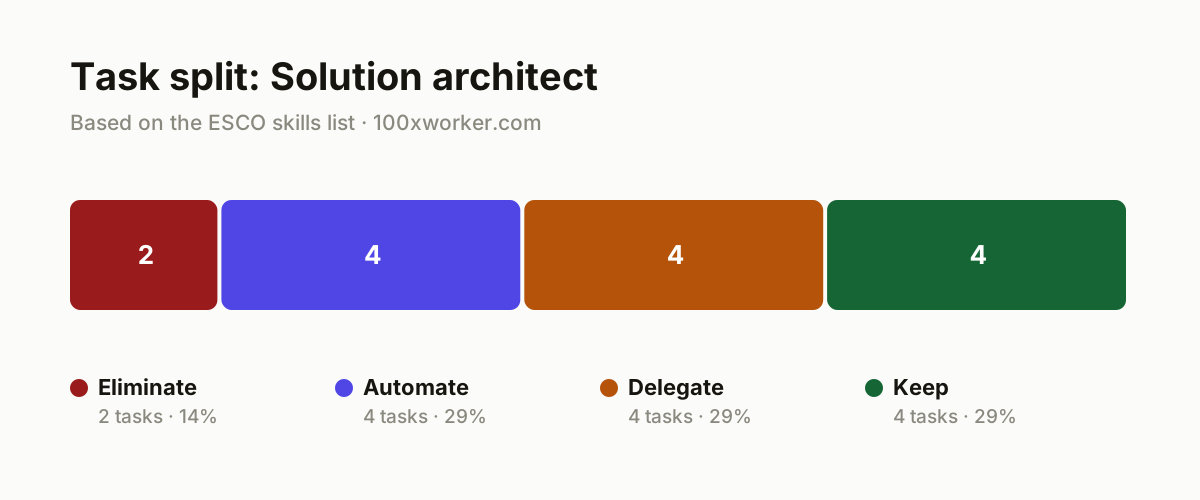
| Task | Bucket | Why |
|---|---|---|
| Drawing architecture diagrams and flowcharts by hand from scratch | eliminate | A language model turns a text description into a first diagram, complete with components and data flows. |
| Typing out boilerplate technical documentation manually | eliminate | AI generates standard structures for specs and installation guides faster and more consistently than manual copy-pasting. |
| Generating and test-running migration scripts | automate | Building automated migration methods and moving existing data is repetitive, pattern-based work an agent learns to handle. |
| Debugging and troubleshooting integration code | automate | Bug-tracing and error-fixing tools suit an agent that scans logs and proposes fixes. |
| Building a first proof of concept or software prototype | automate | Building a working first version to test an idea is exactly where generative AI performs well. |
| Generating API documentation and technical specs from the codebase | automate | Deriving documentation from existing code is mechanical work an agent delivers in near production-ready form. |
| Analyzing software specifications and translating them into architecture choices | delegate | AI reads specs quickly and proposes architecture options, but weighing those options stays your call. |
| Selecting the right software design patterns for a specific case | delegate | AI knows the patterns and their typical uses well, you judge whether they fit the organization's context. |
| Working out integration architecture between systems | delegate | Integrating system components and IT data starts with an AI draft, then you test the risks and dependencies. |
| Clustering customer feedback into concrete requirements | delegate | AI groups feedback into themes, you decide which themes get priority and which ones conflict. |
| Building business relationships and trust with stakeholders | keep | Trust builds through conversation, not through generated text. (Your edge: Human credibility and political sensitivity inside the organization.) |
| Making the final call on architecture choices with budget and risk impact | keep | Someone has to carry responsibility if a choice goes wrong. (Your edge: Accountability you cannot hand off to a model.) |
| Negotiating between conflicting requirements from different departments | keep | Weighing interests that are never written down in any document takes people skills. (Your edge: Sensing implicit interests and power dynamics.) |
| Mentoring and transferring knowledge to the development team | keep | Junior colleagues learn from how you think, not only from what you deliver. (Your edge: Personal context and experience that cannot be copied.) |
Will AI replace solution architects?
No. Microsoft Research found generative AI applicable to 31.3% of the work activities of computer systems analysts, the closest US occupation category, based on 200,000 real Copilot conversations. That leaves the majority of the role, especially trade-off decisions, stakeholder negotiation, and accountability for architecture choices, outside what current AI tools handle on their own. The realistic outcome is a changed task mix: fewer hours on diagrams, documentation, and migration scripts, more time spent reviewing AI-generated drafts and making final calls. Architects who use AI for the mechanical parts of the job free up time for the judgment work that still requires a person, and that shift is already visible in how AI adoption is measured across occupations.
Which solution architect tasks does AI take over?
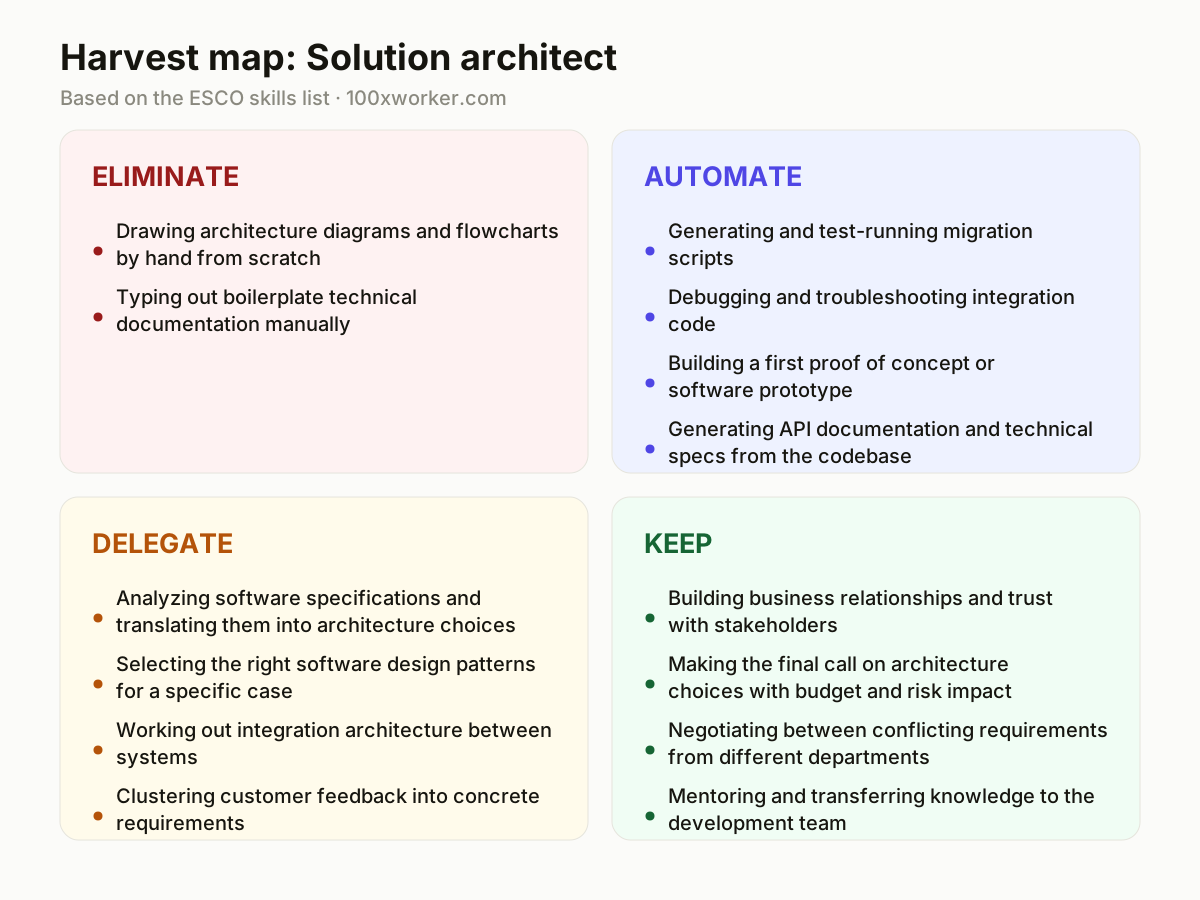
AI takes over the mechanical and pattern-based parts of the job first: drawing a first-draft architecture diagram from a text description, writing boilerplate documentation, generating and test-running migration scripts, debugging integration code, building a proof of concept, and pulling API documentation straight out of a codebase. These are tasks with clear inputs and repeatable structure. Tasks that involve judgment, such as choosing between architecture options, selecting design patterns for a specific organizational context, or clustering customer feedback into requirements, move to a delegate model: AI drafts, you decide. Tasks built on trust, negotiation, and accountability, such as stakeholder relationships and final architecture sign-off, stay entirely with the architect.
How do you become the AI-fluent person on your architecture team?
Start by using AI tools daily on the tasks in the eliminate and automate buckets, so you build a working sense of where they are reliable and where they hallucinate. Keep a personal log of prompts that worked for diagram generation, migration script drafts, and documentation, and share the useful ones with your team. Set up a lightweight review step for anything an agent produces before it goes into a design document or a codebase. Being the AI-fluent person on the team is less about knowing every tool and more about knowing which outputs need a second look and which are safe to ship as-is.
What can you do this month as a solution architect?
Pick one recurring task from the automate bucket, such as generating migration scripts or API documentation, and run it through an AI tool for two weeks to measure the actual time saved. Rewrite one boilerplate documentation template so a language model can fill it from a short brief instead of you typing it from scratch. Draft one architecture diagram from a text description using an AI diagramming tool and compare it against how long the same diagram normally takes you by hand. Small, measured trials like these tell you more than reading predictions about the profession.
ICT application configurators identify, register, and maintain user-specific application configurations based on user requirements and business rules.
ESCO, European Commission
Become the AI person on your team
Run a two-week automation trial
Take one repetitive task, such as migration script generation or documentation drafting, and route it through an AI tool for two weeks. Track time saved and error rate so you have real numbers instead of a general impression.
Build a review checklist for AI-generated architecture drafts
Before an AI-generated diagram or integration proposal goes into a design document, run it through a short checklist covering dependencies, failure points, and cost assumptions. This keeps speed gains from turning into hidden risk.
Share your prompt library with the team
Keep a shared document of prompts that reliably produce useful first drafts for diagrams, migration scripts, and API docs. This turns individual AI fluency into a team-level capability instead of a personal habit.
Want this for your actual task list?
The free scan on the homepage builds your personal task map in 30 seconds, based on your role and industry.
Run the free task scanTools for this work
| Tool | For which tasks | The sober take |
|---|---|---|
| GitHub Copilot / Copilot Chat | Migration script generation, debugging integration code, building a first proof of concept | Good for a first working draft, still needs review before it touches production systems. |
| ChatGPT or Claude | Drafting technical documentation, clustering customer feedback into requirements, analyzing specifications | Useful for structuring messy input, but architecture decisions still need your sign-off. |
| AI-assisted diagramming tools (e.g. Lucidchart AI, Miro AI) | Generating first-draft architecture diagrams and flowcharts from a text description | Speeds up the first version, but check component relationships and data flows manually. |
| Code documentation generators (e.g. Swimm) | Generating API documentation and technical specs from an existing codebase | Reduces manual write-up time, but you still need to verify accuracy against the live code. |
Prompts to try today
First-draft architecture diagram from requirements
Migration script scaffold
Cluster feedback into requirements
Related jobs
Frequently asked questions
Does the Microsoft Research applicability score mean 31.3% of solution architect jobs will disappear?
No. The score measures the share of work activities where generative AI is demonstrably applicable, based on how people actually use Copilot, not the share of jobs at risk of disappearing. It points to task-level change: certain activities like diagramming or documentation shift toward AI assistance, while judgment-heavy activities like final architecture decisions stay with the architect. The number describes applicability of the technology to activities, not a prediction about headcount.
How is Anthropic's Economic Index relevant to solution architects?
The Economic Index classifies millions of real Claude conversations against standardized occupational task lists and splits usage into automation-like (AI does the task) and augmentation-like (AI assists, human decides) categories. For architecture work, this distinction matters in practice: a migration script can be automation-like, while an architecture recommendation is closer to augmentation, since the final choice still requires human judgment about organizational context and risk.
Is generative AI use among professionals actually widespread yet?
Adoption is growing but not universal. Eurostat reported that 32.7% of the EU population aged 16 to 74 used generative AI in the three months before being surveyed in 2025. That means AI use in daily professional work, including architecture tasks like drafting documentation or diagrams, is common but far from standard practice across every organization and team.
Where can I check which tasks are formally part of the solution architect role?
The ESCO taxonomy, maintained by the European Commission, describes occupations and their associated skills across 3,039 roles in 28 languages, covering related occupations such as ICT application configurator. It lists specific skills like integrating system components, developing software prototypes, and using software configuration management tools, which gives a reference point for mapping which of your tasks fall into the eliminate, automate, delegate, or keep buckets.
Sources
- Microsoft Research, Working with AI: Measuring the Applicability of Generative AI to Occupations (2025)
- Anthropic Economic Index
- Eurostat, isoc_ai_iaiu (generative AI use, 2025)
- ESCO, European Commission
Hendrik De Winne, author of Becoming AI-Savvy, founder of VibeLab. Helps teams redesign their work with AI.
This article was drafted with AI assistance from public data sources and editorially reviewed.