100×worker · job analysis
Will AI Replace Software Developers, and What Should You Do About It?
Every few months another headline claims AI is about to replace programmers. The actual data tells a narrower story. Microsoft Research analyzed 200,000 real Copilot conversations across occupations and scored software developers at 27.8% AI applicability, meaning that share of the job's work activities shows clear generative AI use. For comparison, translators top the list at 49% and nurses sit near the bottom at 12%. Developers land in the middle: neither safe from change nor close to obsolete.
That number matters because it forces a more specific question than "will AI take my job." The real question is which of your daily tasks AI already handles well, which ones it can assist with, and which ones still need you. Anthropic's Economic Index, which classifies millions of Claude conversations against detailed occupational task lists, shows the same pattern across knowledge work: some AI use looks like automation (the model does the task), and some looks like augmentation (the model assists while a person decides). For developers, the split runs roughly along the line between writing code and deciding what the code should do.
This article breaks the software developer role into four buckets: tasks to stop doing by hand, tasks to hand fully to automation, tasks to delegate to AI with your review, and tasks that stay yours because they depend on judgment, trust, or accountability.
A software developer builds and maintains software systems from specifications, with working code as the deliverable.
The task split: what AI takes over and what stays yours
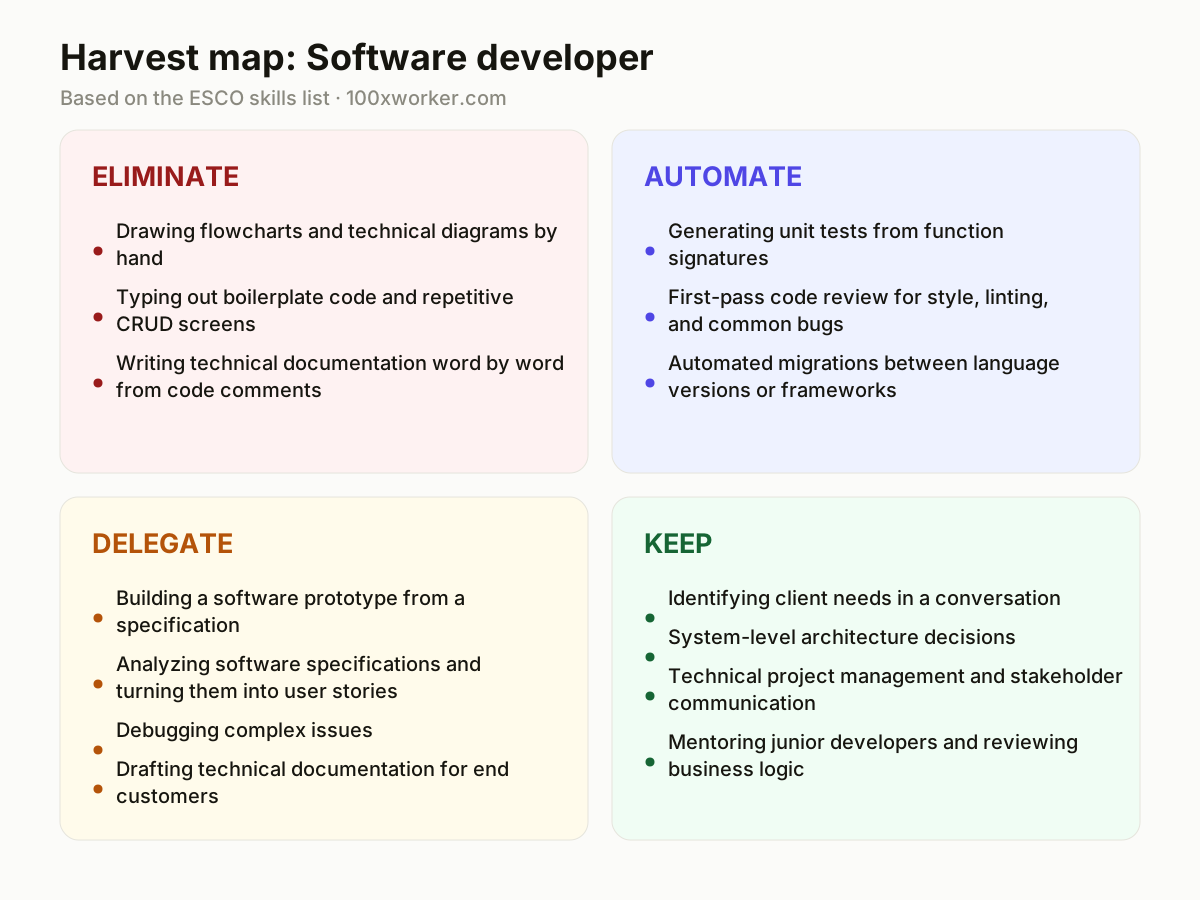
Not every task in a job changes the same way when AI enters the picture. Some tasks disappear because a tool now does them outright. Some get fully automated end to end. Some are best delegated to AI with a human checking the output. And some stay firmly human because they involve trust, accountability, or judgment a model cannot carry. Sorting the software developer role this way, instead of asking a vague "will AI take my job," gives you something you can act on this week.
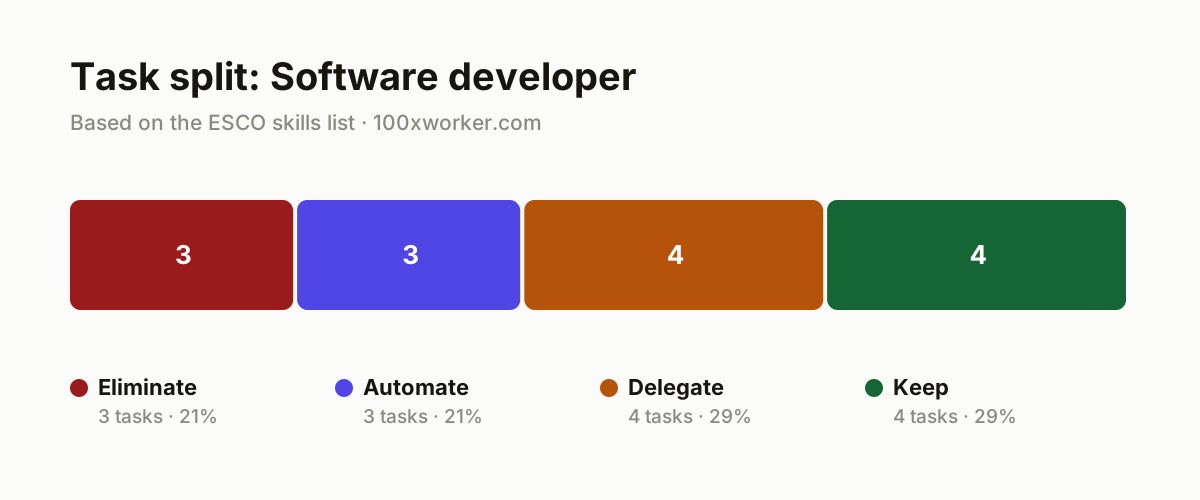
| Task | Bucket | Why |
|---|---|---|
| Drawing flowcharts and technical diagrams by hand | eliminate | AI generates diagrams directly from code or a short description, faster and more consistently than manual drawing. |
| Typing out boilerplate code and repetitive CRUD screens | eliminate | Standard patterns are fully covered by existing code libraries and generation tools. |
| Writing technical documentation word by word from code comments | eliminate | A language model reads the code and comments and turns them into readable documentation. |
| Generating unit tests from function signatures | automate | An agent reads the function, covers edge cases, and produces a test file that runs immediately. |
| First-pass code review for style, linting, and common bugs | automate | Automated review catches mechanical errors before a human looks at the logic. |
| Automated migrations between language versions or frameworks | automate | Migration rules are explicit enough for agents to handle most of the conversion. |
| Building a software prototype from a specification | delegate | AI turns a spec into a working first draft; you decide on architecture choices. |
| Analyzing software specifications and turning them into user stories | delegate | AI structures the requirements; you check them against what the client actually meant. |
| Debugging complex issues | delegate | AI proposes hypotheses from logs and stack traces; you test and decide which one holds. |
| Drafting technical documentation for end customers | delegate | AI delivers a first version; you edit tone and nuance for the audience reading it. |
| Identifying client needs in a conversation | keep | Trust and reading between the lines require a person who knows the client. (Your edge: You hear what the client means but doesn't say.) |
| System-level architecture decisions | keep | Long-term choices about scalability and maintainability require experience and accountability. (Your edge: You carry the consequences of a wrong call.) |
| Technical project management and stakeholder communication | keep | Balancing priorities across teams and deadlines is a social and political process. (Your edge: You negotiate with people, not with a model.) |
| Mentoring junior developers and reviewing business logic | keep | Explaining why a choice is good or bad shapes the next generation of developers. (Your edge: You pass on context no tool can transfer.) |
Which tasks of a software developer can AI take over?
AI is strongest on well-specified, repetitive work: boilerplate code, CRUD screens, flowchart and diagram generation, unit test scaffolding, and first-pass linting or style review. It also handles framework and language migrations where the conversion rules are explicit. These are tasks with a clear input and a checkable output, which is exactly the kind of work Microsoft Research found concentrated in real Copilot usage. What AI does not do well on its own is deciding what to build, how to structure a system for the next five years, or how to read a client who is not saying what they actually want.
Will AI replace software developers?
No, not as a role, but the task list inside the role is shifting fast. Microsoft Research's 27.8% applicability score for software developers means roughly a quarter of daily work activities show strong generative AI use, well below translators at 49% but well above nurses at 12%. That leaves most of the job, architecture, debugging judgment, client communication, and mentoring, still dependent on a person. The risk is not replacement of developers as a group; it is that developers who don't adapt their workflow lose ground to those who do.
How do you become the AI-savvy person on your development team?
Start by naming, out loud, which of your tasks fall into automate, delegate, eliminate, or keep, using the buckets above as a template. Pick one recurring task, like test generation or code review, and build a repeatable prompt or workflow for it instead of reinventing the approach each time. Share what works with your team rather than keeping it as a personal trick. Being the AI-savvy person on a team is less about knowing every tool and more about having a tested, explainable process others can copy.
What can you do this month as a software developer?
Pick one eliminate-bucket task, such as hand-written documentation or manual diagrams, and replace it with a tool this week. Set up one automate-bucket workflow, like AI-generated unit tests tied to your CI pipeline, and measure how much review time it actually saves. Try delegating one debugging session or one specification-to-user-story pass to AI, but keep the final decision yourself. Write down what worked and what didn't; that log becomes your case for how the role should change on your team.
Generative AI applicability ranges from 49% for translators to 12% for nurses; software developers sit closer to the middle at 27.8%.
Microsoft Research, Working with AI (2025)
Become the AI person on your team
Run a task audit on your own sprint
Go through your last two weeks of tickets and sort them into the four buckets. You will usually find more eliminate and automate candidates than you expected, especially in test writing and documentation.
Build one repeatable AI workflow, not ten ad hoc prompts
Pick a single recurring task, such as generating unit tests from function signatures, and turn it into a saved prompt or agent configuration your whole team can reuse. Consistency beats cleverness here.
Keep a decision log for anything AI drafts
When AI proposes a debugging hypothesis or an architecture option, write down why you accepted or rejected it. This builds a record that helps onboard juniors and defends your review process to stakeholders.
Want this for your actual task list?
The free scan on the homepage builds your personal task map in 30 seconds, based on your role and industry.
Run the free task scanTools for this work
| Tool | For which tasks | The sober take |
|---|---|---|
| GitHub Copilot | Boilerplate code, CRUD screens, first-pass code review, in-editor suggestions | Fast for repetitive patterns, still needs review on business logic. |
| Claude (via Anthropic) | Debugging support, specification analysis, drafting user stories, prototype scaffolding | Strong at reasoning through logs and stack traces, but you decide which hypothesis to test. |
| ChatGPT / GPT-based tools | Documentation drafts, migration scripts, diagram generation from code | Useful for first drafts; always check output against the actual codebase. |
| AI-assisted test generators (e.g. Copilot, Codeium) | Unit test generation from function signatures | Good at covering obvious edge cases, weaker on domain-specific business rules. |
Prompts to try today
Generate unit tests from a function
Turn a specification into user stories
Debug a stack trace with hypotheses, not fixes
Related jobs
Frequently asked questions
Is 27.8% a measure of how many developer jobs will disappear?
No. Microsoft Research's applicability score measures the share of work activities in a role where generative AI shows clear applicability, based on real Copilot conversations. It is not a job-loss prediction. A 27.8% score means AI touches roughly a quarter of daily tasks, not that a quarter of developers become redundant. Most of the score concentrates in repetitive coding and documentation tasks, not in architecture or client-facing work.
Does this apply the same way to junior and senior developers?
Not evenly. Juniors often spend more time on boilerplate code, test writing, and documentation, the tasks most affected by automation. Seniors spend more time on architecture, debugging judgment, and mentoring, which sit in the keep bucket. This means AI can compress some of the routine work juniors used to learn from, which raises a real question about how junior developers build experience going forward.
Should I list AI tools on my resume as a developer?
Yes, but be specific rather than listing generic terms like 'AI skills.' Name the workflows you built: for example, an automated test-generation pipeline tied to CI, or a documented prompt library your team reuses. Employers increasingly care less about which tool you used and more about whether you can show a repeatable, checkable process.
How does AI use among developers compare to the general population?
Eurostat reported that 32.7% of the EU population aged 16 to 74 used generative AI in the three months before being surveyed in 2025. Developers, as a technical profession working directly with code-generation tools, generally show higher and more workflow-integrated AI use than the general population, though no occupation-specific EU figure is available in current sources.
Sources
- Microsoft Research, Working with AI: Measuring the Applicability of Generative AI to Occupations (2025)
- Anthropic Economic Index
- Eurostat, Individuals using generative AI (isoc_ai_iaiu)
- ESCO (European Commission skills and occupations taxonomy)
Hendrik De Winne, author of Becoming AI-Savvy, founder of VibeLab. Helps teams redesign their work with AI.
This article was drafted with AI assistance from public data sources and editorially reviewed.