100×worker · job analysis
Will AI Replace DevOps Engineers? A Task-by-Task Guide
DevOps engineers sit between software development and IT operations, building and maintaining the pipelines that ship code safely and keep systems running. Generative AI tools now write deployment scripts, scan logs, and draft documentation, which raises an obvious question: how much of this job is left for a human?
Microsoft Research analyzed 200,000 real Copilot conversations and published an 'AI applicability score' per occupation. For the closest matching category, Software Developers, generative AI is applicable to about 27.8% of documented work activities, compared with 49% for translators and 12% for nurses (Microsoft Research, 2025). That number describes tasks, not jobs. Anthropic's Economic Index, which classifies millions of Claude conversations against the O*NET task taxonomy, finds a similar pattern across technical occupations: AI use splits between automation-like tasks, where AI does the work, and augmentation-like tasks, where AI supports a human decision.
This article breaks the DevOps role into four buckets: tasks that disappear, tasks AI runs largely on its own, tasks you delegate to AI but still check, and tasks that stay with you. Reading it as a task list rather than a job title is the point.
A DevOps engineer merges software development and IT operations into automated, reliable release and management pipelines.
The task split: what AI takes over and what stays yours
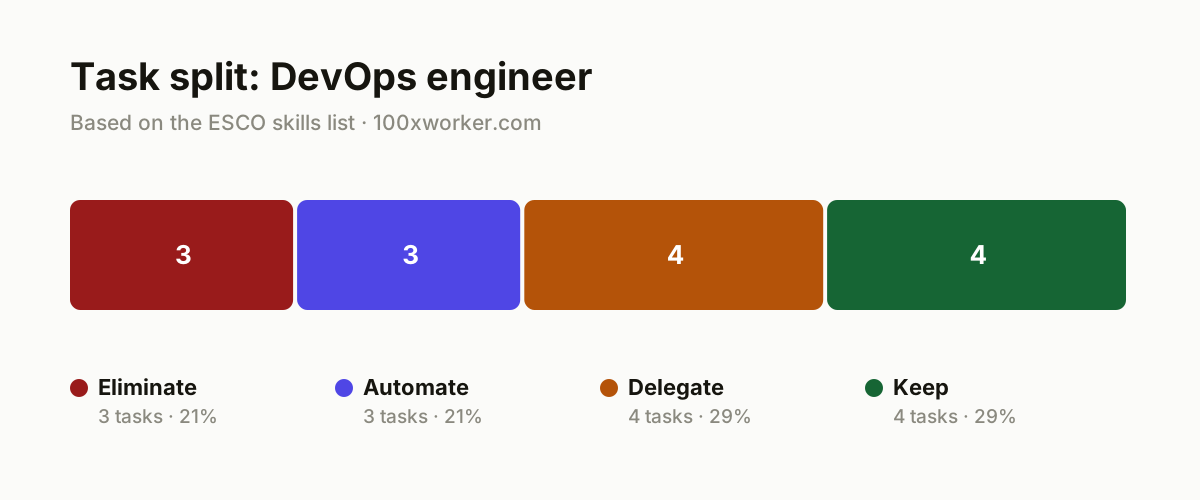
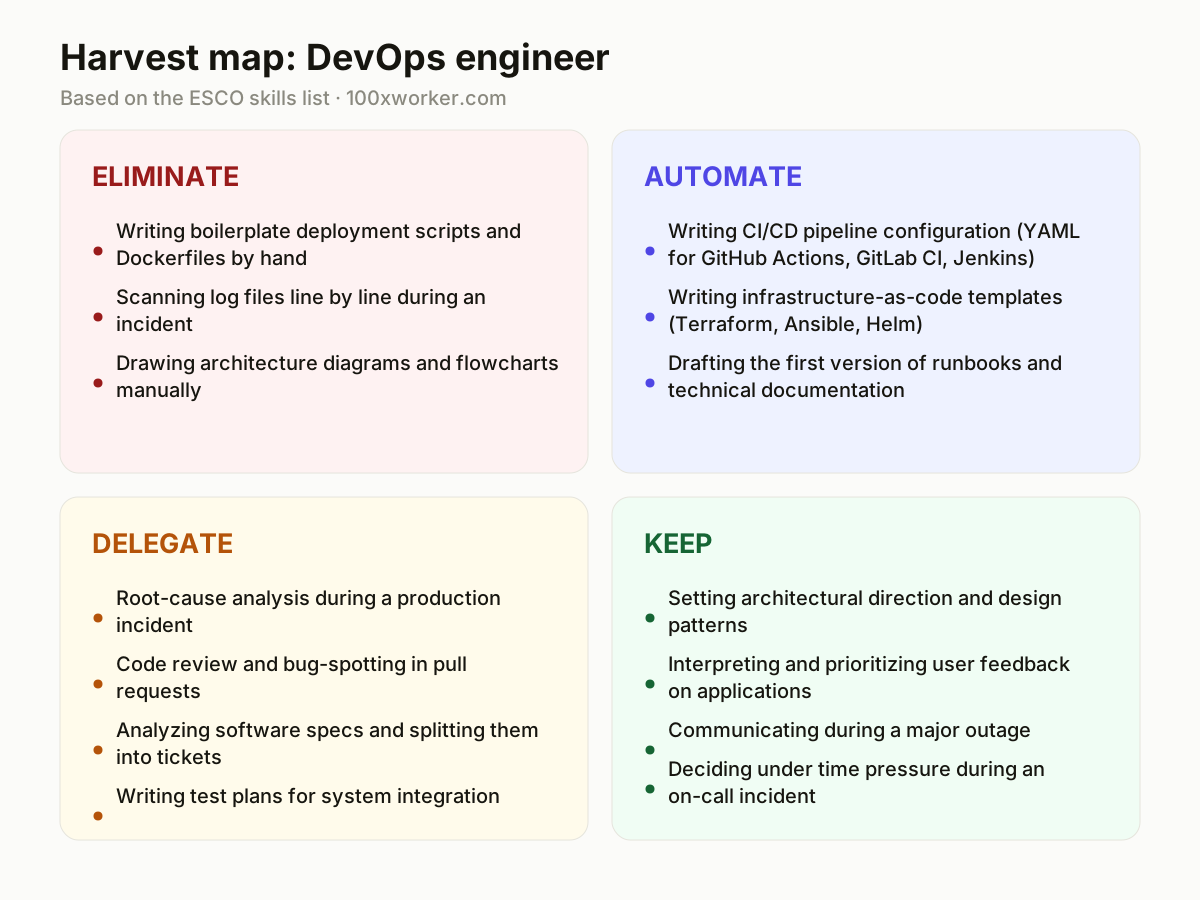
The eliminate/automate/delegate/keep framework sorts DevOps work by how much a human still needs to do, not by whether AI can touch it at all. Eliminate covers tasks AI now does better than manual work ever did. Automate covers tasks AI runs end to end with light human sign-off. Delegate covers tasks where AI produces a first pass that a human must validate before it matters. Keep covers judgment, accountability, and communication that no model carries.
| Task | Bucket | Why |
|---|---|---|
| Writing boilerplate deployment scripts and Dockerfiles by hand | eliminate | AI generates this correctly from a spec; manual work adds little value here. |
| Scanning log files line by line during an incident | eliminate | AI-driven log analysis scans thousands of lines in seconds and spots patterns you would miss. |
| Drawing architecture diagrams and flowcharts manually | eliminate | AI generates a diagram directly from code or a short description, faster and more consistent. |
| Writing CI/CD pipeline configuration (YAML for GitHub Actions, GitLab CI, Jenkins) | automate | An agent builds a working pipeline from your repo structure; you test it and push it live. |
| Writing infrastructure-as-code templates (Terraform, Ansible, Helm) | automate | AI generates the configuration from a spec, ready for you to review and deploy. |
| Drafting the first version of runbooks and technical documentation | automate | AI writes a draft from commits and configuration; you edit and add context. |
| Root-cause analysis during a production incident | delegate | AI proposes a hypothesis from logs and metrics; you validate it and decide on the fix. |
| Code review and bug-spotting in pull requests | delegate | AI flags suspicious patterns and security risks; you judge context and impact. |
| Analyzing software specs and splitting them into tickets | delegate | AI produces a first breakdown; you check it against architecture and team capacity. |
| Writing test plans for system integration | delegate | AI generates test scenarios from specs; you set priority and coverage. |
| Setting architectural direction and design patterns | keep | This decides how the system scales and gets maintained for years. (Your edge: Long-term accountability for the consequences stays human.) |
| Interpreting and prioritizing user feedback on applications | keep | What a user says and what they actually mean requires organizational insight. (Your edge: No model reads context and internal politics.) |
| Communicating during a major outage | keep | Reassuring stakeholders and explaining clearly takes more than listing facts. (Your edge: Conveying trust under pressure is human work.) |
| Deciding under time pressure during an on-call incident | keep | You carry the risk trade-off in a production environment, not a model. (Your edge: Final responsibility always sits with a person.) |
Will AI replace DevOps engineers?
No, not as a role. Microsoft Research's applicability score puts generative AI's reach at about 27.8% of the work activities in the closest occupational category, Software Developers, well below occupations like translation at 49%. AI removes repetitive scripting, log searching, and first-draft documentation, but someone still has to decide what to build, judge risk during an incident, and own the outcome when a deploy breaks production. The role narrows toward review, architecture, and decisions, and away from typing configuration files by hand. Teams that use AI well tend to ship more often, not necessarily employ fewer engineers right away, though hiring growth may slow over time.
Which DevOps tasks does AI take over?
AI now handles the mechanical layer of DevOps work. It eliminates manual writing of boilerplate deployment scripts, Dockerfiles, and architecture diagrams, since a model generates these directly from code or a short spec. It also automates most CI/CD pipeline configuration (GitHub Actions, GitLab CI, Jenkins YAML), infrastructure-as-code templates (Terraform, Ansible, Helm), and first drafts of runbooks and documentation. In both cases a human still reviews before anything reaches production. This matches what Anthropic's Economic Index calls automation-like AI use: the model completes a bounded task, and a person checks the result rather than doing the task from scratch.
What does a DevOps engineer still do?
You still set architectural direction and choose design patterns, because those decisions shape how a system scales and gets maintained for years. You still interpret user feedback and translate it into priorities, since understanding what a stakeholder actually needs takes organizational context no model has. During a major outage, you communicate with affected teams and keep people informed, which requires judgment about tone and trust, not just facts. And when an on-call incident forces a decision under time pressure, the risk trade-off and the responsibility for it stay with you, not with any tool.
What can you do this month as a DevOps engineer?
Pick one recurring task, log analysis during incidents, pipeline YAML, or runbook drafts, and route it through an AI tool for two weeks before you touch it manually. Track how much editing the output needs. Set up an AI-assisted first-pass code review on your next ten pull requests and compare its findings against your own. Ask your team lead which of your current tasks map to the delegate bucket, meaning AI can produce a draft but a human must still sign off, and shift your calendar time toward architecture and incident review instead of scripting.
Systems developers maintain, monitor and improve systems for organisational support, using existing or new technologies to meet particular needs.
ESCO, European Commission occupational taxonomy
Become the AI person on your team
Audit your own task list
Write down every recurring task you do in a week and sort it into eliminate, automate, delegate, or keep. Anything that lands in eliminate or automate is a candidate to hand to a tool this month.
Build a review habit, not a writing habit
Let AI produce the first draft of pipeline configs, runbooks, and diagrams, and spend your time checking correctness and security instead of typing. This shifts your daily work from producer to reviewer.
Practice incident judgment deliberately
Since root-cause analysis and on-call decisions stay with you, run postmortems that separate what the AI flagged from what you decided and why. This keeps the judgment skill sharp even as log scanning gets automated.
Want this for your actual task list?
The free scan on the homepage builds your personal task map in 30 seconds, based on your role and industry.
Run the free task scanTools for this work
| Tool | For which tasks | The sober take |
|---|---|---|
| GitHub Copilot | Eliminate/automate: boilerplate scripts, Dockerfiles, CI/CD YAML | Good for a fast first draft; still needs a human check for security settings. |
| Terraform with AI-assisted authoring (Copilot or Claude in your editor) | Automate: infrastructure-as-code templates | Generates plausible configuration quickly, but review state handling and permissions before applying. |
| Claude or GPT-4 integrated with your log platform | Eliminate: log scanning; delegate: root-cause hypotheses | Speeds up pattern-finding across large log volumes, but you still confirm the cause. |
| AI-assisted code review add-ons for pull requests | Delegate: code review and bug-spotting | Flags obvious issues fast; architectural fit remains a human call. |
Prompts to try today
Draft a runbook from recent commits
First-pass root cause from logs
Turn a spec into tickets
Related jobs
Frequently asked questions
Is DevOps a good career choice given AI progress?
Yes, for now. Microsoft Research's applicability score for the closest category, Software Developers, is 27.8%, meaning most work activities still need a human in the loop, and the score measures where AI can help, not where jobs disappear. The tasks most exposed are scripting, log review, and documentation, which are often entry-level tasks in many teams. Engineers who move quickly into architecture, incident ownership, and cross-team communication are less exposed than those who stay purely in scripting.
How is AI use in DevOps measured?
Two methods are commonly cited. Microsoft Research scored occupations by analyzing 200,000 real Copilot conversations against the tasks people actually asked for help with. Anthropic's Economic Index classifies millions of Claude conversations against the O*NET task list and splits results into automation-like and augmentation-like use. Both approaches look at real usage patterns rather than theoretical automatability, which differs from older studies like Frey and Osborne's 2013 Oxford estimate.
Should I learn prompt engineering as a DevOps engineer?
It helps, but it is not the core skill. Writing a clear prompt for a runbook draft or a root-cause hypothesis takes minutes to learn. The harder skill is judging whether the AI's output is correct, complete, and safe to deploy, which depends on the same system knowledge you needed before AI tools existed.
Does AI adoption vary a lot by country or age group?
Yes. Eurostat reports that 32.7% of the EU population aged 16 to 74 used generative AI in the three months before the 2025 survey, with wide variation between member states and a strong skew toward younger and more educated users. For a technical role like DevOps, adoption inside the profession is generally far higher than the general population figure, since the tools are integrated directly into daily coding and ops work.
Sources
- Microsoft Research, Working with AI: Measuring the Applicability of Generative AI to Occupations (2025)
- Anthropic Economic Index
- Eurostat, isoc_ai_iaiu (generative AI use, 2025)
- ESCO, European Commission occupational taxonomy
Hendrik De Winne, author of Becoming AI-Savvy, founder of VibeLab. Helps teams redesign their work with AI.
This article was drafted with AI assistance from public data sources and editorially reviewed.