100×worker · job analysis
Will AI Replace Game Developers?
Game development is often described as one of the professions most exposed to AI, but the numbers say otherwise. Microsoft Research analyzed 200,000 real conversations with its Copilot AI assistant and found that generative AI is applicable to about 27.8% of tasks performed by software developers, the closest matching occupation category to game development in the study. That is a mid-range score, well below translators at 49% and well above nurses at 12%.
The change is also uneven. Anthropic's Economic Index, which classifies millions of Claude conversations against O*NET task categories, splits AI coding use between automation (AI does the task outright) and augmentation (AI assists while a person still decides). For design and creative choices in games, augmentation dominates. Adoption is already high enough to matter: Eurostat reports that 32.7% of the EU population aged 16 to 74 used generative AI in the three months before being surveyed in 2025.
This article sorts a game developer's actual task list, based on the ESCO occupational profile for digital games developer, into four buckets: tasks AI eliminates outright, tasks it automates end-to-end, tasks you delegate to AI and check, and tasks that stay firmly with you. The goal is a task-level view of the job, not a headline number.
A game developer programs, designs, and tests digital games, and decides which AI output becomes playable.
The task split: what AI takes over and what stays yours
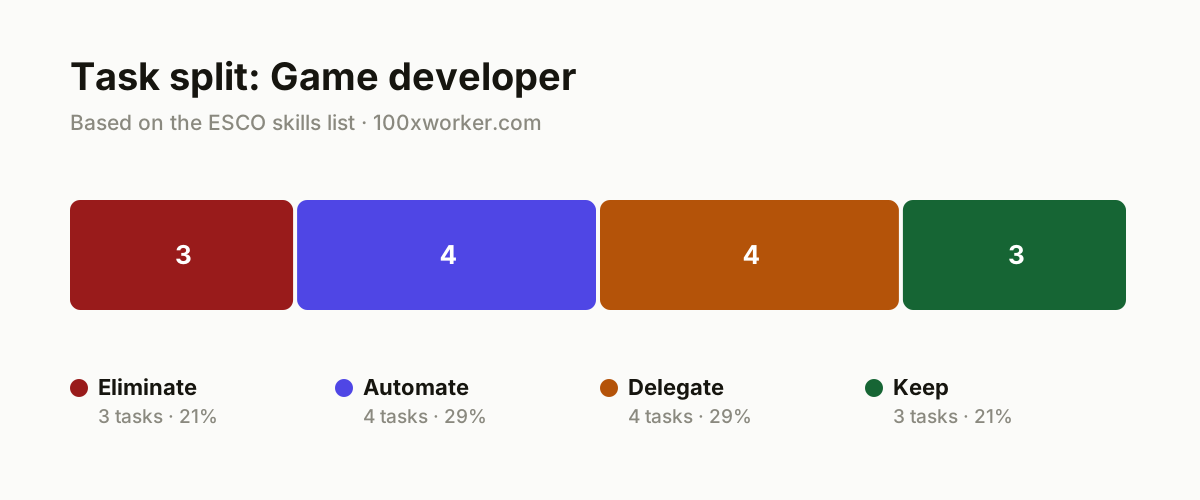
The eliminate/automate/delegate/keep framework sorts tasks by how much human judgment they still require, not by whether AI can touch them at all. Eliminate covers tasks AI now does well enough that doing them by hand wastes time. Automate covers tasks an agent can run start to finish inside a fixed process. Delegate covers tasks where AI produces a strong first draft that still needs your review and correction. Keep covers tasks that depend on judgment, taste, or relationships AI can't replicate. Mapped onto ESCO's digital games developer profile, most core skills, including 3D imaging, software prototyping, and specification analysis, fall into automate or delegate rather than eliminate or keep entirely.
| Task | Bucket | Why |
|---|---|---|
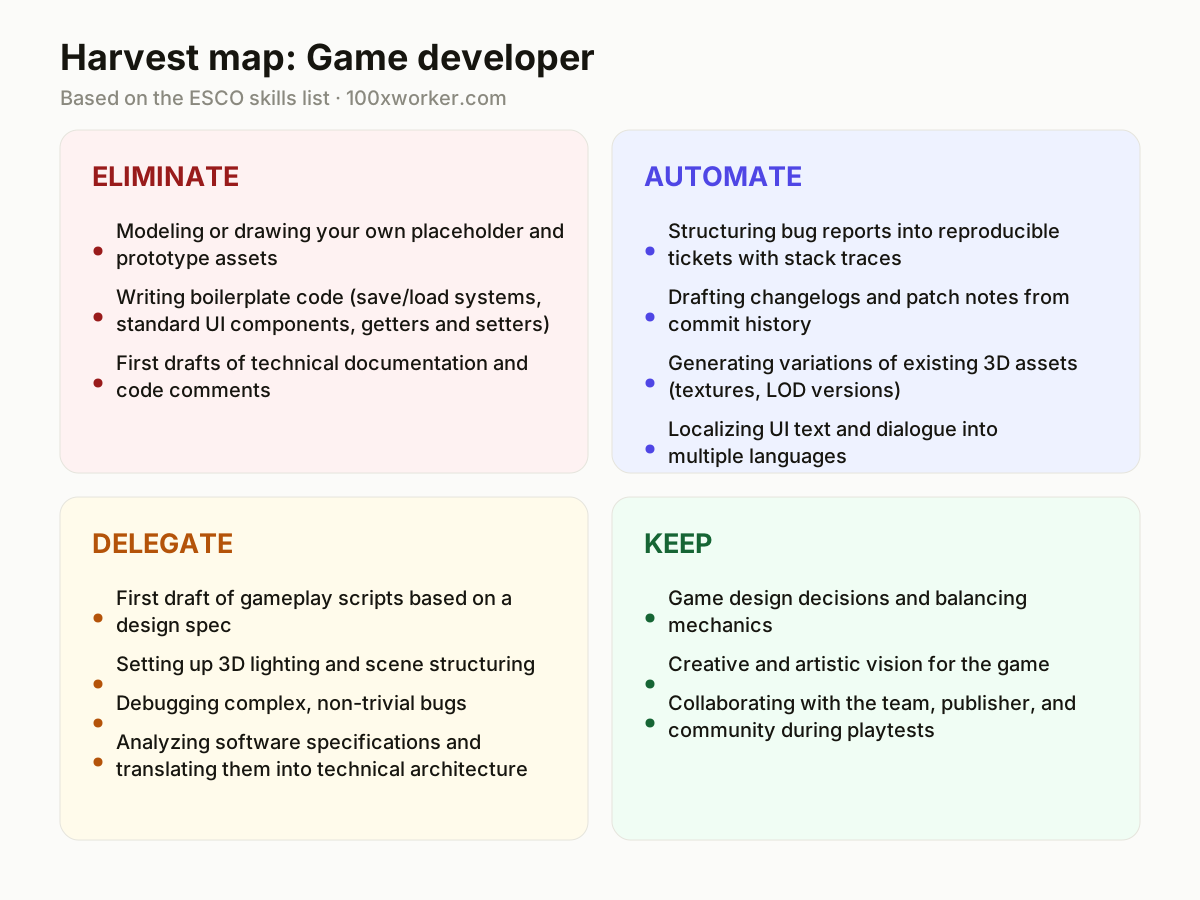
| Modeling or drawing your own placeholder and prototype assets | eliminate | AI generates usable temporary sprites or 3D models instantly, so making them by hand wastes production time. |
| Writing boilerplate code (save/load systems, standard UI components, getters and setters) | eliminate | Predictable, repetitive code comes back correct from AI immediately once you give it a clear spec. |
| First drafts of technical documentation and code comments | eliminate | AI derives these directly from the code, faster and more consistent than writing them by hand. |
| Structuring bug reports into reproducible tickets with stack traces | automate | An agent tags, structures, and categorizes incoming reports without needing you to intervene each time. |
| Drafting changelogs and patch notes from commit history | automate | The source data, the commits, is already structured, so an agent turns it into readable notes consistently. |
| Generating variations of existing 3D assets (textures, LOD versions) | automate | Within a fixed style guide, an agent produces usable variants without manual repetition of the work. |
| Localizing UI text and dialogue into multiple languages | automate | Translation against a fixed glossary carries little unique context each time, so agents handle it well. |
| First draft of gameplay scripts based on a design spec | delegate | AI writes the initial implementation, and you test it against performance and how it actually plays. |
| Setting up 3D lighting and scene structuring | delegate | AI proposes an initial lighting setup, and you adjust it for mood and engine constraints. |
| Debugging complex, non-trivial bugs | delegate | AI analyzes stack traces and the codebase and proposes a fix, and you validate the actual impact. |
| Analyzing software specifications and translating them into technical architecture | delegate | AI drafts a first architecture proposal, and you check it against engine and team constraints. |
| Game design decisions and balancing mechanics | keep | AI can simulate scenarios, but judging whether something is actually fun stays a human call. (Your edge: Feel for flow and fun isn't something you test in a prompt.) |
| Creative and artistic vision for the game | keep | AI generates variations on request, but the choice and stylistic direction stay with you. (Your edge: A distinctive style doesn't come from an average of training data.) |
| Collaborating with the team, publisher, and community during playtests | keep | AI can take notes and summarize feedback, but it can't manage the relationship or negotiation. (Your edge: Trust and persuasion aren't built through a chatbot.) |
Which game developer tasks will AI take over fastest?
The tasks disappearing first are the ones with a clear, checkable output and no creative stakes. Placeholder art, temporary 3D models, and prototype sprites now come from AI image and mesh generators in seconds instead of hours. Boilerplate code such as save/load systems, standard UI components, and repetitive getters and setters follows the same pattern: give the tool a clear spec and it returns correct code on the first try. First drafts of technical documentation and code comments work the same way, since AI can read the code directly and describe what it does. None of this needs a designer's judgment, so it moves to elimination first.
Will AI replace game developers?
No. Microsoft Research's 2025 analysis of real Copilot conversations found generative AI applies to about 28% of tasks done by software developers, the closest comparable category, well below translators at 49% but above nurses at 12%. Older estimates that circulate online, like the 2013 Frey and Osborne robotization percentages, predate large language models entirely and should not be trusted for this occupation. Anthropic's Economic Index shows AI use in coding splits between automation (AI does the task) and augmentation (AI assists while a person decides), and studio work leans toward augmentation for anything touching design or player experience. The job changes shape rather than disappearing: fewer hours on boilerplate and prototypes, more time on debugging, architecture, and design judgment.
How do you become the AI-person in your game studio?
Start by mapping your own task list against the four buckets: eliminate, automate, delegate, keep. Pick one recurring task, such as bug triage or changelog writing, and build a repeatable prompt or agent workflow for it, then document the process so a teammate can run it too. Learn to review AI-generated code and assets critically rather than accepting them by default, since your value shifts from producing output to judging it. Share what works in team channels or documentation instead of keeping it as a personal trick. Studios notice the person who quietly removes friction from the pipeline before anyone asks them to.
What can you do this month as a game developer?
Pick one bucket and act on it this week. From eliminate, let AI generate your next batch of placeholder assets instead of blocking out time for it yourself. From automate, set up a workflow that turns commit history into a draft changelog before your next release. From delegate, ask AI for a first-pass architecture proposal on your next feature spec and treat it as a draft to correct, not a final answer. Track how much time each change saves over two weeks. That log becomes your case for what to change next, and it shows a studio lead exactly where you're already adapting.
Generative AI applies to about 28% of the tasks performed by software developers, the closest comparable category to game development, placing the role in the middle of the range Microsoft measured across occupations.
Microsoft Research, Working with AI (2025)
Become the AI person on your team
Own one repeatable workflow
Pick a task like bug-report triage or 3D asset variation and build a documented prompt or agent workflow for it. Share the workflow with your team instead of keeping it to yourself.
Review, don't just accept
Treat AI-generated code, assets, and documentation as first drafts. Build a short checklist for what you check before merging or shipping AI output.
Track time saved
Log how many hours a specific AI workflow saves over a sprint. Use that number when you propose adopting AI tools more broadly.
Specialize where AI is weak
Put deliberate effort into game balancing, playtesting interpretation, and creative direction, the tasks that stay firmly in the keep bucket.
Want this for your actual task list?
The free scan on the homepage builds your personal task map in 30 seconds, based on your role and industry.
Run the free task scanTools for this work
| Tool | For which tasks | The sober take |
|---|---|---|
| GitHub Copilot | Boilerplate code, first-draft gameplay scripts, code comments | Works best with a clear spec, and still needs review for anything beyond routine code. |
| Claude or ChatGPT | Bug report structuring, changelog drafts, architecture proposals | Useful for turning messy input into structured text, but check technical accuracy against your codebase. |
| Meshy AI or similar 3D generation tools | Placeholder assets, 3D asset variations, texture and LOD generation | Good for volume and speed, not for final art direction on hero assets. |
| Lokalise or DeepL | Localization of UI text and dialogue | Handles glossary-based translation well, but still needs a native speaker pass for tone. |
Prompts to try today
Bug report structuring
Changelog from commits
Gameplay script first draft
Related jobs
Frequently asked questions
Do indie developers face the same AI changes as studio developers?
The task-level shift is similar: boilerplate code, placeholder assets, and documentation move to AI first regardless of studio size. Indie developers often feel the time savings more directly since they carry more of the pipeline solo. The difference is less about which tasks change and more about who absorbs the saved time. A solo developer reinvests it into design and polish, while a studio developer may see role boundaries shift instead.
Will AI generate entire games without human developers?
Not with current tools. AI can produce assets, code snippets, and drafts, but assembling them into a playable, balanced, tested game still requires human decisions about design, performance, and player experience. Microsoft's own data puts generative AI's applicability to software development tasks at under 30%, which leaves the majority of the actual job, including debugging complex issues and creative direction, in human hands for now.
What skills should aspiring game developers focus on now?
Focus less on typing out boilerplate from memory and more on reading and reviewing code critically, since that becomes the daily task once AI drafts more of it. Build strong fundamentals in debugging, architecture, and game design theory, the areas the buckets above keep with humans. Comfort directing AI tools through clear specifications is becoming as useful as raw coding speed.
How reliable are old robotization percentage estimates for game developers?
Not very. The robotization percentages that circulate for many jobs, including game development, trace back to a 2013 Oxford study by Frey and Osborne, done before large language models existed. It measured automation risk from a different generation of technology and doesn't reflect how generative AI actually gets used today. Newer sources like Microsoft Research's Copilot-conversation analysis and Anthropic's Economic Index give a more current, task-level picture.
Sources
- Microsoft Research, Working with AI: Measuring the Applicability of Generative AI to Occupations (2025)
- Anthropic Economic Index
- Eurostat, Use of generative AI (isoc_ai_iaiu)
- ESCO, European Commission occupation taxonomy
Hendrik De Winne, author of Becoming AI-Savvy, founder of VibeLab. Helps teams redesign their work with AI.
This article was drafted with AI assistance from public data sources and editorially reviewed.