100×worker · job analysis
Will AI Replace Research Managers? What Changes and What Doesn't
Research managers oversee R&D projects, staff, and budgets inside universities, labs, and companies. Much of the day-to-day work involves drafting, summarizing, estimating, and reporting, exactly the kind of task that large language models now handle well. Microsoft Research analyzed 200,000 real Copilot conversations across occupations in 2025 and found that literature summarizing and first-draft report writing consistently rank as high-applicability tasks for generative AI, regardless of the specific job title attached to them.
That doesn't mean the role disappears. Anthropic's Economic Index, which classifies millions of Claude conversations against O*NET task categories, finds that a large share of professional AI use looks like augmentation rather than full automation: people working alongside the model on a task, not handing the whole task over. For a research manager, that split matters. Searching journals and typing a summary is close to fully automatable. Negotiating a research proposal with a funder is not.
This article breaks the job into four buckets: tasks to eliminate, tasks to automate, tasks to delegate to AI with a human check, and tasks to keep doing yourself.
A research manager leads R&D projects, staff, and budgets inside a research facility or university.
The task split: what AI takes over and what stays yours
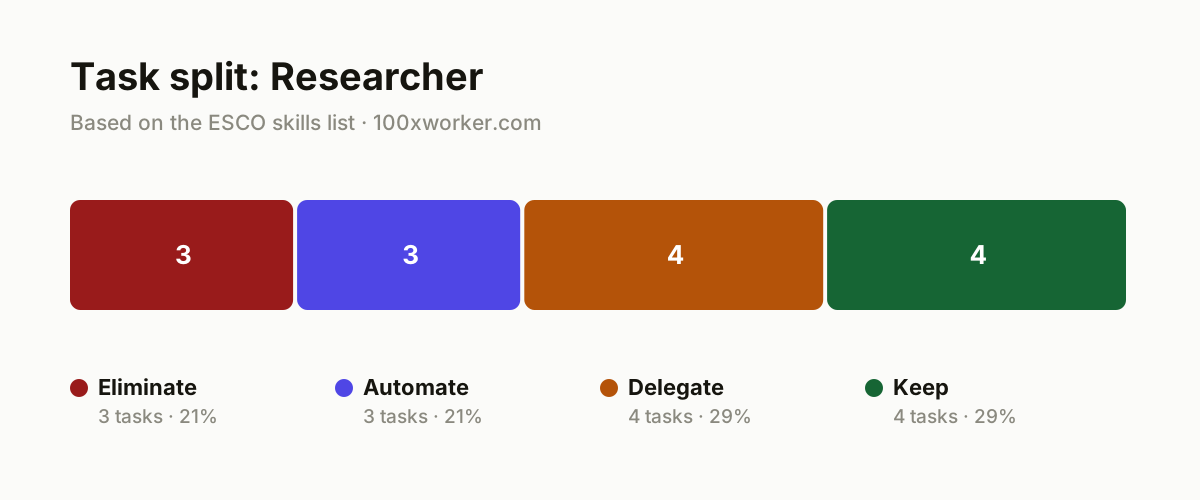
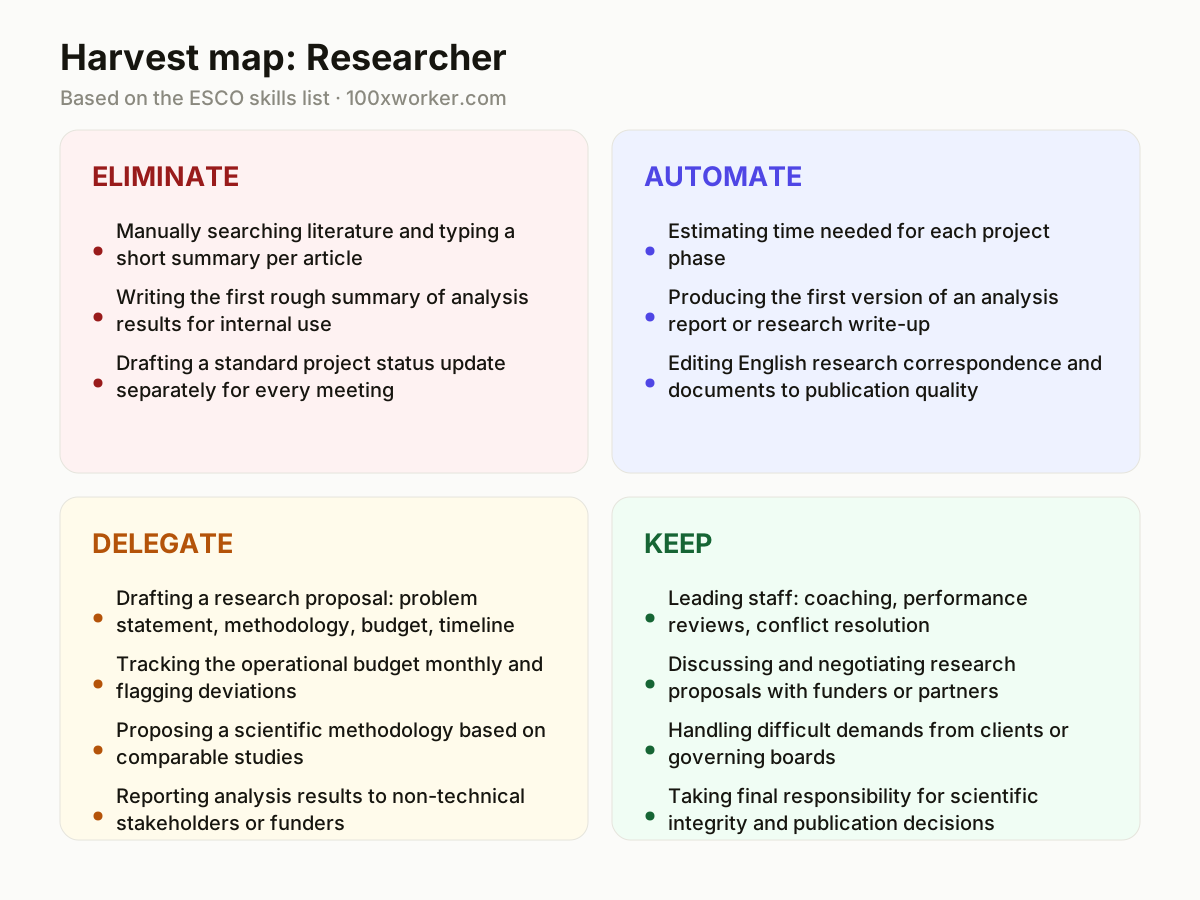
Not every task in a research manager's job changes the same way. Some tasks disappear because AI does them faster with no real loss of quality. Some get automated, meaning AI produces a full first version and you check it. Some get delegated, meaning AI does the heavy lifting but you stay accountable for the judgment call. And some stay entirely with you, because they depend on trust, authority, or accountability that can't be handed to a model.
| Task | Bucket | Why |
|---|---|---|
| Manually searching literature and typing a short summary per article | eliminate | A language model searches and summarizes faster than a person paging through journals for days. |
| Writing the first rough summary of analysis results for internal use | eliminate | Typing that first draft no longer costs human hours, checking it still does. |
| Drafting a standard project status update separately for every meeting | eliminate | It gets assembled automatically from project data instead of collected by hand each time. |
| Estimating time needed for each project phase | automate | An AI agent pulls patterns from completed projects and delivers a grounded schedule. |
| Producing the first version of an analysis report or research write-up | automate | Structure, charts, and summary come ready-made, you check the substance. |
| Editing English research correspondence and documents to publication quality | automate | Language and tone become consistent without you rewriting every sentence. |
| Drafting a research proposal: problem statement, methodology, budget, timeline | delegate | AI produces a full first draft, you decide on scope and feasibility. |
| Tracking the operational budget monthly and flagging deviations | delegate | AI flags overruns, you decide whether and how to correct course. |
| Proposing a scientific methodology based on comparable studies | delegate | AI suggests a method drawn from similar research, you judge whether it fits this project. |
| Reporting analysis results to non-technical stakeholders or funders | delegate | AI translates numbers into plain language, you check whether the nuance survives. |
| Leading staff: coaching, performance reviews, conflict resolution | keep | Trust and closeness in a team get built through people, not a screen. (Your edge: Personal relationships and long-term memory of the people involved.) |
| Discussing and negotiating research proposals with funders or partners | keep | Negotiation requires reading interests and political sensitivity in real time. (Your edge: Reading, live, what the other side wants without them saying it.) |
| Handling difficult demands from clients or governing boards | keep | Setting limits and finding compromise takes authority you build yourself over time. (Your edge: Authority and credibility that you have personally earned.) |
| Taking final responsibility for scientific integrity and publication decisions | keep | Someone has to put their name and career behind a decision. (Your edge: Personal accountability that cannot be outsourced to a model.) |
Which tasks of a research manager will AI change first?
The first tasks to change are the ones built entirely out of reading and writing: searching literature, drafting the first version of an analysis summary, and compiling routine status updates for meetings. These are exactly the tasks Microsoft Research flags as high-applicability in its Copilot conversation analysis. They involve gathering known information and restating it in a structured form, which is close to what current AI models do best. Tasks tied to negotiation, staff leadership, or final sign-off on scientific claims change much more slowly, because they depend on judgment and trust rather than text production.
Will AI replace researchers?
No, not the role itself. AI replaces specific tasks inside the job, mainly drafting, summarizing, and estimating. Anthropic's Economic Index, based on millions of classified Claude conversations, finds that much professional AI use is augmentation rather than full replacement: a person working with the model on part of a task. A research manager still needs to set project direction, manage a team, negotiate funding, and take responsibility for what gets published. What shrinks is the number of hours spent on manual drafting and searching, not the need for someone to hold the role.
How do you become the AI person on your research team?
Start by using AI openly on the tasks in the eliminate and automate buckets: literature summaries, first-draft reports, status updates, time estimates. Show your team the before-and-after time difference. Then build a shared prompt library for recurring documents, like proposal drafts and budget summaries, so the whole team uses the same starting point instead of everyone improvising. Being the AI person means you understand where the tool is reliable and where it needs a check, and you can explain that distinction to your team and to funders who ask how AI was used in a proposal.
What can you do this month to get started?
Pick one recurring document, such as your monthly project status report or a standard proposal section, and run it through an AI tool for two cycles before you decide anything about it. Compare the AI draft against your usual draft for accuracy and tone. Next, set up one automated budget check using project data you already track. Finally, write down which of your weekly tasks fall into the keep bucket, negotiation, staff conversations, sign-off decisions, and protect the time for those explicitly, since that time tends to get eaten by drafting work if you don't.
Across millions of classified conversations, a large share of professional AI use looks like augmentation, someone working alongside the model on part of a task, rather than the model completing the whole task alone.
Anthropic Economic Index
Become the AI person on your team
Run a two-week literature review test
Take a current project's reading list and have an AI tool produce summaries alongside your own. Compare accuracy and coverage before you trust it fully. Share the comparison with your team so everyone knows where the shortcut is safe.
Build one shared proposal template with AI-drafted sections
Draft the problem statement and methodology sections with AI, then have your team edit only the scope and budget assumptions. This keeps drafting fast while keeping the decisions where they belong, with you.
Set up an automated budget flag before the next reporting cycle
Feed your project spending data into a simple automated check that flags deviations above a set threshold. You still decide what to do about a flagged overrun, but you stop discovering it three weeks late.
Want this for your actual task list?
The free scan on the homepage builds your personal task map in 30 seconds, based on your role and industry.
Run the free task scanTools for this work
| Tool | For which tasks | The sober take |
|---|---|---|
| Microsoft Copilot | First drafts of reports, status summaries, correspondence editing | Works inside Office documents you already use, so there's little workflow change. |
| Claude (Anthropic) | Literature summarizing, methodology suggestions, proposal drafting | Strong at long-document reasoning, but you still need to check factual claims against sources. |
| Elicit or Consensus | Literature searching and summarizing across large numbers of papers | Built specifically for research search, faster than general chat tools for this task. |
| Otter.ai or similar meeting-transcription tools | Turning project meetings into structured notes and action items | Reduces manual note-taking, but someone still needs to confirm decisions were captured correctly. |
Prompts to try today
First-draft analysis report
Research proposal skeleton
Stakeholder-friendly results summary
Related jobs
Frequently asked questions
Does AI replace the research manager role entirely?
No. AI takes over specific tasks inside the role, mainly drafting, summarizing literature, and building first-draft reports. It does not replace project leadership, staff management, funder negotiation, or the final call on scientific integrity. Anthropic's Economic Index finds that most professional AI use across occupations is augmentation, meaning people still do part of the task themselves. The research manager job narrows around judgment and relationships rather than disappearing.
What is the safest place to start using AI in this role?
Start with tasks that are already low-risk if AI gets something slightly wrong and easy to check, such as literature summaries or a first-draft status report. These match the high-applicability tasks Microsoft Research identified in its analysis of 200,000 Copilot conversations. Avoid starting with tasks tied to budget sign-off or scientific conclusions until you've built confidence in how the tool performs on lower-stakes drafting work.
How much of my current workload could realistically move to AI?
A meaningful share of drafting, searching, and reporting tasks can move to AI-assisted workflows, based on task-level patterns identified in Microsoft's Copilot conversation study and Anthropic's classification of Claude conversations against O*NET task categories. There's no single official percentage specific to research managers, since no standardized US occupational applicability score exists yet for this exact title. Treat any specific percentage claim for this role as unverified until a dedicated study covers it.
Do I need to learn to code or use complex AI tools to keep up?
No. Most of the useful tools for this role, like Copilot, Claude, or dedicated literature-search tools, work through plain-language prompts inside documents or chat interfaces you already use. The skill that matters more is knowing which tasks to hand over fully, which to check carefully, and which to keep doing yourself, rather than technical tool mastery.
Sources
- Microsoft Research, Working with AI: Measuring the Applicability of Generative AI to Occupations (2025)
- Anthropic Economic Index
- Eurostat, Individuals using generative AI (isoc_ai_iaiu)
- ESCO, European Commission occupation taxonomy
Hendrik De Winne, author of Becoming AI-Savvy, founder of VibeLab. Helps teams redesign their work with AI.
This article was drafted with AI assistance from public data sources and editorially reviewed.