100×worker · job analysis
Will AI Replace Civil Servants and Senior Public Officials?
Civil servants in policy and administration roles run programs, manage staff and budgets, and report on how policy gets implemented. Generative AI already touches many of the recurring, structured parts of that work: drafting reports, summarizing meetings, searching regulations, and putting together first-draft budgets. Eurostat found that 32.7% of the EU population aged 16 to 74 used generative AI in the three months before being surveyed in 2025 (Eurostat, isoc_ai_iaiu, 2025). Adoption inside government offices is following the same curve, task by task rather than job by job.
Microsoft Research analyzed 200,000 real Copilot conversations and built an "AI applicability score" for occupations, published as Working with AI: Measuring the Applicability of Generative AI to Occupations (2025, data on github.com/microsoft/working-with-ai). No public administration or senior government official title from a US classification maps cleanly onto this occupation, so this article uses the qualitative pattern from that research plus the ESCO description of the role (ESCO 1112.6, public administration manager) rather than inventing a number for a title that is not directly measured.
The rest of this article splits the job into four buckets: tasks to eliminate, automate, delegate to AI with review, and keep for yourself, based on where judgment, accountability, and relationships still matter.
A civil servant manages public policy, staff, and budgets, and reports on implementation.
The task split: what AI takes over and what stays yours
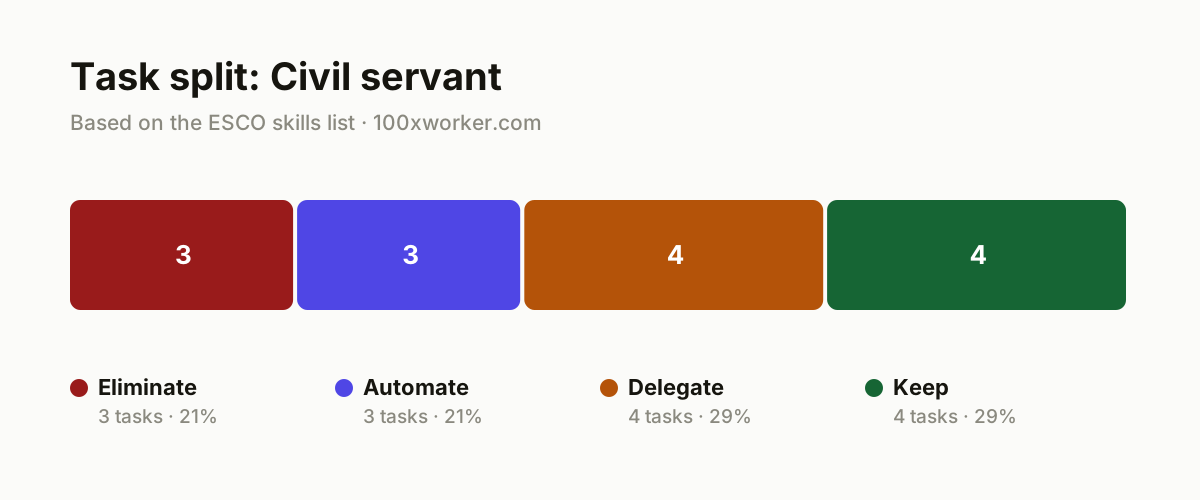
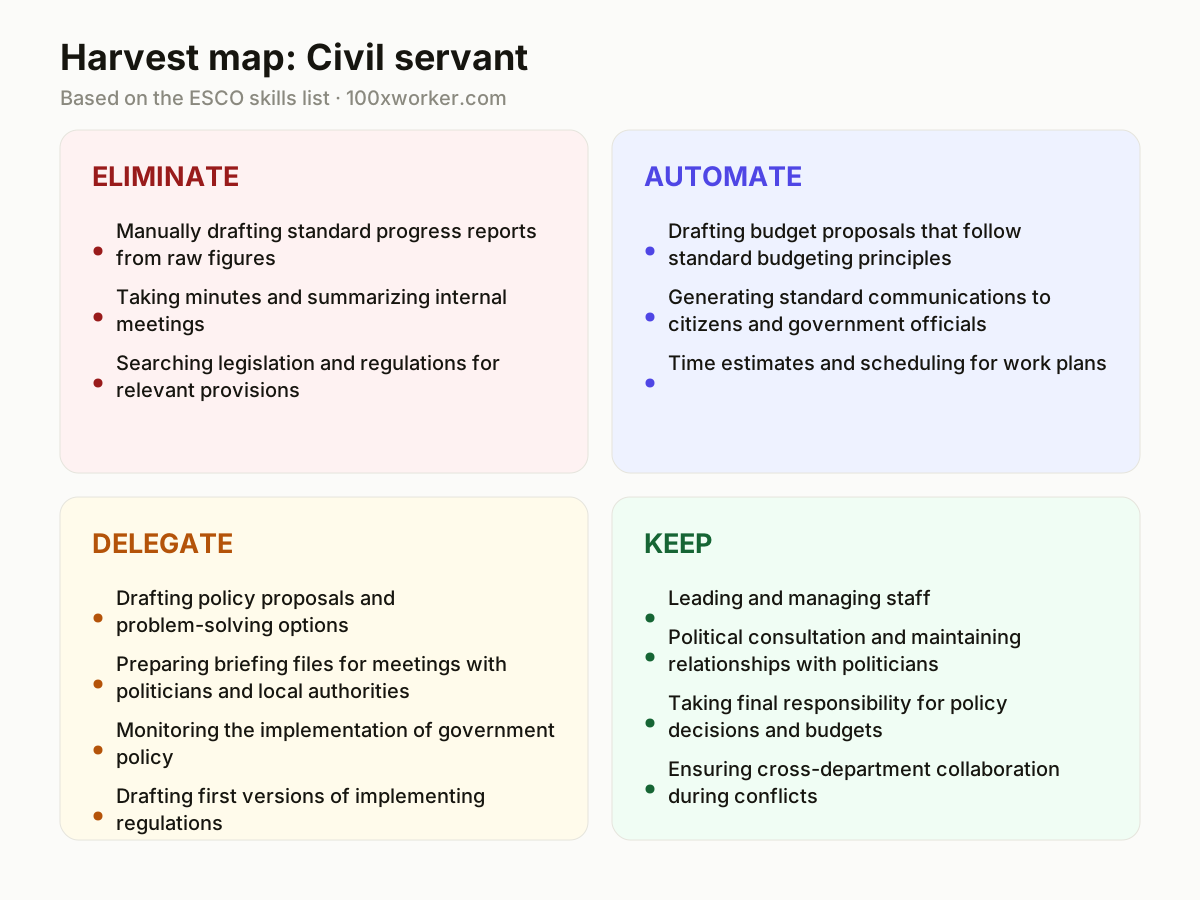
Not every task in a civil servant's job changes the same way. Some recurring tasks disappear because AI does them instantly and better (eliminate). Some structured, rule-based tasks get handled almost entirely by AI with a quick check (automate). Some judgment-heavy tasks get a first draft from AI that you then shape and take ownership of (delegate). And some tasks stay with you because they depend on trust, authority, or accountability that cannot be handed to a model (keep).
| Task | Bucket | Why |
|---|---|---|
| Manually drafting standard progress reports from raw figures | eliminate | AI generates these directly from source systems, faster and more consistently than copying figures into a document. |
| Taking minutes and summarizing internal meetings | eliminate | Transcription and summary happen automatically, so minutes no longer need to be typed up by hand. |
| Searching legislation and regulations for relevant provisions | eliminate | AI finds and cites relevant provisions faster than manually paging through statutes and regulations. |
| Drafting budget proposals that follow standard budgeting principles | automate | Based on historical figures and fixed rules, an AI agent delivers a full draft ready for your review. |
| Generating standard communications to citizens and government officials | automate | Policy changes, updates, and FAQs get converted automatically into clear text tailored to each audience. |
| Time estimates and scheduling for work plans | automate | Based on comparable past projects, AI calculates realistic timelines for new initiatives. |
| Drafting policy proposals and problem-solving options | delegate | AI delivers a first analysis with scenarios and trade-offs, you weigh the political and social context. |
| Preparing briefing files for meetings with politicians and local authorities | delegate | Briefings and background notes come largely finished, you set the tone and flag the sensitive points. |
| Monitoring the implementation of government policy | delegate | Dashboards and risk signals get compiled automatically, you decide which deviation deserves escalation. |
| Drafting first versions of implementing regulations | delegate | AI turns policy choices into a legally usable draft, you and the legal department check it. |
| Leading and managing staff | keep | Motivating, directing, and evaluating employees requires trust you do not hand to a model. (Your edge: People follow people, not a dashboard.) |
| Political consultation and maintaining relationships with politicians | keep | Sensing political dynamics, timing, and unspoken interests stays work that only a person can do. (Your edge: Sensing what stays unsaid.) |
| Taking final responsibility for policy decisions and budgets | keep | Someone has to sign off, answer for the outcome, and explain the choice afterward. (Your edge: Responsibility cannot be delegated.) |
| Ensuring cross-department collaboration during conflicts | keep | When departments have conflicting interests, mediation and authority are needed, not a generated compromise text. (Your edge: Authority cannot be modeled.) |
Which tasks can AI take over from a civil servant?
AI is strongest on the repetitive, document-heavy parts of the job. It can turn raw figures into a standard progress report, transcribe and summarize an internal meeting, search legislation and regulations for the provisions that apply to a case, draft a budget proposal that follows fixed budgeting principles, generate standard letters or FAQ answers for citizens, and estimate timelines for a new work plan by comparing it to past projects. These are the eliminate and automate tasks: recurring, rule-based, and checkable against a source. None of them require political judgment, so AI can do a full first pass and often the final version, with a light human check.
Will AI replace civil servants?
No single tool replaces the role. Microsoft Research studied 200,000 real Copilot conversations across occupations and found that generative AI mainly changes how administrative and managerial tasks get done, not whether the job exists (Microsoft Research, 2025). For a public administration manager, the tasks most exposed are drafting, summarizing, and searching: things with a checkable output. Leading staff, negotiating with politicians and other authorities, and signing off on budgets and policy decisions stay with a person, because someone has to be accountable for the outcome. Expect your task list to shrink and shift toward judgment calls, not your job title to disappear.
What can you do this month as a civil servant?
Start by listing your recurring tasks for one month: reports, meeting types, budget documents, briefings, correspondence. Mark which ones are mostly copying figures or summarizing (eliminate), which follow a fixed template or rule (automate), and which need your judgment before they go out (delegate). Pick one recurring report or one meeting type and test an AI tool on it for two weeks, comparing time spent and quality. Check the ESCO skills list for your occupation (ESCO 1112.6) and note which skills, like stakeholder relationships or budget principles, AI cannot replace, then invest your saved time there.
How many people already use AI at work in the EU?
Eurostat found that 32.7% of the EU population aged 16 to 74 used generative AI in the three months before the 2025 survey (Eurostat, isoc_ai_iaiu). That figure covers the whole population, not government staff specifically, so actual use inside public administration may differ. Anthropic's Economic Index, which classifies large volumes of real AI conversations against detailed task lists, finds that some of that use looks like automation of a task and some looks like augmentation, where a person still directs the work. For a role built on judgment and accountability, augmentation-style use is the more likely pattern.
Some AI use looks like automation of a task, some looks like augmentation where a person still directs the work.
Anthropic Economic Index
Become the AI person on your team
Turn your report pipeline into a draft-and-check flow
Feed source data or last month's report into an AI tool and ask for a first draft in your standard format. Read it for accuracy and tone before it goes out, instead of writing every report from a blank page.
Let AI hold the meeting minutes
Use a transcription and summary tool during internal meetings so action items and decisions get captured automatically. Spend the time you save on following up with the people who own each action item.
Keep sign-off and negotiation for yourself
Let AI produce the first version of a budget, briefing, or implementing regulation, but do the final review, the political conversation, and the signature yourself. That is where your name and your judgment carry weight.
Want this for your actual task list?
The free scan on the homepage builds your personal task map in 30 seconds, based on your role and industry.
Run the free task scanTools for this work
| Tool | For which tasks | The sober take |
|---|---|---|
| Microsoft Copilot (Microsoft 365) | eliminate: meeting minutes and summaries; automate: standard citizen communications | Already deployed inside many government Microsoft 365 tenants, so it may already be available to you. |
| Claude or ChatGPT Enterprise | automate: budget drafts; delegate: policy proposal first drafts and briefing files | Check your organization's data classification and confidentiality rules before uploading internal government documents. |
| AI-assisted legal and regulatory search tools | eliminate: searching legislation and regulations for relevant provisions | Still verify every citation against the official published text before relying on it. |
| AI-assisted dashboard tools (e.g. Power BI Copilot) | delegate: monitoring the implementation of government policy | Dashboards flag anomalies for you, but deciding what needs escalation stays a human call. |
Prompts to try today
Draft a policy brief from source documents
Summarize a stakeholder meeting
Check a budget draft against principles
Related jobs
Frequently asked questions
Will AI replace civil servants?
No. AI takes over specific tasks such as drafting reports, summarizing meetings, and searching regulations, but leadership, political negotiation, and final accountability for decisions stay with a person. Microsoft Research's analysis of 200,000 Copilot conversations across occupations found that generative AI mainly changes task composition rather than eliminating administrative and managerial roles outright.
Which AI skills should a civil servant develop?
Focus on skills that sit next to what AI does well: checking and editing AI-drafted reports and regulations for accuracy, writing clear prompts for policy analysis, and reading dashboards critically instead of producing them by hand. The ESCO skills list for this occupation (ESCO 1112.6) still centers on leadership, budget principles, and stakeholder relationships, none of which AI can supply on its own.
Can AI write policy proposals on its own?
AI can produce a first draft with several policy options, rough pros and cons, and a cost estimate, based on the documents you give it. It cannot weigh political feasibility, public reaction, or legal risk the way an experienced civil servant can. Treat AI output as a starting draft that still needs your review, not a finished proposal ready to submit.
Is there an official score for how much AI affects this specific job?
Not a precise one. Microsoft Research published occupation-level applicability scores for many roles based on real Copilot conversations, and ESCO catalogs 3,039 occupations with their skills, but no public dataset currently gives a single verified applicability number for public administration manager (ESCO 1112.6). Treat any specific percentage you see for this exact title as unverified until you can trace it to a named source.
Sources
- Microsoft Research, Working with AI: Measuring the Applicability of Generative AI to Occupations (2025)
- Anthropic Economic Index
- Eurostat, isoc_ai_iaiu
- ESCO, European Commission
Hendrik De Winne, author of Becoming AI-Savvy, founder of VibeLab. Helps teams redesign their work with AI.
This article was drafted with AI assistance from public data sources and editorially reviewed.