100×worker · job analysis
Will AI Replace Hotel Managers?

Hotel managers spend their days moving between staff schedules, room pricing, financial reports, and guest emails. Generative AI now handles a real slice of that workload, especially the repetitive parts: comparing rates, drafting reports, and answering routine guest questions. It does not handle the parts that require judgment, presence, or authority.
Microsoft Research analyzed 200,000 real Copilot conversations and scored how applicable generative AI is to different occupations. Lodging managers, the closest US category to the ESCO accommodation manager profile, scored 18.3%. That places the role near the lower end of the scale, well below translators (49%) but above occupations that depend almost entirely on physical, hands-on care, such as nurses (12%).
That lower score does not mean AI is irrelevant to hotel management. It means the tasks AI reaches are concentrated in a specific part of the job: pricing, reporting, bookkeeping, and first-line guest communication. The rest, leading people, building relationships with suppliers and partners, and handling a crisis at the front desk, stays firmly human. This article breaks the role into four buckets: tasks to drop, tasks to automate, tasks to delegate to AI with your review, and tasks to keep doing yourself.
A hotel manager runs staff, finances, marketing, and guest experience for a lodging business.
The task split: what AI takes over and what stays yours
Instead of asking whether AI will take over the hotel manager role, it helps to look at the role task by task. Some tasks are already pointless to do by hand and should be eliminated. Some can run fully on automation with your oversight. Some are best delegated to AI for a first draft that you then check and adjust. And some tasks depend on judgment, presence, or trust that AI cannot supply, so you keep doing them yourself.
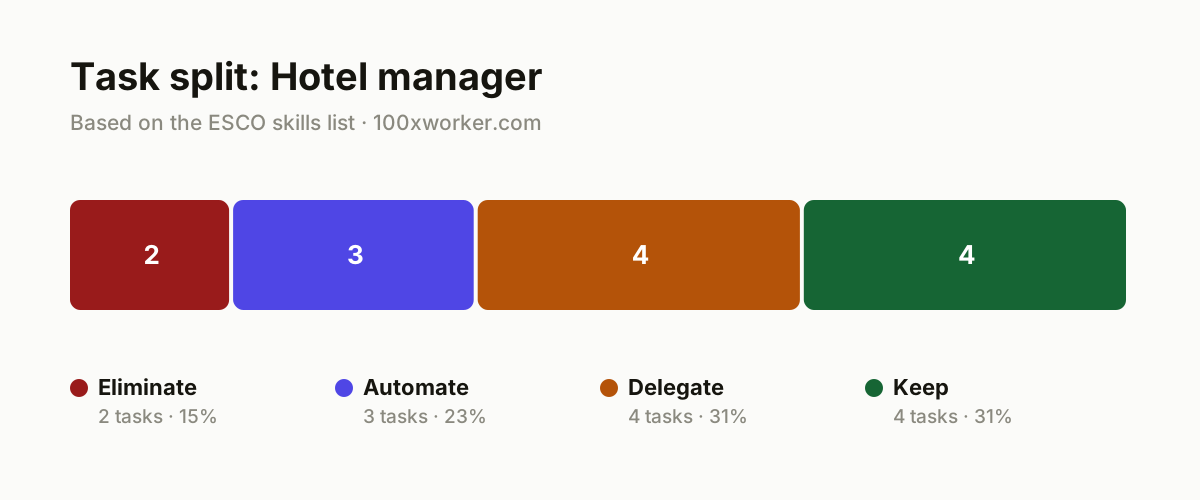
| Task | Bucket | Why |
|---|---|---|
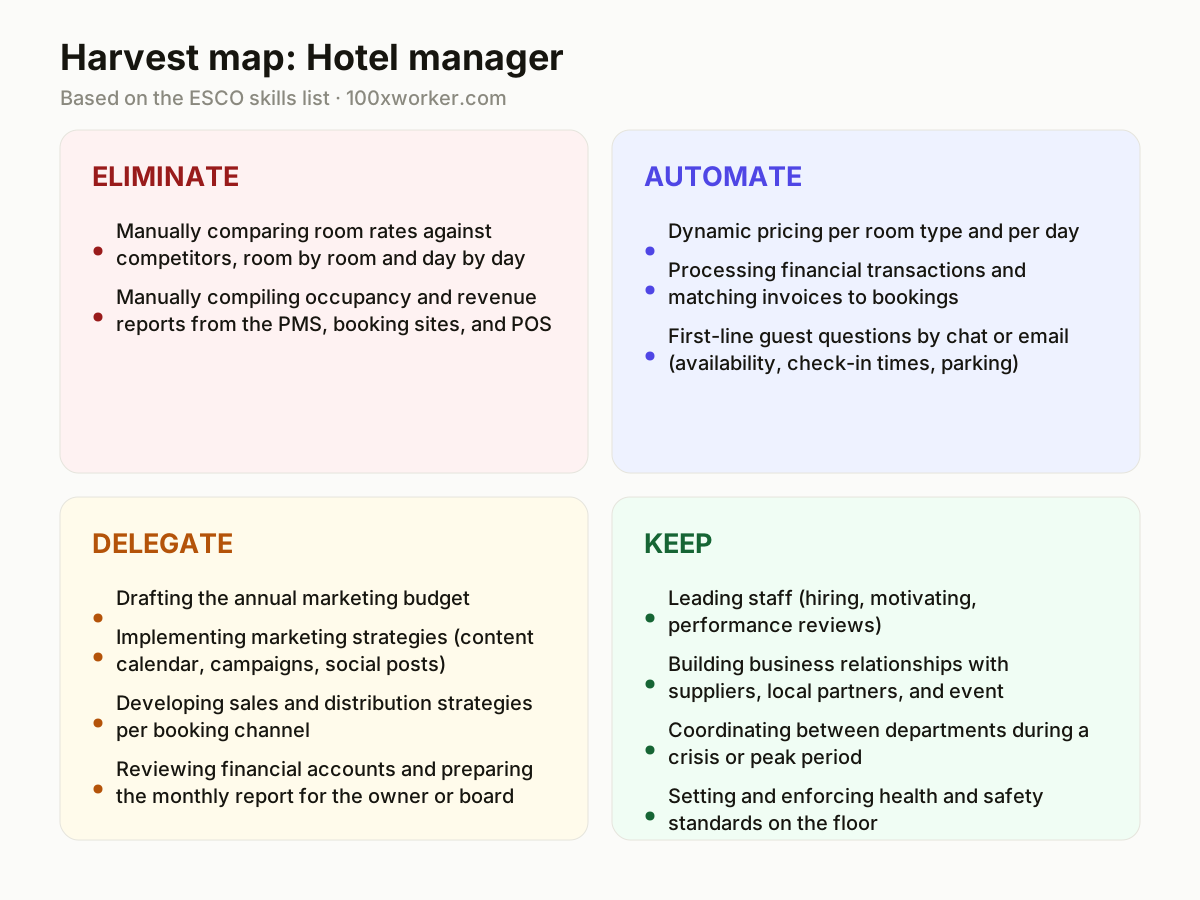
| Manually comparing room rates against competitors, room by room and day by day | eliminate | Dynamic pricing tools do this continuously and more precisely, a side spreadsheet adds nothing. |
| Manually compiling occupancy and revenue reports from the PMS, booking sites, and POS system | eliminate | A connected dashboard generates this automatically, copying data between systems by hand adds nothing. |
| Dynamic pricing per room type and per day | automate | The system adjusts rates based on demand, season, and competitor prices, you just set the limits. |
| Processing financial transactions and matching invoices to bookings | automate | AI-linked accounting tools recognize patterns and flag only the exceptions for your review. |
| First-line guest questions by chat or email (availability, check-in times, parking) | automate | A chatbot answers standard questions around the clock, you step in for complaints or edge cases. |
| Drafting the annual marketing budget | delegate | AI proposes a first split based on last year's numbers, you check it against your own priorities. |
| Implementing marketing strategies (content calendar, campaigns, social posts) | delegate | AI delivers a concrete plan and draft copy, you set the tone and timing. |
| Developing sales and distribution strategies per booking channel | delegate | AI models scenarios for commissions and direct bookings, the final call stays strategic work for you. |
| Reviewing financial accounts and preparing the monthly report for the owner or board | delegate | AI assembles the report from the numbers, you verify it and add context. |
| Leading staff (hiring, motivating, performance reviews) | keep | This stays people work, AI can help you prepare for a conversation but not have it. (Your edge: trust and reading what someone actually needs) |
| Building business relationships with suppliers, local partners, and event organizers | keep | Negotiating and networking require presence and a feel for the other side. (Your edge: personal network and on-the-spot negotiation instinct) |
| Coordinating between departments during a crisis or peak period | keep | Fast decisions under pressure require overview and authority that AI does not have. (Your edge: deciding under time pressure with a full view across departments) |
| Setting and enforcing health and safety standards on the floor | keep | Physical checks and responsibility for guests and staff stay with you. (Your edge: physical presence and legal responsibility) |
Which hotel manager tasks does AI take over?
AI takes over the parts of the job that follow a repeatable pattern: setting room rates against demand and competitor data, matching invoices to bookings, drafting occupancy and revenue reports, and answering routine guest questions about check-in times, parking, or availability. These are high-volume, rule-based tasks where a tool can work continuously and catch details a busy manager might miss. What AI does not take over is anything that requires reading a room, negotiating a supplier contract, or deciding how to handle an overbooked night. Those stay with the manager.
Will AI replace hotel managers?
No. Microsoft Research scored generative AI's applicability to lodging manager tasks at 18.3%, which is on the lower end compared to occupations built around research, writing, or translation. The job depends heavily on leading people, negotiating with partners, and making calls during a crisis, none of which AI can do on its own. What changes is the day-to-day task list: fewer hours on rate comparisons and reports, more hours on staff decisions and guest relationships. The title survives. The daily mix of work does not stay the same.
How do you become the AI person on your hotel team?
Start by mapping your own task list against the four buckets above and picking one or two automate-bucket tasks to hand off first, usually pricing or first-line guest replies. Set up the tool, run it alongside your current process for a few weeks, and only then drop the manual version. Share what you learn with your team in plain terms: what the tool does well, where it fails, and when someone still needs to step in. Being the person who tested it first, documented the failure points, and trained others on the handoff rules is what makes you the AI person, not simply using more software than anyone else.
What can you do this month with AI as a hotel manager?
Pick one eliminate-bucket task and stop doing it by hand this week, most likely rate comparisons if your PMS already offers dynamic pricing. Then set up a chatbot or auto-reply for the five most common guest questions you get by email. Use a general AI assistant to draft your next monthly report to the owner or board from your existing numbers, then check it line by line before sending. None of this requires a new system rollout, just turning on features you may already have access to and reviewing the output.
Hotel managers oversee staff, finances, marketing, and operations, from supervising employees to keeping financial records and organizing activities.
ESCO occupational profile, European Commission
Become the AI person on your team
Pilot one automate-bucket task before rolling it out
Pick dynamic pricing or the guest-chat bot first, since both have clear, measurable outputs. Run it for two to three weeks next to your current process, then compare results before you retire the manual version.
Write a one-page handoff rule for your team
Document exactly when a chatbot answer is fine and when a guest question must go to a human, such as complaints, refund requests, or anything mentioning a safety issue. Share it with front desk staff so nobody guesses.
Use AI drafts as a starting point, not a final answer
Let AI draft the marketing budget, the monthly report, or the campaign calendar, then edit it against your actual priorities and local knowledge. Keep the sign-off step manual, always.
Want this for your actual task list?
The free scan on the homepage builds your personal task map in 30 seconds, based on your role and industry.
Run the free task scanTools for this work
| Tool | For which tasks | The sober take |
|---|---|---|
| Revenue management / dynamic pricing engines | Eliminate: manual rate comparisons. Automate: dynamic pricing per room type and day. | Many property management systems now bundle this, so a separate spreadsheet is rarely needed anymore. |
| AI guest-service chatbots | Automate: first-line guest questions by chat or email. | Works well for FAQs like check-in times and parking, but route complaints straight to a person. |
| AI-assisted accounting and invoice-matching software | Automate: processing financial transactions and matching invoices to bookings. | Cuts manual reconciliation but still needs your sign-off before the books close. |
| General-purpose AI assistants (Microsoft Copilot, Anthropic's Claude, ChatGPT) | Delegate: marketing budget drafts, marketing content, sales strategy scenarios, monthly reports. | Good for a fast first draft, not a substitute for your final review. |
Prompts to try today
Draft a monthly marketing budget
Summarize weekly occupancy and revenue
Draft a first-line guest reply
Related jobs
Frequently asked questions
Do AI pricing tools replace revenue managers in hotels?
No, they replace the manual comparison work, not the decision-making. Dynamic pricing tools adjust room rates continuously based on demand, season, and competitor prices, but someone still has to set the boundaries, approve exceptions during events, and decide how aggressive the strategy should be for a given property. The tool handles the math, the manager handles the judgment calls around it.
Can AI write my hotel's marketing content?
AI can produce a first draft of a content calendar, social posts, and campaign copy quickly, based on a brief you give it. It will not know your regular guests, your local reputation, or the tone that fits your property without guidance from you. Treat AI output as a starting draft you edit, not a finished campaign ready to publish.
How much of a hotel manager's job can AI actually do, according to research?
Microsoft Research scored generative AI's applicability to lodging manager tasks at 18.3%, based on analysis of 200,000 real Copilot conversations mapped to work activities. That is a lower score than many office-based roles, since much of hotel management involves leading people, negotiating with partners, and handling situations on-site that AI cannot observe or act on directly.
What skills should a hotel manager build now that AI handles routine tasks?
Focus on the skills AI cannot supply: reading staff and guests in person, negotiating supplier and partner deals, and making fast decisions during a crisis or peak period. On the technical side, learn to review AI-generated reports and drafts critically rather than accepting them at face value, since someone still has to catch errors and add context AI does not have.
Sources
- Microsoft Research, Working with AI: Measuring the Applicability of Generative AI to Occupations (2025)
- Anthropic Economic Index
- Eurostat, Individuals' use of AI (isoc_ai_iaiu)
- ESCO occupational taxonomy, European Commission
Hendrik De Winne, author of Becoming AI-Savvy, founder of VibeLab. Helps teams redesign their work with AI.
This article was drafted with AI assistance from public data sources and editorially reviewed.