100×worker · job analysis
Will AI Replace Brand Managers, and What Should You Do About It?

Brand managers spend a surprising share of their week on work that has nothing to do with brand judgment: pulling social stats into a spreadsheet, retyping competitor scans, updating budget sheets after every campaign. That is the part of the job generative AI is now good at. Microsoft Research analyzed 200,000 real Copilot conversations and scored occupations on how much of their work AI can plausibly touch. Marketing managers, the closest match to brand manager in that dataset, scored 18.9%. For comparison, translators topped the list at 49%, nurses sat near the bottom at 12%.
That 18.9% is not evenly spread across the job. It concentrates in research, reporting, and drafting. It barely touches the parts of brand management that involve deciding what a brand should mean, negotiating with partners, or managing a creative team. Across the EU, 32.7% of people aged 16 to 74 used generative AI in the last three months of 2025, according to Eurostat. Brand managers are past the point of deciding whether to use these tools. The real question is which tasks to hand over, and which to keep.
A brand manager plans and safeguards how a brand is positioned and presented in the market.
The task split: what AI takes over and what stays yours
Not every task in a brand manager's job changes the same way. Some tasks disappear entirely because a tool now does them by default. Some get fully automated, meaning AI runs them end to end and you just check the output. Some get delegated, meaning AI produces a first draft and you refine it. And some stay entirely with you, because they depend on judgment, relationships, or taste that no model has. Sorting your actual task list into these four buckets, rather than asking whether 'the job' will survive, is the useful way to plan.
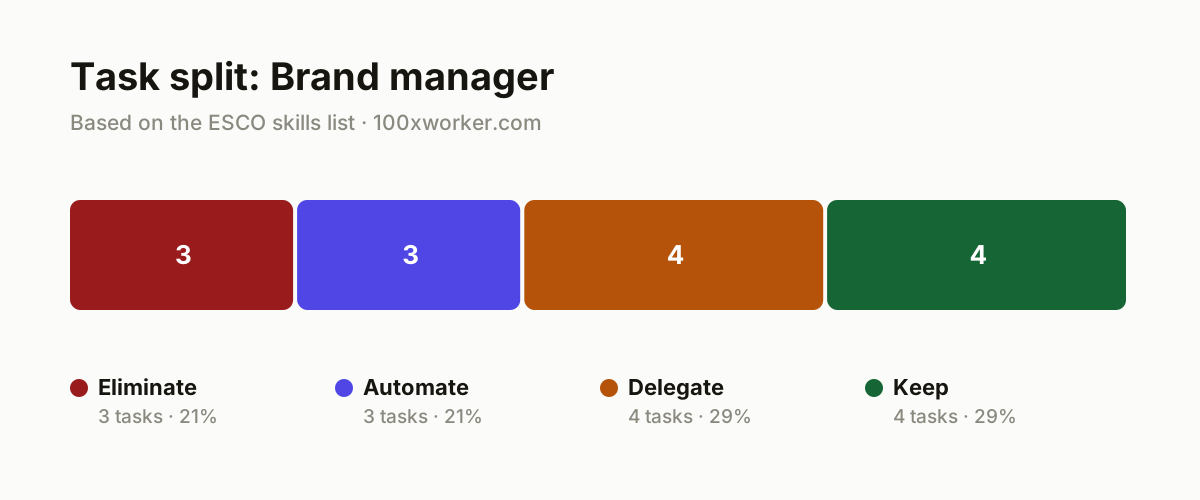
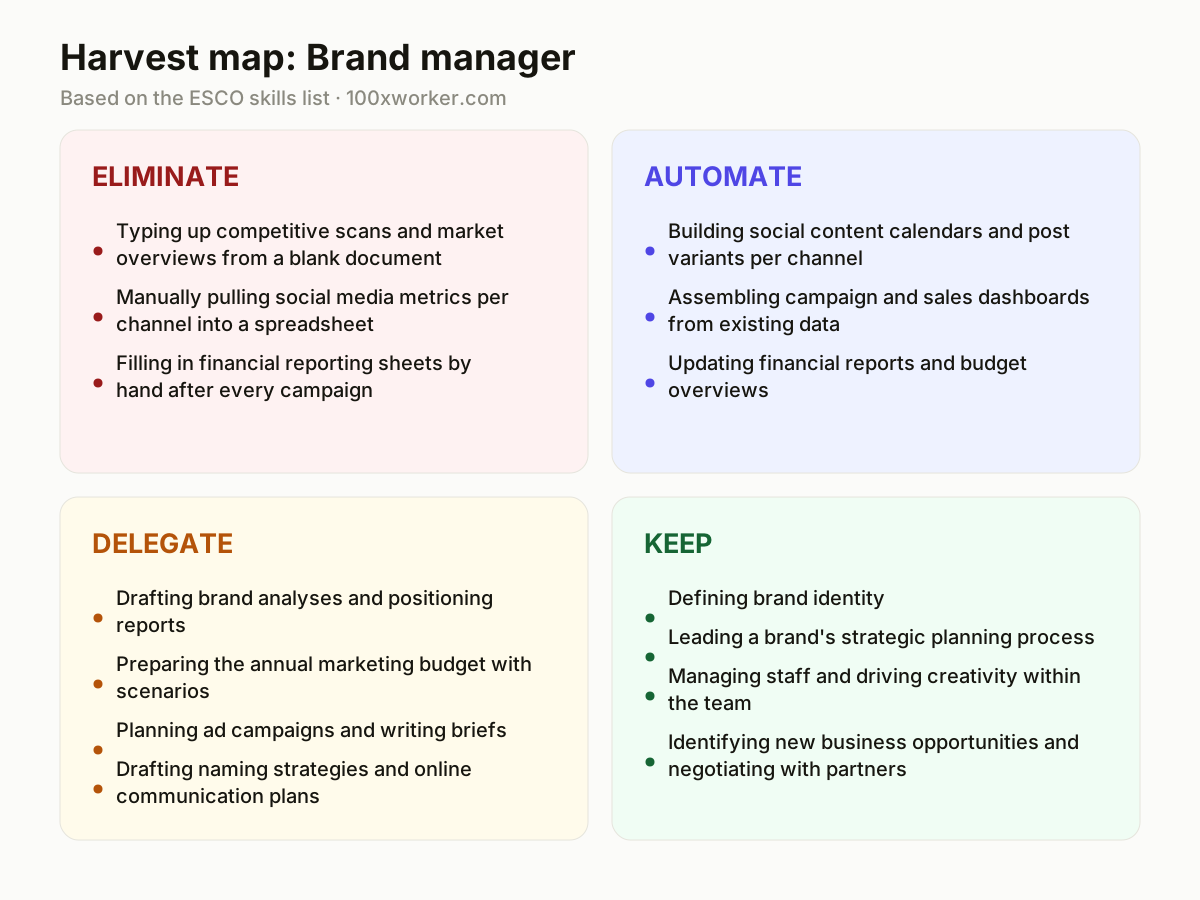
| Task | Bucket | Why |
|---|---|---|
| Typing up competitive scans and market overviews from a blank document | eliminate | AI searches sources and produces a first market scan faster and more consistently than manual work. |
| Manually pulling social media metrics per channel into a spreadsheet | eliminate | Platforms and AI tools now aggregate these numbers automatically, so manual copying adds nothing. |
| Filling in financial reporting sheets by hand after every campaign | eliminate | Numbers from accounting and ad platforms now flow directly into a standing report template. |
| Building social content calendars and post variants per channel | automate | An AI agent generates ready-to-publish variants from your brand guidelines, you just schedule them. |
| Assembling campaign and sales dashboards from existing data | automate | Dashboards update themselves as source data comes in, no manual export needed. |
| Updating financial reports and budget overviews | automate | Accounting data and marketing budgets now link automatically into a live overview. |
| Drafting brand analyses and positioning reports | delegate | AI processes market data and competitor information into a first analysis, you check it against brand instinct. |
| Preparing the annual marketing budget with scenarios | delegate | AI runs scenarios against historical numbers, you pick and defend the final allocation. |
| Planning ad campaigns and writing briefs | delegate | A first brief and media plan comes from AI, you sharpen the creative direction and agency terms. |
| Drafting naming strategies and online communication plans | delegate | AI generates options and structures, you decide what fits the brand story and the market. |
| Defining brand identity | keep | This requires a feel for culture, history, and meaning that no model can sense. (Your edge: Sensing what a brand actually means to people) |
| Leading a brand's strategic planning process | keep | Strategy involves trade-offs between budget, internal politics, and risk that are specific to the organization. (Your edge: Managing internal buy-in and priorities) |
| Managing staff and driving creativity within the team | keep | Motivating, coaching, and organizing creative tension stays a matter between people. (Your edge: Building trust and helping people grow) |
| Identifying new business opportunities and negotiating with partners | keep | Building relationships and negotiating requires social timing you cannot hand to a prompt. (Your edge: Sensing the right moment in a negotiation) |
Will AI replace brand managers?
No. AI applicability research from Microsoft puts generative AI's reach into marketing manager work at 18.9% of activities, well below roles like translation (49%) but above low-exposure roles like nursing (12%). That share is concentrated in research, reporting, and first drafts, not in the judgment calls that define the job. Anthropic's Economic Index similarly shows AI use in marketing splitting between automation of routine output and augmentation of a person's own work, rather than full replacement. Brand managers who treat AI as a tool for the repetitive 20% free up time for the strategic, relational 80% that still needs a person.
Which brand manager tasks disappear, and which stay?
Tasks that disappear are the ones with no real decision in them: retyping competitor scans, manually compiling social stats, filling in financial reporting sheets by hand. Tasks that get automated or delegated are ones with a repeatable structure, like content calendars, dashboards, or a first-pass budget scenario. Tasks that stay are the ones requiring judgment tied to context nobody else has: defining what the brand means, leading the strategic planning process, managing and motivating a team, and building the kind of partner relationships that depend on reading a room. The dividing line is not complexity, it is whether the task depends on your specific judgment or relationships.
What can you do this month to become the AI-savvy person on your team?
Pick one recurring task from the eliminate or automate bucket, such as your monthly competitive scan or channel reporting, and rebuild it with an AI tool this week. Write down the prompt that works and share it with your team so the shortcut is not stuck in your head. Then take one delegate-bucket task, like a campaign brief, and have AI draft the first version every time going forward, spending your own time on the parts a draft cannot solve. Small, repeated wins like this build real fluency faster than reading about AI strategy.
How applicable is generative AI to marketing roles, according to research?
Microsoft Research's 2025 analysis of 200,000 real Copilot conversations scored marketing managers at 18.9% applicability, meaning that share of their work activities is one where generative AI shows up as genuinely useful in practice, not theory. This sits in the middle of the scale: translators scored 49%, the highest of any occupation studied, while nurses scored 12%, among the lowest. Anthropic's Economic Index, which maps millions of Claude conversations onto O*NET task categories, adds that marketing-related AI use leans toward augmentation (helping someone do their own work) more than pure automation. Both datasets point the same way: AI touches specific tasks, not the whole job.
Marketing managers show a generative AI applicability score of 18.9%, compared with 49% for translators and 12% for nurses.
Microsoft Research, Working with AI (2025)
Become the AI person on your team
Turn your reporting into a template AI fills in
Build a standing prompt that takes raw campaign and financial data and outputs your usual report format. Test it for two campaigns, fix the prompt, then hand it to your team as the default process.
Run a monthly AI-assisted brand health check
Feed AI your latest social metrics, competitor moves, and search trends, and ask for a short brand-position summary. Use it as a starting point for your own read, not as the final word.
Document the prompts that work, not just the outputs
When an AI-generated brief or content variant is good, save the exact prompt and note what you edited. Over a few months this becomes a working playbook your team can reuse.
Want this for your actual task list?
The free scan on the homepage builds your personal task map in 30 seconds, based on your role and industry.
Run the free task scanTools for this work
| Tool | For which tasks | The sober take |
|---|---|---|
| ChatGPT or Claude | Competitive scans, first-draft briefs, naming strategy options, budget scenario modeling | Useful for structured first drafts, but brand judgment still has to come from you. |
| Looker Studio or Power BI | Campaign and sales dashboards built from live data feeds | Removes manual export work once data sources are connected properly. |
| Hootsuite or Sprout Social (AI features) | Content calendars, post variants per channel | Speeds up production but still needs a human check against brand voice. |
| Jasper or Copy.ai | Drafting communication plans and campaign copy variants | Good for volume, weak on subtlety without a strong brand brief feeding it. |
Prompts to try today
Fast competitive scan
Campaign brief first draft
Budget scenario modeling
Related jobs
Frequently asked questions
Is the brand manager job at risk of disappearing because of AI?
No. Microsoft Research's applicability score for marketing managers sits at 18.9%, meaning most of the role's work activities are not well matched to generative AI. The tasks AI handles well are research, reporting, and first drafts. Strategy, team leadership, and partner relationships remain squarely with the person in the role.
How much of a brand manager's daily work can AI actually do?
Based on Microsoft's occupation-level analysis, roughly 19% of typical marketing manager work activities show clear generative AI applicability. That figure covers research summaries, reporting, and drafting, not decision-making or people management. Most brand managers will find the share higher for specific repetitive tasks and near zero for strategic ones.
Should a brand manager learn to use AI tools like ChatGPT or Claude?
Yes, at a basic level. Across the EU, 32.7% of people aged 16 to 74 used generative AI in the past three months as of 2025, according to Eurostat, and marketing work is one of the areas where AI use is most common. Not learning the basics means falling behind on speed for routine tasks that colleagues are already automating.
What is the difference between AI 'automating' and 'delegating' brand manager tasks?
Automated tasks run end to end without you touching each step, like a dashboard that updates itself from live data. Delegated tasks still need you: AI produces a first draft, such as a campaign brief or positioning report, and you revise it before it goes anywhere. The automate bucket saves time on execution; the delegate bucket saves time on starting from zero.
Sources
- Microsoft Research, Working with AI: Measuring the Applicability of Generative AI to Occupations (2025)
- Anthropic Economic Index
- Eurostat, Individuals' use of AI (isoc_ai_iaiu)
- ESCO, European Commission occupation taxonomy
Hendrik De Winne, author of Becoming AI-Savvy, founder of VibeLab. Helps teams redesign their work with AI.
This article was drafted with AI assistance from public data sources and editorially reviewed.