100×worker · job analysis
Will AI Replace Sales Managers?

Sales managers spend a good part of the week building reports, checking dashboards, and turning CRM data into something a board can read. Generative AI is now good at exactly that. Microsoft Research analyzed 200,000 real Copilot conversations across occupations and found that generative AI is applicable to about 16.4% of the work activities that make up the sales manager role, a moderate share compared with 49% for translators and 12% for nurses (Microsoft Research, Working with AI, 2025).
That number does not mean 16.4% of sales managers lose their jobs. It means a specific slice of tasks, mostly reporting, dashboard prep, and first-pass analysis, moves to a machine. Anthropic's Economic Index, which classifies millions of real Claude conversations against the O*NET task list, finds a similar split in most occupations: some AI use automates a task outright, some augments a person's judgment instead. Across the EU, 32.7% of people aged 16 to 74 used generative AI in the three months before Eurostat's 2025 survey, so this shift is already underway in daily work.
This article breaks the sales manager role down using the ESCO taxonomy's list of core skills and sorts the actual tasks into what to eliminate, automate, delegate to AI, and keep for yourself.
A sales manager directs teams and strategy; AI mainly takes over reporting and analysis tasks.
The task split: what AI takes over and what stays yours
AI does not change the sales manager job title. It changes the task list underneath it. Four buckets help sort that list: eliminate covers manual steps that better tooling makes pointless, automate covers tasks a system now does without you, delegate covers tasks where AI drafts and you approve, and keep covers judgment and relationship work that stays with you. The tasks below come from the ESCO skill list for sales managers, sorted into that framework.
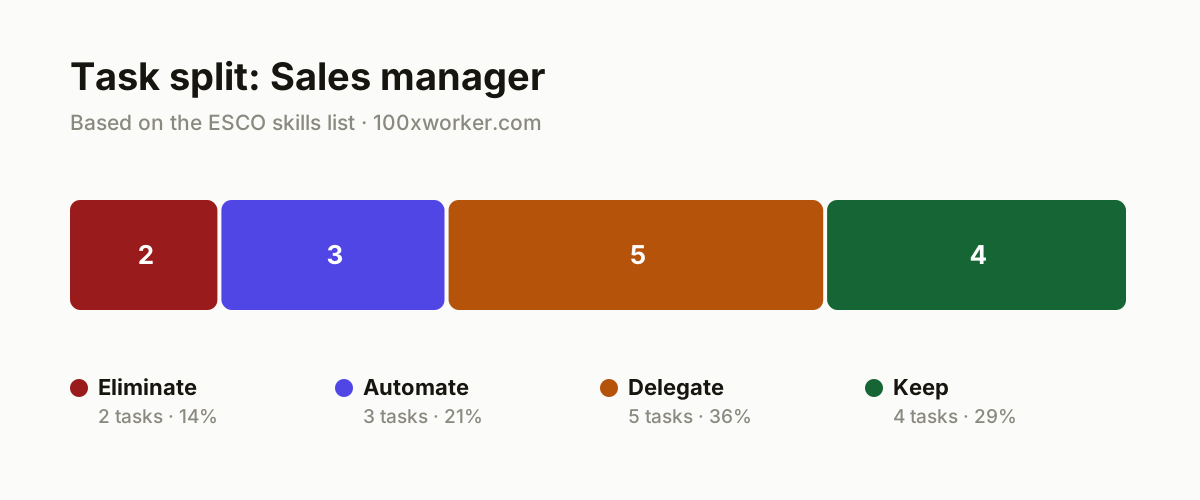
| Task | Bucket | Why |
|---|---|---|
| Manually re-typing sales figures from the CRM into Excel reports | eliminate | Modern CRM dashboards already show live numbers, so re-typing adds nothing. |
| Keeping separate spreadsheets alongside the CRM to track the pipeline | eliminate | One AI-enhanced source of truth removes shadow spreadsheets and the errors they cause. |
| Producing sales reports and periodic performance summaries | automate | An AI agent pulls CRM data and writes a readable report without you touching it. |
| Preparing dashboards and visual data for leadership updates | automate | Charts and dashboards generate automatically from live data, no manual formatting needed. |
| Tracking KPIs and flagging deviations | automate | A system watches KPIs continuously and alerts you to problems, so you stop checking manually. |
| Reviewing sales figures and product-level sales analysis | delegate | AI produces the first-pass analysis and patterns, you judge the conclusions and decide what to do. |
| Analyzing consumer buying trends | delegate | AI processes large datasets faster, you translate the trend into a concrete plan for your team. |
| Running first-round market research, desk research and competitor analysis | delegate | AI assembles an initial overview, you check it against what you actually see in the market. |
| Drafting and refining sales pitches and talking points | delegate | AI writes a first version from product information, you sharpen tone and persuasion. |
| Drafting the annual marketing budget | delegate | AI calculates an initial split based on historical data, you adjust it for strategy. |
| Managing staff and motivating the sales team | keep | Motivation and trust build in a real conversation, not a chat window. (Your edge: You know the person behind the numbers, AI only knows the numbers.) |
| Making strategic business decisions | keep | The responsibility and organizational context sit with you, not a tool. (Your edge: You own the decision, AI only supplies input.) |
| Building and maintaining a professional network | keep | Trust with clients and partners takes presence and time to build. (Your edge: Relationships get built in conversations, not prompts.) |
| Supervising sales activities and coaching the team | keep | Coaching depends on reading someone's mood and context, which AI cannot assess. (Your edge: You read body language, AI only reads data.) |
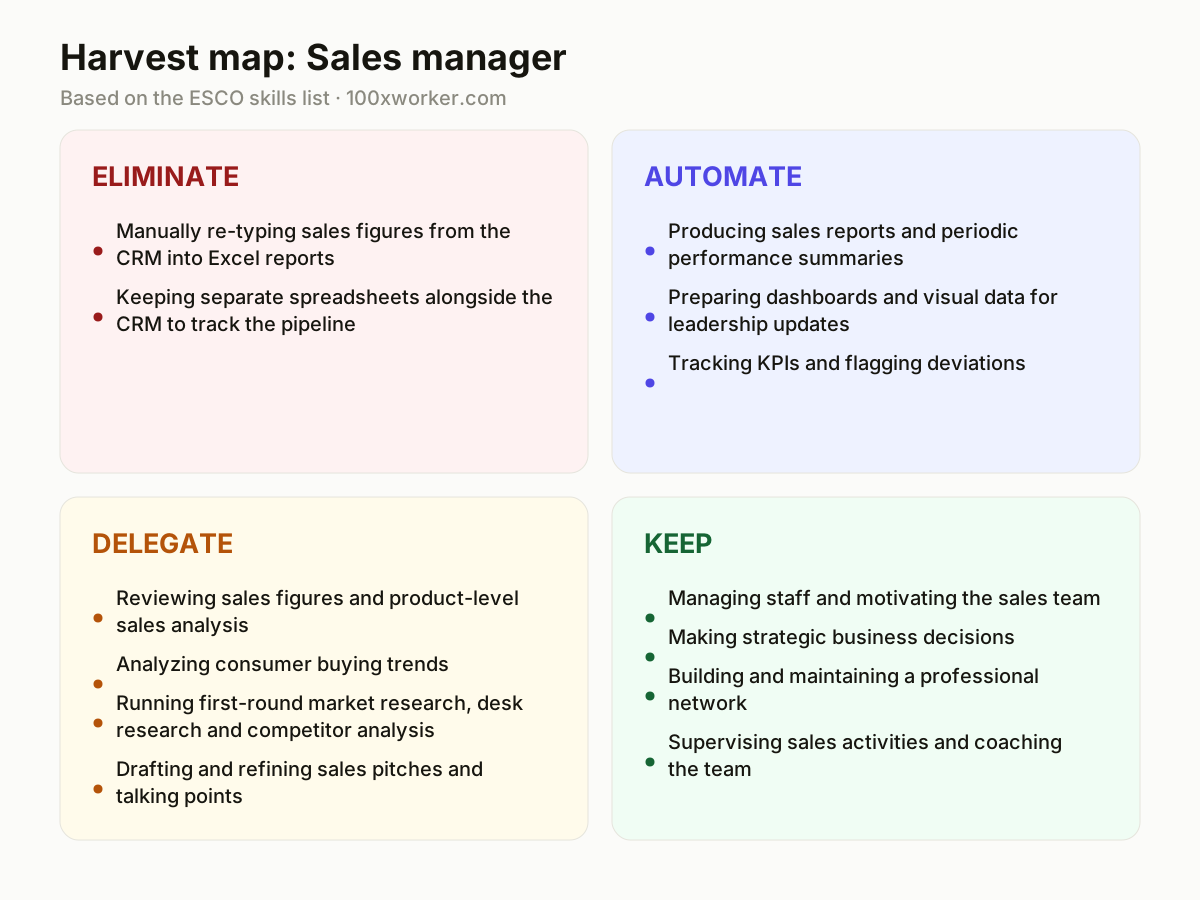
Which sales manager tasks can AI take over?
AI already handles report generation, dashboard building, and KPI monitoring, tasks that used to take a sales manager hours each week. It also produces first-draft sales analyses, market research summaries, and pitch scripts that you edit rather than write from scratch. Budget proposals and buying-trend analysis get a machine-generated first pass too. What AI does not do is decide strategy, run performance conversations, or read a client's hesitation in a meeting. The dividing line runs between documents and data on one side, and judgment and relationships on the other.
Will AI replace sales managers?
No single tool replaces the job, but the task mix inside it is changing fast. Microsoft Research analyzed 200,000 real Copilot conversations and found generative AI applicable to roughly 16.4% of sales manager work activities, a moderate share compared with 49% for translators and 12% for nurses. Anthropic's Economic Index shows a similar pattern across occupations, splitting AI use between automating routine tasks and augmenting judgment-heavy ones. For sales managers, the automation share concentrates in reporting and analysis, while coaching, negotiation, and strategic decisions stay with people. The role survives; the daily task list looks different.
How do you become the AI person on your sales team?
Start by mapping your own task list against the four buckets: what you eliminate, automate, delegate to AI, and keep for yourself. Bring one AI tool into a low-risk task first, like drafting the monthly sales report, and measure the time saved. Share the workflow with your team instead of keeping it as a personal shortcut. Being the AI person on a sales team means setting the norm for how the CRM's AI features, drafting tools, and analysis assistants get used, and pushing back when a task genuinely needs a human read, like a client renewal conversation.
What can you do this month as a sales manager?
Pick one recurring report or dashboard and hand it to an AI workflow this week, then check the output against last month's numbers before you trust it. Ask your CRM vendor what AI features are already included and turn them on. Run one market research question through an AI tool and compare it with what your team sees in the field. Block time on your calendar for the tasks AI cannot touch: one-on-ones, pipeline reviews with real judgment calls, and client meetings. That reallocation of hours is the real shift this quarter.
Across occupations studied, the share of work activities where generative AI is applicable ranges from about 12% for nurses to 49% for translators, with sales managers near the lower end at 16.4%.
Microsoft Research, Working with AI: Measuring the Applicability of Generative AI to Occupations (2025)
Become the AI person on your team
Run the pilot on your own report first
Before asking your team to trust an AI-drafted report, run it yourself for one full reporting cycle and compare it line by line with the manual version. Fix the prompt until the output matches your standards, then hand the workflow to the team with a short written guide.
Set the rule for what never goes fully automated
Decide explicitly which tasks always need a human check before they leave the building, like anything that goes to a client or affects someone's compensation. Write that rule down so the team has a clear line instead of guessing case by case.
Turn AI time savings into coaching time
If a report used to take three hours and now takes thirty minutes, put the freed time into one-on-ones or pipeline reviews rather than letting it disappear into more reporting. Track it for a month so the trade-off is visible instead of assumed.
Want this for your actual task list?
The free scan on the homepage builds your personal task map in 30 seconds, based on your role and industry.
Run the free task scanTools for this work
| Tool | For which tasks | The sober take |
|---|---|---|
| AI features already inside your CRM | automate (KPI tracking, dashboards), eliminate (manual spreadsheets) | Check what your existing CRM already includes before buying a separate tool. |
| General-purpose AI assistants (e.g., ChatGPT, Claude) | delegate (pitch drafts, market research summaries, budget first drafts) | Treat every output as a first draft that still needs your edit. |
| Meeting and call intelligence tools | automate (call notes, follow-up summaries), delegate (buying-trend signals from calls) | Useful for capturing conversations, still needs a manager's read on tone. |
| BI dashboards with an AI layer | automate (visual reporting, KPI alerts) | Most of the value comes from the alerting, not the chart itself. |
Prompts to try today
Draft a monthly sales report
First-draft sales pitch
Buying trend analysis
Related jobs
Frequently asked questions
Does AI replace the sales manager role entirely?
No. Microsoft Research's applicability score for sales managers sits at 16.4%, a moderate share of work activities where generative AI clearly helps, well below roles like translation (49%). The role does not disappear, but the daily task list shifts. Reporting, dashboard building, and first-draft analysis move to AI tools, while staff management, strategic decisions, and client relationships stay with the person in the role. Expect the job to keep the same title with a different weekly task mix.
What percentage of a sales manager's job can AI do?
Microsoft Research puts the applicable share at about 16.4% of work activities for the closest matching occupation category, based on an analysis of 200,000 real Copilot conversations. That figure leans toward tasks like report generation and data summarization rather than judgment calls or people management. It comes from the 2025 paper Working with AI: Measuring the Applicability of Generative AI to Occupations, and it measures task-level applicability rather than predicted job loss.
Which AI tools should a sales team start with?
Start with whatever AI features already exist inside your CRM, since most major platforms now include some reporting or forecasting AI at no extra cost. Add a general-purpose AI assistant for drafting pitches, budget proposals, and market research summaries, treating every output as a first draft. Meeting or call intelligence tools help with note-taking and follow-up, but keep a manager's review on anything client-facing. Add tools one at a time and measure the time saved before adding the next one.
How is this different from generic advice that AI will change every job?
This breakdown works at the task level instead of the job title level. It uses the ESCO taxonomy's list of core skills for sales managers, from setting sales targets to running market research, and sorts each one into what to eliminate, automate, delegate, or keep. Anthropic's Economic Index shows the same automate-versus-augment split across occupations generally, which supports treating tasks individually rather than assuming an entire role gets replaced or stays untouched.
Sources
- Microsoft Research, Working with AI: Measuring the Applicability of Generative AI to Occupations (2025)
- Anthropic Economic Index
- Eurostat, isoc_ai_iaiu (generative AI use, EU population 16-74)
- ESCO, European Commission
Hendrik De Winne, author of Becoming AI-Savvy, founder of VibeLab. Helps teams redesign their work with AI.
This article was drafted with AI assistance from public data sources and editorially reviewed.