100×worker · job analysis
Will AI Replace Market Researchers, and What Should You Do About It?
Market researchers spend a lot of time on work that looks like data entry: cleaning survey exports, transcribing interviews, coding open-ended answers. That is exactly the kind of task large language models are good at. Microsoft Research analyzed 200,000 real conversations with its Copilot assistant and scored occupations by how much of their task list generative AI can plausibly handle. For market research analysts and marketing specialists, the closest US occupational match to this role, that score came out at 35.0%. For comparison, translators scored highest at 49%, nurses among the lowest at 12%.
That number does not mean a third of market researchers lose their jobs. It means a third of the tasks that make up the job are ready to be handed to a tool. Anthropic's Economic Index, which classifies millions of Claude conversations against the O*NET task taxonomy, draws a similar line: some AI use replaces a task outright (automation), some AI use happens alongside a person doing the thinking (augmentation). For market research, most of the current use looks like augmentation: drafting, summarizing, and structuring, with a human deciding what it means.
This article breaks the job down task by task using an eliminate, automate, delegate, keep framework, so you can see exactly where AI changes your week and where it does not.
A market researcher collects and analyzes market data to inform customer behavior, competitive position, and marketing decisions.
The task split: what AI takes over and what stays yours
Not every task in a market researcher's job changes the same way. Some tasks disappear because a tool does them outright and nobody needs to check the manual version anymore (eliminate). Some get handled by an AI system with light human review (automate). Some still need a person driving the work, with AI doing the first pass (delegate). And some tasks stay with you because they depend on judgment, relationships, or in-person trust that AI cannot replicate (keep). Sorting your own task list into these four buckets is a faster way to see where your time actually goes than any generic prediction about your job title.
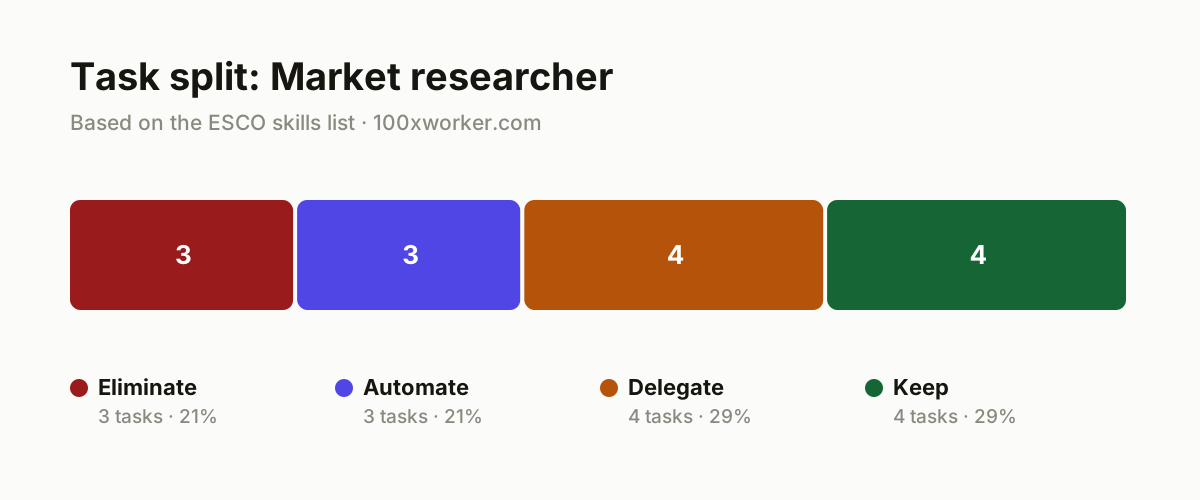
| Task | Bucket | Why |
|---|---|---|
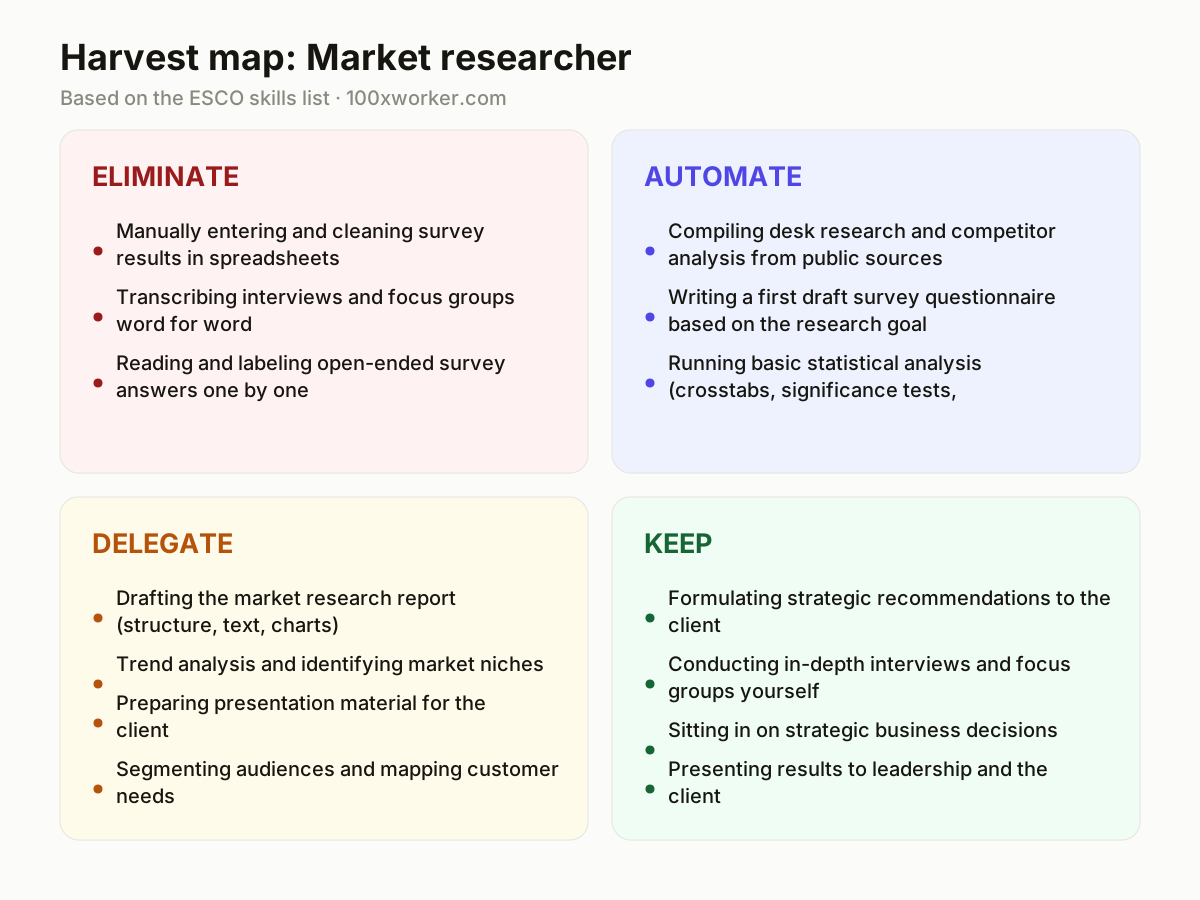
| Manually entering and cleaning survey results in spreadsheets | eliminate | Scripts and AI tools import, deduplicate, and structure raw data faster and without entry errors. |
| Transcribing interviews and focus groups word for word | eliminate | Transcription software delivers a usable text within minutes, at a fraction of the manual time. |
| Reading and labeling open-ended survey answers one by one | eliminate | AI clusters and categorizes thousands of open responses faster and more consistently than a person. |
| Compiling desk research and competitor analysis from public sources | automate | An AI agent searches sources, structures findings, and delivers a usable summary. |
| Writing a first draft survey questionnaire based on the research goal | automate | AI generates a question set aligned to the marketing mix and objective, ready for you to validate. |
| Running basic statistical analysis (crosstabs, significance tests, correlations) | automate | Scripts or AI tools run these calculations on raw datasets without arithmetic errors. |
| Drafting the market research report (structure, text, charts) | delegate | AI writes a full first draft, you check the conclusions against what you know about the client. |
| Trend analysis and identifying market niches | delegate | AI flags patterns in the data, you judge whether they are commercially relevant. |
| Preparing presentation material for the client | delegate | AI builds a first deck, you sharpen the message for the people who will actually be in the room. |
| Segmenting audiences and mapping customer needs | delegate | AI clusters data into segments, you validate them against qualitative signals from the field. |
| Formulating strategic recommendations to the client | keep | These recommendations shape a company's budget and direction. (Your edge: You weigh internal politics and risk tolerance, AI does not.) |
| Conducting in-depth interviews and focus groups yourself | keep | Respondents talk differently to a person than to an AI-run questionnaire. (Your edge: Building trust and knowing when to push for a real answer.) |
| Sitting in on strategic business decisions | keep | Relationships, history, and gut feel inside the company all factor in here. (Your edge: You know the people at the table, AI does not.) |
| Presenting results to leadership and the client | keep | Persuading a room requires reading who is skeptical and why. (Your edge: You read the room live and adjust your story on the spot.) |
Will AI replace market researchers?
Not as a whole job. Microsoft Research's applicability score for this occupation category is 35.0%, meaning a third of the task list overlaps with what generative AI can plausibly handle today, mostly data cleaning, transcription, and first-draft writing. The remaining tasks, strategic recommendations, live interviewing, and reading a room during a client presentation, depend on judgment and trust that current AI systems don't have. The realistic outcome is a smaller task list per researcher and more time spent on interpretation instead of production. ESCO's occupational taxonomy still lists this as a distinct role with 21 core skills, most of which involve analysis and communication rather than data handling.
Which market researcher tasks does AI take over?
AI takes over the mechanical parts first: transcribing interviews, cleaning survey data, coding open-ended responses, and running basic statistics like crosstabs and correlations. It also handles a first draft of most deliverables: a questionnaire outline, a desk research summary, a report structure, or a presentation deck. What it doesn't take over is the judgment layer: deciding which findings matter, phrasing a recommendation for a specific client's politics, and knowing which segment insight actually changes a marketing strategy. The practical shift is that researchers spend less time producing documents and more time reviewing and correcting what a tool produced.
What can you do this month to become the AI-savvy person on your team?
Pick one recurring task, ideally transcription or survey data cleanup, and run it through an AI tool for two weeks instead of doing it manually. Time both versions so you have real numbers to show your manager. Then try feeding a past research brief into an AI tool and ask it to draft a questionnaire or report outline, and compare it against what you would have written from scratch. Save the prompts that worked. Being the person on the team who already knows which tasks a tool handles well, and which it doesn't, is more valuable than being the person who resists using it.
Which market researcher skills remain irreplaceable?
Anything that depends on a relationship or live judgment stays with you: conducting in-depth interviews where a respondent opens up differently to a person than to a chatbot, sitting in strategic meetings where internal politics shape the decision, and presenting findings to a skeptical client where you have to adjust your argument on the spot. AI can summarize a transcript, but it cannot decide when to push a respondent for a real answer or sense that a client is about to walk away from a recommendation. Those moments require reading people, not data.
Generative AI is applicable to roughly a third of the tasks performed by market research analysts and marketing specialists.
Microsoft Research, Working with AI (2025)
Become the AI person on your team
Time-box one manual task and replace it
Take your most repetitive task, likely transcription or data cleaning, and run it through an AI tool for two weeks. Track the hours saved and bring that number to your next team meeting.
Build a prompt library from real briefs
Every time you get a usable AI draft (a questionnaire, a report skeleton, a competitor summary), save the exact prompt that produced it. Share the library with colleagues instead of keeping it to yourself.
Audit AI output before it reaches a client
Set a habit of checking every AI-drafted conclusion against the raw data before it goes into a deck. This is the review step that protects your name when a client questions a number.
Want this for your actual task list?
The free scan on the homepage builds your personal task map in 30 seconds, based on your role and industry.
Run the free task scanTools for this work
| Tool | For which tasks | The sober take |
|---|---|---|
| ChatGPT or Claude | Drafting questionnaires, report outlines, desk research summaries, and presentation text (delegate, automate) | Good for a fast first draft, still needs a researcher to check whether the conclusions actually hold up. |
| Otter.ai or similar transcription software | Transcribing interviews and focus groups (eliminate) | Cuts transcription time from hours to minutes, but accuracy still drops with overlapping speakers or accents. |
| Python (pandas) or a spreadsheet AI add-in | Cleaning survey exports, running crosstabs and significance tests (automate) | Faster and less error-prone than manual entry, but someone still has to sanity-check the output against the source data. |
| Qualtrics or SurveyMonkey with built-in AI analysis | Coding open-ended answers, basic trend flagging (eliminate, automate) | Useful for volume, but a human still decides which flagged trend is commercially meaningful. |
Prompts to try today
First-draft questionnaire
Cluster open-ended survey answers
Draft report structure from raw findings
Related jobs
Frequently asked questions
How much of a market researcher's job can AI actually do?
Microsoft Research's applicability score, based on 200,000 real Copilot conversations, puts market research analysts and marketing specialists at 35.0%. That means roughly a third of the task list overlaps with what generative AI can currently handle, mostly transcription, data cleaning, and first-draft writing. The other two-thirds, interviewing, judgment calls, and client-facing persuasion, still require a person. The number describes task coverage, not job loss.
Do I need to learn to code to keep up with AI in market research?
No. Most of the AI tools relevant to this job, chatbots for drafting, transcription software, survey platforms with built-in analysis, require no coding. Basic prompt writing and knowing how to check AI output against raw data matter more than programming skills. If you already run statistical software, that skill still helps, but it is not a requirement to use AI effectively in this role.
Will AI make market researcher jobs disappear?
The evidence points to task change rather than job disappearance. AI absorbs the mechanical parts of the role, transcription, data entry, first-draft reports, while the interpretive and relational parts (interviewing respondents, presenting to skeptical clients, weighing internal politics) stay with humans. ESCO still lists market researcher as a distinct occupation with 21 core skills, most of them analytical and communicative rather than administrative, which suggests the role is narrowing, not vanishing.
What is the difference between AI 'automating' and AI 'augmenting' research tasks?
Anthropic's Economic Index, which classifies millions of Claude conversations against the O*NET task list, distinguishes automation (AI completes a task with little human input) from augmentation (AI assists while a person still drives the decision). Most current AI use in market research looks like augmentation: a tool drafts a questionnaire or summarizes findings, and the researcher decides what matters and how to present it to a client.
Sources
- Microsoft Research, Working with AI: Measuring the Applicability of Generative AI to Occupations (2025)
- Anthropic Economic Index
- Eurostat, Individuals' use of AI (isoc_ai_iaiu)
- ESCO, European Commission occupational taxonomy
Hendrik De Winne, author of Becoming AI-Savvy, founder of VibeLab. Helps teams redesign their work with AI.
This article was drafted with AI assistance from public data sources and editorially reviewed.