100×worker · job analysis
Will AI Replace Product Managers?
Product managers spend a lot of their week on tasks that involve reading, summarizing, and drafting: market research, feedback analysis, roadmap documents, business plans. That is exactly the kind of work generative AI is now being used for at scale. In 2025, 32.7% of the EU population aged 16 to 74 had used generative AI in the previous three months, according to Eurostat, and adoption is even higher among people doing knowledge work.
Microsoft Research analyzed 200,000 real conversations with Copilot and built an 'AI applicability score' per occupation, published in the paper Working with AI: Measuring the Applicability of Generative AI to Occupations (2025). Anthropic's Economic Index goes further, classifying millions of Claude conversations against the O*NET task taxonomy and splitting AI use into automation-like use (AI does the task) versus augmentation-like use (AI helps you do the task). Neither dataset gives product management a single official score, but both point in the same direction: research, writing, and synthesis tasks shift toward AI first, judgment and negotiation tasks stay with people.
This article breaks the product manager role into four buckets, tasks to eliminate, automate, delegate, or keep, based on the ESCO occupational taxonomy (European Commission), which lists 3,039 occupations and their skills across 28 languages.
A product manager steers a product's lifecycle through market research, strategy, and team collaboration.
The task split: what AI takes over and what stays yours
Not every product manager task is affected by AI in the same way. Some tasks disappear because AI does them instantly and nobody needs the manual version anymore (eliminate). Some tasks still exist but AI runs them end to end with light review (automate). Some tasks AI can draft, but a person has to approve and adjust the result (delegate). And some tasks stay fully human because they depend on trust, judgment, or accountability (keep). Sorting your own task list into these four buckets is a more useful exercise than asking whether 'the PM job' will survive.
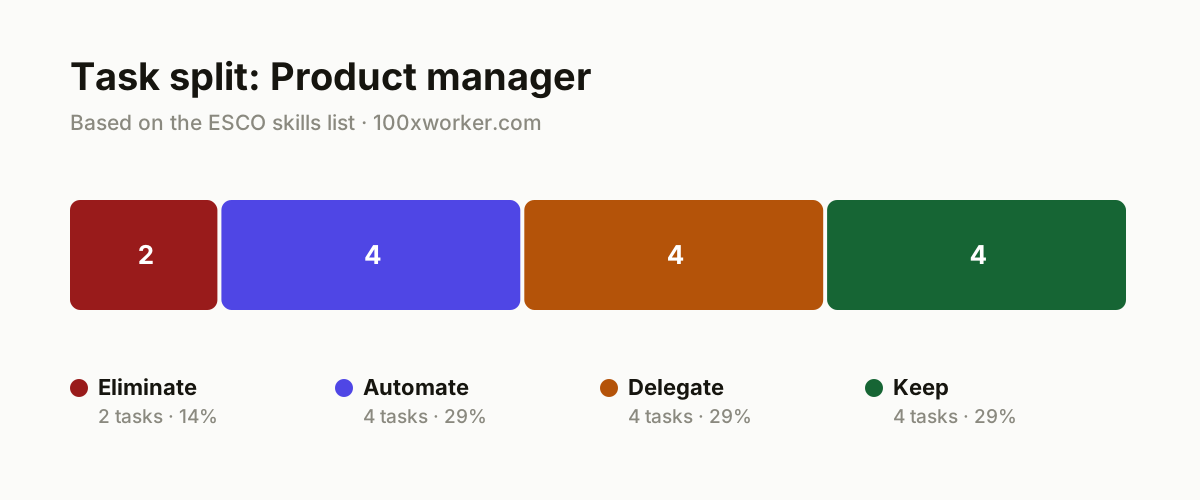
| Task | Bucket | Why |
|---|---|---|
| Manually collecting raw market research data (surveys, screenshots, spreadsheets stitched together by hand) | eliminate | AI scans and structures these sources instantly; doing this by hand adds no value anymore. |
| Manually tracking competitors in spreadsheets (pricing, features, reviews) | eliminate | Agents monitor this continuously and flag changes; nobody needs to update it by hand. |
| Drafting market research reports (gathering sources, synthesizing findings, first layout) | automate | An agent pulls sources and delivers a publish-ready summary with citations attached. |
| Clustering customer feedback and reviews into themes (analyzing buying trends) | automate | AI reads thousands of responses and groups them; no one has to do that manually. |
| Meeting notes and action items from customer calls and sprint reviews | automate | Transcription and action lists appear automatically, ready to share with the team. |
| Translating and localizing product documentation and release notes | automate | Agents handle this quickly and accurately, ready to publish right away. |
| Drafting business plans (first version: problem statement, market, business model) | delegate | AI builds the structure and numbers from your input; you check the assumptions. |
| Developing communication strategies (first concept for messaging and channel choice) | delegate | AI writes a first draft; you check it against brand and internal politics. |
| Building the product roadmap and an impact/effort prioritization matrix | delegate | AI scores features from data; you decide which bets are worth taking. |
| Developing promotional materials (first concepts for copy and visuals) | delegate | AI generates a starting point; you guard brand, tone, and legal limits. |
| Persuading stakeholders and defending internal priorities | keep | Negotiating with sales, engineering, and leadership takes trust and timing. (Your edge: Reading power dynamics and unwritten rules is not something AI can do.) |
| Running customer conversations for deep insight | keep | Context, hesitation, and body language are missing from a chat log; probing stays human work. (Your edge: Sensing what a customer actually means, unsaid.) |
| Defining technology strategy and making go/no-go calls | keep | You carry the final responsibility and the risk; no agent does that for you. (Your edge: Owning a mistake nobody saw coming.) |
| Guarding quality control at product launch | keep | Checking whether AI and team output truly meets the customer's need. (Your edge: The gut feeling that something still isn't right.) |
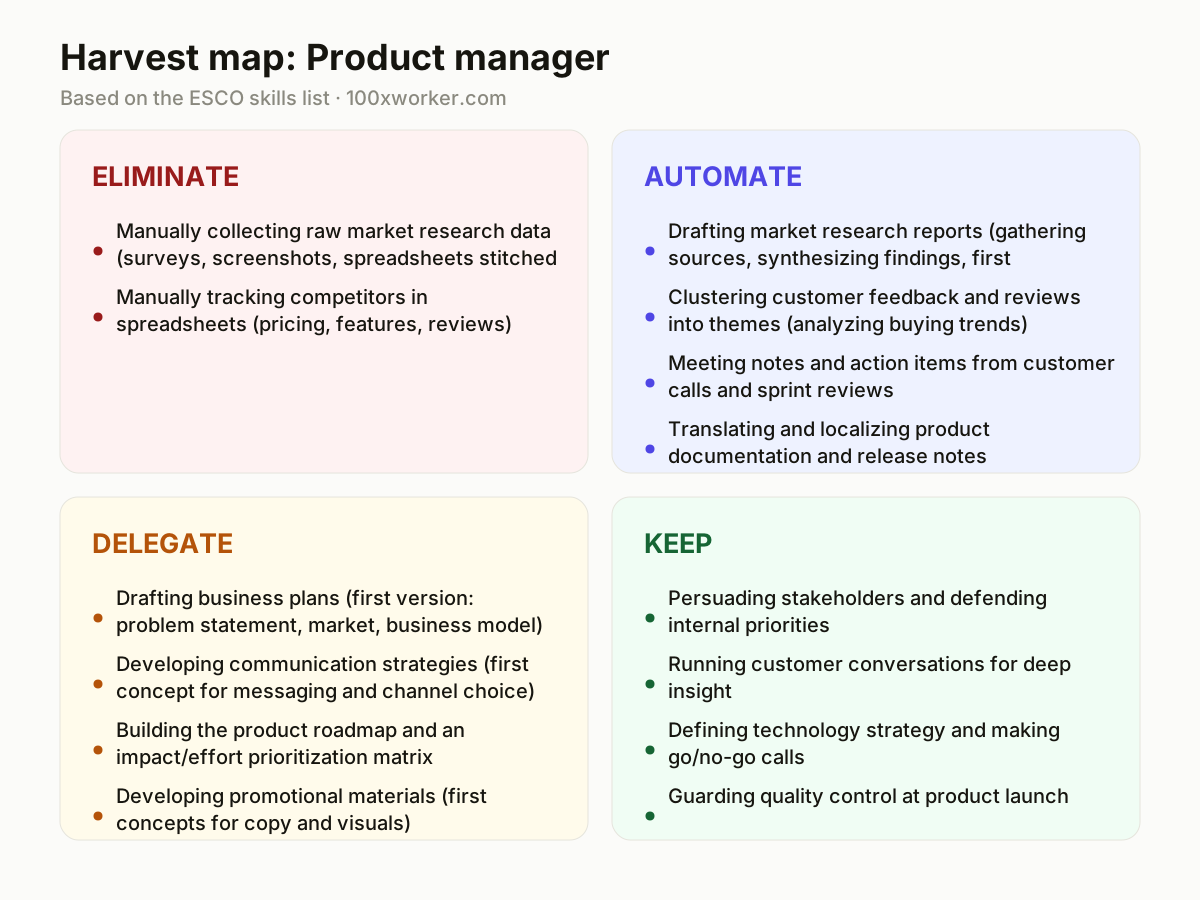
Which product manager tasks does AI take over?
AI takes over the tasks that involve gathering, structuring, and summarizing information. Competitor tracking, market research synthesis, feedback clustering, meeting notes, and document translation increasingly run through AI tools with little manual work left. These are the tasks in the eliminate and automate buckets: work that used to take hours of copying and pasting now happens in minutes, often with a first draft or summary ready before you open your laptop. What AI does not take over is the decision about what to do with that information, which is where product managers still earn their role.
Will AI replace product managers?
Full replacement looks unlikely based on current evidence. Microsoft Research's applicability score, built from 200,000 real Copilot conversations, measures how much a job's tasks overlap with what people actually use AI for, not whether the job disappears. Anthropic's Economic Index shows a similar pattern across occupations: AI use splits between automation (AI does the task) and augmentation (AI supports a person doing it), and product management leans toward augmentation because so much of the job is judgment, negotiation, and accountability. Older estimates like Frey and Osborne's 2013 Oxford study, often cited as 'automation risk percentages,' predate large language models and should be treated with caution.
How do you become the AI-savvy person on your product team?
Start by rebuilding your own task list using the ESCO skill descriptions for product managers (identifying market niches, analyzing trends, developing product designs, managing customer experience) and marking which ones AI can already draft. Then bring a working AI habit into team rituals: run competitor scans in a shared tool instead of a private spreadsheet, feed customer call transcripts into a shared summarizer, and show colleagues the prompt, not just the output. Being the AI-savvy person on a product team is less about knowing the newest tool and more about being the one who has already tested it on real work and can say what it got wrong.
What can you do this month to start using AI as a product manager?
Pick one recurring task from the automate bucket, most commonly meeting notes or competitor tracking, and set up a tool for it this week. Run it in parallel with your current manual process for two weeks, compare the outputs, then drop the manual version once you trust it. Next, take one delegate-bucket task, like a first roadmap draft, and have AI produce a version you edit rather than write from scratch. Track how much time you get back and use that time on stakeholder conversations, the part of the job least likely to be automated.
The applicability score reflects how much AI conversations overlap with an occupation's tasks, not whether that occupation is being replaced.
Microsoft Research, Working with AI (2025), paraphrased summary of the paper's framing
Become the AI person on your team
Turn your task list into an audit
List every recurring task from your calendar and to-do list for one month. Sort each one into eliminate, automate, delegate, or keep, using the ESCO skill list for product managers as a checklist so nothing gets missed.
Pilot before you roll out
Test one AI tool on one task for two weeks before recommending it to the wider team. Bring a before/after example to your next team meeting instead of a general pitch about AI.
Document what AI gets wrong
Keep a short running list of where AI drafts miss context, get facts wrong, or misread tone. This list becomes your case for where human review stays mandatory, and it is more convincing than a general policy.
Want this for your actual task list?
The free scan on the homepage builds your personal task map in 30 seconds, based on your role and industry.
Run the free task scanTools for this work
| Tool | For which tasks | The sober take |
|---|---|---|
| ChatGPT or Claude | Market research synthesis, feedback clustering, business plan and roadmap first drafts | Useful for a first draft; the market judgment call still has to be yours. |
| Otter.ai or Fireflies.ai | Meeting transcription and action items from customer calls and sprint reviews | Cuts note-taking time but still needs a human check on what actually got decided. |
| DeepL | Translating and localizing product documentation and release notes | Fast and generally accurate for standard product text, less reliable for nuanced marketing copy. |
| Perplexity | Competitor tracking and quick market research lookups | Good for a fast overview; always verify pricing and feature claims against the source. |
| Notion AI or Productboard | Roadmap drafts and impact/effort prioritization matrices | Helps structure a first version; the prioritization decision stays with the product manager. |
Prompts to try today
Cluster customer feedback into themes
First-draft roadmap prioritization
Meeting notes to action items
Related jobs
Frequently asked questions
Does AI replace the product manager role entirely?
No evidence in current research supports that. Microsoft Research's applicability score and Anthropic's Economic Index both measure overlap between AI conversations and job tasks, not job elimination. Product management leans toward tasks Anthropic classifies as augmentation, where AI supports a person rather than replacing them, because so much of the job depends on negotiation, judgment, and accountability that current AI systems do not carry.
Which AI tool should a product manager try first?
Start with a general chat assistant like ChatGPT or Claude for research synthesis and first drafts, since it covers the widest range of automate and delegate tasks with the least setup. Add a specialized tool, such as a meeting transcriber or a translation tool, once you know which recurring task actually costs you the most time each week.
Is the old 'robotization percentage' for product managers still accurate?
No. The commonly cited automation-risk percentages trace back to Frey and Osborne's 2013 Oxford study, published years before large language models existed. It measured a different kind of automation risk (physical and rule-based tasks) and does not reflect how generative AI is actually used in knowledge work today. Newer sources like Microsoft Research and Anthropic's Economic Index are built on real AI usage data instead.
How is AI use for product managers actually measured?
There is no single official percentage for product managers specifically. Microsoft Research's applicability score is built from 200,000 real Copilot conversations mapped to occupational tasks. Anthropic's Economic Index classifies Claude conversations against the O*NET task taxonomy and splits results into automation-like and augmentation-like use. Both are conversation-based measures of current AI use, not predictions of job loss.
Sources
- Microsoft Research, Working with AI: Measuring the Applicability of Generative AI to Occupations (2025)
- Anthropic Economic Index
- Eurostat, isoc_ai_iaiu
- ESCO, European Commission
Hendrik De Winne, author of Becoming AI-Savvy, founder of VibeLab. Helps teams redesign their work with AI.
This article was drafted with AI assistance from public data sources and editorially reviewed.