100×worker · job analysis
Will AI Replace Communications Officers?
Communications officers spend a lot of their week on tasks that generative AI now does reasonably well: first drafts, translations, meeting notes, media scans. That does not mean the role disappears. Microsoft Research analyzed 200,000 real Copilot conversations and scored occupations by how much of their daily work generative AI can plausibly touch. Public relations managers, the closest occupational match to communications officer, land at 22.2% applicability. For comparison, translators score highest at 49%, and registered nurses score low at 12%.
That number describes exposure, not extinction. Anthropic's Economic Index, which classifies millions of Claude conversations against the O*NET task taxonomy, splits AI use into two kinds: automation-like use, where AI does the task outright, and augmentation-like use, where a person stays in the loop and directs the work. Most communications work falls into the second category, at least for now.
The practical question is not whether AI will replace communications officers, since it will not do that outright. The practical question is which specific tasks on your calendar this month can be eliminated, automated, or handed off, so you can spend more time on the parts of the job that still need a person: crisis response, relationships with press and leadership, and strategic calls that depend on knowing your organization from the inside.
A communications officer aligns an organization's internal and external messages and protects its reputation.
The task split: what AI takes over and what stays yours
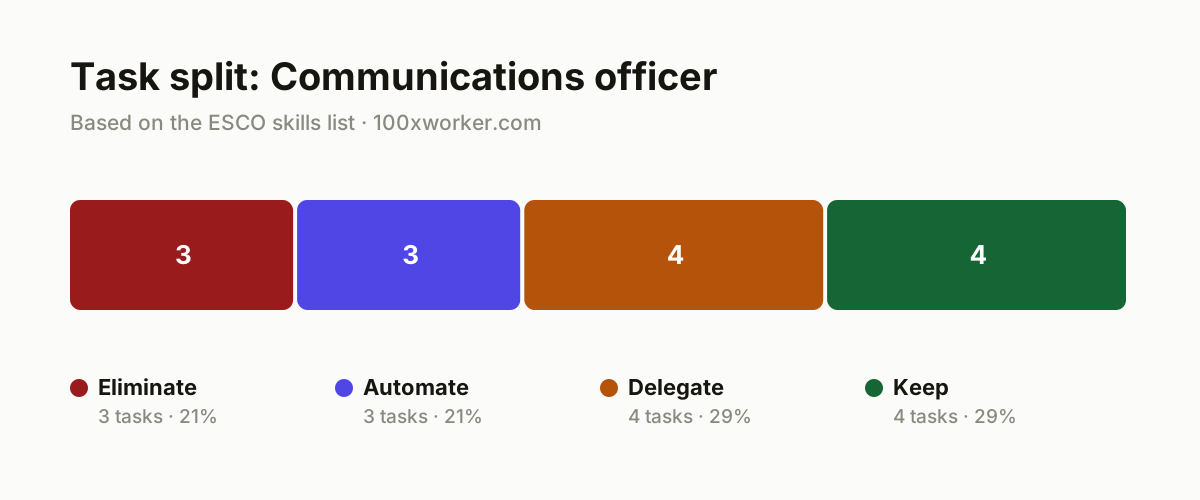
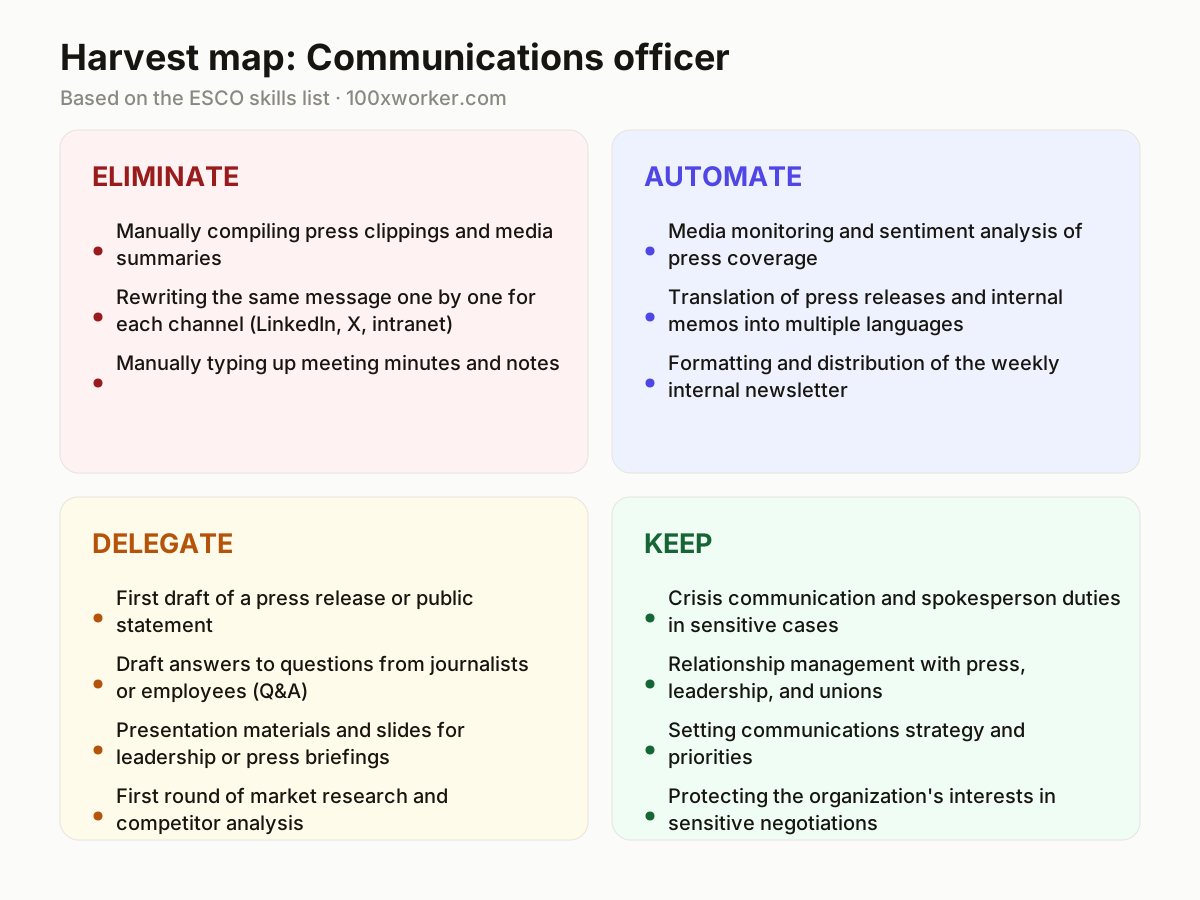
We sort a communications officer's tasks into four buckets. Eliminate: tasks AI already does well enough that doing them manually is a waste of time. Automate: tasks a tool or workflow can run with little to no supervision. Delegate: tasks where AI produces a usable first version that you still need to check and finish. Keep: tasks that stay with a person because they require judgment, trust, or accountability that no model can carry.
| Task | Bucket | Why |
|---|---|---|
| Manually compiling press clippings and media summaries | eliminate | Monitoring tools scan media continuously and automatically filter by brand name, topic, or competitor. |
| Rewriting the same message one by one for each channel (LinkedIn, X, intranet) | eliminate | Generative tools turn one core message into channel-specific versions with the right length instantly. |
| Manually typing up meeting minutes and notes | eliminate | Transcription and summarization tools deliver a usable summary within minutes after the meeting ends. |
| Media monitoring and sentiment analysis of press coverage | automate | Agents track mentions around the clock and flag spikes or a negative tone automatically. |
| Translation of press releases and internal memos into multiple languages | automate | Translation models score highest of all occupational tasks measured, at 49% applicability per Microsoft Research. |
| Formatting and distribution of the weekly internal newsletter | automate | Fixed templates and distribution lists can be run end-to-end through workflow automation tools. |
| First draft of a press release or public statement | delegate | AI produces a full first version from the facts you supply, you rewrite the sharp edges and check tone. |
| Draft answers to questions from journalists or employees (Q&A) | delegate | A language model builds a consistent Q&A based on prior positions, you check nuance and legal risk. |
| Presentation materials and slides for leadership or press briefings | delegate | AI turns a message into structure and slides, you handle the final direction and delivery. |
| First round of market research and competitor analysis | delegate | AI summarizes public sources into a working overview, you test it against what you know internally. |
| Crisis communication and spokesperson duties in sensitive cases | keep | Every word and every second of timing matters, with real consequences for reputation and trust. (Your edge: Only a person carries final responsibility and legal risk in a crisis.) |
| Relationship management with press, leadership, and unions | keep | Trust builds in real conversations over years, not through generated text. (Your edge: Trust only forms through personal, repeated contact.) |
| Setting communications strategy and priorities | keep | Strategic choices depend on internal politics and long-term goals a model has no access to. (Your edge: You know the internal dynamics, a language model does not.) |
| Protecting the organization's interests in sensitive negotiations | keep | Diplomacy and weighing competing interests require experience and standing within the organization. (Your edge: Authority and experience outweigh anything a model generates.) |
Which tasks of a communications officer does AI take over?
AI takes over the repetitive, format-heavy parts of the job first: compiling press clippings, rewriting one message for five channels, and typing up meeting notes. It also handles translation of press releases and memos into multiple languages, where models score their highest applicability of any occupational task measured by Microsoft Research (49%). Media monitoring and sentiment tracking run largely unattended once set up. What AI does not take over is anything requiring judgment about tone, risk, or internal politics. Drafting still needs a person to finish it.
Will AI replace communications officers?
Full replacement is unlikely with current tools. Microsoft Research scores public relations managers, the closest match to communications officer, at 22.2% applicability of generative AI to their daily tasks. That leaves the majority of the job, including crisis response, relationship building, and strategic judgment, in human hands. Anthropic's Economic Index shows most professional AI use is augmentation, meaning a person directs the tool, rather than automation, meaning the tool runs unsupervised. The job changes shape. It loses drafting, translation, and monitoring work, and keeps everything that depends on trust, timing, and accountability.
What can you do this month to become the AI person on your team?
Pick one recurring task, such as the weekly newsletter or media monitoring, and set up a tool or workflow to run it with minimal input from you. Build a short internal guide showing colleagues how you draft press statements with AI and what you always check by hand afterward. Offer to run the first AI-assisted Q&A prep for the next leadership briefing. Document which prompts and tools actually saved time, so you have concrete examples when your manager asks how the team's work is changing.
How much of a communications officer's work is automatable according to research?
Microsoft Research's applicability score for public relations managers, the closest occupational match, is 22.2% of daily work activities, based on an analysis of 200,000 real Copilot conversations. That figure describes where generative AI can plausibly assist, not where jobs disappear. Translators score highest of all occupations at 49%, registered nurses score low at 12%, which shows how much this varies by field. For communications work, the automatable share concentrates in drafting, translation, and monitoring, not in strategy, negotiation, or crisis response.
Generative AI is applicable to about a fifth of the daily tasks that make up work like public relations and communications management.
Microsoft Research, Working with AI (2025)
Become the AI person on your team
Turn one core message into a channel kit
Write the core message once, then use a generative tool to produce the LinkedIn post, the intranet version, and the press quote in one pass. Keep a shared template so colleagues stop rewriting from scratch every time.
Automate the media scan, keep the judgment call
Set up a monitoring tool to flag mentions and sentiment shifts automatically, then spend your time deciding which flags actually need a response. Share the weekly digest with leadership so they see the pattern, not just the raw feed.
Draft Q&A prep before the pressure hits
Feed a language model your organization's prior public statements and ask it to draft likely journalist or employee questions with answer options. Review and tighten the risky ones yourself before any briefing goes out.
Want this for your actual task list?
The free scan on the homepage builds your personal task map in 30 seconds, based on your role and industry.
Run the free task scanTools for this work
| Tool | For which tasks | The sober take |
|---|---|---|
| ChatGPT or Claude | First drafts of press releases, Q&A prep, presentation structure | Useful for a fast first version, but every public-facing line still needs your review. |
| DeepL | Translation of press releases and internal memos | Solid for straightforward translation, less reliable for idiom or legal nuance. |
| Otter.ai or Microsoft Teams transcription | Meeting minutes and notes | Cuts note-taking time sharply, but someone still needs to check names and decisions. |
| Meltwater or Brandwatch | Media monitoring and sentiment analysis | Good at flagging volume and tone shifts, weak at judging whether a mention actually matters. |
| Canva or Microsoft Designer | Presentation materials and slides | Speeds up layout work, but the story and emphasis still come from you. |
Prompts to try today
First draft of a press statement
Q&A prep for a briefing
Channel adaptation of one core message
Related jobs
Frequently asked questions
Which part of a communications officer's job is safest from AI?
Crisis communication, spokesperson duties, and relationship management with press and leadership are safest. These require accountability, trust built over time, and split-second judgment calls that carry real reputational and sometimes legal consequences. Anthropic's Economic Index shows most professional AI use in this space is augmentation, where a person directs the tool, rather than full automation. Strategic decisions about messaging priorities also stay human, since they depend on internal politics and long-term goals a model cannot access.
Do I need to learn to code or use complex AI tools?
No. Most useful AI tools for communications work, like ChatGPT, DeepL, or transcription apps, need only plain-language instructions, not coding. The skill that matters most is writing a clear prompt with enough context, and then knowing what to check before you publish anything the model produces. Treat AI output the way you would treat a junior colleague's draft: useful as a starting point, never final without your review.
How reliable is the 22.2% applicability figure for my specific job?
The figure comes from Microsoft Research's analysis of Copilot conversations, mapped to the U.S. occupational category closest to communications officer, public relations managers. It is a research estimate of task exposure, not a measured productivity gain or a prediction of job loss, and country-specific roles can differ from the U.S. occupational average it is based on. Treat it as a directional signal about where AI is likely to matter most in this role, not an exact figure for your organization.
How widely is generative AI actually used at work right now?
Adoption varies by region and use case. Eurostat reports that 32.7% of the EU population aged 16 to 74 used generative AI in the three months before being surveyed in 2025. That figure covers all uses, not just workplace communications tasks, but it shows generative AI has moved well past early adopters into mainstream use across Europe.
Sources
- Microsoft Research, Working with AI: Measuring the Applicability of Generative AI to Occupations (2025)
- Anthropic Economic Index
- Eurostat, isoc_ai_iaiu
- ESCO, European Commission occupation taxonomy
Hendrik De Winne, author of Becoming AI-Savvy, founder of VibeLab. Helps teams redesign their work with AI.
This article was drafted with AI assistance from public data sources and editorially reviewed.