100×worker · job analysis
Will AI Replace PR Officers, and What Should You Do About It?

A PR officer, also called a spokesperson, publicist, or press officer, speaks on behalf of a company or organization. The European Commission's ESCO taxonomy lists the role among 3,039 occupations described across the EU, with core skills covering media relations, public speaking, drafting press materials, and protecting a client's interests in public.
Generative AI already touches a meaningful slice of that work. Microsoft Research analyzed 200,000 real Copilot conversations and scored each occupation by how much of its work generative AI demonstrably supports. Public relations specialists came in at 36.5%, below translators (49%) but well above nurses (12%). That number points to where AI reaches deep, into drafting and research, and where it doesn't, into judgment calls made under pressure.
Anthropic's Economic Index, which classifies millions of Claude conversations against standardized O*NET task lists, finds a similar split between automation-like use (AI does the task) and augmentation-like use (AI speeds up a person doing it). For PR work, most usage falls into the second category. Across the EU, 32.7% of people aged 16 to 74 used generative AI in the last three months of 2025, according to Eurostat, so the tools a PR officer reaches for are now mainstream, not a lab experiment.
A PR officer runs communication strategies on behalf of an organization to protect and promote its reputation and interests.
The task split: what AI takes over and what stays yours
Not every task in a PR officer's job is affected equally by AI. Sorting the work into four buckets, eliminate, automate, delegate, and keep, shows where tools take over completely, where they run with light supervision, where you stay in charge of a human-AI split, and where your judgment and presence can't be substituted. This mirrors how the Microsoft applicability score works: it measures work activities, not entire jobs.
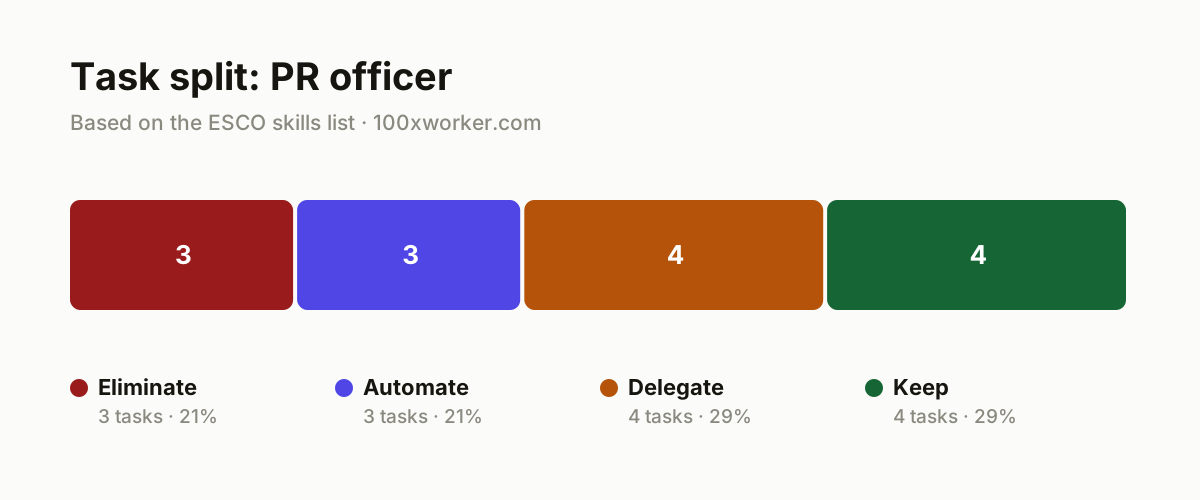
| Task | Bucket | Why |
|---|---|---|
| Typing press releases from a blank page | eliminate | AI generates a usable first draft in seconds from your briefing and house style. |
| Manually cutting and pasting media coverage into a report | eliminate | Monitoring tools collect and cluster coverage automatically, no one has to chase it down. |
| Transcribing interviews and press conferences word for word | eliminate | Transcription tools deliver a usable text within minutes, clean enough for a first read. |
| First draft of a press release or public statement | automate | An AI agent turns facts, quotes, and key messages into a structured, publication-ready draft. |
| Daily media roundup with tone and reach per channel | automate | Automated summaries show what's happening each morning, no manual scanning required. |
| FAQ and Q&A documents for spokespeople on an active issue | automate | Based on past communication and known facts, AI drafts a consistent question-and-answer set. |
| Speech and presentation drafts for a spokesperson | delegate | AI writes the first 80%, you rewrite tone, nuance, and the sensitive lines. |
| Crisis communication scenarios and worst-case messaging | delegate | AI assembles scenarios and message lines, you decide which one holds up under pressure. |
| Analysis of external factors and public opinion around an issue | delegate | AI processes large volumes of coverage into a pattern, you draw the strategic conclusion. |
| Drafting a communication strategy for a campaign | delegate | AI structures goals, audiences, and channels, you test it against the organization's culture. |
| Giving live interviews and press conferences | keep | A journalist asks unexpected questions, that demands improvisation and authority in the room. (Your edge: No one trusts an AI voice in a live crisis.) |
| Building relationships with journalists and newsrooms | keep | Trust grows from years of personal contact, not a generated email. (Your edge: Trust is personal and grows slowly.) |
| Making diplomatic calls during a crisis or conflict of interest | keep | Choosing the right tone between honesty and protecting the client takes experience. (Your edge: The risk stays your responsibility, not the model's.) |
| Public presentations and appearances | keep | Presence, timing, and reading the room decide whether a message lands. (Your edge: Charisma doesn't come out of a prompt.) |
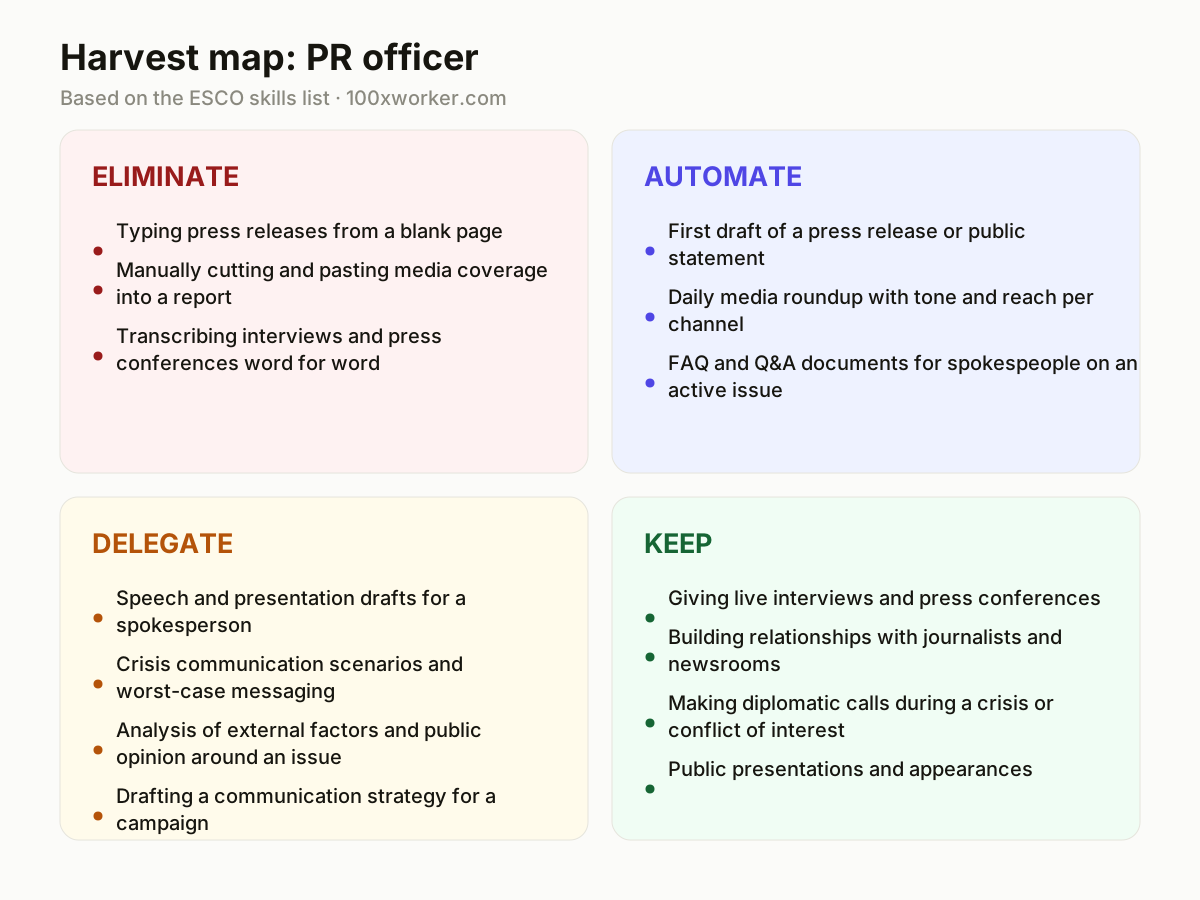
Which PR officer tasks does AI take over?
AI takes over the mechanical front end of the job: blank-page drafting, transcription, and manual media scanning. Give it a briefing and house style, and a tool produces a workable press release draft in seconds. Monitoring platforms cluster coverage automatically instead of someone scrolling through alerts. Transcription tools turn a recorded interview into readable text within minutes. None of this is new technology in concept, but generative models make the output usable without heavy cleanup, which is why these tasks move from something you do daily to something you check.
Will AI replace PR officers?
No. Microsoft Research's applicability score puts public relations specialists at 36.5%, meaning roughly a third of the work activities in the role are places where generative AI demonstrably helps. That leaves most of the job, live interviews, journalist relationships, crisis judgment, and diplomatic calls, outside AI's reach. ESCO's skill list for the role centers on relationship building, rhetoric, and protecting a client's interests in public, none of which a model can carry out on its own. The job changes shape. It doesn't disappear.
How do you become the AI power user of the PR team?
Start by treating AI as the person who writes your first drafts, not your final ones. Feed it your past press releases, tone guidelines, and known facts about a topic, and let it produce the FAQ, the media summary, or the speech skeleton. Keep your own hands on anything that will be quoted back to you: the sensitive sentence in a crisis statement, the line a journalist will pull out of context. Build a habit of checking AI-drafted text against your organization's actual voice before it goes anywhere near a client or a reporter.
What can you actually do this month with AI as a PR officer?
Pick one recurring task and automate it fully this month, most teams start with the daily media roundup or the first-draft press release. Set up a monitoring tool that clusters coverage automatically so mornings start with a summary instead of a manual scan. Draft one crisis communication scenario using AI to generate the message options, then run the human decision of which line to use. Track how much drafting time you save over four weeks before touching anything higher-stakes, like a client-facing strategy document.
The applicability score measures the share of work activities where generative AI is demonstrably useful, based on 200,000 real conversations, not whole jobs replaced.
Microsoft Research, Working with AI: Measuring the Applicability of Generative AI to Occupations (2025)
Become the AI person on your team
Build a house-style prompt library
Save your organization's tone, banned phrases, and standard disclaimers as a reusable prompt template. Every draft an AI tool produces starts closer to your actual voice, which cuts editing time on press releases and Q&A documents.
Automate the morning media scan
Set a monitoring tool to deliver a clustered summary of coverage by channel and tone before you open your inbox. This replaces the manual clip-and-paste roundup and frees the first hour of the day for judgment work.
Run crisis scenarios before you need them
Use AI to draft two or three worst-case messaging scenarios for an active issue, then have the team stress-test each one. This turns crisis prep from a blank-page exercise into a review exercise, which is faster under real pressure.
Want this for your actual task list?
The free scan on the homepage builds your personal task map in 30 seconds, based on your role and industry.
Run the free task scanTools for this work
| Tool | For which tasks | The sober take |
|---|---|---|
| ChatGPT or Claude | Press release drafts, speech drafts, FAQ documents | Useful for a fast first draft, still needs a human edit before anything goes out. |
| Media monitoring platforms (e.g. Meltwater, Cision) | Daily media roundups, coverage clustering | Cuts the manual scanning task but still needs someone to judge what's actually significant. |
| Otter.ai or similar transcription tools | Transcribing interviews and press conferences | Fast and mostly accurate, but names and technical terms often need a manual check. |
| Perplexity or a similar research assistant | Analysis of external factors and public opinion | Good for gathering sources quickly, the strategic read still comes from you. |
Prompts to try today
First-draft press release
Crisis Q&A builder
Media coverage pattern check
Related jobs
Frequently asked questions
Is 36.5% a high or low AI applicability score for PR officers?
It sits in the middle of Microsoft Research's occupation ranking. Translators score highest at 49%, and nurses score lowest at 12%. A 36.5% score means a meaningful chunk of the daily work, mostly drafting, research, and monitoring, is a place where generative AI already helps, while the core relationship and crisis-judgment work stays outside that reach.
Which AI tools should a PR officer start with?
Start with a general chat tool like ChatGPT or Claude for drafting press releases, speeches, and FAQ documents. Add a media monitoring platform for the daily coverage scan and a transcription tool for interviews. None of these replace judgment calls, they replace the mechanical steps that used to eat the first hour of your day.
Does AI change what skills matter most for PR officers?
Yes. ESCO's skill list for the role, media relations, rhetoric, diplomacy, protecting a client's interests, doesn't shrink, it becomes the differentiator. When AI handles drafting and monitoring, the skills that decide whether you're good at the job are the ones AI can't touch: reading a room, holding a line under a journalist's questions, and building trust over years.
How is AI adoption in PR different from other office jobs?
Anthropic's Economic Index finds that across occupations, most AI use is augmentation (speeding up a person) rather than full automation (replacing a task outright). PR work fits that pattern closely: the visible AI use is drafting help and research, not autonomous decision-making. Eurostat data shows 32.7% of the EU population already used generative AI in late 2025, so PR officers are adopting tools that are already mainstream in the wider workforce.
Sources
- Microsoft Research, Working with AI: Measuring the Applicability of Generative AI to Occupations (2025)
- Anthropic Economic Index
- Eurostat, isoc_ai_iaiu (generative AI use, 2025)
- ESCO, European Commission occupation taxonomy
Hendrik De Winne, author of Becoming AI-Savvy, founder of VibeLab. Helps teams redesign their work with AI.
This article was drafted with AI assistance from public data sources and editorially reviewed.