100×worker · job analysis
Will AI Replace Bank Advisors?
Bank advisors spend their days moving between paperwork, compliance checks, and conversations with clients about money. Generative AI is already sitting inside a good chunk of that work. Microsoft Research analyzed 200,000 real conversations with its Copilot assistant and scored occupations by how much of their task list AI can plausibly handle. Personal financial advisors, the closest US occupation to a bank account manager, scored 35.5%. That places advisors in the middle of the pack, well above nurses at 12% but far below translators at 49%, the highest-scoring occupation in the study (Microsoft Research, 2025).
That number does not mean a third of advisor jobs disappear. Anthropic's Economic Index, which classifies millions of Claude conversations against the O*NET task framework, splits AI use into automation, where AI does a task end to end, and augmentation, where AI assists a person who stays in charge. For a role built on trust, most of the applicable tasks fall into the second category.
Adoption is already widespread. Across the EU, 32.7% of people aged 16 to 74 used generative AI in the past three months in 2025, according to Eurostat. Clients are showing up to meetings having already asked a chatbot about mortgage rates or savings products.
A bank advisor guides clients on accounts and financial products while AI handles routine paperwork.
The task split: what AI takes over and what stays yours
Not every task in a bank advisor's job responds to AI the same way. Some tasks disappear because software already does them better. Some get automated end to end, with a human checking the output. Some stay split between a machine draft and a human decision. And some tasks stay fully human because they involve trust, judgment, or responsibility that cannot be delegated. Sorting the job this way, task by task rather than job by job, is the approach ESCO uses to describe over 3,000 occupations across Europe, and it is the same lens this article applies to bank advisors.
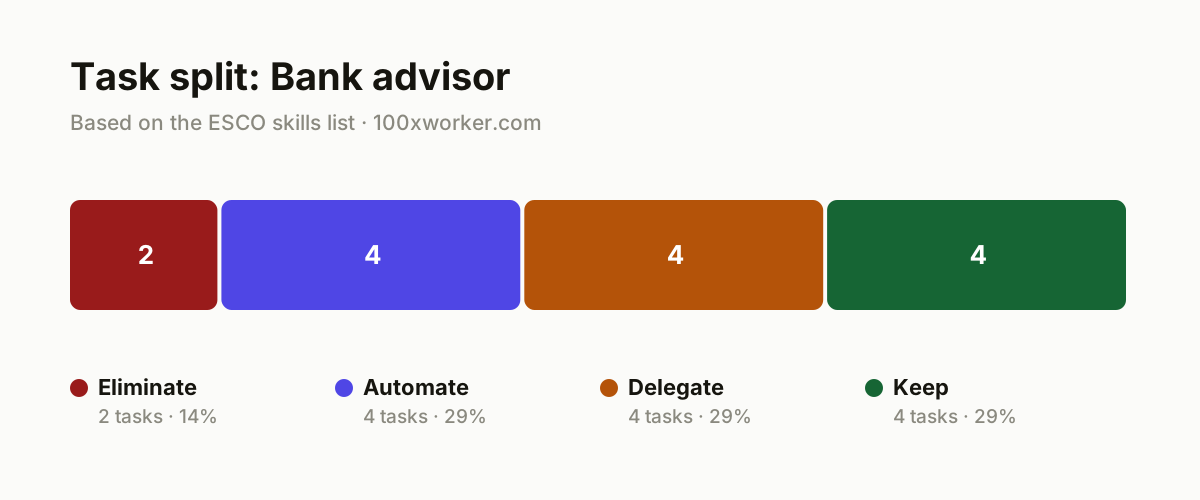
| Task | Bucket | Why |
|---|---|---|
| Manually retyping client details when opening an account | eliminate | Digital onboarding and document recognition do this faster and with fewer errors than manual entry. |
| Repeating basic product information (interest rates, terms, opening hours) | eliminate | Clients already find this in the banking app, website, or chatbot before they reach you. |
| Checking documents when opening a bank account (KYC checks) | automate | An AI agent matches submitted documents against internal rules and flags anything unusual for you. |
| Drafting standard letters and confirmation emails after a client meeting | automate | Filling in fixed templates from meeting content is exactly what an AI agent does well. |
| Summarizing client conversations in the CRM | automate | Transcription plus summary is repetitive work a tool handles more consistently than handwritten notes. |
| Producing a first rough read of a company's annual accounts | automate | Calculating and listing financial ratios is mechanical work for a tool, not an advisory decision. |
| Drafting a first version of a client's financial plan | delegate | AI generates options from client data, you choose, refine, and take responsibility for the final plan. |
| Analyzing a company's financial performance for a loan application | delegate | AI spots patterns in the numbers, you weigh context, sector, and relationship in the final advice. |
| Preparing advice on the right account type or product mix | delegate | AI lists possible options, you choose what fits the client's situation and risk appetite. |
| Running a first compliance and risk check on a file | delegate | AI checks against company standards and financial policy, you decide on borderline cases. |
| Protecting the client's interests in sensitive or complex decisions | keep | Trust and legal responsibility sit with a person, not a model. (Your edge: Taking responsibility is not a task you outsource) |
| Resolving account complaints and problems once they escalate | keep | Angry or anxious clients need adaptability that a script cannot offer. (Your edge: Empathy in a tense conversation is human work) |
| Negotiating with managers for exceptions to policy | keep | Internal relationships and a feel for what is achievable stay human skills. (Your edge: Organizational instinct is built, not automated) |
| Making ethical calls in advisory decisions | keep | Responsible business conduct requires judgment that goes beyond applying rules. (Your edge: You ask yourself the hard question, not a model) |
What tasks will AI take over from bank advisors?
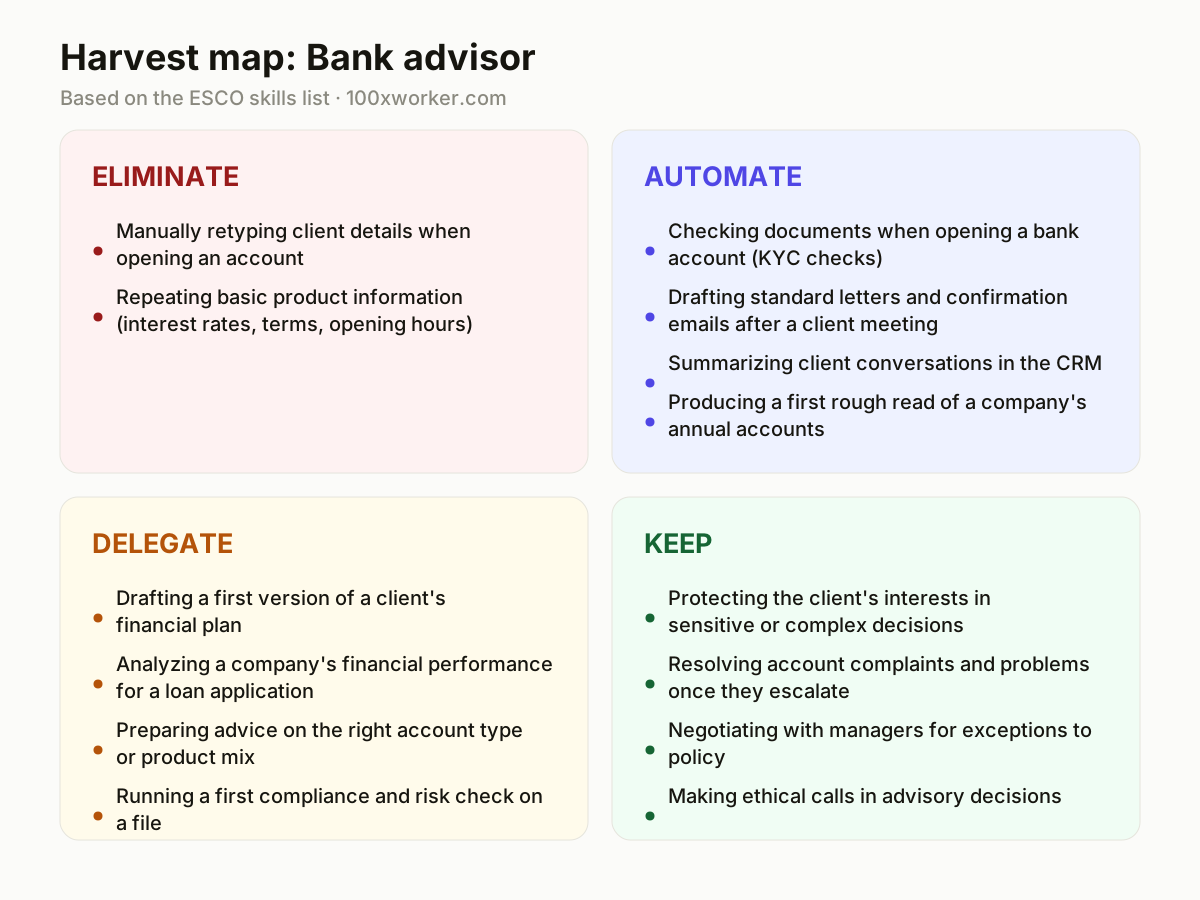
AI takes over the mechanical parts of the job first. Retyping client details during account opening and repeating standard product information are already handled by onboarding software, bank apps, and chatbots. Beyond that, AI agents can run KYC document checks, draft standard confirmation letters and follow-up emails, summarize client meetings straight into the CRM, and produce a first rough read of a company's annual accounts. None of these are advisory decisions. They are the paperwork and pattern-matching around advice, which is exactly what Microsoft Research finds generative AI applies to across roughly a third of a financial advisor's task list.
Will AI replace bank advisors?
No single number says a bank advisor's job is safe or at risk. Microsoft Research puts AI applicability for personal financial advisors, the closest US match, at 35.5% of work activities, roughly in the middle among analyzed occupations. That is a task-level figure, not a headcount forecast. Anthropic's Economic Index shows that in most advisory-adjacent work, AI use skews toward augmentation, a person staying in charge while AI drafts or checks, rather than full automation. The job title likely survives; the daily task list does not. Advisors who let AI handle documentation, drafting, and first-pass analysis, while keeping client trust and judgment calls, are the ones whose role holds up.
How do you become the AI-savvy person in your branch?
Start by mapping your own week against the four buckets: what you already eliminate, what you could automate with a document or summary tool, what you could delegate as a draft for AI to produce and you to check, and what must stay yours. Pick one recurring task, such as meeting summaries or first-draft financial plans, and run it through an AI tool for two weeks before trusting it on real client files. Share what works with colleagues instead of keeping it to yourself. Being the AI-savvy person in a branch is less about knowing every tool and more about being the one who has already tested what breaks and what holds up.
What can you do this month as a bank advisor?
Pick one task from the automate bucket, most likely meeting summaries or standard confirmation letters, and test an AI tool on it for two weeks, checking every output against what you would have written yourself. Ask your compliance team which AI tools are already approved for use with client data, since KYC and financial documents are sensitive. Keep a short log of where AI drafts save you time and where they get client details wrong. By month's end, you should know exactly which parts of your task list are safe to hand off and which still need your full attention.
Across 200,000 real Copilot conversations, generative AI proves applicable to more than a third of the tasks personal financial advisors perform.
Microsoft Research, Working with AI (2025)
Become the AI person on your team
Map your task list before adopting any tool
Write down everything you do in a typical week and sort it into eliminate, automate, delegate, and keep. This takes an hour and tells you where AI actually helps instead of guessing from a vendor pitch.
Run a two-week pilot on one task
Pick meeting summaries or first-draft financial plans and test an AI tool against your own output for two weeks. Compare accuracy and time saved before rolling it out to other tasks.
Keep the compliance conversation open
KYC documents and client financial data are sensitive, so loop in compliance before feeding files into any AI tool. This protects both the client and you if something goes wrong.
Practice explaining AI-assisted advice to clients
Clients increasingly arrive having already asked a chatbot about their options. Being able to explain what AI drafted, and why you changed it, builds more trust than pretending the draft came from you alone.
Want this for your actual task list?
The free scan on the homepage builds your personal task map in 30 seconds, based on your role and industry.
Run the free task scanTools for this work
| Tool | For which tasks | The sober take |
|---|---|---|
| Microsoft Copilot | Meeting summaries in the CRM, drafting confirmation letters and emails | The same assistant Microsoft used to score occupational task applicability, including financial advisor tasks. |
| Claude or ChatGPT | First-draft financial plans, rough reads of annual accounts | Useful for drafting; a human still checks numbers and final recommendations. |
| KYC document verification software | Checking submitted documents against compliance rules during account opening | Flags mismatches for a human to review rather than approving accounts on its own. |
| CRM with built-in AI summarization | Summarizing client conversations, logging next steps | Cuts manual note-taking but still needs a quick human check for accuracy. |
Prompts to try today
Draft a first-pass financial plan
Summarize a client meeting for the CRM
First-pass read of annual accounts
Related jobs
Frequently asked questions
Will AI take my job as a bank advisor?
Not in the sense of the job title disappearing. Microsoft Research finds generative AI applicable to about 35.5% of a personal financial advisor's tasks, the closest US equivalent, which leaves most client-facing judgment, compliance responsibility, and complaint handling with a human. Expect your task list to shrink and shift toward checking AI output and handling complex cases, rather than your job vanishing outright.
Which parts of my job are safest from AI?
Tasks that involve protecting a client's interests in a sensitive decision, resolving escalated complaints, negotiating exceptions with managers, and making ethical calls stay with you. These require trust, legal accountability, and judgment that current AI tools are not built to own, even when they can draft supporting material.
How fast is AI adoption moving in this field?
Fast enough to matter now. In 2025, 32.7% of the EU population aged 16 to 74 had used generative AI in the past three months, according to Eurostat. Clients are already using chatbots to research products before meetings, which changes what they expect from a conversation with you.
Do I need to learn to code or use complex AI tools?
No. Most of the relevant tools are chat-based assistants, like Copilot, Claude, or ChatGPT, or features built into your existing CRM and document systems. The skill that matters more is knowing which of your tasks to hand to AI, which to check carefully, and which to keep fully yours.
Sources
- Microsoft Research, Working with AI: Measuring the Applicability of Generative AI to Occupations (2025)
- Anthropic Economic Index
- Eurostat, isoc_ai_iaiu
- ESCO (European Commission)
Hendrik De Winne, author of Becoming AI-Savvy, founder of VibeLab. Helps teams redesign their work with AI.
This article was drafted with AI assistance from public data sources and editorially reviewed.