100×worker · job analysis
Will AI Replace Property Managers, and What Should You Do About It?
Property managers handle rent collection, contractor oversight, owner meetings, and reserve fund planning. Most of that work involves documents and numbers, which makes it a natural target for generative AI. But the size of that target is smaller than headlines suggest.
Microsoft Research analyzed 200,000 real Copilot conversations across occupations and scored each one on an 'AI applicability' scale. Property, Real Estate, and Community Association Managers landed at 13.9%, well below translators (49%) but above nurses (12%). That number describes a share of tasks, not a share of jobs. Anthropic's Economic Index, which classifies millions of Claude conversations against standardized occupational task lists, finds a similar pattern across professions: AI shows up more as augmentation (helping with a task) than full automation (replacing it).
This article breaks the property manager role into four buckets: tasks AI eliminates outright, tasks it automates end to end, tasks you delegate to AI and then check, and tasks that stay firmly with you. The goal is not to guess whether 'AI will take the job.' It is to see, task by task, what already changed.
A property manager oversees a building's operations, finances, and tenant or owner relations on behalf of its owners.
The task split: what AI takes over and what stays yours
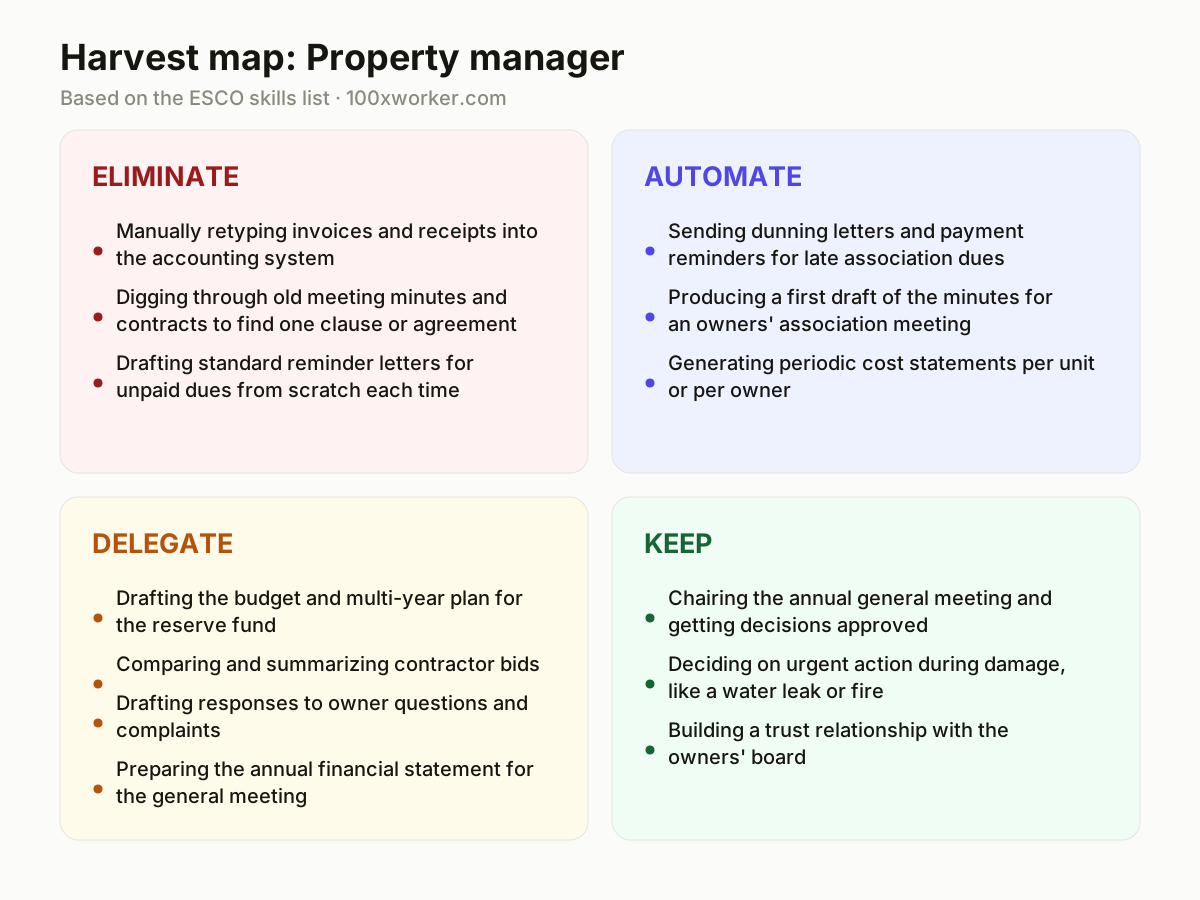
Instead of asking whether AI replaces property managers, break the role into its actual tasks. Some tasks disappear because software now does them without anyone asking. Some run automatically once you set them up. Some you hand to an AI tool but still review and sign off on. And some stay entirely yours, because they depend on judgment, trust, or legal responsibility that no model carries.
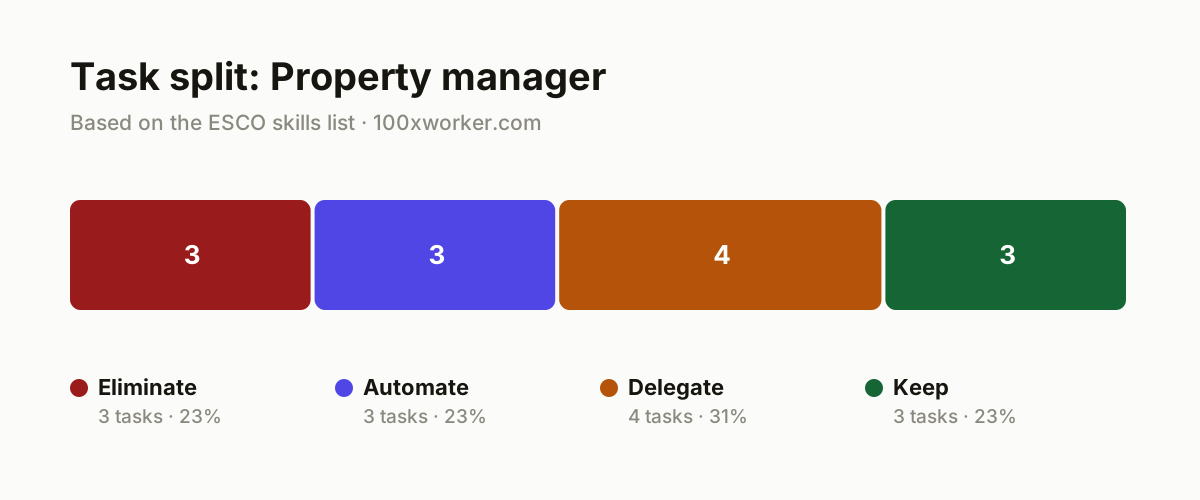
| Task | Bucket | Why |
|---|---|---|
| Manually retyping invoices and receipts into the accounting system | eliminate | OCR software reads invoices automatically and posts them, so typing them in by hand disappears. |
| Digging through old meeting minutes and contracts to find one clause or agreement | eliminate | AI search tools scan the full archive in seconds, so flipping through folders becomes unnecessary. |
| Drafting standard reminder letters for unpaid dues from scratch each time | eliminate | A template with an automatic due-date check sends the reminder without anyone writing it. |
| Sending dunning letters and payment reminders for late association dues | automate | An automated workflow connects the accounting system to email and sends reminders on the due date. |
| Producing a first draft of the minutes for an owners' association meeting | automate | Speech-to-text plus summarization tools turn a meeting recording into a usable draft. |
| Generating periodic cost statements per unit or per owner | automate | The accounting system pulls this straight from running accounts, with no manual calculation. |
| Drafting the budget and multi-year plan for the reserve fund | delegate | AI produces a numbers-based draft from historical data; you check it against reality and negotiate with the board. |
| Comparing and summarizing contractor bids | delegate | AI lines up prices, terms, and risks side by side; you make the call and justify it to owners. |
| Drafting responses to owner questions and complaints | delegate | AI writes a first reply based on the file and the bylaws; you adjust the tone and send it. |
| Preparing the annual financial statement for the general meeting | delegate | AI structures the figures into the standard format; you verify accounting accuracy and sign. |
| Chairing the annual general meeting and getting decisions approved | keep | Negotiating between owners with conflicting interests requires reading the room in real time. (Your edge: You sense tension between owners and redirect the conversation on the spot.) |
| Deciding on urgent action during damage, like a water leak or fire | keep | A fast call on risk, liability, and priority requires experience and legal accountability. (Your edge: Legal responsibility for emergency decisions sits with you, not a tool.) |
| Building a trust relationship with the owners' board | keep | Owners hand over their largest investment to a person, not a dashboard. (Your edge: Personal trust is something no algorithm can build for you.) |
Which property manager tasks does AI take over?
AI mostly takes over document-heavy, repetitive tasks: reading and posting invoices, searching contracts and old minutes, drafting reminder letters, and generating cost statements. Microsoft Research's applicability score of 13.9% for this occupation reflects exactly this: a modest but real slice of work activities, concentrated in paperwork rather than decisions. Tasks like negotiating with owners, chairing meetings, and handling emergencies stay outside that slice, because they depend on judgment and in-person trust that current AI tools cannot replicate.
Will AI replace property managers?
No, not based on current evidence. Microsoft's applicability score measures which tasks AI can help with, not which jobs disappear. At 13.9%, property management sits in the lower half of occupations Microsoft studied, well behind roles like translation (49%). Anthropic's Economic Index shows a similar split across occupations generally: AI usage leans toward augmenting a task rather than fully automating it. The job changes shape, with less time on paperwork and more on relationships, contractor oversight, and urgent calls, but the role itself remains.
What can you do this month as a property manager?
Pick one recurring paperwork task, such as drafting reminder letters or summarizing contractor bids, and test an AI tool on it for two weeks. Keep a human check on anything that goes out under your name or involves money. Ask your accounting or property management software vendor whether OCR invoice processing is already built in but unused. Small, task-level changes like this add up faster than waiting for a full system overhaul.
Which AI tools are useful for a property manager?
General-purpose assistants like Microsoft Copilot or Claude handle drafting, summarizing meeting recordings, and comparing contractor bids. Property management platforms increasingly bundle OCR-based invoice scanning and automated reminder workflows directly into their accounting modules. None of these tools replace the accounting sign-off, the board negotiation, or the emergency judgment call. Treat them as drafting and search assistants, not decision-makers, and review anything before it goes to owners or gets filed.
AI applicability of 13.9% for property and real estate managers places the role well below high-applicability occupations like translation, and above low-applicability ones like nursing.
Microsoft Research, Working with AI: Measuring the Applicability of Generative AI to Occupations (2025)
Become the AI person on your team
Automate the reminder cycle first
Connect your accounting system to your email tool so overdue-dues reminders send themselves on the due date. This is one of the lowest-risk automations because the logic is simple and errors are easy to catch.
Use AI as a search layer over your archive
Feed old contracts and meeting minutes into a document search tool with AI-powered retrieval. Instead of searching folder by folder for a clause, you ask a question and get the passage directly.
Draft with AI, decide yourself
Let AI produce the first version of a budget, a bid comparison, or a response to an owner complaint. Read every draft before it goes out, since accuracy and tone still need a human check.
Want this for your actual task list?
The free scan on the homepage builds your personal task map in 30 seconds, based on your role and industry.
Run the free task scanTools for this work
| Tool | For which tasks | The sober take |
|---|---|---|
| Microsoft Copilot | Drafting meeting minutes, owner responses, and financial report summaries | Useful for first drafts; still requires a human review before anything is sent or filed. |
| OCR invoice-scanning modules (built into most property accounting software) | Eliminating manual invoice and receipt entry | Many platforms already include this; check settings before buying a separate tool. |
| AI document search tools | Finding clauses in old contracts and past meeting minutes | Works best when your archive is digitized and consistently named. |
| Claude or similar assistants | Comparing contractor bids and drafting reserve fund budget proposals | Good at structuring comparisons; the final judgment call stays yours. |
Prompts to try today
Compare contractor bids
Draft a response to an owner complaint
Summarize a meeting recording into draft minutes
Related jobs
Frequently asked questions
How much of a property manager's job can AI actually do?
Based on Microsoft Research's analysis of 200,000 Copilot conversations, generative AI is applicable to about 13.9% of work activities in this occupation. That covers document-heavy tasks like invoice processing, reminder letters, and meeting minute drafts. It does not cover negotiating with owners, chairing meetings, or making emergency decisions, which make up most of the role's day-to-day judgment calls.
Do I need to learn to code to use AI in property management?
No. The tools most useful for this role, like Copilot, Claude, and OCR modules built into property accounting software, work through plain-language prompts or are already integrated into software you likely use. The main skill is learning to write clear instructions and to review AI output carefully, not programming.
Is AI use in property management already common?
Adoption of generative AI tools among the general public is rising quickly. Eurostat reports that 32.7% of the EU population aged 16 to 74 used generative AI in the three months before the 2025 survey. Property management specifically is not broken out in that data, but the trend suggests AI-assisted drafting and search tools are becoming standard office tools across professions, including this one.
What happens to entry-level property management tasks?
Tasks like invoice entry, standard reminder letters, and contract lookups are the most likely to disappear or shrink, since these are exactly the kinds of repetitive, document-based work Microsoft's applicability score flags. This changes what junior staff spend time on, shifting them toward contractor coordination, owner communication, and reviewing AI-drafted documents rather than typing them from scratch.
Sources
- Microsoft Research, Working with AI: Measuring the Applicability of Generative AI to Occupations (2025)
- Anthropic Economic Index
- Eurostat, isoc_ai_iaiu (generative AI use, 2025)
- ESCO (European Commission occupation and skills taxonomy)
Hendrik De Winne, author of Becoming AI-Savvy, founder of VibeLab. Helps teams redesign their work with AI.
This article was drafted with AI assistance from public data sources and editorially reviewed.