100×worker · job analysis
Will AI Replace Financial Controllers?

A financial controller keeps a company's books honest. That means budgets, monthly close, reconciliations, variance analysis, and the reports that go to leadership and auditors. It is a role built on numbers, deadlines, and accountability, which makes it a natural test case for what generative AI can and cannot do.
Microsoft Research analyzed 200,000 real conversations with its Copilot assistant and scored how much of each occupation's work overlaps with what generative AI can already do. Financial managers, the closest matching category to financial controller, scored 14.9%. That sits well below translators (49%, the highest score in the study) and above nurses (12%, one of the lowest). In other words, AI touches a meaningful slice of the job, not the whole job.
Anthropic's Economic Index adds a second layer: when people use AI for finance-related tasks, usage splits between automation-like patterns (AI does the task end to end) and augmentation-like patterns (AI assists while a human decides). For controllers, most of the near-term change falls into the second category. This article breaks the role into four buckets: eliminate, automate, delegate, and keep, so you can see exactly which tasks shift and which stay yours.
A financial controller safeguards a company's financial health through budgets, reporting, and internal controls.
The task split: what AI takes over and what stays yours
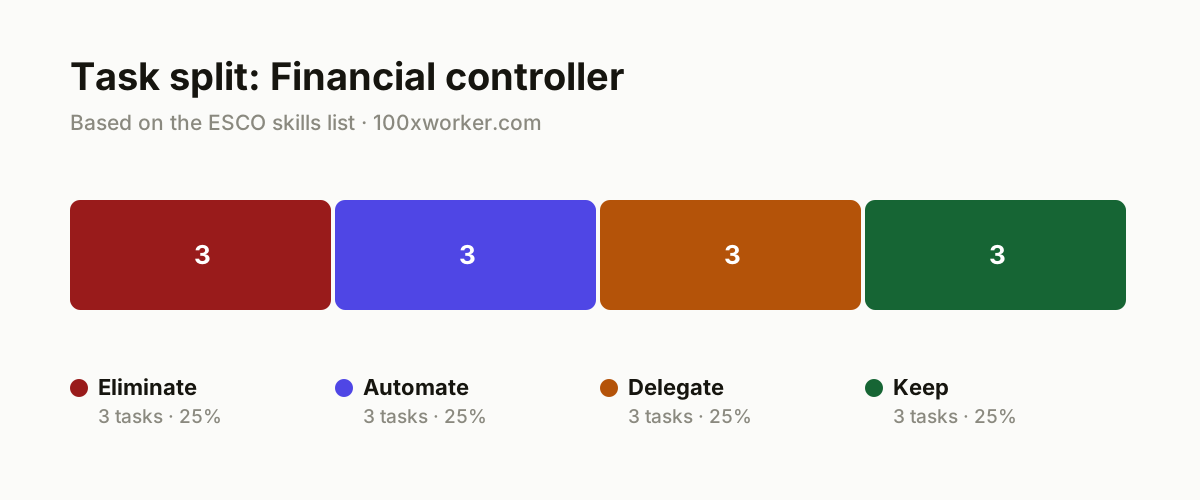
Not every task in a financial controller's job changes the same way. Some tasks disappear because they were never worth doing by hand. Others get fully automated because they are rule-based and repetitive. A third group gets delegated to AI for a first draft that a human then checks. A final group stays firmly with the human controller because it involves judgment, accountability, or trust that no model can carry. Sorting your own task list into these four buckets is the most useful exercise you can do this quarter.
| Task | Bucket | Why |
|---|---|---|
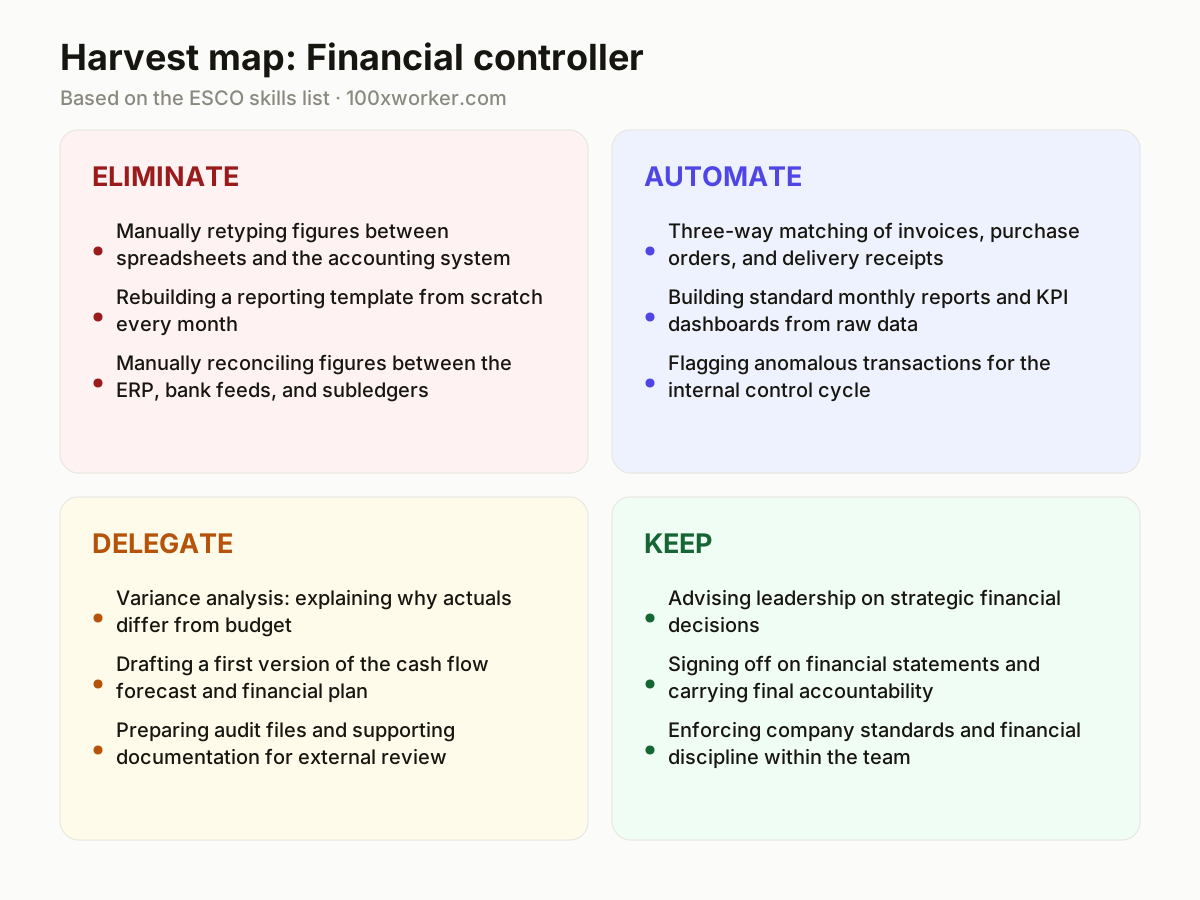
| Manually retyping figures between spreadsheets and the accounting system | eliminate | Pure copy work with no judgment involved, error-prone and fully automatable. |
| Rebuilding a reporting template from scratch every month | eliminate | Templates can be generated automatically from the ERP, so repeating the work adds nothing. |
| Manually reconciling figures between the ERP, bank feeds, and subledgers | eliminate | Matching algorithms do this faster and without typos compared to a person. |
| Three-way matching of invoices, purchase orders, and delivery receipts | automate | Rule-based, repetitive work that agents can run unsupervised per transaction, production-ready. |
| Building standard monthly reports and KPI dashboards from raw data | automate | The structure is fixed and only the numbers change, ideal for full automation. |
| Flagging anomalous transactions for the internal control cycle | automate | Pattern detection across large datasets works more consistently than manual sampling. |
| Variance analysis: explaining why actuals differ from budget | delegate | AI drafts a first explanation from historical patterns, you test it against business context. |
| Drafting a first version of the cash flow forecast and financial plan | delegate | AI turns history into a draft scenario, you adjust the assumptions and risks. |
| Preparing audit files and supporting documentation for external review | delegate | AI gathers and structures evidence, you judge completeness and interpretation. |
| Advising leadership on strategic financial decisions | keep | Requires reading company culture, internal politics, and risk appetite. (Your edge: Leadership trusts your judgment, not a model's output.) |
| Signing off on financial statements and carrying final accountability | keep | Legal and personal liability cannot be delegated to software. (Your edge: Personal liability toward auditors and regulators.) |
| Enforcing company standards and financial discipline within the team | keep | Gray areas in behavior and culture need human judgment, not a rule set. (Your edge: Judgment calls in situations no procedure covers.) |
Which financial controller tasks can AI take over?
AI already handles the mechanical layer of the job well: retyping numbers between systems, rebuilding the same report template every month, and reconciling ERP entries against bank feeds and subledgers. Three-way invoice matching, standard KPI dashboards, and anomaly flagging for internal controls can run largely unsupervised once set up. Anthropic's Economic Index shows this kind of automation-like use is common for structured, repeatable finance work. What AI does not take over is the interpretation layer: deciding what a variance actually means for the business, or whether an anomaly is a real risk or a data quirk.
Will AI replace financial controllers?
No, not as a full role. Microsoft Research's applicability score for financial managers sits at 14.9%, meaning most of the job still falls outside what generative AI can currently do well. What changes is the task mix inside the role: less time on data entry and reconciliation, more time on judgment calls, variance explanations, and advising leadership. Controllers who resist adapting their task list will look increasingly slow next to peers who use AI for drafts and checks. The job title survives; the daily task list does not stay the same.
How do you become the finance team's AI power user?
Start by mapping your own weekly tasks into the eliminate, automate, delegate, and keep buckets, then pick one recurring report or reconciliation to automate first. Build a small library of prompts for variance analysis and forecast drafting so you are not starting from a blank page each month. Learn where your ERP or reporting tool already has AI features built in (many do) before buying a separate tool. Share what you automate with your finance team so the whole department, not just you, moves faster.
What can you do this month as a financial controller?
Pick one manual reconciliation task and test whether your current software (ERP, BlackLine, or similar) can automate the matching. Draft one variance analysis with an AI assistant, then compare it against your own explanation to see where the model gets it wrong. Ask your team to log which tasks each week feel like pure data entry, since those are your best candidates for elimination. Finally, write down which decisions you will never hand to a model, so your accountability boundaries are explicit before anyone questions them.
Generative AI applies to a measurable share of a job's work activities, not to the job as a whole.
Microsoft Research, Working with AI (2025)
Become the AI person on your team
Automate the three-way match first
Invoice, purchase order, and delivery matching is rule-based and high-volume, which makes it the fastest win. Set it up once, monitor exceptions weekly, and free up hours for analysis instead of paperwork.
Build a variance analysis prompt library
Save the prompts that produce useful first drafts for explaining budget-to-actual gaps. Reuse and refine them each month instead of writing from scratch, then always check the draft against internal context before sending it up.
Own the audit trail, not the drafting
Let AI assemble and organize supporting documentation for auditors, but keep the final review and sign-off with you. Auditors will ask you, not the tool, to defend the numbers.
Want this for your actual task list?
The free scan on the homepage builds your personal task map in 30 seconds, based on your role and industry.
Run the free task scanTools for this work
| Tool | For which tasks | The sober take |
|---|---|---|
| Microsoft Copilot (Excel, Dynamics 365 Finance) | automate: dashboards and standard reports; delegate: draft variance explanations | Built into tools controllers already use, so adoption friction is lower than a separate app. |
| Anthropic Claude | delegate: cash flow forecast drafts, audit documentation summaries | Useful for drafting and summarizing, but check figures against source systems before circulating. |
| BlackLine (or similar reconciliation software) | eliminate: manual reconciliation between ERP, bank, and subledgers | Matching engines handle high-volume reconciliation more reliably than spreadsheets. |
| RPA platforms (UiPath, Power Automate) | eliminate: retyping data between systems; automate: three-way matching | Best for stable, rule-based workflows that rarely change format. |
Prompts to try today
Variance analysis first draft
Cash flow forecast scenario draft
Audit documentation summary
Related jobs
Frequently asked questions
Does the AI applicability score of 14.9% mean 15% of controllers will lose their job?
No. The score measures the share of work activities where generative AI is demonstrably applicable, not the share of jobs at risk. It comes from Microsoft Research's analysis of 200,000 real Copilot conversations mapped to occupational task data. A low-to-mid score like 14.9% suggests task-level change (less manual reconciliation and drafting) rather than role elimination.
Is a financial controller's job different from a CFO's job in terms of AI exposure?
Yes, though they overlap. The ESCO occupational taxonomy classifies the CFO-level role (financial manager) around strategic financial planning, stakeholder advice, and final accountability for statements. Controllers sit closer to the operational layer: budgets, reconciliations, and internal reporting. That operational layer has more repeatable, automatable tasks than the strategic advisory work a CFO does.
Which AI tools are safe to use with sensitive financial data?
Prioritize tools with enterprise data agreements and clear retention policies over free consumer chat tools. Many ERP and reporting platforms now include AI features that keep data inside your existing system boundary, which is generally safer than pasting figures into a general-purpose chatbot. Check your company's data policy before using any AI tool with unpublished financials.
What skills should a financial controller build now?
Focus on prompt-writing for recurring tasks (variance analysis, forecast drafts), reviewing AI output for errors against source data, and understanding where automation in your ERP or reconciliation software already covers repetitive work. The judgment and accountability side of the job (advising leadership, signing off on statements) stays human, so sharpening that communication and oversight skill matters as much as learning new tools.
Sources
- Microsoft Research, Working with AI: Measuring the Applicability of Generative AI to Occupations (2025)
- Anthropic Economic Index
- ESCO (European Commission occupational taxonomy)
- Eurostat, isoc_ai_iaiu
Hendrik De Winne, author of Becoming AI-Savvy, founder of VibeLab. Helps teams redesign their work with AI.
This article was drafted with AI assistance from public data sources and editorially reviewed.