100×worker · job analysis
Will AI Replace Risk Managers, and What Should You Do About It?
Risk managers spend a lot of time on work that looks technical but is actually repetitive: pulling numbers from financial statements, updating standard reports, scanning news feeds for triggers. That is exactly the kind of work generative AI is good at. Microsoft Research analyzed 200,000 real conversations people had with Copilot at work and built an applicability score for each occupation. Financial Risk Specialists, the closest match to a risk manager role, score 24.1%. For comparison, translators top the list at 49% and nurses sit near the bottom at 12%.
A score in the mid-20s means a meaningful slice of the job can be reshaped by AI without the role disappearing. Anthropic's Economic Index, which classifies millions of Claude conversations against standardized task lists, finds a similar pattern across knowledge work: some AI use replaces a task outright (automation), and some just makes a person faster at it (augmentation). For risk managers, most of the near-term shift falls into the augmentation category: AI drafts the scenario analysis, you decide what it means for the business.
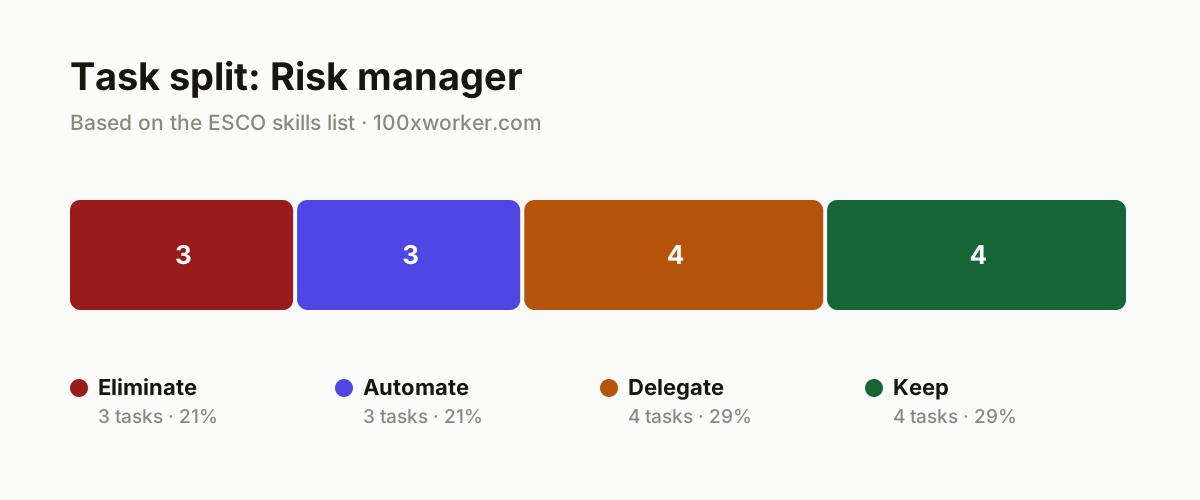
This article breaks the risk manager job into four buckets: tasks that disappear, tasks that get automated, tasks you hand to AI but still check, and tasks that stay with you because someone has to be accountable for them.
A risk manager identifies business risks, assesses them, and advises on prevention and control.
The task split: what AI takes over and what stays yours
Not every task in a risk manager's job changes the same way. Some tasks vanish because the underlying manual step is no longer needed. Some get fully automated by software or an AI agent. Some get delegated to AI for a first draft, with a human checking the result. And some stay firmly with the person, usually because they involve judgment, accountability, or a relationship someone needs to trust. Sorting the job this way, rather than asking 'will AI take my job,' gives a clearer picture of what actually changes month to month.
| Task | Bucket | Why |
|---|---|---|
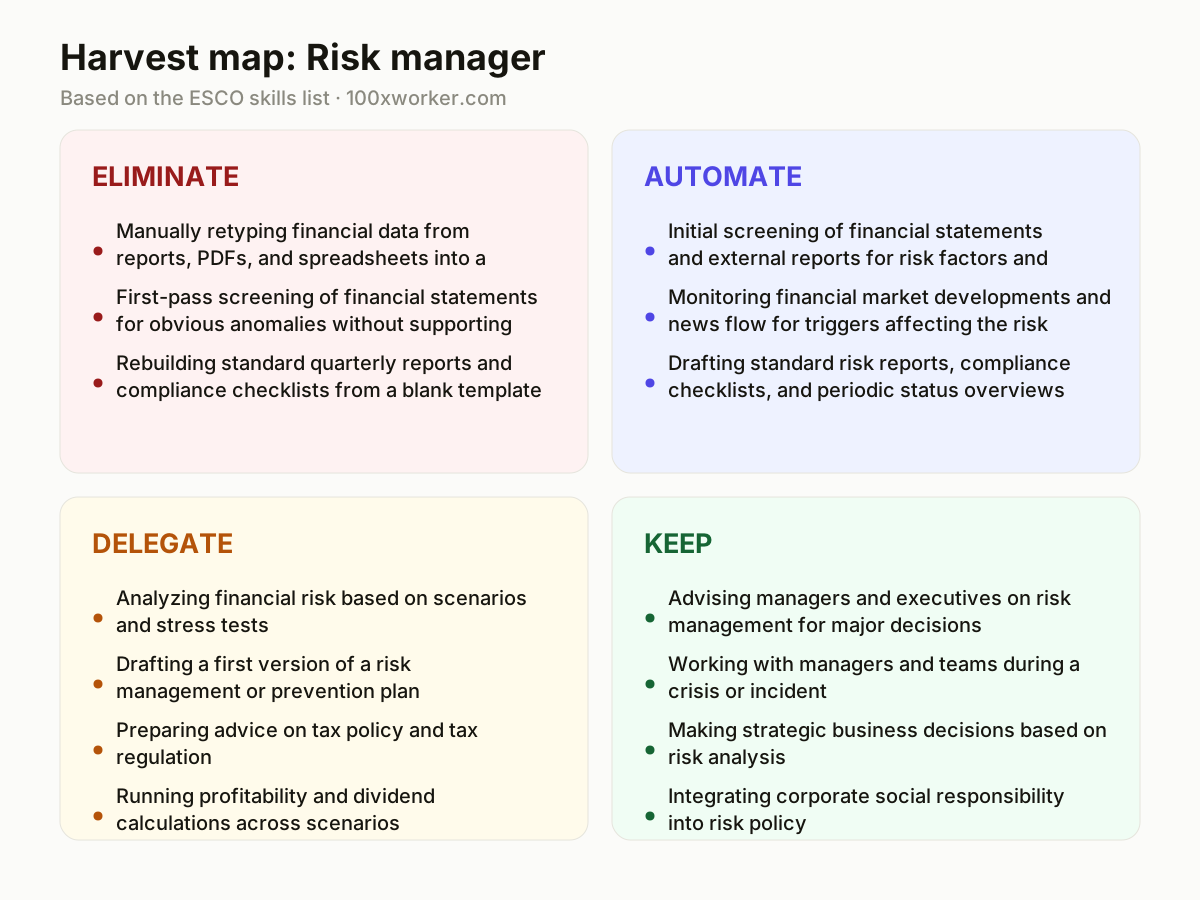
| Manually retyping financial data from reports, PDFs, and spreadsheets into a central risk file | eliminate | Agents now read and structure this data directly, faster and more consistently than manual entry. |
| First-pass screening of financial statements for obvious anomalies without supporting software | eliminate | Automated risk scans already catch standard patterns, so manual page-by-page review adds little. |
| Rebuilding standard quarterly reports and compliance checklists from a blank template every cycle | eliminate | Templates now populate automatically with current figures, so the structure itself never has to be rebuilt. |
| Initial screening of financial statements and external reports for risk factors and anomalies | automate | An agent scans documents consistently against predefined risk signals and returns a findings list. |
| Monitoring financial market developments and news flow for triggers affecting the risk profile | automate | Continuous monitoring suits a system that never stops watching and sends an alert immediately. |
| Drafting standard risk reports, compliance checklists, and periodic status overviews | automate | The structure and figures are predictable enough to generate directly from existing systems. |
| Analyzing financial risk based on scenarios and stress tests | delegate | AI builds a first scenario analysis, you test the assumptions and the sensitivity of the outcome. |
| Drafting a first version of a risk management or prevention plan | delegate | An agent writes the structure and standard measures, you fill in the company-specific priorities. |
| Preparing advice on tax policy and tax regulation | delegate | AI searches and summarizes regulation, you check whether it actually applies to this business. |
| Running profitability and dividend calculations across scenarios | delegate | The calculations go fast with AI, but the interpretation and the final recommendation stay with you. |
| Advising managers and executives on risk management for major decisions | keep | Leadership needs someone who can advise with real accountability, not a suggestion from a tool. (Your edge: Trust and accepting responsibility cannot be delegated to a model.) |
| Working with managers and teams during a crisis or incident | keep | Crisis moments require fast, credible communication that colleagues can actually rely on. (Your edge: Human judgment under pressure stays human work.) |
| Making strategic business decisions based on risk analysis | keep | A decision with legal and financial consequences needs a person who signs off on it. (Your edge: Final accountability and liability rest with a person.) |
| Integrating corporate social responsibility into risk policy | keep | What a company finds acceptable is a values choice, not a calculation. (Your edge: Judgment calls about reputation and ethics are not computation.) |
Which risk manager tasks can AI take over?
AI is strongest on the parts of the job that are pattern-based and document-heavy: pulling data out of financial statements, flagging anomalies against known risk signals, monitoring news and market feeds for triggers, and generating standard compliance reports. Microsoft Research's applicability score of 24.1% for financial risk roles reflects exactly this slice. These are tasks with clear inputs and predictable outputs, which is where large language models perform reliably. The tasks AI struggles with are the ones without a clean answer: weighing reputational risk against financial upside, or deciding how much risk a specific leadership team can tolerate.
Will AI replace risk managers?
No single number says a job disappears, and 24.1% applicability is a task-level figure, not a headcount prediction. Older estimates that claim a whole occupation is 'X% automatable' usually trace back to a 2013 Oxford study (Frey & Osborne) done before large language models existed, and it does not reflect how AI is actually used today. What changes is the shape of the job: less time on manual screening and report assembly, more time on judgment calls, stakeholder conversations, and decisions someone has to be accountable for. The risk manager who adapts becomes the person who directs AI output and owns the final call, not someone competing with it.
How do you become the AI-savvy person on your risk team?
Start by mapping your own task list against the four buckets above, honestly, task by task. Pick one recurring report or screening process and run it through an AI tool for a month, comparing its output against what you'd normally produce manually. Learn to write specific prompts that reference your actual risk categories and reporting templates instead of generic questions. Then share what works with colleagues: the person who can explain which AI outputs to trust and which to double-check becomes the reference point for the whole team, which is a stronger position than trying to out-manual the automation.
What can you do this month as a risk manager?
Pick one task from the automate or delegate bucket, ideally something you do every week, like a market monitoring check or a first-draft scenario analysis. Set up an AI workflow for it, run it in parallel with your normal process for two or three cycles, and compare accuracy and time saved. Document what the AI gets right and where it needs correction. That gives you a concrete, defensible case for how you're using AI, which matters more in performance reviews than a vague claim of 'using AI more.'
Generative AI is applicable to about a quarter of the work activities found in financial risk roles, based on real, observed usage patterns.
Microsoft Research, Working with AI (2025)
Become the AI person on your team
Build a prompt library for recurring reports
Save the prompts that reliably produce a usable first draft of your quarterly risk report or compliance checklist. Refine them over time instead of starting from scratch each cycle.
Run a monitoring agent and audit it weekly
Set an AI tool to track market and news triggers relevant to your risk categories, then spend fifteen minutes a week checking what it flagged against what you would have caught manually.
Show your work when you present AI-assisted analysis
When you bring a scenario analysis to leadership, note which parts came from an AI draft and which assumptions you personally verified. It builds trust in both the output and your process.
Want this for your actual task list?
The free scan on the homepage builds your personal task map in 30 seconds, based on your role and industry.
Run the free task scanTools for this work
| Tool | For which tasks | The sober take |
|---|---|---|
| Microsoft Copilot | Screening financial statements, drafting standard reports, summarizing long documents | Its applicability data for financial risk roles comes from Microsoft's own usage study, so it is worth testing first. |
| Claude (Anthropic) | Scenario analysis drafts, tax policy summaries, risk plan first drafts | Anthropic's own Economic Index shows this kind of drafting work leans toward augmentation rather than full automation. |
| ChatGPT | Preparing advice on tax regulation, drafting compliance checklists | Useful for first drafts, but check regulatory specifics against a current source before sending anything out. |
| GRC (governance, risk, compliance) platforms with AI features | Monitoring market triggers, generating periodic status overviews | Many existing risk platforms have added AI summarization; check what your organization already licenses before adding a new tool. |
Prompts to try today
First-pass risk screening of a financial statement
Draft a scenario analysis for stress testing
Summarize tax regulation changes relevant to a business unit
Related jobs
Frequently asked questions
Is a 24.1% applicability score the same as saying 24.1% of risk managers will lose their jobs?
No. The score measures the share of work activities where generative AI is demonstrably useful, based on real usage data from 200,000 Copilot conversations. It says nothing directly about headcount or layoffs. A role can absorb a meaningful share of AI-assisted work while still requiring the same number of people, because the freed-up time typically goes toward judgment-heavy tasks like advising leadership or handling a crisis, not toward eliminating positions.
How is AI actually being used in risk and finance work right now?
Eurostat data shows 32.7% of the EU population aged 16-74 used generative AI in the three months before the 2025 survey, and a Google/Ipsos survey found 61% of Belgians had used an AI chatbot. In professional risk work specifically, Anthropic's Economic Index finds usage split between automation-style tasks (data extraction, report drafting) and augmentation-style tasks (reviewing and refining AI-generated analysis), with the latter more common in judgment-heavy roles like risk management.
Should I trust older studies claiming risk management is highly automatable?
Be cautious with any 'robotization percentage' you see attributed to older sources. The widely cited figures on occupational automatability trace back to a 2013 Oxford study by Frey and Osborne, published years before large language models existed. It was not built to measure generative AI and does not reflect how tools like Copilot or Claude are actually used in risk work today. Prefer more recent, usage-based data such as Microsoft Research's 2025 applicability scores.
What skills should a risk manager build to stay relevant?
Focus on skills that sit above what AI can do reliably: interpreting AI-generated scenario analysis rather than just producing one, advising executives with clear reasoning they can act on, and making the judgment calls behind maatschappelijk verantwoord ondernemen (corporate social responsibility) style risk trade-offs. ESCO's occupational taxonomy lists financial analysis, risk factor assessment, and advising on risk management as core skills for this role, and those are exactly the tasks least affected by current AI applicability scores.
Sources
- Microsoft Research, Working with AI: Measuring the Applicability of Generative AI to Occupations (2025)
- Anthropic Economic Index
- Eurostat, isoc_ai_iaiu (generative AI use in the EU, 2025)
- ESCO (European Commission occupational taxonomy)
Hendrik De Winne, author of Becoming AI-Savvy, founder of VibeLab. Helps teams redesign their work with AI.
This article was drafted with AI assistance from public data sources and editorially reviewed.