100×worker · job analysis
Will AI Replace Management Consultants?
Management consultants sell judgment, but a lot of their billable hours go to work that has nothing to do with judgment: retyping numbers from PDFs, formatting slide decks, transcribing interviews. Microsoft Research analyzed 200,000 real Copilot conversations and scored how applicable generative AI is to each occupation. Management analysts land at 35.3%, well below translators at the top (49%) but far above nurses at the bottom (12%).
That 35% is not evenly spread across the job. Anthropic's Economic Index, which classifies millions of Claude conversations against O*NET task categories, shows AI use splits into automation-like use (AI does the task) and augmentation-like use (AI helps a person do the task). For consultants, most of the applicable work sits on the augmentation side: financial analysis, drafting, research synthesis.
Meanwhile, Eurostat reports that 32.7% of the EU population aged 16 to 74 used generative AI in the last three months of 2025. Clients are already running their own numbers through a chatbot before your call starts. The question is no longer whether AI touches the job. It is which parts of the job you keep, hand off, or stop doing altogether.
A consultant analyzes business processes and advises on fixes; AI takes over the analysis grunt work, the client relationship and the decision stay human.
The task split: what AI takes over and what stays yours
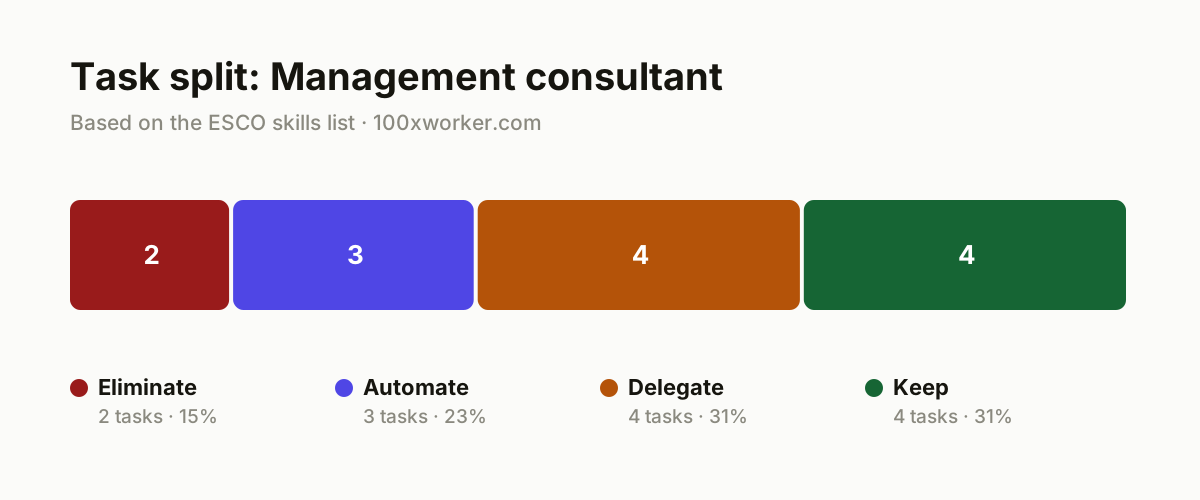
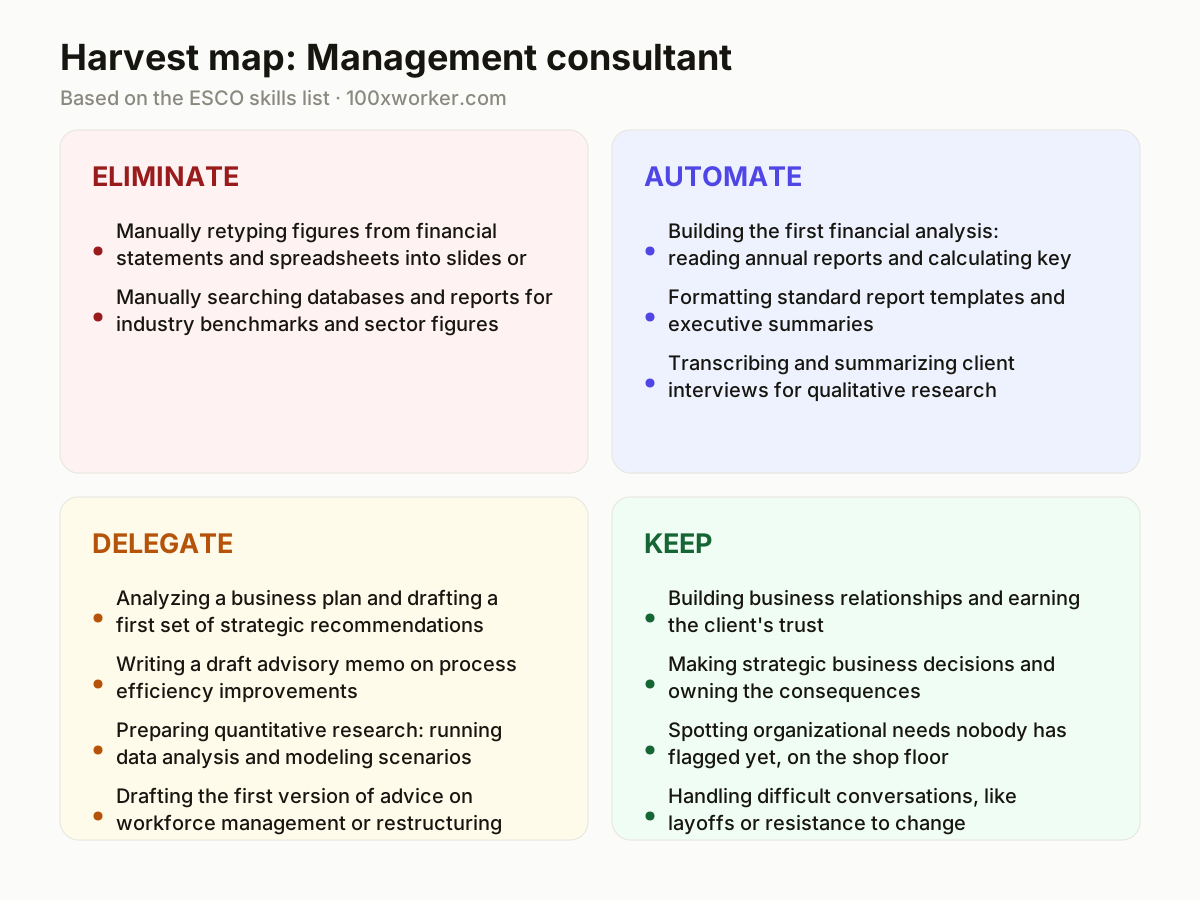
Split the job into four buckets: tasks to eliminate because AI made them pointless, tasks to automate because AI now does them end to end, tasks to delegate to AI as a first draft you still check, and tasks to keep because they depend on trust, judgment, or reading a room. This is the same framework used across occupations built on the ESCO taxonomy of the European Commission, which catalogs 3,039 jobs and their required skills.
| Task | Bucket | Why |
|---|---|---|
| Manually retyping figures from financial statements and spreadsheets into slides or memos | eliminate | AI tools extract tables straight from PDFs, so retyping numbers by hand adds no value. |
| Manually searching databases and reports for industry benchmarks and sector figures | eliminate | Search agents scan sources faster and more consistently than a consultant browsing manually. |
| Building the first financial analysis: reading annual reports and calculating key ratios | automate | An agent ingests the financial statements and calculates liquidity, solvency, and profitability ratios without a human step. |
| Formatting standard report templates and executive summaries | automate | Fixed structure, repeated formatting, agents produce this error-free and in house style. |
| Transcribing and summarizing client interviews for qualitative research | automate | Transcription and first-pass thematic clustering are mechanical tasks AI does faster than a junior analyst. |
| Analyzing a business plan and drafting a first set of strategic recommendations | delegate | AI builds the structure and scenarios, you check them against context, politics, and feasibility before you sign off. |
| Writing a draft advisory memo on process efficiency improvements | delegate | The first 80 percent of the report is there, you rewrite the recommendations that clash with reality on the ground. |
| Preparing quantitative research: running data analysis and modeling scenarios | delegate | AI runs the variants, you decide which assumptions are realistic for this client. |
| Drafting the first version of advice on workforce management or restructuring | delegate | Sensitive material, AI gives you a starting point, you weigh legal and human consequences before it reaches the client. |
| Building business relationships and earning the client's trust | keep | Advice only gets followed if the client trusts the advisor, not just the report itself. (Your edge: Trust is built in conversation, not in a document.) |
| Making strategic business decisions and owning the consequences | keep | Someone has to make the call and answer for the outcome in front of the board. (Your edge: AI advises, a person with a name and reputation decides.) |
| Spotting organizational needs nobody has flagged yet, on the shop floor | keep | This takes reading between the lines, hallway conversations, a feel for what nobody says out loud. (Your edge: What isn't in the data, you only see on site.) |
| Handling difficult conversations, like layoffs or resistance to change | keep | Consultation methods only work if the person across from you feels heard. (Your edge: Emotion and negotiation don't automate.) |
Which management consultant tasks will AI take over first?
The tasks going first are the mechanical ones: pulling numbers out of PDFs into slides, hunting for sector benchmarks across databases, transcribing client interviews, and formatting standard report templates. These sit in the eliminate and automate buckets. Microsoft Research's 35.3% applicability score for management analysts maps closely onto this kind of repeatable, low-judgment work. Financial ratio calculation from annual reports is the clearest case: an AI agent reads the statement and produces liquidity, solvency, and profitability figures without a human doing the arithmetic. What doesn't go first is anything that requires sitting in a room with a client and reading what they're not saying.
Will AI replace management consultants?
No. Microsoft Research's applicability score of 35.3% for management analysts means roughly a third of task-level work is where generative AI demonstrably helps, not that a third of consultants lose their jobs. Compare it to translators at 49% and nurses at 12%: consulting sits in the middle, a job built on judgment and relationships rather than pure information processing. Anthropic's Economic Index shows most AI use in knowledge work is augmentation, a person working with AI, not automation, AI replacing the person outright. The job changes shape. Clients still pay for someone who takes responsibility for a recommendation and stakes their name on it.
How do you become the AI-savvy person on your consulting team?
Start by running your own financial analysis through an AI tool before a junior analyst does it manually, and compare the output. Build a standard prompt library for the recurring deliverables: interview summaries, ratio breakdowns, first-draft recommendations. Learn to spot where an AI-generated recommendation is generic versus where it reflects the client's actual situation, because that gap is exactly where your judgment adds value. Teach your team the difference between augmentation (AI helps you think) and automation (AI does the task), a distinction Anthropic's Economic Index uses to classify AI conversations, and apply it to your own workflow.
What can you do this month as a consultant?
Pick one recurring deliverable, a report template or an interview summary, and run it through an AI tool for two weeks before you touch it manually. Time both versions. Feed a recent annual report into an AI tool and check whether its ratio calculations match your own, then use the time saved to sit in on one more client conversation instead of building one more slide. Small, tracked experiments beat a big AI strategy memo nobody reads.
Across 200,000 real Copilot conversations, generative AI applies to just over a third of a management analyst's work, one of the lower applicability scores among the occupations studied.
Microsoft Research, Working with AI: Measuring the Applicability of Generative AI to Occupations (2025)
Become the AI person on your team
Run the numbers through AI before the junior does
Feed the client's annual report into an AI tool and get liquidity, solvency, and profitability ratios back in minutes. Use the saved hours to double-check the assumptions instead of the arithmetic.
Build a prompt library for the recurring deliverables
Save working prompts for interview transcription and clustering, first-draft recommendations, and executive summaries. Share it with the team so everyone starts from the same baseline instead of reinventing the wheel each engagement.
Spend the freed-up hours on the client relationship
If AI cuts drafting time in half, use that time to sit in on more stakeholder conversations. The recommendations that stick come from understanding what the client actually needs, not from a better-formatted slide.
Want this for your actual task list?
The free scan on the homepage builds your personal task map in 30 seconds, based on your role and industry.
Run the free task scanTools for this work
| Tool | For which tasks | The sober take |
|---|---|---|
| Microsoft 365 Copilot | automate: report templates, executive summaries, drafting from meeting notes | Built into the Office tools most consulting firms already use, so adoption friction is low. |
| Claude (Anthropic) | delegate: business plan analysis, first-draft strategic recommendations, scenario write-ups | Anthropic's own Economic Index tracks how these conversations split between automation-like and augmentation-like use. |
| ChatGPT with data analysis | automate: financial ratio calculations, quantitative scenario modeling | Useful for running variants quickly, but check the underlying assumptions before you present them. |
| AI-based search and research agents | eliminate: sector benchmark research, competitor scans | Faster than manual database searches, but still needs a human check on source reliability. |
Prompts to try today
First-pass financial ratio analysis
Draft efficiency recommendations from process notes
Summarize and cluster client interview transcripts
Related jobs
Frequently asked questions
Is management consulting a high-risk job because of AI?
Not according to the most recent measure. Microsoft Research's 2025 applicability score puts management analysts at 35.3%, in the middle of the range compared to translators (49%) and nurses (12%). Older automation-risk rankings, like the widely cited Frey and Osborne study from Oxford (2013), predate large language models entirely and don't reflect how generative AI actually gets used in consulting today. Treat pre-2020 automation percentages for any job with caution.
What's the difference between automation and augmentation in AI use for consultants?
Anthropic's Economic Index classifies AI conversations into two types: automation-like use, where AI completes a task with little human input, and augmentation-like use, where a person and AI work through a task together. For consultants, most high-value work (strategic recommendations, client advice) falls into augmentation. Mechanical tasks like transcription or ratio calculation lean automation. Knowing which bucket a task falls into helps you decide how much to check the output before it goes to a client.
Which AI tools do consultants use most today?
General-purpose tools like Microsoft Copilot and Claude are the most common starting points because they plug into existing document and spreadsheet workflows. Consultants increasingly use them for financial ratio analysis, first-draft recommendations, and interview transcription and clustering. Specialized research and benchmarking agents are gaining ground for eliminating manual database searches. Firm-wide adoption still varies widely, so check what tools your own firm has approved and how it handles client data confidentiality.
Do you need to learn to code or build AI agents as a consultant?
No. The skill that matters more is knowing how to write a clear prompt, how to check an AI-generated financial analysis against the source document, and how to spot when a recommendation is generic rather than grounded in the client's actual context. Coding helps if you want to build custom automation, but most consulting firms will use off-the-shelf tools like Copilot or Claude rather than in-house agents.
Sources
- Microsoft Research, Working with AI: Measuring the Applicability of Generative AI to Occupations (2025)
- Anthropic Economic Index
- Eurostat, isoc_ai_iaiu (2025)
- ESCO taxonomy, European Commission
Hendrik De Winne, author of Becoming AI-Savvy, founder of VibeLab. Helps teams redesign their work with AI.
This article was drafted with AI assistance from public data sources and editorially reviewed.