100×worker · job analysis
Will AI Replace Business Analysts, and What Should You Do About It?
Business analysts spend a large share of their time producing documents: requirements, process models, cost-benefit reports, meeting notes. That is exactly the kind of work generative AI is good at drafting. Microsoft Research analyzed 200,000 real Copilot conversations and scored occupations by how much of their work AI can plausibly touch. Computer systems analysts, the nearest US occupational category to business analysts, scored 31.3%, well below translators at 49% but far above registered nurses at 12%.
That number does not mean a third of business analysts lose their jobs. It means roughly a third of the tasks inside the role, drafting a BRD, sketching a process diagram, structuring a cost-benefit table, overlap with what current AI tools do well. The rest of the role, reading stakeholder politics, negotiating priorities, defending a recommendation to leadership, stays firmly human. This article breaks the role into four buckets: tasks AI eliminates outright, tasks it automates end-to-end, tasks you delegate and review, and tasks you keep because they need a person in the room.
A business analyst turns business needs into documented requirements and IT solutions.
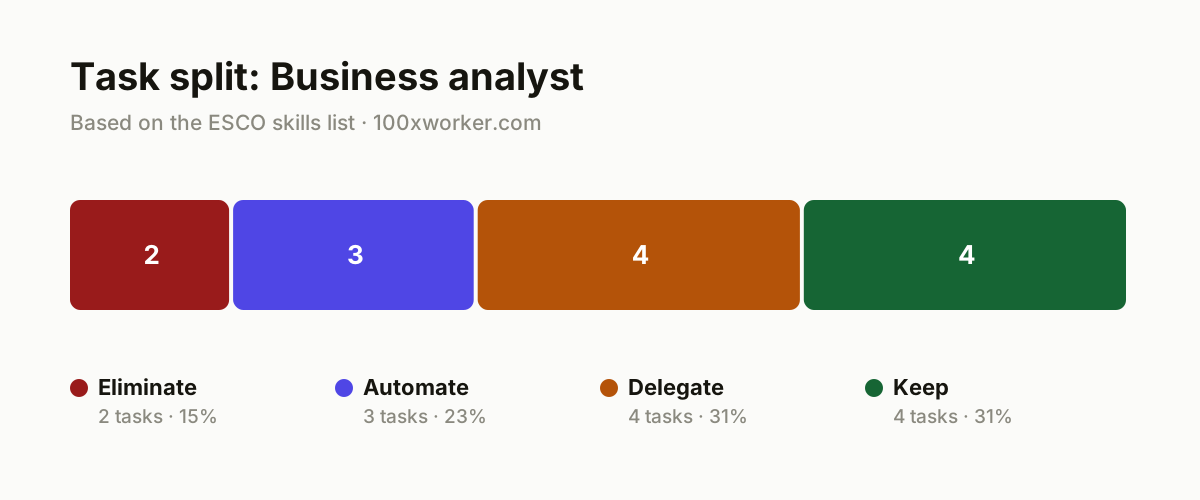
The task split: what AI takes over and what stays yours
Instead of asking whether AI will replace business analysts as a job title, break the role into its actual tasks. Some tasks disappear because a tool now does them without being asked. Some run fully inside an AI agent. Some get a first draft from AI that you then review and correct. And some stay entirely with you because they depend on trust, politics, or accountability that no model carries. Sorting the role this way, rather than treating it as one block, is closer to how the work is actually changing.
| Task | Bucket | Why |
|---|---|---|
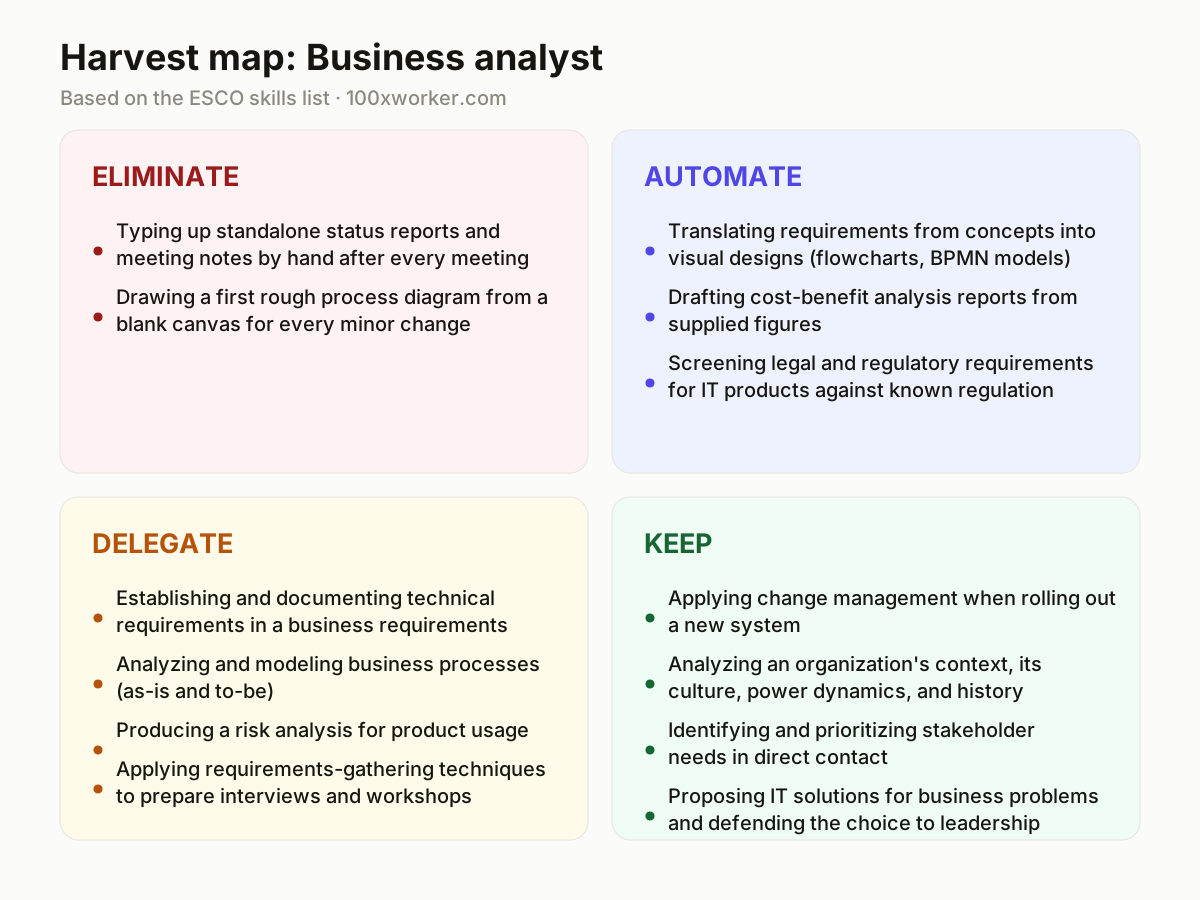
| Typing up standalone status reports and meeting notes by hand after every meeting | eliminate | Transcription and summary tools produce this directly from the recording. |
| Drawing a first rough process diagram from a blank canvas for every minor change | eliminate | AI generates an initial sketch from a text description, so starting from scratch adds no value. |
| Translating requirements from concepts into visual designs (flowcharts, BPMN models) | automate | An agent converts written requirements into a first visual model without you touching it. |
| Drafting cost-benefit analysis reports from supplied figures | automate | An agent structures the numbers, runs the scenarios, and delivers a report in your template. |
| Screening legal and regulatory requirements for IT products against known regulation | automate | AI searches regulation faster and more consistently than a manual checklist. |
| Establishing and documenting technical requirements in a business requirements document (BRD) | delegate | AI drafts a first BRD from interviews and notes, you review and sharpen it. |
| Analyzing and modeling business processes (as-is and to-be) | delegate | AI surfaces patterns and bottlenecks in process data, you decide what actually matters. |
| Producing a risk analysis for product usage | delegate | AI lists risks drawn from comparable cases, you weigh the organization-specific context. |
| Applying requirements-gathering techniques to prepare interviews and workshops | delegate | AI drafts question lists and workshop agendas, you run the conversation and read the undercurrents. |
| Applying change management when rolling out a new system | keep | Resistance, trust, and office politics do not automate. (Your edge: You sense when a team is ready. A model does not.) |
| Analyzing an organization's context, its culture, power dynamics, and history | keep | This takes presence, memory of who clashes with whom, and political feel. (Your edge: AI does not read an organization's unwritten rules.) |
| Identifying and prioritizing stakeholder needs in direct contact | keep | Negotiating priorities and budgets stays human work at the table. (Your edge: You negotiate live. A chatbot does not sit in the room.) |
| Proposing IT solutions for business problems and defending the choice to leadership | keep | The final trade-off and accountability for a recommendation rest with the analyst. (Your edge: You sign off on the advice, not the model.) |
Which business analyst tasks does AI take over first?
AI moves fastest on tasks with a clear input and output: turning written requirements into a first visual model, drafting cost-benefit reports from numbers you already have, and checking IT product requirements against known regulation. Tools produce a first draft in minutes instead of hours. Meeting notes and status write-ups disappear almost entirely once you record a session and let a transcription tool summarize it. The work that survives longest involves ambiguity, reading what a stakeholder actually needs versus what they say, weighing organizational risk, and defending a recommendation to leadership. Microsoft Research's 31.3% applicability score for computer systems analysts reflects roughly a third of work activities, concentrated in these draft-and-structure tasks, not client-facing judgment calls.
Will AI replace business analysts?
No single tool replaces the role, but the mix of tasks inside it is shifting. Anthropic's Economic Index classifies Claude conversations against O*NET tasks and splits usage into automation-like tasks, where AI does the work directly, and augmentation-like tasks, where AI assists while a person decides. Business analyst work leans toward the augmentation side: drafting a BRD, modeling a process, screening regulation, all with a human check afterward. The tasks that stay firmly human, change management, stakeholder negotiation, reading organizational politics, do not show up as automatable in either the Microsoft or Anthropic data. The job continues with a different task mix, not the same job performed by a machine.
What does a 31.3% AI applicability score actually mean?
Microsoft Research analyzed 200,000 real Copilot conversations and scored occupations by how much of their work generative AI can plausibly touch. Computer systems analysts, the closest US match to business analysts, scored 31.3%. For comparison, translators scored highest at 49%, and registered nurses scored low at 12%. The score does not mean 31% of analysts lose their jobs. It means roughly a third of the work activities in the role, drafting, structuring, first-pass modeling, overlap with what current generative AI does well. The other two-thirds, judgment, negotiation, and context reading, stay largely untouched by the same measure.
What can you do this month as a business analyst?
Break your own role into tasks instead of thinking about your job title as one block. List every recurring deliverable, BRDs, process maps, cost-benefit reports, meeting notes, and mark each one eliminate, automate, delegate, or keep. Run one real BRD or process diagram through an AI tool this week and compare the draft to what you would normally produce from scratch. Keep a written record of where the AI draft was wrong or missed context, that gap is exactly the skill to sharpen. Spend the time you save on the stakeholder conversations and change management work that stay firmly yours.
Generative AI's applicability varies widely by occupation, from about 49% of work activities for translators down to about 12% for registered nurses.
Microsoft Research, Working with AI (2025)
Become the AI person on your team
Turn every deliverable into a checklist item
List your recurring outputs, BRDs, process models, cost-benefit reports, and sort each into eliminate, automate, delegate, or keep. This turns a vague concern about AI into a concrete list you can act on this quarter.
Draft with AI, decide without it
Let a tool produce the first version of a requirements document or process diagram, then spend your time checking it against what stakeholders actually said in the room. The review step is where your judgment adds value, not the typing.
Build a change management track record
Document the rollouts you have led where resistance, politics, or trust mattered more than the technical spec. This track record is what stays scarce and valuable as drafting work gets automated.
Want this for your actual task list?
The free scan on the homepage builds your personal task map in 30 seconds, based on your role and industry.
Run the free task scanTools for this work
| Tool | For which tasks | The sober take |
|---|---|---|
| Claude or ChatGPT | Drafting BRDs, cost-benefit reports, and requirement summaries | Good for a first draft, weak on organization-specific context you have to add yourself. |
| Miro AI or Lucidchart | Generating first-pass process diagrams and flowcharts from text descriptions | Speeds up the blank-canvas step, but you still need to correct the flow logic. |
| Otter.ai or Fireflies.ai | Transcribing and summarizing meetings and requirements workshops | Removes manual note-taking almost entirely if you remember to record the session. |
| Microsoft Copilot (Word, Excel) | Structuring cost-benefit tables and drafting sections of requirement documents | Works inside tools you already use, so adoption friction is low. |
Prompts to try today
First-draft BRD from meeting notes
Process model from a written description
Cost-benefit structure from raw numbers
Related jobs
Frequently asked questions
Does AI replace the business analyst role entirely?
No. Generative AI takes over drafting and structuring tasks, first versions of requirements documents, process diagrams, and cost-benefit reports, but it does not run stakeholder negotiations, change management, or organizational politics. Microsoft Research's applicability score of 31.3% for the closest US occupation match suggests roughly a third of work activities overlap with current AI capability, leaving the rest, judgment and relationships, to the analyst.
Which AI tools do business analysts actually use?
Most business analysts use general-purpose chat tools like ChatGPT or Claude for drafting documents and reports, transcription tools like Otter.ai or Fireflies.ai for meeting notes, and diagramming tools with AI features like Miro or Lucidchart for a first pass at process models. None of these replace the requirements interview or the stakeholder conversation, they speed up the paperwork around it.
How common is generative AI use among professionals in general?
Eurostat reports that 32.7% of the EU population aged 16 to 74 used generative AI in the three months before being surveyed in 2025. That figure covers all use, not just work tasks, but it shows generative AI has moved from a niche tool to a mainstream one across a wide range of jobs, business analysis included.
Should I break my job down using a standard skills framework?
It helps. The European Commission's ESCO taxonomy breaks the business analyst role into specific skills, from business process modeling to risk analysis to change management, across 3,039 occupations described in 28 languages. Going through a list like that skill by skill, rather than judging your job as one block, makes it easier to see which parts AI can draft and which parts still need you.
Sources
- Microsoft Research, Working with AI: Measuring the Applicability of Generative AI to Occupations (2025)
- Anthropic Economic Index
- Eurostat, Use of generative AI (isoc_ai_iaiu), 2025
- ESCO (European Skills, Competences, Qualifications and Occupations), European Commission
Hendrik De Winne, author of Becoming AI-Savvy, founder of VibeLab. Helps teams redesign their work with AI.
This article was drafted with AI assistance from public data sources and editorially reviewed.