100×worker · job analysis
Will AI Replace E-commerce Managers?
Generative AI use in professional life is no longer rare. Across the EU, 32.7% of people aged 16 to 74 used generative AI in the three months before the survey, according to Eurostat's 2025 data (isoc_ai_iaiu). For e-commerce managers, the more useful number comes from Microsoft Research: after analyzing 200,000 real Copilot conversations, its 2025 paper estimates that generative AI is applicable to about 18.9% of work activities in the closest comparable US occupation category, marketing managers. That is far below translators (49%) and above nurses (12%), which suggests a mixed job: some tasks are ripe for AI, others are not.
That pattern matches how Anthropic's Economic Index describes AI at work. It classifies millions of real conversations against the O*NET task list and splits usage into automation-like use, where AI does the task, and augmentation-like use, where AI supports a person doing the task. For an e-commerce manager, this means writing product copy or pulling KPI numbers looks automatable, while negotiating with a supplier or setting technology strategy does not. The rest of this article breaks the role into concrete tasks so you can see which category each one falls into.
An e-commerce manager plans and runs the online sales strategy and oversees data quality, brand visibility, and sales performance.
The task split: what AI takes over and what stays yours
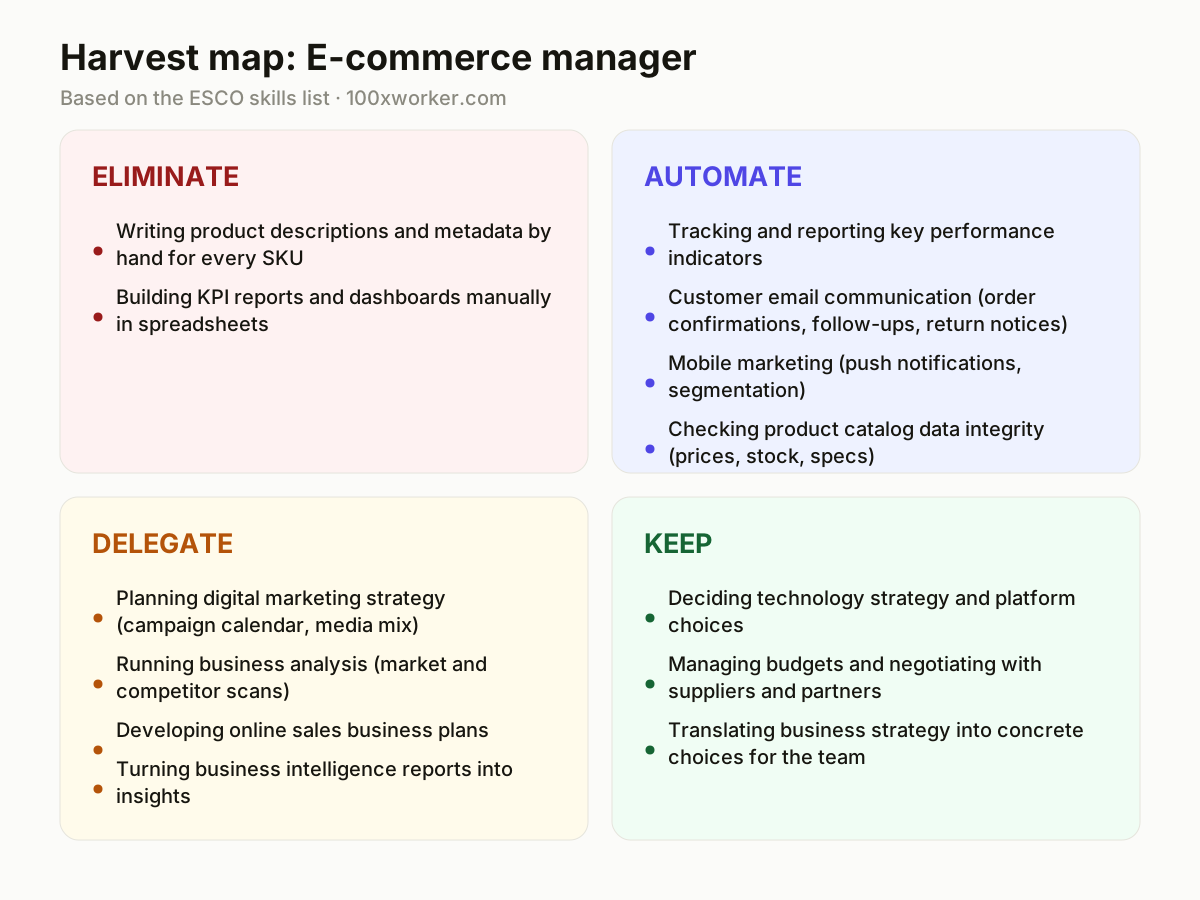
Not every part of the e-commerce manager job changes the same way. Some tasks can be dropped because software already does them well. Some can run on autopilot with an occasional check. Some are best handed to AI for a first draft that you then correct. And some stay with you because they involve judgment, negotiation, or accountability that a model cannot carry. Sorting your actual task list into these four buckets, eliminate, automate, delegate, keep, gives a clearer picture than asking whether the job as a whole survives.
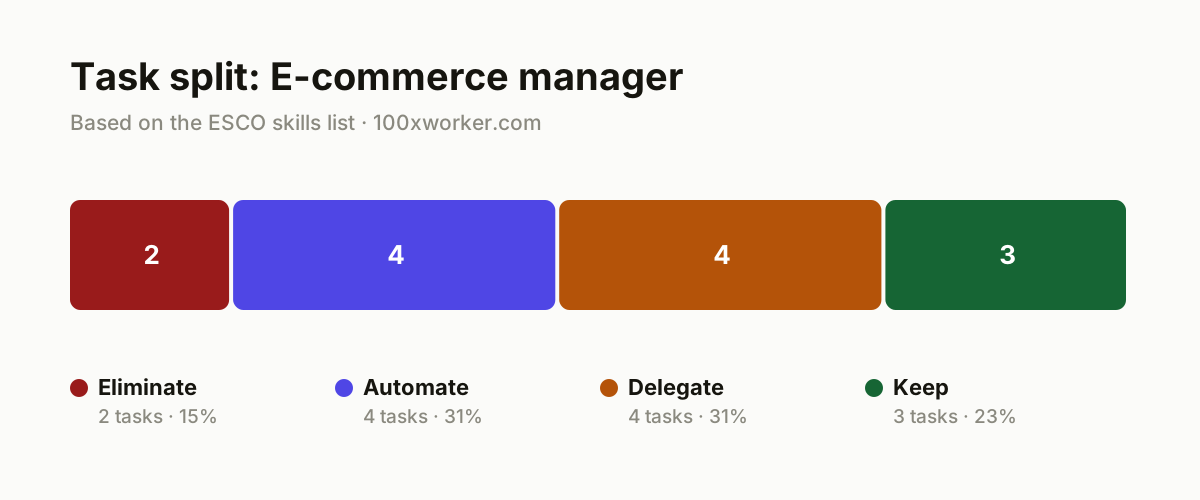
| Task | Bucket | Why |
|---|---|---|
| Writing product descriptions and metadata by hand for every SKU | eliminate | AI tools generate copy and tags directly from specs, faster and more consistently than a copywriter working product by product. |
| Building KPI reports and dashboards manually in spreadsheets | eliminate | BI tools pull numbers straight from your systems and rebuild the dashboard automatically, every morning. |
| Tracking and reporting key performance indicators | automate | Agents connect to your sales and ad data and send a daily summary without anyone opening a file. |
| Customer email communication (order confirmations, follow-ups, return notices) | automate | Standard emails write and send themselves, including tone and language matched to each customer segment. |
| Mobile marketing (push notifications, segmentation) | automate | AI segments customers and times personalized push messages without manual list-building. |
| Checking product catalog data integrity (prices, stock, specs) | automate | An agent cross-checks sources and flags mismatches before a customer sees the wrong price. |
| Planning digital marketing strategy (campaign calendar, media mix) | delegate | AI drafts a first calendar and media split based on past campaigns, you adjust the priorities. |
| Running business analysis (market and competitor scans) | delegate | AI gathers and structures the first 80 percent of a market scan, you check the conclusions against what you see in the market yourself. |
| Developing online sales business plans | delegate | AI writes a first draft of the business case, you rewrite the financial and risk sections. |
| Turning business intelligence reports into insights | delegate | AI summarizes the numbers in plain language, you decide which conclusion actually deserves action. |
| Deciding technology strategy and platform choices | keep | Which platform, which vendor, which architecture is a decision with budget impact for years. (Your edge: Accountability and risk judgment stay with you.) |
| Managing budgets and negotiating with suppliers and partners | keep | Negotiating price and terms takes human judgment that a language model cannot supply. (Your edge: Negotiation stays human work, AI at most supplies numbers.) |
| Translating business strategy into concrete choices for the team | keep | Marketing and sales need to know why a decision was made, and explaining that falls to you. (Your edge: Persuading and explaining a decision is still your job.) |
Which tasks can AI take over from an e-commerce manager?
AI already handles routine, structured work well: writing product descriptions and metadata across large catalogs, generating standard customer emails, segmenting audiences for mobile push campaigns, and pulling KPI numbers into a daily dashboard. It also catches data problems fast, such as mismatched prices or specs between your catalog and supplier feeds. These are tasks with clear inputs and predictable outputs, which is exactly where generative AI performs reliably. The tasks it cannot take over involve negotiation, accountability, or a decision that commits budget for years, such as choosing a platform or vendor.
Will AI replace e-commerce managers?
Not as a whole role. Microsoft Research's 2025 analysis of 200,000 Copilot conversations puts AI applicability at about 18.9% of work activities for the closest comparable occupation, marketing managers, well below high-exposure roles like translation. Anthropic's Economic Index adds a useful distinction: most AI use in this kind of job looks like augmentation, where a person still drives the task, rather than full automation. That matches what the task breakdown above shows: content and reporting tasks shift to AI, but strategy, budget ownership, and negotiation stay with a person. The job restructures around fewer routine tasks, it does not disappear.
How do you become the AI-savvy person on the e-commerce team?
Start by mapping your actual task list against the four buckets above, rather than guessing which tools to buy. Automate the highest-volume repetitive tasks first, such as KPI reporting or catalog checks, since those generate the clearest time savings. Build a habit of using AI for first drafts on delegated tasks like market scans or business plans, then spend your saved time on the review and correction step. Share what works with your marketing and sales colleagues so the whole team adjusts its workflow together, not just your own.
What can you do this month as an e-commerce manager?
Pick one eliminate-bucket task, such as manual product description writing, and move it fully to an AI tool this week. Set up one automated report, for example a daily KPI summary pulled from your sales and ad platforms, and check its accuracy for two weeks before trusting it fully. Try delegating one upcoming market scan or business plan draft to AI and compare the output against your own knowledge. Keep a short log of what AI got wrong so your team learns where to double-check.
Most real-world AI use in knowledge work looks like augmentation of a task rather than full automation of it.
Anthropic Economic Index (2025)
Become the AI person on your team
Audit your task list before your tool stack
List every recurring task you do in a normal month and sort it into eliminate, automate, delegate, or keep. This takes an afternoon and tells you exactly where AI adoption will save the most time, instead of buying tools first and finding uses later.
Own the review step, not the drafting step
Once AI drafts product copy, reports, or market scans, your value shifts to catching errors, checking tone, and deciding what actually matters in the output. Build a short checklist for this review so it does not get skipped when you are busy.
Bring the team along, not just yourself
If you automate customer emails or KPI reporting on your own, marketing and sales colleagues may keep duplicating the old manual process. Document the new workflow and walk the team through it so the time savings apply across the department, not just to you.
Want this for your actual task list?
The free scan on the homepage builds your personal task map in 30 seconds, based on your role and industry.
Run the free task scanTools for this work
| Tool | For which tasks | The sober take |
|---|---|---|
| ChatGPT or Claude | Product descriptions, metadata, first drafts of business plans and market scans | Fast for drafting text, but check facts, pricing, and brand voice before anything goes live. |
| Power BI or Looker with AI features | KPI tracking and dashboard building | Automates the data pull, but you still decide which numbers matter and why. |
| Klaviyo or similar marketing automation with AI segmentation | Mobile marketing, customer email communication | Handles segmentation and send timing well, review templates periodically for tone drift. |
| Copilot in Excel or Google Workspace AI | Catalog data integrity checks, quick reporting | Good at spotting inconsistencies across large spreadsheets, less good at judging which ones matter. |
Prompts to try today
Draft a product description from specs
Summarize a weekly KPI report
Build a first-draft market scan
Related jobs
Frequently asked questions
How is AI applicability for e-commerce managers actually measured?
Microsoft Research's 2025 paper analyzed 200,000 real Copilot conversations and scored how much of each occupation's work activities generative AI can plausibly handle. There is no exact US category for e-commerce manager, so the closest match, marketing managers, scores 18.9%. For comparison, translators score highest at 49% and nurses score low at 12%. Treat the 18.9% figure as a useful benchmark for a role with heavy content and reporting work, not an exact measurement of the e-commerce manager job specifically.
What is the difference between automation-like and augmentation-like AI use?
Anthropic's Economic Index, which classifies millions of real Claude conversations against O*NET task lists, splits AI use into two types. Automation-like use means AI completes the task with little human involvement, such as generating a product description. Augmentation-like use means AI supports a person who still drives the task, such as helping structure a market analysis that you then verify. Most knowledge work, including e-commerce management, leans toward augmentation rather than full automation.
How many professionals are actually using generative AI at work?
Eurostat reports that 32.7% of the EU population aged 16 to 74 used generative AI in the three months before its 2025 survey (isoc_ai_iaiu). That figure covers general use, not job-specific use, but it shows AI tools have moved from niche to mainstream across the working population in a short period. For an e-commerce manager, it means colleagues in marketing, sales, and customer service are likely already using these tools informally, even without a formal team policy.
Where can I check exactly which tasks make up my job?
The European Commission's ESCO taxonomy describes 3,039 occupations with their associated skills in 28 languages, including the eBusiness manager role (ESCO code 2431.10.2), which covers e-commerce management. It lists the essential skills tied to the role, from managing budgets to planning digital marketing strategies, which is a useful starting point for building your own eliminate, automate, delegate, keep breakdown rather than relying on a general job title alone.
Sources
- Microsoft Research, Working with AI: Measuring the Applicability of Generative AI to Occupations (2025)
- Anthropic Economic Index
- Eurostat, isoc_ai_iaiu (generative AI use, 2025)
- ESCO, European Commission occupation taxonomy
Hendrik De Winne, author of Becoming AI-Savvy, founder of VibeLab. Helps teams redesign their work with AI.
This article was drafted with AI assistance from public data sources and editorially reviewed.