100×worker · job analysis
Will AI Replace Business Developers?
Business developers in technology companies spend a lot of time on work that sits between the real client conversations: researching prospects, tracking competitors, drafting reports, and writing follow-up emails. Generative AI now handles large parts of that in-between work. Microsoft Research analyzed 200,000 real Copilot conversations across occupations in 2025 and found that communication-heavy, research-heavy roles, the kind of work business developers do daily, show some of the higher applicability scores for generative AI assistance (Microsoft Research, Working with AI, 2025).
Anthropic's Economic Index goes a step further and splits AI use into two types: automation-like use, where AI does a task end to end, and augmentation-like use, where AI supports a person who stays in charge. That split matters for business development, because most of the job cannot be fully automated, but a large share of it can be augmented.
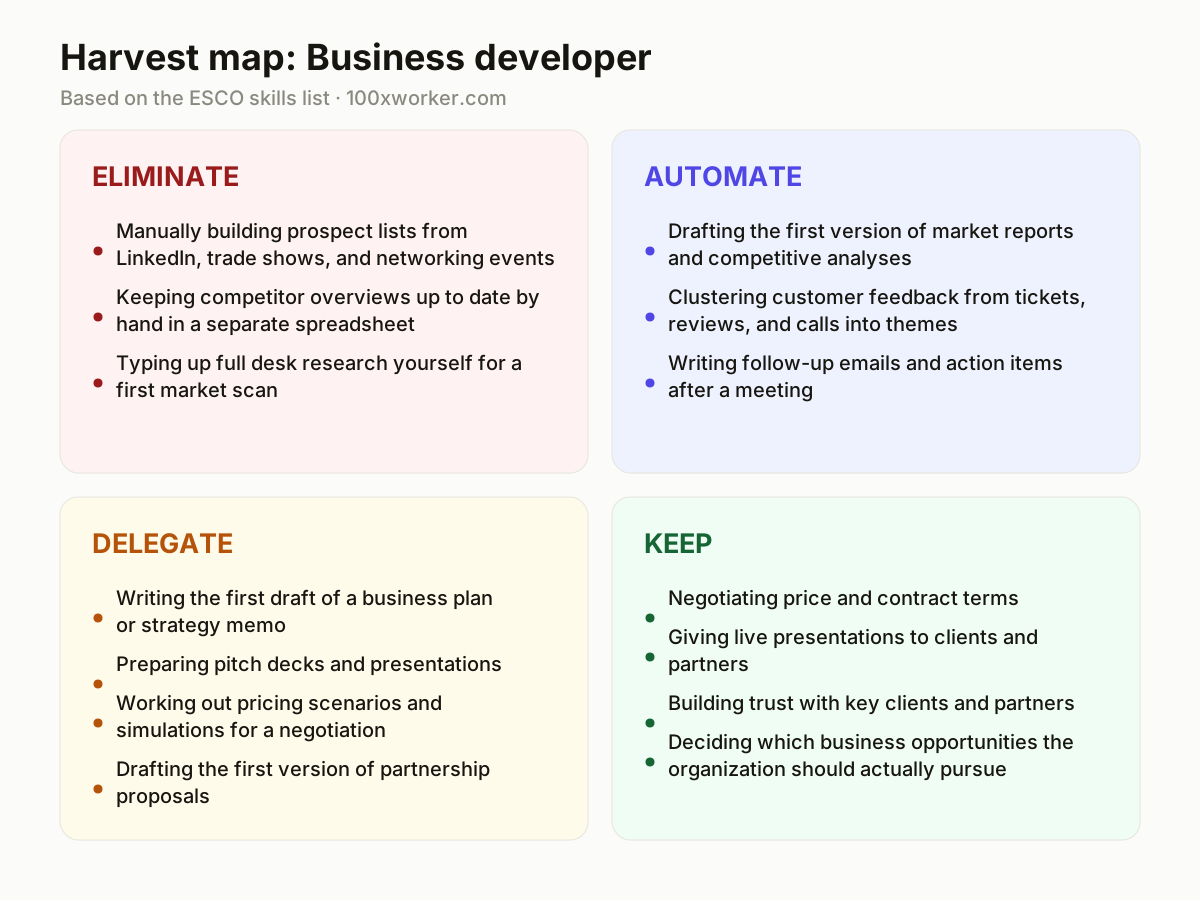
This article sorts the tasks of an ICT business development manager, as described in the European Commission's ESCO taxonomy, into four groups: tasks to eliminate, tasks to automate, tasks to delegate to AI with a human check, and tasks to keep entirely in human hands.
A business developer in tech spots new opportunities, negotiates deals, and turns market trends into strategy.
The task split: what AI takes over and what stays yours
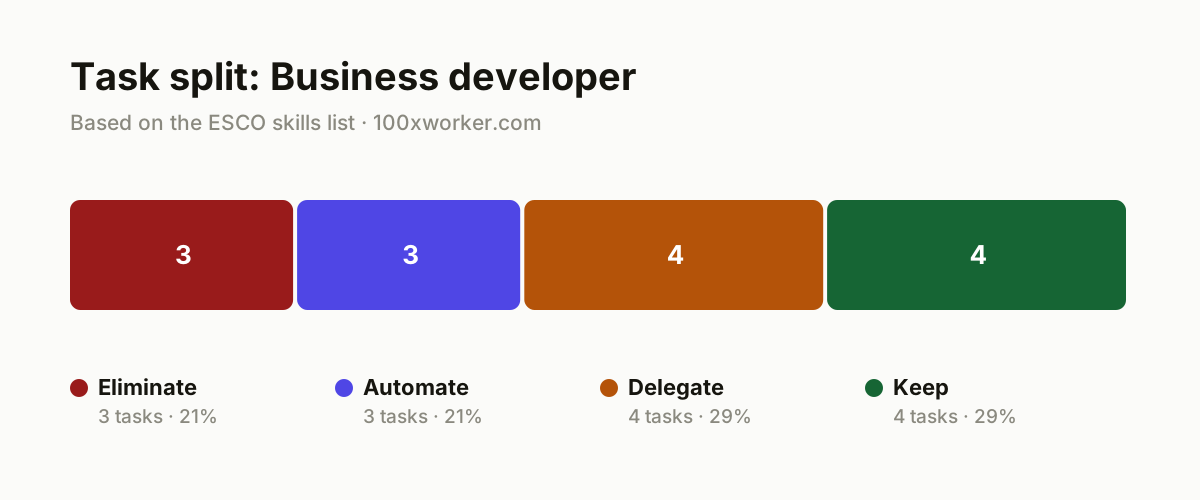
Not every task in a business development role changes the same way. Some tasks disappear because AI does the underlying search or comparison work faster and more consistently than a person scrolling through tabs. Others get a first version written by AI and then handed to you to check and finish. Others still stay fully with you, because they depend on trust, live judgment, and accountability that no model can carry. Sorting the job this way, task by task rather than job title by job title, is closer to how the actual research measures AI's effect on work.
| Task | Bucket | Why |
|---|---|---|
| Manually building prospect lists from LinkedIn, trade shows, and networking events | eliminate | An AI agent searches these sources faster and more consistently than an hour of scrolling. |
| Keeping competitor overviews up to date by hand in a separate spreadsheet | eliminate | It goes stale the moment you save it; AI can refresh it on demand. |
| Typing up full desk research yourself for a first market scan | eliminate | Basic sector or company background is now minutes of work, not hours. |
| Drafting the first version of market reports and competitive analyses | automate | An AI tool pulls together technology trends and market data into a readable starting document. |
| Clustering customer feedback from tickets, reviews, and calls into themes | automate | Spotting patterns across hundreds of comments is faster and more consistent for a model than for a person. |
| Writing follow-up emails and action items after a meeting | automate | Turning notes into a clear email is standard work with no negotiation risk attached. |
| Writing the first draft of a business plan or strategy memo | delegate | AI lays out structure and arguments; you check them against the real business context. |
| Preparing pitch decks and presentations | delegate | The skeleton version comes together faster; you add the story and the deal logic. |
| Working out pricing scenarios and simulations for a negotiation | delegate | AI runs the variants; you decide which scenario actually goes on the table. |
| Drafting the first version of partnership proposals | delegate | Standard clauses and structure are ready; you adjust for relationship and risk. |
| Negotiating price and contract terms | keep | This requires reading what the other party actually wants, not just what they say. (Your edge: Judging in real time when to concede or push harder.) |
| Giving live presentations to clients and partners | keep | Persuading a room depends on timing, body language, and spontaneous reaction. (Your edge: Reacting instantly to how your audience responds.) |
| Building trust with key clients and partners | keep | Trust builds up over months of consistency, not from one good conversation. (Your edge: Being reliably yourself over time.) |
| Deciding which business opportunities the organization should actually pursue | keep | This call weighs risk, culture, and long-term strategy against each other. (Your edge: Taking responsibility for a decision that has real consequences.) |
Which tasks does AI take over from business developers?
AI takes over the research and drafting tasks that sit before the actual client work: pulling together prospect lists, tracking competitors, summarizing a market or a company, drafting the first version of a report, proposal, or pitch deck, and clustering feedback from tickets and calls into themes. These are tasks with a clear input and a checkable output, which is exactly the kind of work that shows up as highly applicable in Microsoft Research's analysis of real Copilot conversations. The output still needs a human read-through before it goes to a client or leadership, but the first draft no longer needs to start from a blank page.
Will AI replace business developers?
No, not as a job title, but the day-to-day task list changes a lot. Anthropic's Economic Index shows that a large share of professional AI use is augmentation, meaning a person stays in charge while AI drafts, researches, or summarizes. The tasks that stay firmly human are negotiation, live presenting, relationship building, and deciding which opportunities are worth pursuing. Those depend on reading people, taking risk, and being accountable for a decision, none of which a model can do for you. The role shifts toward more time on those human tasks and less time on research and first drafts.
How do you become the AI go-to person on your business development team?
Start by mapping your own week against the four groups above: which tasks you can drop, which you can hand fully to a tool, and which need your check before going out. Pick one recurring task, such as the weekly competitor update or the meeting follow-up email, and build a simple AI workflow for it, then document the prompt so a colleague can reuse it. Share what worked and what did not in a short team note. Being the person who has already tested this on real work carries more weight than being the person who talks about AI in general terms.
What can you do this month to start using AI?
Pick three tasks from the eliminate and automate lists above and run them through an AI tool for two weeks: a prospect list, a competitor overview, and a set of meeting follow-up emails. Compare the AI-produced version against what you would have written yourself and note where you still had to correct it. Then take one delegate task, such as a partnership proposal draft, and use AI for the first version while you keep control of the final wording and the relationship-sensitive parts. That gives you a concrete, working sense of where the line between automate, delegate, and keep sits for your own role.
AI applicability differs task by task within the same occupation, not job by job.
Microsoft Research, Working with AI (2025)
Become the AI person on your team
Turn one report into a repeatable prompt
Take the last market report or competitor overview you wrote by hand and rebuild the prompt that would have produced a usable first draft. Save it somewhere your team can find it, so the next person does not start from zero.
Log where AI drafts still needed a real fix
Keep a short running note of the mistakes AI makes on your specific market or clients, wrong pricing assumptions, outdated competitor names, tone that misses the client. That log becomes your case for where human review still matters.
Bring one AI-assisted proposal to your next negotiation
Use an AI-drafted pricing scenario as a starting point in your next negotiation prep, then walk through with your manager which scenario you would actually present and why. This shows the judgment layer AI cannot supply.
Want this for your actual task list?
The free scan on the homepage builds your personal task map in 30 seconds, based on your role and industry.
Run the free task scanTools for this work
| Tool | For which tasks | The sober take |
|---|---|---|
| Microsoft Copilot | Automate tasks: first drafts of market reports, follow-up emails, meeting summaries | This is the tool directly studied in Microsoft Research's applicability analysis of real work conversations. |
| Claude (Anthropic) | Delegate tasks: business plan drafts, partnership proposal drafts, pricing scenario write-ups | Anthropic's Economic Index tracks exactly this kind of drafting and reasoning use across professional roles. |
| AI research or browsing agent (e.g. an AI assistant with web browsing) | Eliminate tasks: prospect list building, desk research, competitor scans | Good for pulling and summarizing public information quickly, but check names, numbers, and dates before reuse. |
| AI-assisted CRM or meeting notes tool | Automate and delegate tasks: clustering customer feedback, turning meeting notes into action items | Useful for pattern spotting across many tickets or calls, but confirm any client-facing claim before it goes out. |
Prompts to try today
First draft of a market and competitor report
Cluster customer feedback into themes
Pricing scenario simulation for a negotiation
Related jobs
Frequently asked questions
Do business developers need to learn to code or use AI APIs?
No. Most of the tools relevant to this role, chat-based AI assistants, AI features inside a CRM, or AI-assisted document tools, work through plain-language prompts. What matters more is knowing which of your tasks belong in the eliminate, automate, or delegate group, and writing a clear enough prompt that the first draft is actually usable. Coding skills are not a requirement for this job's AI use, though comfort experimenting with new software helps.
Which part of the job is safest from AI for now?
Negotiation, live presenting, relationship building with key clients, and deciding which opportunities to pursue are the safest, because they depend on reading people in the moment and taking responsibility for outcomes. Anthropic's Economic Index and Microsoft Research both point to a similar pattern across roles: tasks with a clear, checkable output shift toward AI first, while judgment-heavy, relationship-heavy tasks stay with the person doing the job.
How is AI use among professionals measured?
Microsoft Research studied 200,000 real Copilot conversations and scored how applicable generative AI is per occupation. Anthropic's Economic Index classifies millions of Claude conversations against the O*NET task framework and splits use into automation-like and augmentation-like patterns. Eurostat separately tracks generative AI adoption across the general EU population (32.7% of people aged 16 to 74 used it in the last three months of 2025). These are different measurement approaches, not directly comparable numbers.
Where does the ICT business development manager occupation fit in ESCO?
The European Commission's ESCO taxonomy lists this occupation under code 2434.2, within the group of ICT sales professionals. ESCO describes 3,039 occupations with associated skills across 28 languages, and its skill list for this role includes market research, business needs analysis, identifying new business opportunities, and giving live presentations, which lines up closely with the task groups covered in this article.
Sources
- Microsoft Research, Working with AI: Measuring the Applicability of Generative AI to Occupations (2025)
- Anthropic Economic Index
- Eurostat, Individuals' use of AI (isoc_ai_iaiu)
- ESCO, European Commission
Hendrik De Winne, author of Becoming AI-Savvy, founder of VibeLab. Helps teams redesign their work with AI.
This article was drafted with AI assistance from public data sources and editorially reviewed.