100×worker · job analysis
Will AI Replace Product Owners? What Changes in Your Job
Product owners spend much of their week translating stakeholder input into backlog items, writing requirement documents, and reporting on sprint progress. Generative AI is already good at drafting that kind of text, which raises an obvious question: does that make the role obsolete?
Microsoft Research analyzed 200,000 real Copilot conversations and scored occupations by how much of their daily work generative AI can plausibly handle. Computer and information systems managers, the closest US occupational category to product owner, scored 15.2%. That is far below translators (49%) but well above nurses (12%), placing product owner work in the middle of the applicability range (Microsoft Research, 2025).
Anthropic's Economic Index, which classifies millions of Claude conversations against O*NET task lists, draws a further distinction: some AI use is automation, where the model completes a task end to end, and some is augmentation, where a person stays in the loop and uses AI as a thinking partner. For product owners, most of the applicable work falls into the second category. Across the EU, 32.7% of people aged 16 to 74 used generative AI in the last three months of 2025 (Eurostat), so this is no longer a niche skill.
This article breaks the product owner job into four buckets, tasks to eliminate, automate, delegate, and keep, using the ESCO occupational taxonomy (European Commission) description of related ICT management roles as a reference point.
A product owner who uses AI has models draft documents and analysis, and keeps control of priorities and stakeholders.
The task split: what AI takes over and what stays yours
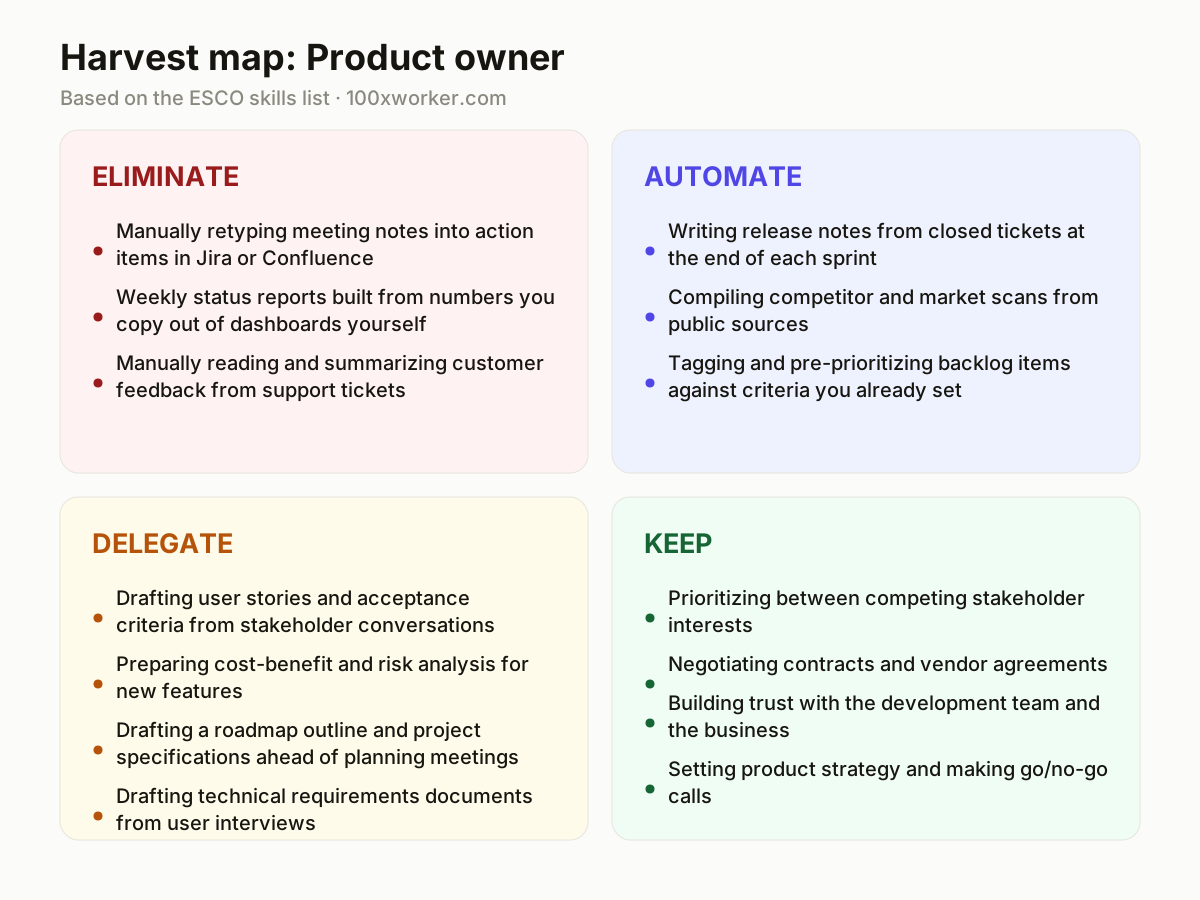
AI does not eliminate the product owner role, but it does reshape the task list underneath it. Some tasks disappear because AI performs them without any need for a human step in between. Others get automated, running on a schedule without you triggering each run. A third group gets delegated, meaning AI drafts the first version and you review, edit, and approve it. The last group stays fully human, because it depends on judgment, relationships, or accountability that no model carries.
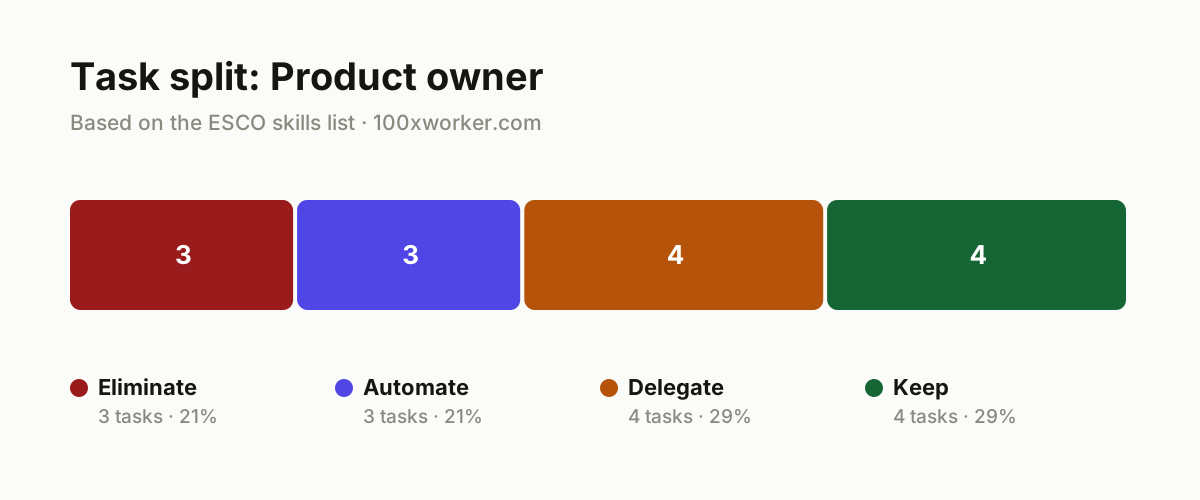
| Task | Bucket | Why |
|---|---|---|
| Manually retyping meeting notes into action items in Jira or Confluence | eliminate | Transcription and summarization tools do this faster and with fewer errors than a person taking notes live. |
| Weekly status reports built from numbers you copy out of dashboards yourself | eliminate | Dashboards can generate this themselves; copying numbers by hand adds no insight. |
| Manually reading and summarizing customer feedback from support tickets | eliminate | Reading large volumes of tickets is exactly the kind of language work AI now handles. |
| Writing release notes from closed tickets at the end of each sprint | automate | An agent reads the ticket history and produces publish-ready text without you drafting it. |
| Compiling competitor and market scans from public sources | automate | Recurring, structured research that an agent can run on a fixed schedule. |
| Tagging and pre-prioritizing backlog items against criteria you already set | automate | Once the criteria are fixed, this is rule-based work that needs no per-item human judgment. |
| Drafting user stories and acceptance criteria from stakeholder conversations | delegate | AI turns raw input into a structured first draft; you check it against business context and approve it. |
| Preparing cost-benefit and risk analysis for new features | delegate | AI lays out the numbers and risk points; you weigh what actually matters for this product and team. |
| Drafting a roadmap outline and project specifications ahead of planning meetings | delegate | A workable first draft saves time; the real sequencing and trade-off decisions stay with you. |
| Drafting technical requirements documents from user interviews | delegate | AI structures the input into usable specs; you check completeness and feasibility with engineering. |
| Prioritizing between competing stakeholder interests | keep | This requires knowledge of internal politics and long-term interests that no dataset captures. (Your edge: You know the people and history behind every request.) |
| Negotiating contracts and vendor agreements | keep | Negotiation depends on building trust and reading tactical positioning, not generating text. (Your edge: You read body language and interests no document records.) |
| Building trust with the development team and the business | keep | Relationships are built through presence and consistency, not generated text. (Your edge: People follow people they trust, not an agent.) |
| Setting product strategy and making go/no-go calls | keep | This requires ownership and context beyond anything captured in tickets or documents. (Your edge: You carry the consequences of the decision, not the model.) |
Will AI replace product owners?
Not likely in the near term. Microsoft Research's applicability score for computer and information systems managers, the closest match to product owner, is 15.2%, meaning generative AI plausibly covers roughly one in seven typical work activities, not the whole job. The tasks AI handles well are drafting-heavy: writing up requirements, summarizing tickets, generating status reports. The tasks that stay with a person involve judgment calls between stakeholders, contract negotiation, and carrying accountability for a go/no-go decision. Anthropic's Economic Index finds most professional AI use is augmentation, a person staying in the loop, rather than full automation. For product owners, that pattern holds: AI drafts, you decide.
What can you do this month to start using AI as a product owner?
Start with one recurring task you already do every sprint. Feed your ticket history into a tool like ChatGPT or Copilot and ask it to draft release notes, then edit and publish. Do the same with meeting transcripts: run them through a transcription tool, turn the output into a first-draft action list, and check it against what you remember before sending it out. Pick a single stakeholder document, such as a requirements draft or cost-benefit summary, and let AI produce the first version instead of a blank page. Track how much editing time that saves you over two or three sprints before rolling it out further.
Which AI tools do product owners already use?
Most product owners start with general-purpose chat tools such as ChatGPT or Claude for drafting user stories, requirements, and stakeholder summaries. Microsoft Copilot is common where teams already run Microsoft 365 or Azure DevOps, since it can read tickets and documents directly inside those tools. Jira and Confluence both ship AI features for summarizing tickets and drafting release notes. Meeting transcription tools convert calls into notes and action items automatically. None of these replace the product owner's judgment; they remove the manual drafting step that used to eat hours every week.
How will the product owner role change in the long term?
Expect the job to shift further toward judgment work and away from document production. Across the EU, 32.7% of people aged 16 to 74 already used generative AI in the past three months as of 2025 (Eurostat), and that adoption curve keeps rising, so AI-drafted documents will become the default starting point rather than something you build from scratch. The ESCO taxonomy already lists cost management, risk analysis, and stakeholder requirements as core product owner skills; those stay, but the manual drafting behind them fades. Product owners who spend less time typing and more time deciding, negotiating, and building trust will hold the more durable version of this role.
AI use splits into automation, where the model completes the task alone, and augmentation, where a person stays in the loop and uses AI as a thinking partner.
Anthropic Economic Index
Become the AI person on your team
Turn ticket history into release notes automatically
Set up a workflow where an AI tool reads closed tickets at the end of each sprint and drafts release notes for you to review. This turns a 30-60 minute writing task into a five-minute edit.
Use AI as a first-draft machine for stakeholder documents
Instead of opening a blank document for requirements or cost-benefit analysis, feed AI the raw stakeholder conversation and ask for a structured draft. You keep editorial control, but you stop starting from zero.
Protect your calendar for the judgment work
Block the time that AI freed up from status reports and note-taking for stakeholder conversations and prioritization decisions. That is the part of the job that stays yours.
Want this for your actual task list?
The free scan on the homepage builds your personal task map in 30 seconds, based on your role and industry.
Run the free task scanTools for this work
| Tool | For which tasks | The sober take |
|---|---|---|
| Microsoft Copilot | Drafting release notes, summarizing tickets, generating status reports (automate and delegate buckets) | Works best when your team already runs Microsoft 365 or Azure DevOps. |
| ChatGPT or Claude | Drafting user stories, acceptance criteria, requirements documents, and cost-benefit analysis (delegate bucket) | General-purpose and tool-agnostic, a good starting point without new integrations. |
| Jira and Confluence AI features | Tagging and pre-prioritizing backlog items, summarizing tickets (automate and eliminate buckets) | Built into tools most product owners already use daily. |
| Meeting transcription tools (Otter.ai, Microsoft Teams transcription) | Converting meetings into notes and action items (eliminate bucket) | Cuts manual note-taking but still needs a human check for accuracy. |
Prompts to try today
Draft release notes from closed tickets
Turn stakeholder notes into user stories
Build a first-draft cost-benefit analysis
Related jobs
Frequently asked questions
Does AI replace the need for a product owner?
No. Microsoft Research's applicability score for the closest matching occupation, computer and information systems managers, is 15.2%, meaning generative AI plausibly covers a minority of daily tasks. Prioritization, negotiation, and accountability for product decisions stay with a person. AI changes the mix of tasks inside the role rather than removing the role itself.
How much of my documentation work can I actually hand to AI?
A large share of first-draft writing: requirements documents, user stories, release notes, and cost-benefit summaries. Anthropic's Economic Index shows most professional AI use is augmentation, meaning a person reviews and edits rather than publishing AI output directly. Treat AI drafts as a starting point, not a final deliverable, and always check them against business context before sharing them with stakeholders.
Are product owners using AI already, or is this mostly hype?
Adoption is already broad and growing. Across the EU, 32.7% of people aged 16 to 74 used generative AI in the past three months as of 2025 (Eurostat). Given that product owner work involves heavy writing and analysis, it sits well within the range of jobs where daily AI use is now common rather than exceptional.
Which product owner tasks should I never fully hand to AI?
Keep prioritization between competing stakeholder interests, contract and vendor negotiation, relationship-building with your development team, and any go/no-go decision on product strategy. These depend on context, trust, and accountability that AI cannot carry. Use AI to prepare the analysis behind these decisions, but make the call yourself and own the outcome.
Sources
- Microsoft Research, Working with AI: Measuring the Applicability of Generative AI to Occupations (2025)
- Anthropic Economic Index
- Eurostat, isoc_ai_iaiu (2025)
- ESCO, European Commission
Hendrik De Winne, author of Becoming AI-Savvy, founder of VibeLab. Helps teams redesign their work with AI.
This article was drafted with AI assistance from public data sources and editorially reviewed.