100×worker · job analysis
Will AI Replace Cloud Architects?
Cloud architects design the systems that companies run their business on: cloud infrastructure, data flows, integration layers, and the decisions that lock a company into a provider or a pattern for years. That makes it a job built on judgment, not repetition, which is exactly why the AI question around it gets confused so often.
Microsoft Research analyzed 200,000 real Copilot conversations and scored occupations by how much of their actual work activity generative AI can plausibly do. Computer network architects, the closest US Bureau of Labor Statistics category to a cloud architect, land at 25.2%. That's far below translators (49%, the highest scored occupation) and well above nurses (12%, one of the lowest). It puts cloud architecture in the middle: AI reaches deep into the documentation, code generation, and analysis parts of the job, but not into the parts that involve accountability and negotiation.
Anthropic's Economic Index, which classifies millions of Claude conversations against the O*NET task taxonomy, adds a useful distinction: a lot of AI use in technical work is augmentation (helping a person think through a problem) rather than automation (replacing the task outright). Eurostat reports that 32.7% of the EU population aged 16 to 74 used generative AI in the three months before being surveyed in 2025, so adoption is already mainstream, not a future event. This article breaks the cloud architect role into four buckets: tasks to eliminate, automate, delegate to AI, and keep for yourself.
A cloud architect designs and manages the architecture of cloud-based ICT systems that meet business requirements.
The task split: what AI takes over and what stays yours
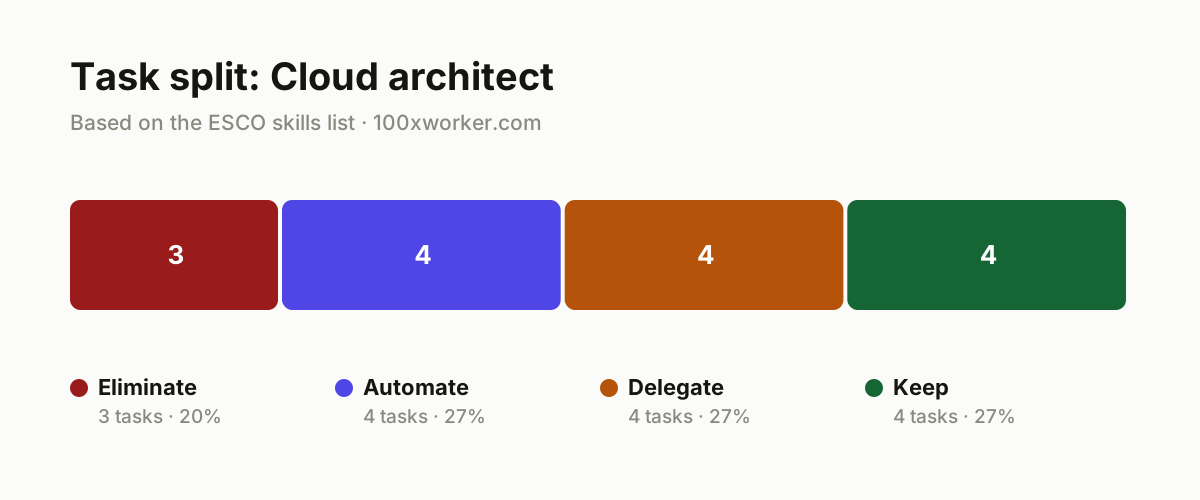
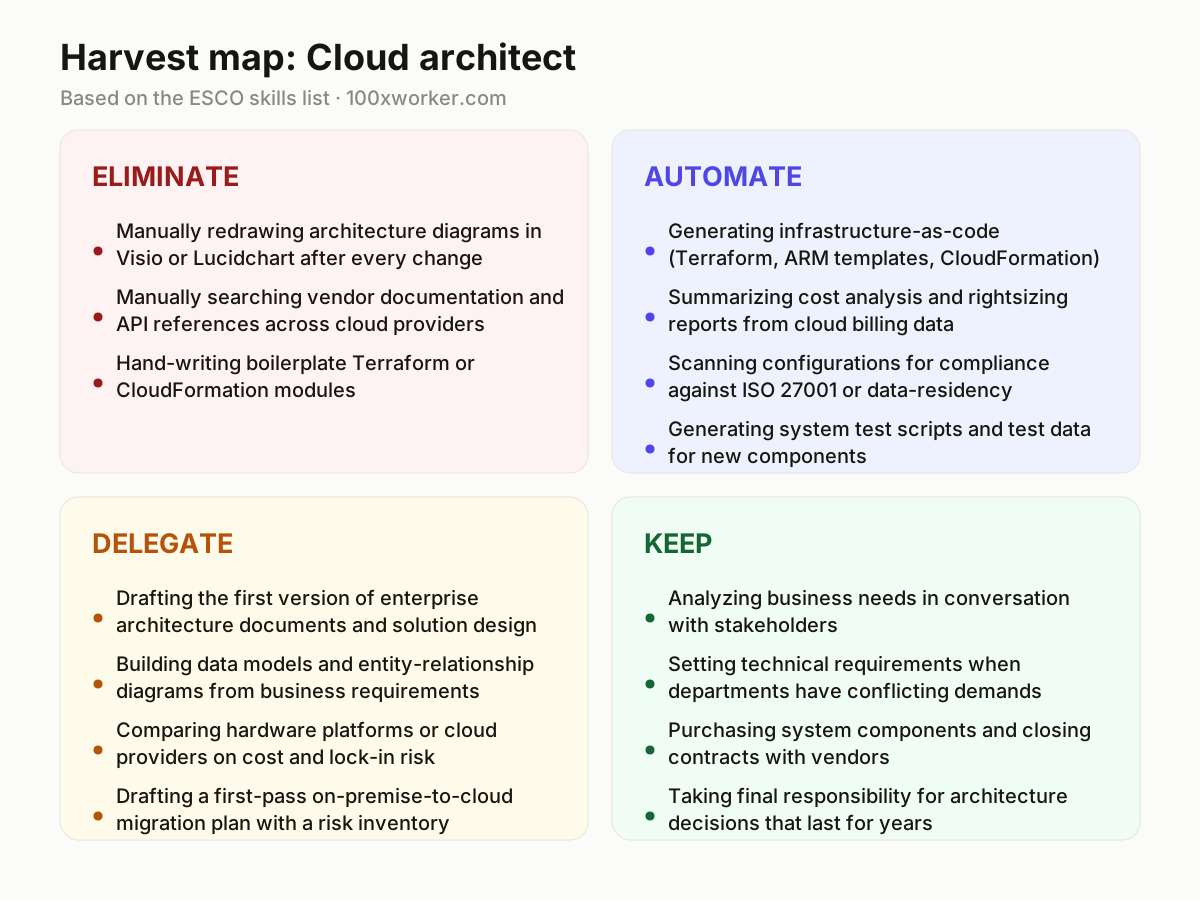
Instead of asking whether AI will replace cloud architects, it helps to break the job into its actual tasks. Some tasks disappear because AI absorbs them entirely. Some get automated with a human review step. Some get delegated to AI for a first draft that you then correct. And some stay with you because they involve judgment, negotiation, or accountability that no model can carry. This eliminate, automate, delegate, keep framework is how we look at every occupation on this site, and it maps directly onto ESCO's task-level description of the ICT system architect role.
| Task | Bucket | Why |
|---|---|---|
| Manually redrawing architecture diagrams in Visio or Lucidchart after every change | eliminate | AI generates diagrams straight from code or configuration, refreshed on demand. |
| Manually searching vendor documentation and API references across cloud providers | eliminate | A chatbot with current documentation answers the question faster than manual lookup. |
| Hand-writing boilerplate Terraform or CloudFormation modules | eliminate | Repeatable infrastructure code is exactly the kind of text language models handle well. |
| Generating infrastructure-as-code (Terraform, ARM templates, CloudFormation) from requirements | automate | Agents produce working templates; you review for security and cost before merging. |
| Summarizing cost analysis and rightsizing reports from cloud billing data | automate | AI turns cost-explorer and billing exports into a readable report faster than a spreadsheet exercise. |
| Scanning configurations for compliance against ISO 27001 or data-residency requirements | automate | Rule-based scanning is agent work, not architect work. |
| Generating system test scripts and test data for new components | automate | Test code follows fixed patterns that AI reproduces reliably. |
| Drafting the first version of enterprise architecture documents and solution design documents | delegate | AI writes the structure and most of the text; you rewrite the decisions that matter. |
| Building data models and entity-relationship diagrams from business requirements | delegate | A solid starting point saves hours, but you decide the final relationships. |
| Comparing hardware platforms or cloud providers on cost and lock-in risk | delegate | AI lines up the options; you weigh the risks that don't fit in a table. |
| Drafting a first-pass on-premise-to-cloud migration plan with a risk inventory | delegate | The structure of a migration plan is largely repeatable, but the exceptions are not. |
| Analyzing business needs in conversation with stakeholders | keep | Gathering real requirements means reading what people don't say out loud. (Your edge: Sensing office politics and hidden agendas) |
| Setting technical requirements when departments have conflicting demands | keep | Prioritizing between competing interests is negotiation, not a task. (Your edge: Negotiating between business and IT) |
| Purchasing system components and closing contracts with vendors | keep | Commercial and contractual tradeoffs stay human work. (Your edge: Owning liability and the long-term vendor relationship) |
| Taking final responsibility for architecture decisions that last for years | keep | Someone has to sign off on a choice the company will live with for years. (Your edge: Personal accountability and long-term vision) |
Which tasks will AI take over from cloud architects?
AI takes over the documentation-heavy and pattern-based parts of the job first: redrawing diagrams, searching vendor docs, writing boilerplate infrastructure code, generating test scripts, and summarizing cost reports. These are tasks with a clear right answer and a repeatable structure. What AI does not take over is the negotiation between departments, the vendor contract terms, or the decision about which architecture the company commits to for the next five years. Those tasks require accountability that sits with a person, not a model.
Will AI replace cloud architects?
No. Microsoft Research's applicability score for computer network architects sits at 25.2%, meaning roughly a quarter of the job's activities overlap with what generative AI can do well, based on real usage patterns rather than speculation. The rest of the job, requirements analysis, stakeholder negotiation, vendor contracts, and final accountability for architecture decisions, stays with the person. Anthropic's Economic Index finds that most AI use in technical work looks like augmentation, a person working through a problem with AI, rather than a task disappearing entirely. The role changes shape before it disappears, if it disappears at all.
How do you become the AI-savvy person on your cloud team?
Start by using AI on the tasks in the eliminate and automate buckets: let it draft diagrams from your IaC repo, generate a first Terraform module, and summarize a billing export before you touch a spreadsheet. Build a habit of reviewing AI output for security and cost assumptions rather than rewriting from scratch. Then push further into the delegate bucket: have AI draft a solution design document or migration plan outline, and spend your time on the parts that need judgment, the risk section, the stakeholder tradeoffs, the final sign-off.
What can you do this month as a cloud architect?
Pick one recurring task from the eliminate bucket, such as diagram updates or vendor doc lookups, and replace it with an AI workflow this week. Next, take one document you draft regularly (a solution design document or a cost report) and build a reusable prompt or template for a first draft. Track how much review time that actually saves you over two weeks before rolling it out to your team, and keep the accountability tasks, contracts, negotiations, final architecture decisions, explicitly with yourself.
Generative AI applies directly to roughly a quarter of a computer network architect's work activities, based on real usage patterns rather than assumption.
Microsoft Research, Working with AI (2025)
Become the AI person on your team
Turn your IaC repo into diagram source of truth
Feed your Terraform or CloudFormation code into an AI diagramming tool and generate architecture diagrams directly from the current state, not from a stale Visio file. Set it up so the diagram regenerates on every merge.
Build a prompt library for recurring documents
Save working prompts for solution design documents, migration plans, and cost reports in a shared team folder. Update them as you find phrasing that produces better first drafts, so juniors on your team reuse them instead of starting from zero.
Make cost review a weekly AI-assisted habit
Pipe your cloud billing export into an AI summary each week instead of once a quarter. Catching a rightsizing opportunity early is worth more than a polished report you only read after the bill is already high.
Want this for your actual task list?
The free scan on the homepage builds your personal task map in 30 seconds, based on your role and industry.
Run the free task scanTools for this work
| Tool | For which tasks | The sober take |
|---|---|---|
| GitHub Copilot | Boilerplate infrastructure code, test scripts, code-level review | Works inside your existing IDE and repo, so it fits the automate bucket without a new workflow. |
| Claude or ChatGPT | Drafting solution design documents, migration plans, vendor comparisons | Good for structured first drafts; you still own the decisions inside them. |
| Eraser.io or similar diagram-as-code tools | Architecture diagrams generated from code or text description | Removes the manual redraw step, but check the output against the actual current infrastructure. |
| Cloud provider cost tools (AWS Cost Explorer, Azure Cost Management) with AI summaries | Cost analysis and rightsizing reports | Native tooling is usually enough; a separate AI cost platform only pays off at scale. |
Prompts to try today
Generate a Terraform module from a requirement
Summarize a cloud cost export into an action list
Draft a solution design document outline
Related jobs
Frequently asked questions
Is the cloud architect job at risk of disappearing because of AI?
Based on Microsoft Research's applicability scoring, no. The comparable US occupation, computer network architects, scores 25.2% on generative AI applicability, meaning most of the job's activities fall outside what AI currently handles well. The role changes shape, with more time spent on requirements, negotiation, and accountability, and less on documentation and boilerplate code, but the occupation itself is not disappearing.
What is the difference between AI automating a task and AI augmenting it?
Anthropic's Economic Index, which classifies millions of Claude conversations against O*NET tasks, distinguishes automation-like use, where AI produces a finished output that replaces the task, from augmentation-like use, where AI helps a person think through a problem they still own. Most AI use in technical, judgment-heavy work like cloud architecture leans toward augmentation rather than full automation.
Should I trust older statistics about which jobs AI will automate?
Be careful with 'robotization percentage' figures still circulating online. Many trace back to Frey and Osborne's 2013 Oxford study, which predates large language models entirely and measured a different kind of automation risk. For a current picture, use occupation-level data published after the generative AI shift, such as Microsoft Research's 2025 applicability scores or Anthropic's Economic Index.
How common is generative AI use among professionals already?
Eurostat reports that 32.7% of the EU population aged 16 to 74 used generative AI in the three months before its 2025 survey. That means AI use at work, including in technical roles like cloud architecture, is already mainstream rather than an early-adopter behavior, which is why building an explicit AI workflow into your job now is worth the time.
Sources
- Microsoft Research, Working with AI: Measuring the Applicability of Generative AI to Occupations (2025)
- Anthropic Economic Index
- Eurostat, Use of generative AI (isoc_ai_iaiu)
- ESCO, ICT system architect occupation profile
Hendrik De Winne, author of Becoming AI-Savvy, founder of VibeLab. Helps teams redesign their work with AI.
This article was drafted with AI assistance from public data sources and editorially reviewed.