100×worker · job analysis
Will AI Replace Database Administrators?
Database administrators spend a lot of their week on work that is repetitive by design: writing backup scripts against known specifications, tracing an outage through log files, keeping schema documentation in sync with reality. That is exactly the kind of work generative AI is good at. Microsoft Research analyzed 200,000 real Copilot conversations and scored occupations on an 'AI applicability' scale. Database administrators land at 29.7%, well below translators (49%) but far above nurses (12%). That number is not a verdict on your job. It is a rough map of where the routine ends and the judgment starts.
Anthropic's Economic Index, built from millions of real Claude conversations mapped against the O*NET task taxonomy, makes a similar point in a different way: AI use in professional work splits into automation-like use (AI does the task) and augmentation-like use (AI helps you do the task). For DBAs, both patterns show up, often on the same day. Eurostat found that 32.7% of the EU population aged 16 to 74 used generative AI in the three months before being surveyed in 2025, so most of your colleagues are already experimenting with these tools whether or not it is part of an official workflow.
This article uses the same four-bucket framework across every occupation on 100xworker.com: eliminate, automate, delegate, keep. Applied to the ESCO occupation profile for database administrator (code 2521.1), it gives you a concrete list instead of a vague warning.
A database administrator designs, secures, and maintains databases; AI takes over routine query and backup tasks.
The task split: what AI takes over and what stays yours
Not every DBA task responds to AI the same way. Some tasks disappear because AI does them faster with no real loss of quality. Some get automated end to end, with you reviewing exceptions. Some get delegated, meaning AI drafts and you decide. And some stay entirely yours because they require organizational judgment, legal responsibility, or trust that no model can build. Sorting your actual task list into these four buckets tells you more than any single applicability percentage.
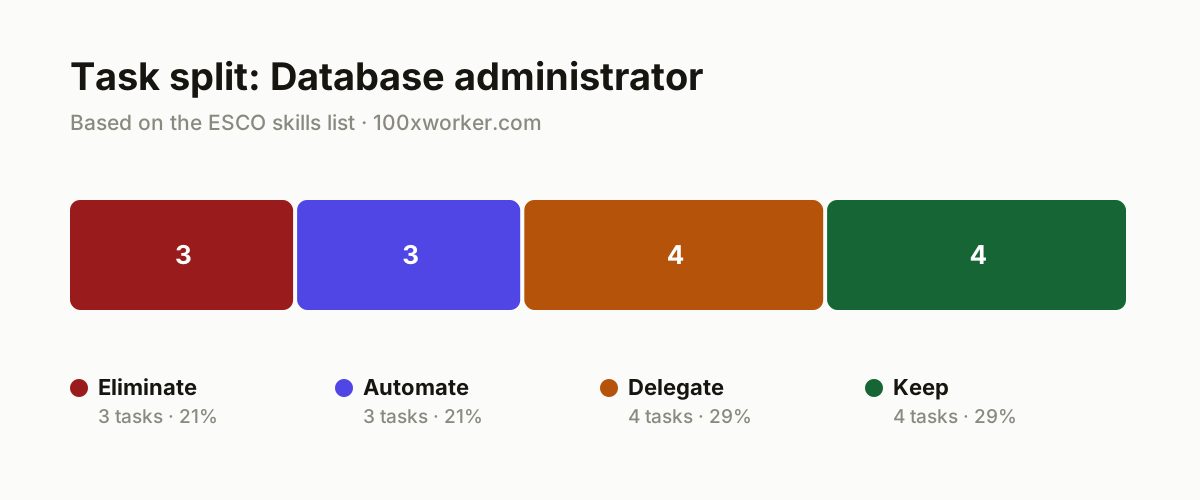
| Task | Bucket | Why |
|---|---|---|
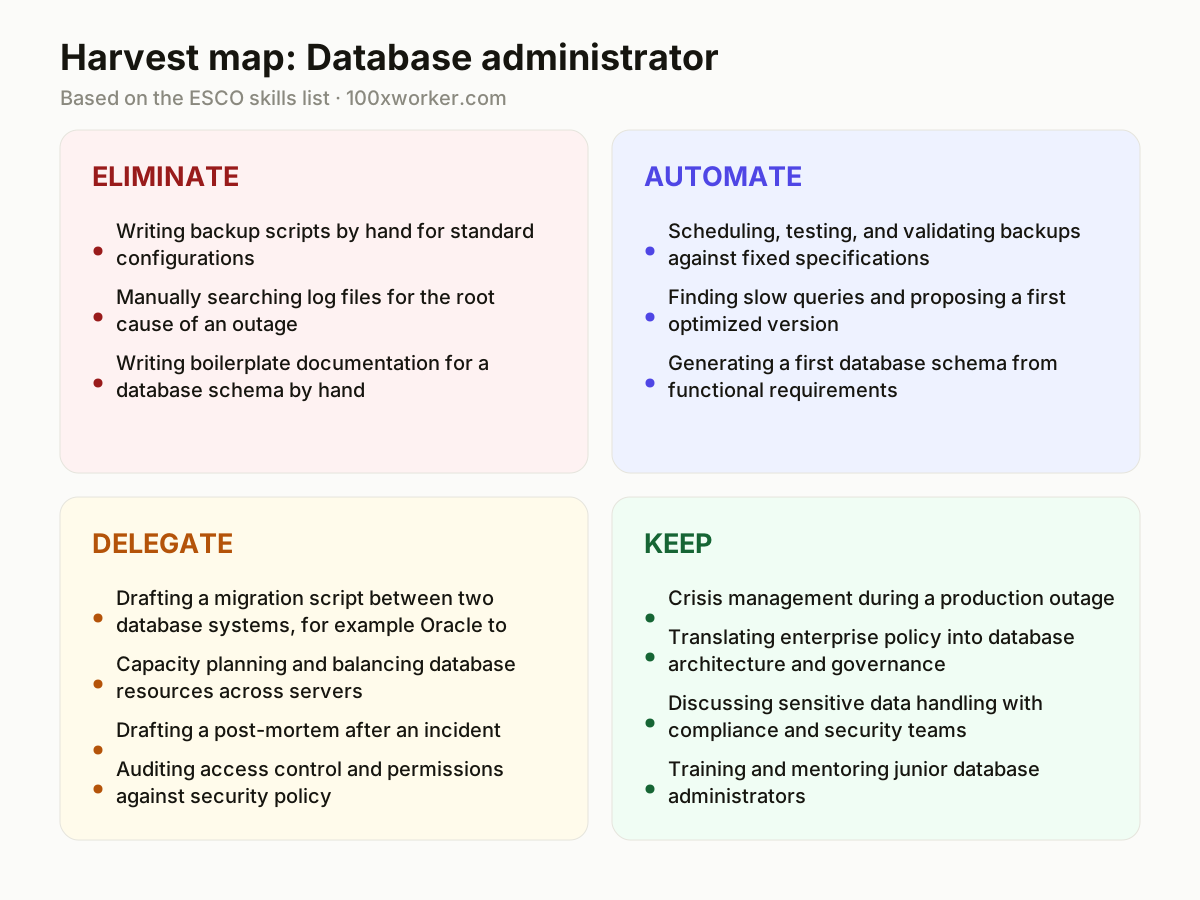
| Writing backup scripts by hand for standard configurations | eliminate | An agent generates and tests this faster and more consistently than someone retyping it each time. |
| Manually searching log files for the root cause of an outage | eliminate | Pattern recognition in logs is exactly where language models beat a human scrolling through text. |
| Writing boilerplate documentation for a database schema by hand | eliminate | The structure already lives in the schema itself, so an agent can derive the text automatically. |
| Scheduling, testing, and validating backups against fixed specifications | automate | Agents follow the spec, run the test restore, and flag only the exceptions to you. |
| Finding slow queries and proposing a first optimized version | automate | Query analysis and index suggestions sit on well documented territory where models reliably spot patterns. |
| Generating a first database schema from functional requirements | automate | Going from a written spec to a working DDL script is a translation task agents now handle at production quality. |
| Drafting a migration script between two database systems, for example Oracle to PostgreSQL | delegate | AI knows the syntax differences, but you test against real production data before releasing it. |
| Capacity planning and balancing database resources across servers | delegate | AI proposes a distribution based on load data, you weigh in the business context. |
| Drafting a post-mortem after an incident | delegate | AI turns the timeline and logs into a first draft, you determine the actual root cause. |
| Auditing access control and permissions against security policy | delegate | AI flags deviations from policy, you decide what counts as a real risk. |
| Crisis management during a production outage | keep | Making decisions under time pressure with incomplete information stays human work. (Your edge: Taking responsibility when things break, at 3am.) |
| Translating enterprise policy into database architecture and governance | keep | This requires organizational knowledge that is never fully documented anywhere. (Your edge: Reading political and organizational context nobody writes down.) |
| Discussing sensitive data handling with compliance and security teams | keep | Legal tradeoffs and business risk are yours to weigh, AI does not get this right. (Your edge: Owning a legally defensible decision.) |
| Training and mentoring junior database administrators | keep | Building trust and passing on experience happens in conversation, not in a document. (Your edge: A mentor decides what a junior can handle now.) |
Which database administrator tasks does AI take over?
AI takes over the parts of the job that follow a known pattern: writing backup scripts against a fixed spec, searching logs for a known error signature, and drafting documentation straight from a schema. It also handles a step further, proposing query optimizations, generating a first schema draft from requirements, and running scheduled backup validation with only exceptions flagged to you. What it does not do well is decide what the organization actually needs, weigh legal risk, or take responsibility when something breaks in production. Those stay with the human DBA.
Will AI replace database administrators?
No single occupation gets fully replaced by generative AI according to the available data. Microsoft Research puts database administrators at 29.7% AI applicability, meaning roughly three in ten work activities show clear overlap with what current models can do well. Anthropic's Economic Index shows the same activities splitting between AI doing the task outright and AI assisting a human who stays in control. The job changes shape: less time on routine scripting and log triage, more time on architecture decisions, security judgment calls, and mentoring. The title survives. The daily task list does not stay the same.
How do you become the AI-savvy person on your database team?
Start by feeding AI the tasks in your automate and delegate buckets: query tuning, migration script drafts, post-mortem timelines. Build a habit of always reviewing AI output against real production data before you ship it, since these tools do not know your specific schema history or your team's incident record. Document the prompts that work so colleagues can reuse them instead of starting from a blank chat window each time. Being the AI-savvy person on the team means being the one who knows exactly where the model is reliable and where it is guessing.
What can you do this month as a database administrator?
Pick one recurring task from the eliminate bucket, such as backup scripts or schema documentation, and set up an agent workflow for it this week. Take one delegate-bucket task, like a migration script or an access audit, and run it through an AI tool once with your own review layered on top, so you can measure the time saved honestly. Write down which parts of your job map to the keep bucket, crisis response, policy translation, compliance conversations, mentoring, and make sure your manager knows those are where your time should go next quarter.
AI use in professional work splits into automation-like use, where AI does the task, and augmentation-like use, where AI helps a human do it.
Anthropic Economic Index
Become the AI person on your team
Build a prompt library for recurring DBA tasks
Save the exact prompts that produce usable migration scripts, index suggestions, or post-mortem drafts. Share them with your team instead of letting everyone rediscover the same wording separately.
Run a shadow test before trusting AI output
Before you let an agent handle scheduled backup validation or query optimization unsupervised, run it in parallel with your existing process for a few cycles and compare results directly.
Own the review checklist, not just the output
Write down what you actually check when reviewing an AI-generated schema or migration script. That checklist becomes your value once the drafting itself is no longer the bottleneck.
Want this for your actual task list?
The free scan on the homepage builds your personal task map in 30 seconds, based on your role and industry.
Run the free task scanTools for this work
| Tool | For which tasks | The sober take |
|---|---|---|
| GitHub Copilot / ChatGPT | Automate query optimization and schema DDL generation, eliminate boilerplate documentation | General purpose, works inside your IDE or terminal, output still needs your review before it touches production. |
| EverSQL / pganalyze | Automate slow query detection and index suggestions | Purpose-built for query tuning, useful for a first pass but you decide what actually gets applied. |
| Claude or GPT via API | Delegate migration script drafting and post-mortem drafting | Strong at translating between SQL dialects, but validate every script against your real schema and sample data. |
| Redgate / Liquibase with AI-assisted docs | Eliminate manual schema documentation | Generates documentation from schema metadata, accuracy checks are still your responsibility. |
| Cloud-native monitoring with anomaly detection (e.g. Datadog) | Automate log pattern analysis for outage triage | Flags anomalies quickly, but confirming the actual root cause stays a human judgment call. |
Prompts to try today
Draft a migration script
Diagnose a slow query
Draft an incident post-mortem
Related jobs
Frequently asked questions
What percentage of database administrator work can AI currently handle?
Microsoft Research puts database administrators at a 29.7% AI applicability score, based on analysis of 200,000 real Copilot conversations mapped against occupational task lists. For comparison, translators score highest at 49% and nurses score low at 12%. This is a measure of task overlap with current generative AI capability, not a prediction of job loss, and it does not account for review time, data sensitivity, or the judgment calls that stay with the DBA.
Is the old 'X% of jobs will be automated' number from 2013 still accurate for DBAs?
No. The widely cited robotization percentages that circulate for many occupations trace back to Frey and Osborne's 2013 Oxford study, published years before large language models existed. It measured a different kind of automation risk and does not reflect how generative AI actually performs on real tasks today. Task-level data from Microsoft Research and Anthropic's Economic Index gives a more current picture for database administrators specifically.
Do AI tools already write full, production-ready database schemas?
AI tools can generate a first draft of a schema from a functional description, and they do this well enough to save real drafting time. That places it in the automate bucket, not the eliminate bucket. You still need to review the schema against your organization's actual data volumes, access patterns, and compliance requirements before deploying it, since the model has no visibility into your specific production history.
How many professionals are actually using generative AI tools day to day?
Eurostat found that 32.7% of the EU population aged 16 to 74 used generative AI in the three months before being surveyed in 2025. Adoption varies by role and region, but the trend line is upward across technical professions, including database administration, where query help and script drafting are common early use cases.
Sources
- Microsoft Research, Working with AI: Measuring the Applicability of Generative AI to Occupations (2025)
- Anthropic Economic Index
- Eurostat, isoc_ai_iaiu (2025)
- ESCO, European Commission occupation taxonomy
Hendrik De Winne, author of Becoming AI-Savvy, founder of VibeLab. Helps teams redesign their work with AI.
This article was drafted with AI assistance from public data sources and editorially reviewed.