100×worker · job analysis
Will AI Replace Data Scientists?
Data scientists spend real hours on tasks that look automatable: cleaning messy spreadsheets, writing SQL queries, building the same dashboard every Monday. Generative AI now handles a meaningful chunk of that mechanical work, which raises an obvious question: what is actually left for you to do?
Microsoft Research analyzed 200,000 real Copilot conversations across occupations and found that generative AI is applicable to about 35.7% of the work activities that make up a data scientist's job (Microsoft Research, Working with AI, 2025). That places data scientists in the middle of the pack: well below translators (49%) but far above nurses (12%). The number describes overlap between AI capability and daily tasks, rather than a prediction that a third of data scientists will lose their jobs.
This article breaks the role down the way ESCO, the European Commission's occupational taxonomy, describes it: task by task. Some tasks disappear outright. Some get automated end-to-end. Some get delegated to AI with you reviewing the output. And some stay firmly in human hands, because they depend on judgment, accountability, or trust that a model cannot supply.
A data scientist collects, cleans, and models data to find patterns and support decisions.
The task split: what AI takes over and what stays yours
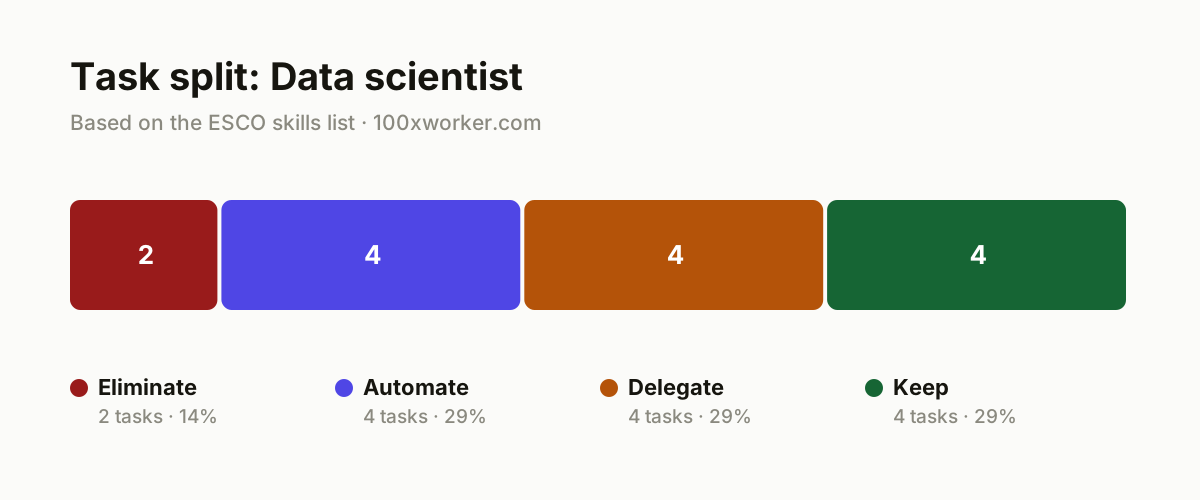
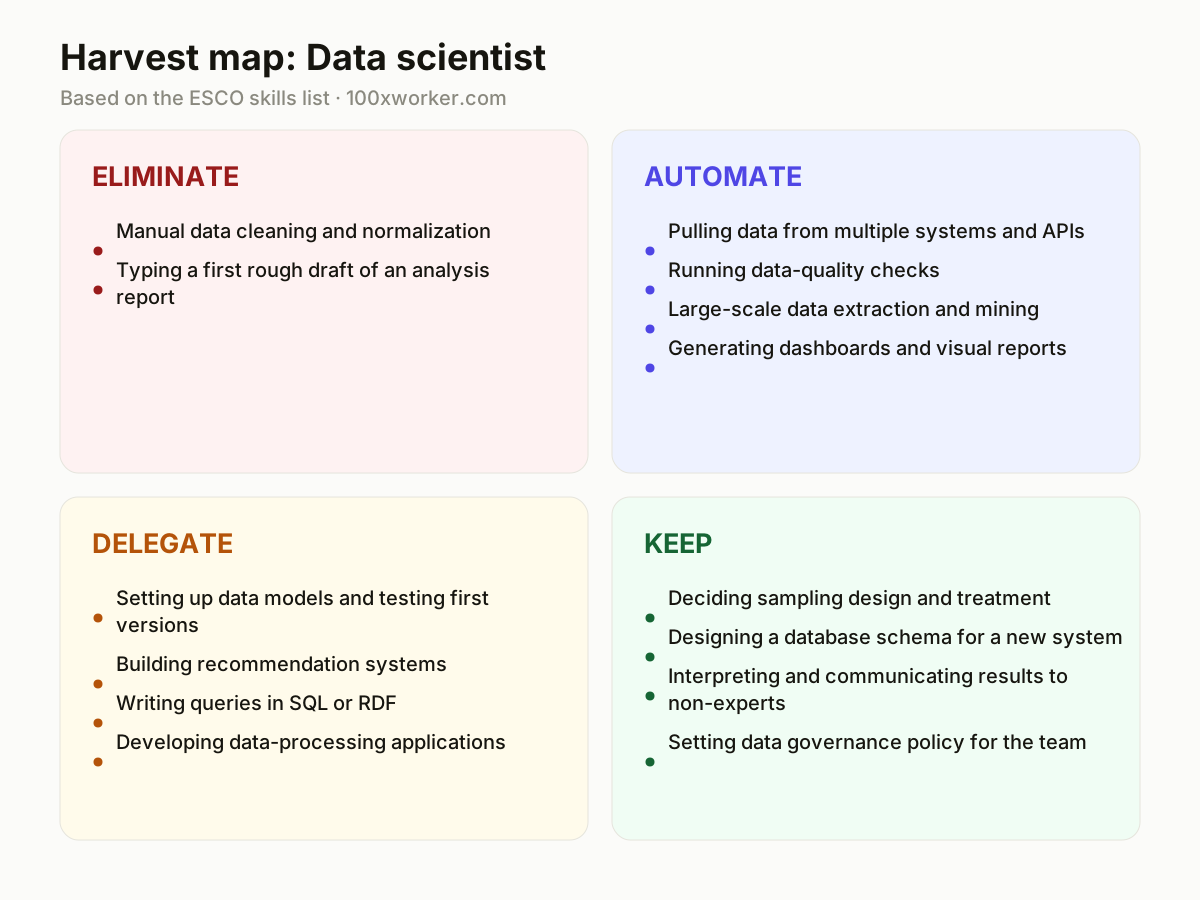
Not every task in a data scientist's job responds to AI the same way. This article sorts the ESCO-listed core tasks into four buckets: eliminate (work that disappears because a tool now does it silently), automate (recurring workflows that run without your daily input, though you still set them up and monitor them), delegate (work AI drafts first and you review before it ships), and keep (work that depends on judgment, context, or accountability that stays with you). The split below follows the actual skill list ESCO uses to define the data scientist occupation.
| Task | Bucket | Why |
|---|---|---|
| Manual data cleaning and normalization | eliminate | Pipelines catch missing values and inconsistencies automatically; this work leaves your task list entirely. |
| Typing a first rough draft of an analysis report | eliminate | Turning numbers into prose is formatting, not analysis. A language model does it in seconds. |
| Pulling data from multiple systems and APIs | automate | Agents combine sources on their own using fixed rules, without you writing every query by hand. |
| Running data-quality checks | automate | Validation rules monitor incoming data continuously and flag anomalies without your involvement. |
| Large-scale data extraction and mining | automate | Searching millions of rows for patterns is computation a model does faster and more consistently. |
| Generating dashboards and visual reports | automate | Charts and dashboards refresh automatically as new data arrives, with no manual formatting. |
| Setting up data models and testing first versions | delegate | AI proposes model variants based on your data; you decide which assumption actually holds. |
| Building recommendation systems | delegate | AI drafts the first architecture and code; you check it for bias and business fit. |
| Writing queries in SQL or RDF | delegate | AI drafts the query; you verify the logic and the result before you rely on it. |
| Developing data-processing applications | delegate | AI writes a first working version of a pipeline; you review, test, and adjust it. |
| Deciding sampling design and treatment | keep | The sampling method you choose determines whether your conclusions hold up at all. (Your edge: you spot the bias a model doesn't see) |
| Designing a database schema for a new system | keep | Architectural choices depend on business context and how the data will be used later. (Your edge: you anticipate how the schema gets misused tomorrow) |
| Interpreting and communicating results to non-experts | keep | Making the story behind the numbers land with leadership takes trust and context a chart can't supply. (Your edge: people trust a colleague faster than a graph) |
| Setting data governance policy for the team | keep | Deciding accountability and process requires agreements across teams and legal judgment. (Your edge: you can't outsource accountability to a model) |
What tasks does AI take over from data scientists?
AI already removes two kinds of work from a data scientist's plate. First, it eliminates repetitive cleanup: manual data normalization, deduplication, and first-draft report writing disappear because pipelines and language models handle them directly. Second, it automates larger recurring workflows: pulling data from multiple APIs, running data-quality checks, mining large datasets for patterns, and refreshing dashboards. None of this requires you to write every query or catch every missing value by hand anymore. What stays is judgment: choosing the right sampling method, designing a database schema that will hold up in two years, and deciding which pattern actually matters to the business. AI speeds up the mechanical steps; you still own the decisions built on top of them.
Will AI replace data scientists?
No single tool replaces the role, but the role is shrinking around AI. Microsoft Research's analysis of 200,000 real Copilot conversations puts the applicability of generative AI to data scientist work at 35.7% of tasks, lower than translators (49%) but far higher than nurses (12%). Anthropic's Economic Index shows a similar split between AI that automates a task outright and AI that augments a human doing it. In practice, the parts of the job built on repeatable steps, like cleaning, querying, and first drafts, move to AI. The parts built on context, like why this metric matters or who might misuse this schema, stay with you.
How do you become the AI-savvy person on your data team?
Start by treating your own task list like an audit. ESCO lists over twenty core skills for the data scientist role, from data mining to database schema design; go through them and mark which ones a model already does passably. Then position yourself where AI output needs a human check: reviewing AI-generated SQL before it runs against production, catching bias in an AI-drafted recommendation engine, or translating a model's output into a decision a non-technical director will act on. Being fast with a chatbot no longer sets you apart. What matters now is knowing which AI output to trust, and which to rewrite.
What can you do this month to start?
Pick one recurring report you write by hand and rebuild it as a template plus prompt, so drafting drops from an hour to ten minutes. Set up one automated data-quality check using existing validation rules instead of manual spot checks. Run one AI-drafted SQL query through a proper review before trusting it in production. Finally, write down, in one page, which of your current tasks fall into eliminate, automate, delegate, or keep. That page becomes your case for what your role should look like in six months, and it gives your manager something concrete to plan around instead of vague AI anxiety.
Generative AI is already applicable to a substantial share, about a third, of the tasks that make up a typical data scientist's job.
Microsoft Research, Working with AI (2025)
Become the AI person on your team
Audit your task list against ESCO skills
Go through the ESCO skill list for data scientists and rate each skill on how much of it AI already handles. This turns a vague fear into a concrete list of what to automate first and what to protect.
Build a personal prompt library
Save the prompts that reliably produce a good first draft of a report, a SQL query, or a data-quality check. Reuse and refine them instead of rewriting instructions every time.
Own the review step, not just the output
When AI drafts a model, a query, or a dashboard, be the person who catches the bias, the wrong join, or the misleading chart before it ships. That review step is where trust in your work gets built.
Want this for your actual task list?
The free scan on the homepage builds your personal task map in 30 seconds, based on your role and industry.
Run the free task scanTools for this work
| Tool | For which tasks | The sober take |
|---|---|---|
| GitHub Copilot / Cursor | developing data-processing applications, first-draft pipeline code | Speeds up the delegate-bucket coding work; you still review logic and edge cases. |
| ChatGPT / Claude | drafting analysis reports, summarizing findings for non-experts | Good for the eliminate-bucket first draft, weak on domain-specific nuance without your input. |
| dbt + Great Expectations | data-quality processes, validation rules | Automates the checks that used to eat a data scientist's afternoon. |
| Power BI / Tableau with AI features | generating dashboards and visual reports | Refreshes visuals automatically, but you still decide which metric belongs on the dashboard. |
Prompts to try today
First-draft analysis report
SQL query review
Bias check for a recommendation system
Related jobs
Frequently asked questions
What percentage of a data scientist's job can AI already do?
Microsoft Research analyzed 200,000 real Copilot conversations and found generative AI applicable to about 35.7% of the work activities in data scientist roles, based on the closest matching US occupational category. For comparison, translators scored highest at 49% and nurses lowest at 12%. That number describes task overlap, not job loss; most data scientists keep their title while their day-to-day mix of tasks shifts toward review, judgment, and communication instead of manual cleanup and querying.
Which data scientist tasks are safest from AI automation?
Tasks that require contextual judgment stay hardest to automate: choosing a sampling method that avoids bias, designing a database schema that anticipates future misuse, and communicating results in a way a skeptical director will actually trust and act on. Anthropic's Economic Index shows this same pattern across occupations: AI use splits between automating repeatable steps and augmenting a human who still owns the final call. Data governance decisions, like setting data policy for a team, fall firmly on the augmentation side.
How is AI use among data professionals changing?
Adoption of generative AI tools is rising fast across the workforce. Eurostat reports that 32.7% of the EU population aged 16 to 74 used generative AI in the three months before being surveyed in 2025. Data scientists, who already work with query languages, statistics, and coding tools daily, tend to adopt AI coding and drafting assistants earlier than the general population, though no occupation-specific adoption figure for data scientists is available in current public data.
Does the ESCO taxonomy show data scientist skills becoming obsolete?
ESCO lists over twenty core skills for the data scientist role, covering everything from data mining to database schema design and statistics. None of these skills disappear outright; AI changes how much manual effort each one requires. Skills tied to mechanical steps, like data cleansing or running standard queries, shift toward oversight. Skills tied to design and interpretation, like schema design or explaining findings to non-experts, remain largely intact and arguably grow more valuable as raw execution gets cheaper.
Sources
- Microsoft Research, Working with AI: Measuring the Applicability of Generative AI to Occupations (2025)
- Anthropic Economic Index
- Eurostat, isoc_ai_iaiu (generative AI use, EU population 16-74)
- ESCO occupational taxonomy, European Commission
Hendrik De Winne, author of Becoming AI-Savvy, founder of VibeLab. Helps teams redesign their work with AI.
This article was drafted with AI assistance from public data sources and editorially reviewed.