100×worker · job analysis
Will AI Replace Data Analysts?
Data analysts spend a large part of their week on tasks that follow predictable rules: pulling numbers from a CRM, matching them against a spreadsheet, checking for duplicates, building the same report as last week with new figures. That kind of work is exactly what generative AI is good at, and the data now backs this up. Microsoft Research analyzed 200,000 real conversations people had with Copilot at work and scored how applicable generative AI is to each occupation's actual tasks. For data scientists, the occupational category closest to data analysts, that applicability score came out at 35.7%, well above the low end (nurses, 12%) but below the top scorer (translators, 49%).
That single number does not tell you whether your job disappears. It tells you that roughly a third of the task mix is now something AI can do reasonably well, at least as a first pass. The rest, including deciding what question the data should answer, judging whether a dataset is trustworthy, and presenting findings to a skeptical VP, still needs a person. This article breaks the data analyst role into four buckets, eliminate, automate, delegate, and keep, so you can see exactly where the shift is happening.
A data analyst collects, cleans, analyzes, and visualizes data to support business decisions.
The task split: what AI takes over and what stays yours
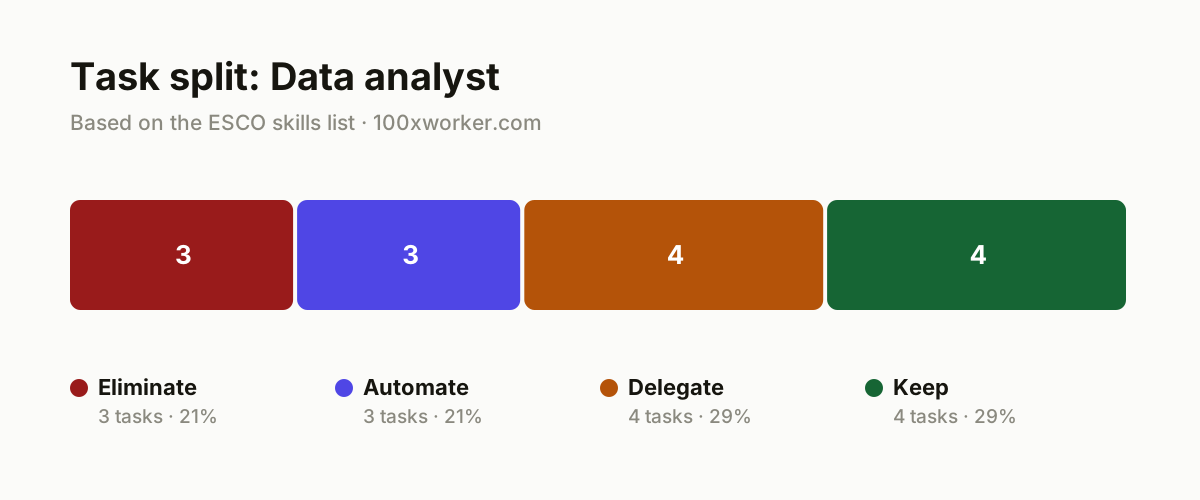
We sort a data analyst's real tasks into four buckets. Eliminate covers work that AI plus modern data infrastructure makes pointless to do by hand at all. Automate covers work an AI system or agent can run largely unsupervised, following fixed rules. Delegate covers work where AI produces a strong first draft that you still need to check, edit, or adapt. Keep covers work that stays with you because it needs organizational context, judgment, or trust that no model has access to.
| Task | Bucket | Why |
|---|---|---|
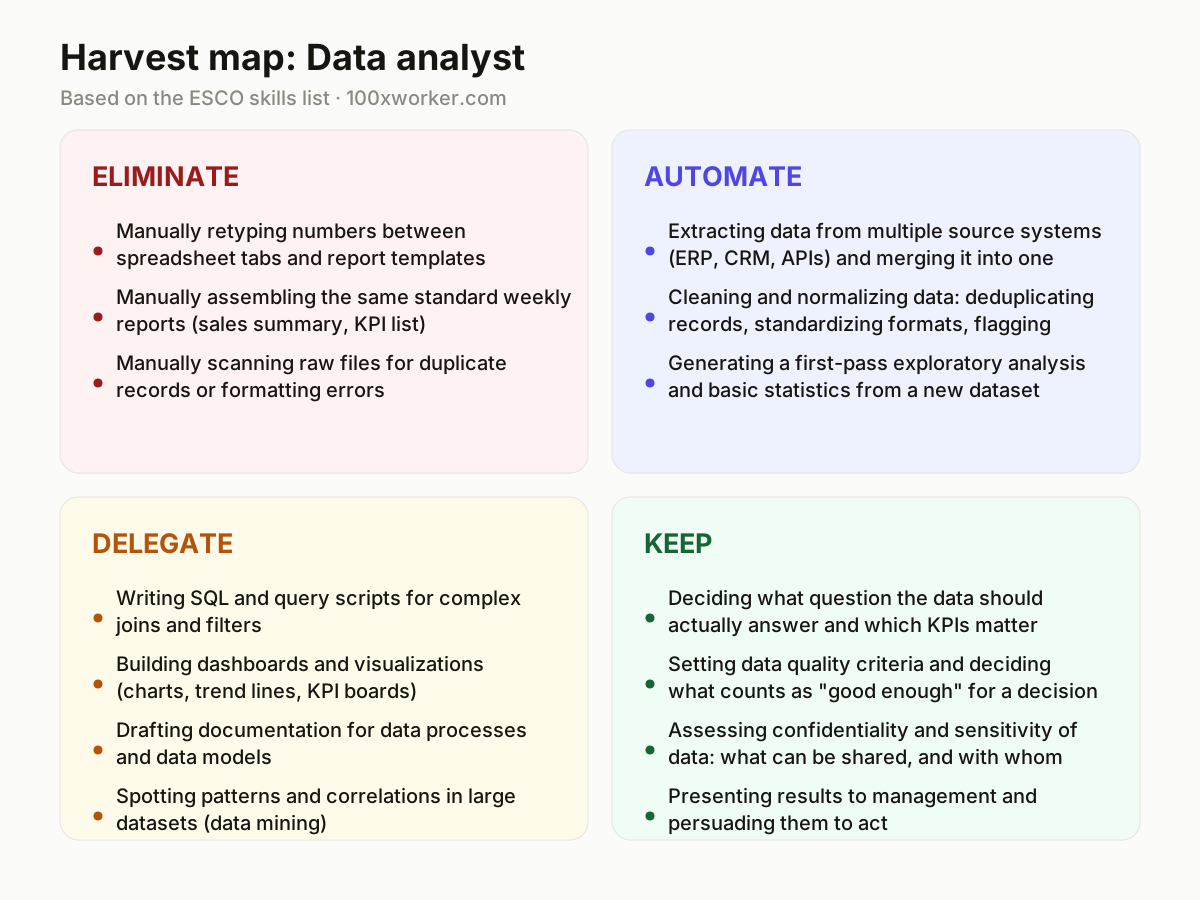
| Manually retyping numbers between spreadsheet tabs and report templates | eliminate | Automated data pipelines make manual copying between files unnecessary. |
| Manually assembling the same standard weekly reports (sales summary, KPI list) | eliminate | Live dashboards connected to fixed data sources replace this routine work entirely. |
| Manually scanning raw files for duplicate records or formatting errors | eliminate | Automated validation rules catch these faster and more consistently than a person. |
| Extracting data from multiple source systems (ERP, CRM, APIs) and merging it into one dataset | automate | ETL tools and AI agents do this daily, unsupervised, following fixed rules. |
| Cleaning and normalizing data: deduplicating records, standardizing formats, flagging missing values | automate | Rule-based AI scripts do this repeatably and with fewer errors than manual work. |
| Generating a first-pass exploratory analysis and basic statistics from a new dataset | automate | AI agents produce averages, distributions, and outliers within minutes as a starting point. |
| Writing SQL and query scripts for complex joins and filters | delegate | AI drafts the query, you check the logic against the real data model. |
| Building dashboards and visualizations (charts, trend lines, KPI boards) | delegate | AI delivers a first version, you rework it to fit the stakeholder's actual question. |
| Drafting documentation for data processes and data models | delegate | AI writes a first draft from the underlying code, you add context and exceptions. |
| Spotting patterns and correlations in large datasets (data mining) | delegate | AI scans faster than you can, but you judge whether a pattern is business-relevant and causally sound. |
| Deciding what question the data should actually answer and which KPIs matter | keep | This requires knowledge of the organization and its real problems. (Your edge: Context about the business that no model has access to.) |
| Setting data quality criteria and deciding what counts as "good enough" for a decision | keep | This is a risk judgment with consequences for the organization. (Your edge: Taking responsibility for a judgment call, not a calculation.) |
| Assessing confidentiality and sensitivity of data: what can be shared, and with whom | keep | This requires legal and ethical judgment that goes beyond applying a rule. (Your edge: Ethical and legal judgment a script cannot carry.) |
| Presenting results to management and persuading them to act | keep | Numbers only persuade once someone has earned trust and can handle pushback in the room. (Your edge: Building trust and reading the room in a live conversation.) |
Which data analyst tasks does AI take over?
AI takes over the mechanical middle of the job: pulling data out of ERP and CRM systems, merging it, deduplicating records, standardizing date and currency formats, and flagging missing values. It also produces a first exploratory pass on a new dataset, averages, distributions, obvious outliers, within minutes. What it does not take over is deciding which question the dataset should answer or whether the result is trustworthy enough to act on. Those steps stay with the analyst, because they depend on knowing the business, not the data format.
Will AI replace data analysts?
No, not as a job title, but the task mix inside the job changes substantially. Microsoft Research found generative AI applicable to 35.7% of work activities for data scientists, the closest comparable occupation, based on 200,000 real workplace Copilot conversations. That means roughly a third of the routine work, extraction, cleaning, first-draft dashboards, can be handled by AI today. The remaining two-thirds, framing the right question, judging data quality, handling confidentiality, and persuading stakeholders, still requires a person with organizational context and accountability. The role shifts toward interpretation and judgment, away from manual production.
How many data analyst tasks can AI handle today?
There is no single official percentage for "data analyst" specifically. The closest documented figure is Microsoft Research's 35.7% applicability score for data scientists, drawn from real Copilot usage. Anthropic's Economic Index adds a useful distinction: it classifies AI conversations against O*NET task categories and splits usage into automation-like (AI does the task directly) versus augmentation-like (AI assists while a person stays in control). For data-heavy roles, a large share of current AI use leans augmentation-like: drafting queries, summarizing datasets, or explaining code, rather than fully replacing the analyst's judgment.
What should you do this month as a data analyst?
Start by listing every recurring task you did last month and sorting it into the four buckets: eliminate, automate, delegate, keep. Pick one automate-bucket task, such as data cleaning or first-pass statistics, and set up an AI-assisted workflow for it this week. Pick one delegate-bucket task, like SQL drafting or dashboard building, and practice reviewing AI output critically instead of writing everything from scratch. Spend the time you free up on the keep-bucket work: understanding what the business actually needs from the data, and getting better at presenting findings to people who will push back.
AI usage in data-related work splits between automation-like use, where AI performs the task directly, and augmentation-like use, where a person stays in control and AI assists.
Anthropic Economic Index
Become the AI person on your team
Audit your own task list against the four buckets
Write down every task you did in the last two weeks, then mark each one eliminate, automate, delegate, or keep. Most analysts find that over half their time goes to eliminate and automate work, which is the clearest sign of where to change your workflow first.
Turn AI-drafted queries into a review habit, not a copy-paste habit
When AI generates a SQL query or a dashboard, do not just run it. Check the joins against the actual data model, check filters against edge cases, and note where the AI got the business logic wrong. That review skill becomes more valuable than writing the query from scratch.
Practice explaining a dataset's limits, not just its findings
AI can summarize what a dataset shows. It cannot tell a stakeholder why the sample is biased, why a metric changed definition last quarter, or why a correlation should not drive a decision. Build a habit of stating data limitations out loud before presenting conclusions.
Want this for your actual task list?
The free scan on the homepage builds your personal task map in 30 seconds, based on your role and industry.
Run the free task scanTools for this work
| Tool | For which tasks | The sober take |
|---|---|---|
| GitHub Copilot / Cursor | Automate: SQL and script drafting; Delegate: query writing for complex joins | Good at syntax, unreliable on business logic specific to your data model. |
| ChatGPT / Claude | Automate: exploratory analysis and basic statistics; Delegate: documentation drafts | Useful for a fast first pass, but check numbers against the actual dataset before sharing them. |
| Power BI Copilot / Tableau Pulse | Eliminate: standard recurring reports; Delegate: first-draft dashboards and visualizations | Speeds up dashboard building, but the layout usually still needs reworking for the actual audience. |
| Fivetran / Airbyte (AI-assisted connectors) | Automate: extracting and merging data from ERP, CRM, and API sources | Runs unsupervised once configured, but someone still has to validate the output schema. |
| dbt with AI-generated tests | Automate: data cleaning and normalization; Eliminate: manual duplicate checks | Strong for repeatable pipeline validation, weak at judging whether the data is meaningful. |
Prompts to try today
First-pass exploratory analysis
SQL draft with join-logic check request
Stakeholder-ready summary with limitations stated
Related jobs
Frequently asked questions
Will AI replace data analysts?
Not as a role. Microsoft Research's applicability score of 35.7% for data scientists, the closest comparable occupation, shows AI can handle a meaningful share of the task mix, mostly extraction, cleaning, and first-draft reporting. It does not cover defining the right business question, judging data quality, or persuading stakeholders. Those tasks require organizational context and accountability that current AI systems do not have, so the job changes shape rather than disappearing.
What is the biggest task change for data analysts right now?
The shift is from producing numbers to reviewing and interpreting AI-produced numbers. Tasks like data extraction, cleaning, and first-draft dashboards move from manual work to AI-assisted or AI-automated work. The analyst's time increasingly goes toward checking AI output against the real data model, judging whether findings are business-relevant, and communicating results and their limitations clearly to decision-makers.
Which data analyst skills stay valuable despite AI?
Skills tied to judgment and context stay valuable: defining which KPIs actually matter for a business problem, setting data quality thresholds, evaluating confidentiality and data sensitivity, and presenting findings persuasively to stakeholders who may push back. These require accountability and organizational knowledge that AI tools cannot provide, unlike query writing or basic statistics, which AI increasingly handles as a first draft.
Is the 35.7% Microsoft figure specific to data analysts?
No. It measures data scientists, the closest occupational category in Microsoft Research's Copilot conversation analysis, not data analysts specifically. Data analyst work overlaps heavily with data science on tasks like querying, cleaning, and basic statistics, but the exact percentage for the data analyst title has not been separately published. Treat 35.7% as a reasonable proxy, not an exact figure for this specific role.
Sources
- Microsoft Research, Working with AI: Measuring the Applicability of Generative AI to Occupations (2025)
- Anthropic Economic Index
- Eurostat, isoc_ai_iaiu
- ESCO, European Commission
Hendrik De Winne, author of Becoming AI-Savvy, founder of VibeLab. Helps teams redesign their work with AI.
This article was drafted with AI assistance from public data sources and editorially reviewed.