100×worker · job analysis
Will AI Replace Actuaries, and What Should You Do About It?
Actuaries analyze financial risk for a living, so it is fair to ask how much of that work a language model can now do. Microsoft Research studied 200,000 real conversations people had with Copilot and scored how applicable generative AI is to each occupation's actual work activities. Actuaries scored 15.8%, low compared to translators (49%, the highest scoring occupation) but higher than nurses (12%). That places actuarial work firmly in the middle: some tasks shift a lot, most stay put.
That 15.8% is not a threat number, it is a task map. Anthropic's Economic Index, which classifies millions of Claude conversations against the O*NET task taxonomy, shows a similar pattern across knowledge work: AI use splits between automation-like tasks (AI does the work directly) and augmentation-like tasks (AI supports a person who stays in charge). For actuaries, the automation share concentrates in data handling and first-draft writing. The augmentation share, where you stay the decision-maker, covers model assumptions, client advice, and anything with a signature attached.
The European Commission's ESCO taxonomy classifies actuarial consultant as occupation 2120.1, built around skills like statistical financial reporting, risk analysis, and giving advice on financial matters. Those are exactly the skills that split cleanly into what AI can draft and what a licensed actuary must still decide.
An actuary analyzes and quantifies financial risk, advising on insurance, pensions, and investments.
The task split: what AI takes over and what stays yours
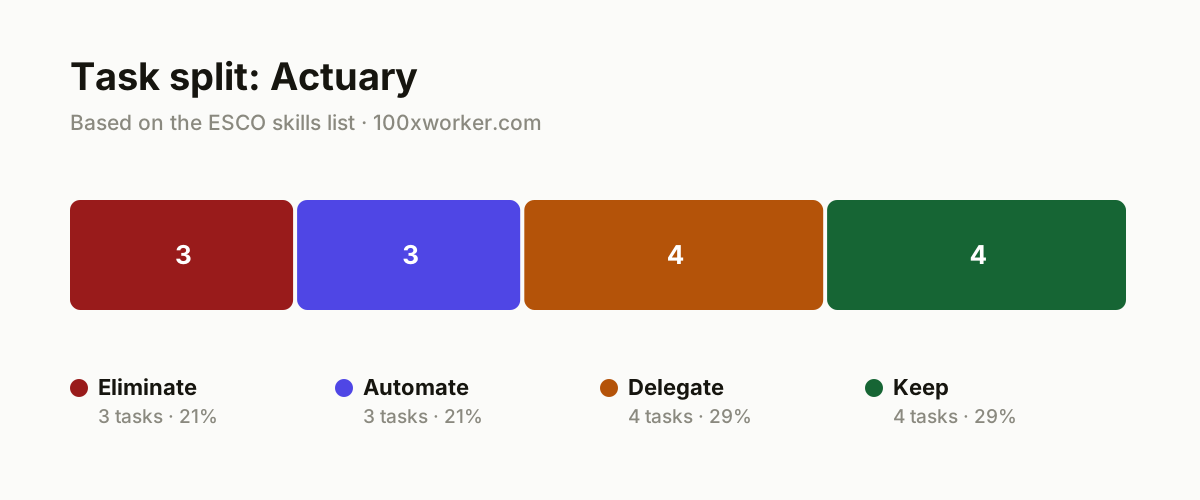
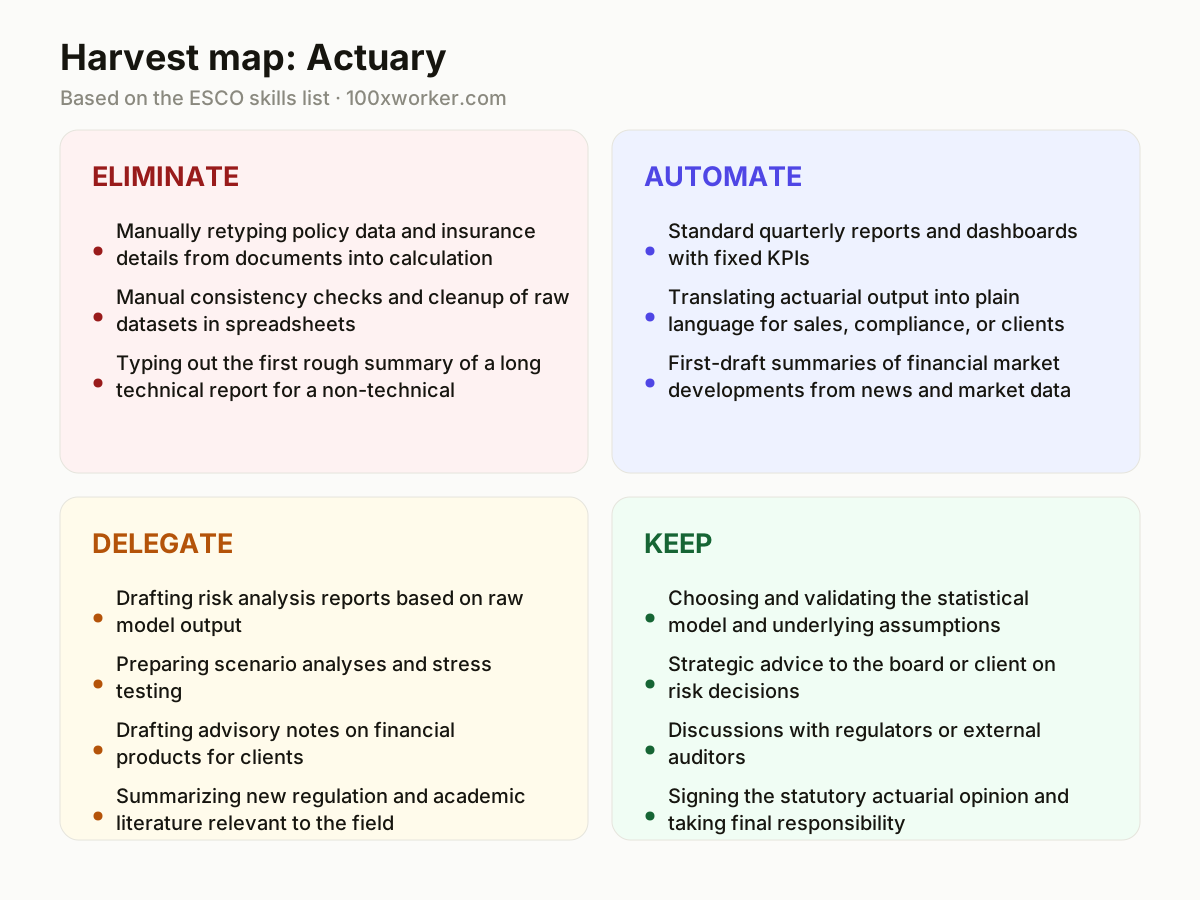
Instead of asking whether AI will replace actuaries, it helps to sort the actual job into four buckets: tasks AI eliminates outright, tasks AI now automates end to end, tasks you delegate to AI but still check, and tasks you keep because they require judgment, accountability, or a signature. This is not a prediction, it is a task-level breakdown of where actuarial work already stands.
| Task | Bucket | Why |
|---|---|---|
| Manually retyping policy data and insurance details from documents into calculation models | eliminate | An AI agent reads and structures source documents faster and with fewer transcription errors. |
| Manual consistency checks and cleanup of raw datasets in spreadsheets | eliminate | Rule-based validation and anomaly detection now handles this work automatically. |
| Typing out the first rough summary of a long technical report for a non-technical audience entirely by hand | eliminate | A language model produces a readable first draft in seconds. |
| Standard quarterly reports and dashboards with fixed KPIs | automate | Fixed format, fixed data sources: an agent generates this production-ready without intervention. |
| Translating actuarial output into plain language for sales, compliance, or clients | automate | A repeatable task with clear style rules, well suited to full automation. |
| First-draft summaries of financial market developments from news and market data | automate | Gathering and structuring information into a fixed template requires no judgment call. |
| Drafting risk analysis reports based on raw model output | delegate | AI writes the first 80%, you review the assumptions and check the conclusions. |
| Preparing scenario analyses and stress testing | delegate | AI varies the parameters and summarizes results, you decide which scenarios matter. |
| Drafting advisory notes on financial products for clients | delegate | AI can prepare a first draft, but you sign off on the actual advice. |
| Summarizing new regulation and academic literature relevant to the field | delegate | AI filters and condenses, you judge the impact on your own models. |
| Choosing and validating the statistical model and underlying assumptions | keep | Requires expertise on which assumptions are realistic for this specific portfolio. (Your edge: judgment about what a model may and may not assume) |
| Strategic advice to the board or client on risk decisions | keep | Combines numbers with business context, internal politics, and the client's actual risk appetite. (Your edge: building trust and persuading people in the room) |
| Discussions with regulators or external auditors | keep | Requires negotiation, explanation, and accountability that no tool can take over. (Your edge: personal credibility in front of a supervisory body) |
| Signing the statutory actuarial opinion and taking final responsibility | keep | The signature and legal liability rest with the person, not the model. (Your edge: personal liability that cannot be transferred to software) |
Which actuarial tasks does AI take over?
AI takes over the mechanical parts of the job first: retyping policy data, cleaning raw datasets, drafting first-pass summaries of technical reports, and translating model output into plain language for non-actuaries. These are high-volume, low-judgment tasks with clear inputs and outputs. Microsoft Research's applicability score of 15.8% for actuaries reflects roughly this slice of the work. Model selection, assumption-setting, and anything requiring a signature stay untouched, because they depend on portfolio-specific judgment and legal accountability that current AI tools do not carry.
Will AI replace actuaries?
No single number supports that claim. Microsoft Research's 15.8% applicability score for actuaries is well below occupations like translation (49%), meaning most actuarial work activities do not currently have a clear generative AI substitute. What changes is the task mix inside the job: less time on data entry and first drafts, more time on judgment calls, client conversations, and regulatory sign-off. The role narrows toward exactly the parts that require a licensed professional's accountability, which is the part AI cannot take on.
How do you become the AI person on your actuarial team?
Start by mapping your own task list into the four buckets above, then push the eliminate and automate tasks onto AI tools first, since they carry the least risk. Build a small internal library of tested prompts for report drafting, scenario summaries, and regulation-tracking, and share it with your team instead of keeping it to yourself. Volunteer to pilot one AI tool on a live project, document what breaks, and report back with specifics. Being the person who can say exactly where AI helps and where it fails becomes more valuable than being the fastest adopter.
What can you do this month to start working with AI as an actuary?
Pick one recurring task from the eliminate or automate bucket, such as a quarterly dashboard or a plain-language summary for compliance, and run it through an AI tool for two weeks alongside your normal process. Compare output quality and time saved. Write down which parts of the output you had to fix every time, since that tells you where your judgment is still required. Then move one delegate-bucket task, like a scenario-analysis draft, into your workflow with a clear review step before anything goes to a client or regulator.
The applicability score reflects the share of real work activities where generative AI is demonstrably useful, based on actual usage patterns rather than task descriptions alone.
Microsoft Research, Working with AI: Measuring the Applicability of Generative AI to Occupations (2025)
Become the AI person on your team
Build a prompt library for recurring reports
Collect the prompts that reliably produce a usable first draft for quarterly dashboards, market summaries, and regulatory literature reviews. Store them where your team can reuse and improve them instead of everyone starting from scratch.
Run a side-by-side pilot before rolling out a tool
Test one AI tool against your current process on a real, low-risk task for two to four weeks. Track time saved and error rate, then present the actual numbers to your manager instead of a general impression.
Own the review checklist, not just the output
For every delegated task, write a short checklist of what you personally verify before signing off, such as assumption sources or data vintage. This protects your accountability while still letting AI do the drafting.
Want this for your actual task list?
The free scan on the homepage builds your personal task map in 30 seconds, based on your role and industry.
Run the free task scanTools for this work
| Tool | For which tasks | The sober take |
|---|---|---|
| Microsoft Copilot (Excel, Word) | eliminate: data cleanup; automate: standard KPI reports | Best where the source data and report format are already fixed and repeatable. |
| Claude (Anthropic) | automate: plain-language translation of results; delegate: first drafts of risk analysis reports | Strong at turning technical output into audience-appropriate language, but still needs a human review pass. |
| ChatGPT with custom instructions | delegate: scenario-analysis summaries; delegate: literature and regulation summaries | Useful for first drafts, weak on portfolio-specific context unless you feed it directly. |
| Python/R with AI coding assistants (e.g. GitHub Copilot) | eliminate: consistency checks; automate: dashboard generation | Speeds up scripting for validation and reporting, does not replace model design decisions. |
Prompts to try today
First-draft risk analysis report
Plain-language translation for compliance
Regulation and literature scan
Related jobs
Frequently asked questions
What percentage of actuarial work can AI currently do?
Microsoft Research's analysis of 200,000 real Copilot conversations found generative AI demonstrably applicable to 15.8% of actuarial work activities. That is a mid-range score compared to other professions studied, well below translators (49%) but above nurses (12%). It covers mainly data preparation, first-draft writing, and translating technical results into plain language, not model selection or signed statutory work.
Which actuarial tasks are safest from AI automation?
Tasks that require licensed judgment and legal accountability stay with the human actuary: choosing and validating statistical model assumptions, advising a board on risk decisions, negotiating with regulators or auditors, and signing the statutory actuarial opinion. These require context, credibility, and personal liability that no current AI tool carries.
Should actuaries learn to use AI tools now or wait?
Start now, on low-risk recurring tasks. The tasks in the eliminate and automate buckets, like data cleanup and standard reporting, carry little downside if you test an AI tool alongside your current process. Waiting mainly costs you the learning curve, since the tools and their limitations are already well documented for tasks like drafting and summarization.
Does the ESCO taxonomy classify actuaries as at risk from AI?
ESCO does not assign AI-risk scores; it classifies actuarial consultant (code 2120.1) by the skills the role requires, such as statistical financial reporting, risk analysis, and financial advice. Those skill categories map onto the same split seen in the applicability data: routine calculation and reporting skills shift toward AI tools, while advisory and risk-judgment skills stay with the person.
Sources
- Microsoft Research, Working with AI: Measuring the Applicability of Generative AI to Occupations (2025)
- Anthropic Economic Index
- Eurostat, isoc_ai_iaiu (generative AI use, EU population 16-74)
- ESCO, European Commission occupation taxonomy
Hendrik De Winne, author of Becoming AI-Savvy, founder of VibeLab. Helps teams redesign their work with AI.
This article was drafted with AI assistance from public data sources and editorially reviewed.