100×worker · job analysis
Will AI Replace Investment Analysts, and What Should You Do About It?
Investment analysts spend their days moving between two very different kinds of work: pulling numbers out of filings and building models, and sitting across from a fund manager defending a call with their own judgment. AI is good at the first kind and mostly useless at the second, which is why the question is not whether AI replaces the job, but which half of it disappears first.
Microsoft Research analyzed 200,000 real Copilot conversations and scored financial and investment analyst work at 27.8% AI applicability, meaning roughly a quarter of the tasks that make up the role overlap with what generative AI already handles well. That is a mid-range score: translators sit at the top of the scale at 49%, nursing sits near the bottom at 12%. ESCO, the European Commission's occupation taxonomy, describes the investment analyst role as researching investments worldwide to make informed recommendations to fund managers, work that spans everything from reading annual reports to judging geopolitical risk.
This article breaks that role into four buckets: tasks AI already does end to end, tasks an AI agent runs with light supervision, tasks AI drafts for a human to finish, and tasks that stay entirely human. It also covers concrete tools and prompts you can use this month.
An investment analyst researches companies and markets to give fund managers evidence-based investment recommendations.
The task split: what AI takes over and what stays yours
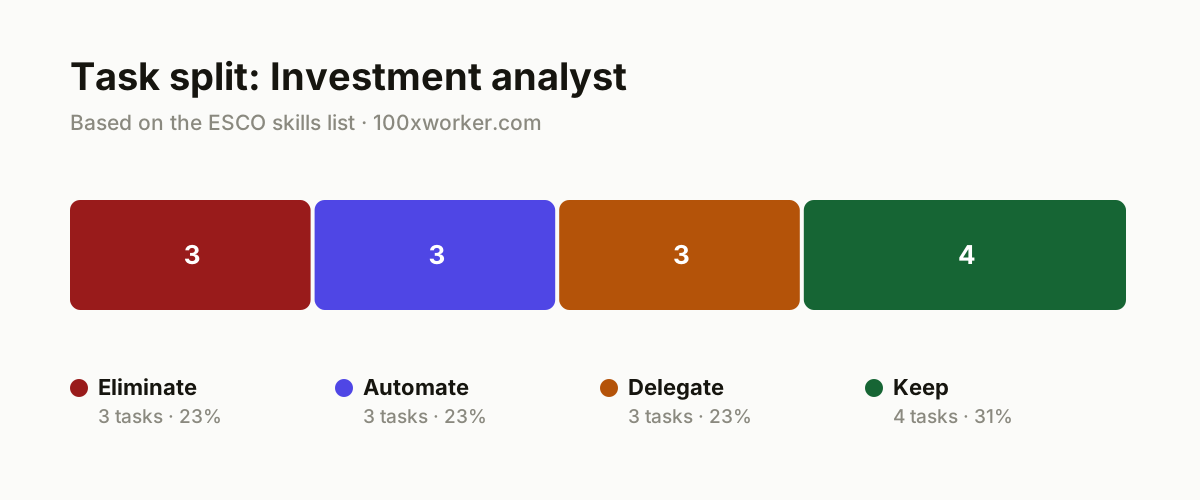
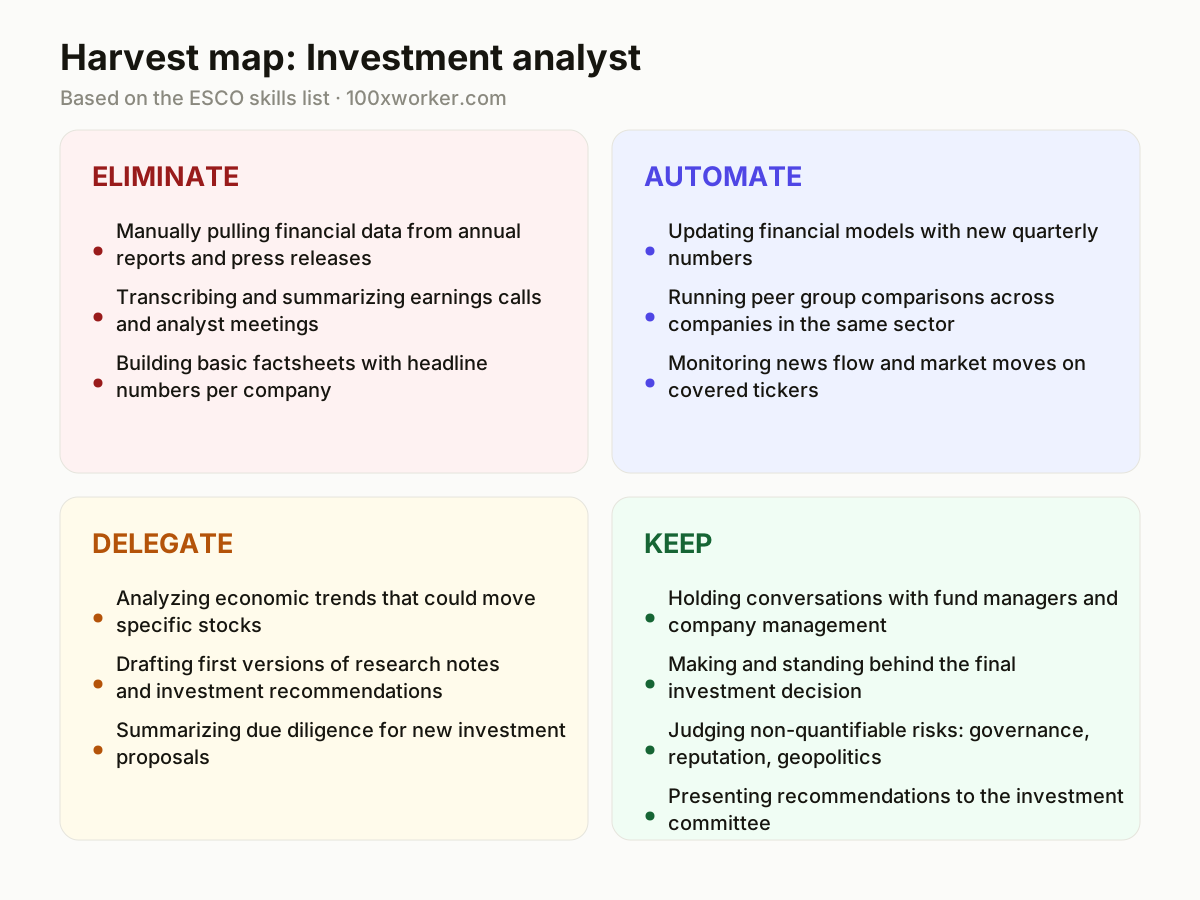
Investment analyst work splits cleanly into four buckets once you look at it task by task instead of as one big job title. Eliminate covers manual work AI already does end to end, with no review needed. Automate covers tasks where an AI agent runs the process but a human sets it up and checks the output. Delegate covers tasks where AI drafts and a human decides. Keep covers the judgment calls, relationships, and accountability that stay with the analyst no matter how good the models get.
| Task | Bucket | Why |
|---|---|---|
| Manually pulling financial data from annual reports and press releases | eliminate | AI reads and structures source documents faster and more consistently than copy-pasting into a spreadsheet. |
| Transcribing and summarizing earnings calls and analyst meetings | eliminate | Speech-to-text and summarization are pure processing tasks that need no judgment. |
| Building basic factsheets with headline numbers per company | eliminate | A first-pass overview of revenue, margin, and debt is pure template work. |
| Updating financial models with new quarterly numbers | automate | An agent recalculates DCF and ratio models the moment new data lands, without manual re-entry. |
| Running peer group comparisons across companies in the same sector | automate | Lining up key metrics and flagging outliers is repeatable and rule-based. |
| Monitoring news flow and market moves on covered tickers | automate | Alerts filter noise out of thousands of headlines faster than anyone can scroll. |
| Analyzing economic trends that could move specific stocks | delegate | AI connects macro data to sectors, but translating that into a specific portfolio call needs judgment. |
| Drafting first versions of research notes and investment recommendations | delegate | AI supplies structure and supporting evidence; the final buy, hold, or sell call stays with the analyst. |
| Summarizing due diligence for new investment proposals | delegate | AI gathers and organizes the material, but weighing risk in borderline cases stays human work. |
| Holding conversations with fund managers and company management | keep | Building trust and reading what is not said does not happen through a chat window. (Your edge: Reading nuance and trust in a live conversation) |
| Making and standing behind the final investment decision | keep | Accountability to clients and compliance cannot be outsourced to a model. (Your edge: Owning responsibility for the recommendation) |
| Judging non-quantifiable risks: governance, reputation, geopolitics | keep | These risks slip past models because they need context and experience to weigh properly. (Your edge: Weighing context that has no clean number) |
| Presenting recommendations to the investment committee | keep | Persuading a room, admitting doubt, and fielding tough questions under pressure is a human skill. (Your edge: Persuading a room and arguing through doubt) |
Will AI replace investment analysts?
No, not in the sense of the role disappearing. Microsoft Research puts the AI applicability score for financial and investment analysts at 27.8%, well below occupations like translation (49%) but far above roles such as nursing (12%). That means roughly a quarter of daily work activities can be handled by generative AI today, concentrated in data gathering, summarizing, and model updates. The parts that stay human are client relationships, final investment calls, and judgment on risks that do not show up in a spreadsheet. Firms are more likely to need fewer junior analysts doing grunt work and more senior analysts who can direct AI tools and take responsibility for the output.
Which tasks of an investment analyst does AI take over?
AI is already handling the mechanical front end of the job: pulling numbers out of annual reports, transcribing earnings calls, and building first-draft factsheets. Further up the chain, AI agents update financial models the moment new quarterly data lands, run peer comparisons across a sector, and monitor news feeds for anything relevant to a covered ticker. None of this needs a human in the loop for the first pass. What AI does not do on its own is decide what those numbers mean for a specific portfolio, or put its name behind a buy, hold, or sell call. That judgment stays with the analyst, even when AI writes the first draft of the note.
How does the AI applicability of investment analysts compare to other occupations?
Microsoft's 2025 study of 200,000 real Copilot conversations scored financial and investment analysts at 27.8% applicability, roughly in the middle of the range it measured. Translators topped the list at 49%, while nursing came in at just 12%, showing that AI applicability tracks how much of a job is language and data processing versus hands-on human contact. Older automation studies, like Frey and Osborne's 2013 Oxford paper, predate large language models entirely and used a different method (probability of full automation, not task-level applicability), so their numbers for finance roles are not directly comparable to this newer data.
What can you do this month to become the AI-savvy person on your team?
Pick one recurring task from the eliminate or automate bucket, like updating a peer comparison table or summarizing an earnings call, and build a repeatable AI workflow for it this month. Test the output against a task you did manually last quarter and note where it gets it wrong. Bring that workflow to your team instead of keeping it to yourself. Read the ESCO skill list for your occupation and check which skills on it are already partly automated versus which ones, like portfolio judgment and market relationships, still sit entirely with you. That gap is where your value is moving.
Investment analysts research investments worldwide to make informed recommendations to fund managers.
ESCO, European Commission occupation taxonomy
Become the AI person on your team
Automate one model update this month
Take the quarterly update process for one financial model and script it with an AI agent that pulls new filings and recalculates ratios. Check the first three outputs by hand before trusting it.
Turn earnings calls into structured notes automatically
Feed earnings call transcripts into an AI summarizer that extracts guidance changes, margin commentary, and management tone. Use the output as a draft, not a final note.
Build a peer comparison template AI can refresh
Set up a standard peer group table with the metrics you always pull, then let an AI tool refresh it whenever new filings drop. You review the table and flag outliers yourself.
Want this for your actual task list?
The free scan on the homepage builds your personal task map in 30 seconds, based on your role and industry.
Run the free task scanTools for this work
| Tool | For which tasks | The sober take |
|---|---|---|
| Claude or ChatGPT | Drafting research note structure, summarizing earnings calls, first-pass due diligence summaries | Useful for drafts, but check every number against the source filing. |
| Microsoft Copilot in Excel | Updating financial models, building peer comparison tables | Good at formula and formatting work, weak on judging which comparisons actually matter. |
| AI-powered news and alert platforms | Monitoring news flow and market moves on covered tickers | Cuts scanning time but still needs a human filter for relevance. |
| AI transcription services | Transcribing and summarizing earnings calls and analyst meetings | Accurate for clean audio, less reliable with heavy accents or crosstalk. |
Prompts to try today
Peer comparison draft
Earnings call summary
Research note first draft
Related jobs
Frequently asked questions
Is the investment analyst job at risk of disappearing because of AI?
Not as a job title. Microsoft Research scores financial and investment analyst work at 27.8% AI applicability, meaning about a quarter of daily tasks overlap with what generative AI already does well. The rest, client relationships, final calls, and risk judgment, stays human for now. Expect fewer analysts doing pure data entry and more analysts who direct AI tools and take responsibility for the output.
Which AI tools do investment analysts actually use day to day?
Most use a mix of a general chat assistant (Claude or ChatGPT) for drafting and summarizing, spreadsheet copilots for model updates, and news monitoring tools for tracking covered tickers. None of these are specialized finance products by default, they are general AI tools applied to finance tasks. The specific stack varies a lot by firm size and existing data infrastructure.
How is AI use among finance professionals measured?
Anthropic's Economic Index classifies millions of real Claude conversations against the O*NET task list and splits usage into automation-like use, where AI does the task, versus augmentation-like use, where AI assists a human doing the task. Microsoft Research takes a similar approach with 200,000 Copilot conversations, scoring occupations on what share of their tasks generative AI can plausibly handle. Neither method predicts headcount changes, both measure task overlap.
Should junior investment analysts worry more than senior ones?
The tasks AI eliminates first, data pulling, transcription, basic factsheets, sit disproportionately in junior workloads. That does not mean junior roles vanish, but the entry-level job description is shifting toward directing AI output and catching its errors rather than doing the manual work by hand. Analysts who learn to build and check AI workflows early have an advantage over those who wait.
Sources
- Microsoft Research, Working with AI: Measuring the Applicability of Generative AI to Occupations (2025)
- Anthropic Economic Index
- ESCO, European Commission occupation taxonomy
- Eurostat, generative AI use in the EU population (isoc_ai_iaiu)
Hendrik De Winne, author of Becoming AI-Savvy, founder of VibeLab. Helps teams redesign their work with AI.
This article was drafted with AI assistance from public data sources and editorially reviewed.