100×worker · job analysis
Will AI Replace Financial Advisors?

Financial planning sits in the middle of the pack when it comes to AI exposure. Microsoft Research analyzed 200,000 real Copilot conversations and scored occupations by how much of their daily work generative AI can plausibly touch. Personal financial advisors landed at 35.5%, well below translators (49%) but far above nurses (12%). That number does not tell you your job disappears. It tells you roughly a third of what you currently do by hand can move to a tool.
The useful question is not whether AI replaces financial advisors. It is which of your specific tasks change first. Summarizing a client's annual report, running a retirement projection, or drafting a first-pass risk assessment are pattern-based tasks. AI systems handle those well today. Sitting across from a client during a market crash and making them trust your judgment is a different kind of work entirely.
Across the EU, 32.7% of people aged 16 to 74 used generative AI in the last three months of 2025, according to Eurostat. Your clients are already using these tools to check their own numbers before they walk into your office. That changes what they expect from the meeting.
A financial advisor helps clients plan retirement, investments, risk, and taxes through advice tailored to their situation.
The task split: what AI takes over and what stays yours
Not every task in a financial advisor's job responds to AI the same way. We split the job into four buckets: tasks you should stop doing by hand (eliminate), tasks a tool now does reliably on its own (automate), tasks where AI drafts and you check (delegate), and tasks that stay yours because they need judgment, trust, or accountability (keep). The split follows how Anthropic's Economic Index classifies real usage: some AI work replaces a step entirely, some augments what a person still does.
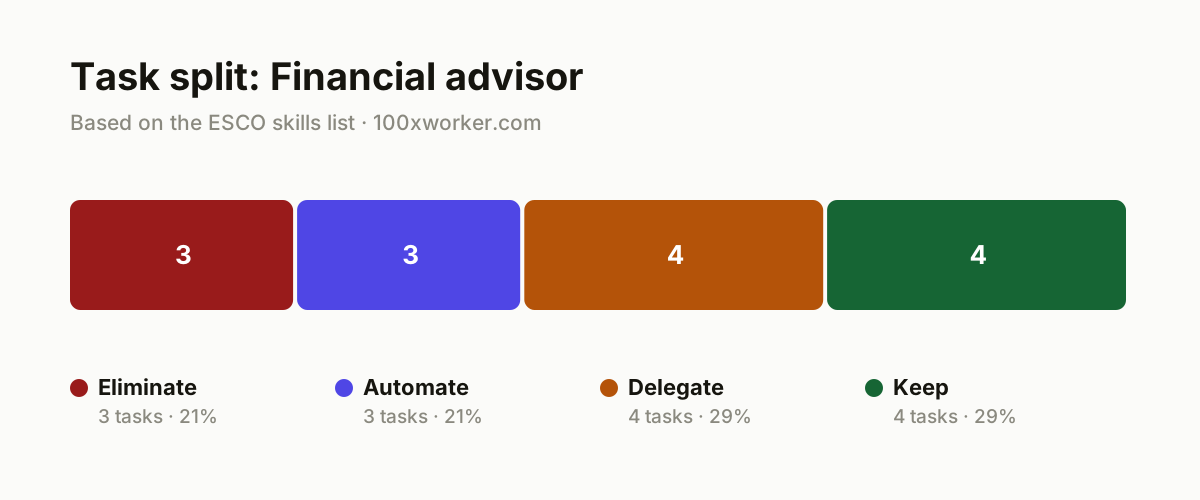
| Task | Bucket | Why |
|---|---|---|
| Manually retyping financial data from bank statements and annual reports into spreadsheets | eliminate | Agents read documents directly. Retyping no longer adds anything. |
| Keeping client credit history in separate spreadsheets outside the core system | eliminate | Duplicate records only create error risk, not value. |
| Manually assembling standard compliance and disclaimer text for each client file | eliminate | Standard text belongs in a template, not in manual work per client. |
| Summarizing annual reports and investment statements into a readable client report | automate | Summarizing financial information is rule-driven and repeatable. |
| Running forecast calculations for retirement, mortgage payoff, or wealth growth | automate | Financial calculation support is pure calculation logic, not judgment. |
| Screening investment portfolios automatically for drift from the client's risk profile | automate | Checking portfolios for deviation is a rule-matching task. |
| Drafting a first version of a financial plan from client data | delegate | AI produces a usable draft. You test it against the client's real situation. |
| Formulating draft advice on a financial product such as insurance or an investment | delegate | The first line of reasoning exists. You weigh the client's context. |
| Analyzing credit history and asset risk into a draft risk assessment | delegate | AI structures the data. You judge the actual risk. |
| Preparing a client meeting: identifying needs and drafting a risk profile in advance | delegate | AI sets up the questions and first read. You steer the conversation. |
| Running the advisory conversation and making the decision together with the client | keep | Giving financial advice depends on trust you build over time, not a script. (Your edge: Reading non-verbal cues and earning trust in the room.) |
| Taking final responsibility for the financial plan and signing off on it | keep | Someone has to be liable for the advice. That cannot be handed off. (Your edge: Liability and ethical judgment when a case is unclear.) |
| Guiding complex estate planning and wealth transfer within families | keep | Family dynamics and discretion need a person, not a model. (Your edge: Discretion and reading family tension.) |
| Reassuring and redirecting clients during market turbulence | keep | You manage panic with your voice and presence, not with text. (Your edge: Staying calm and credible at the right moment.) |
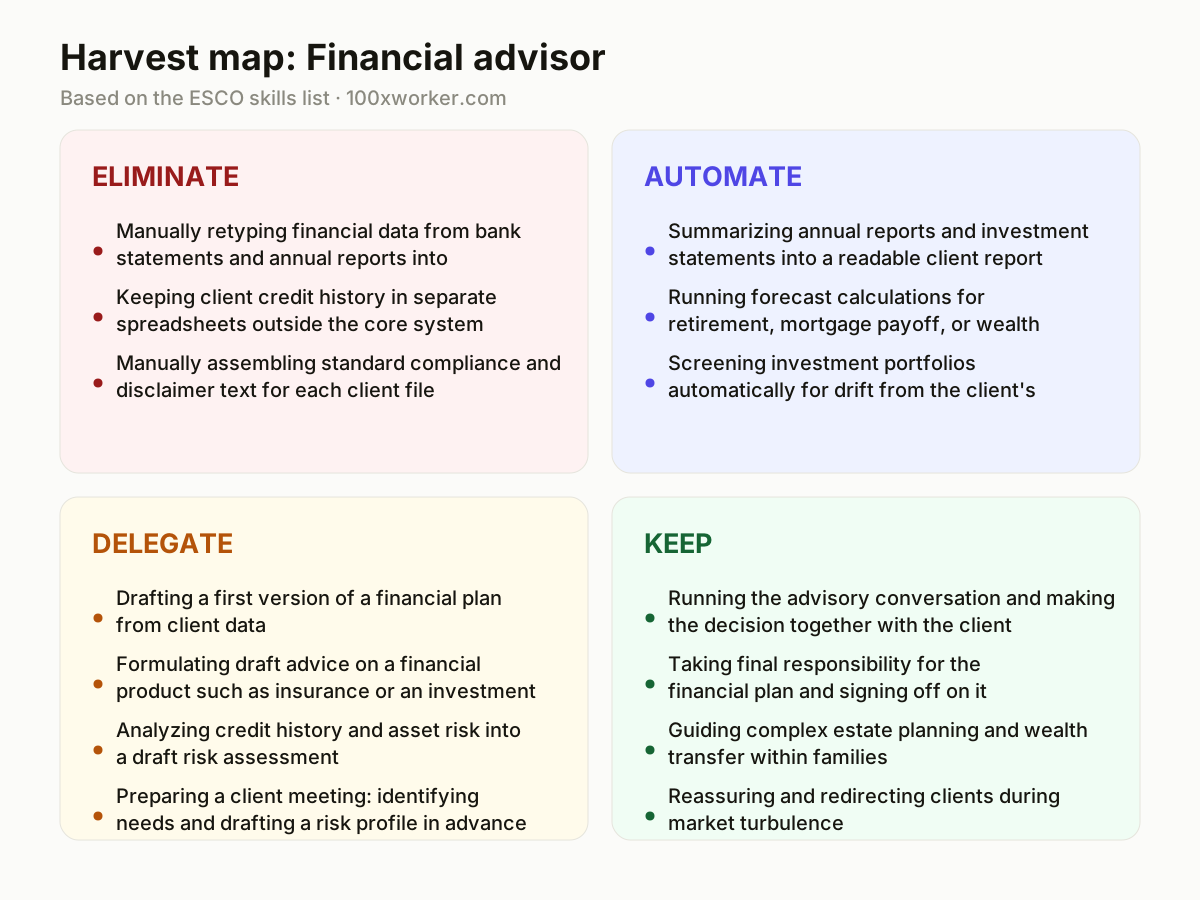
Which tasks of a financial advisor does AI take over?
AI takes over the document-heavy, pattern-based parts of the job: reading bank statements, summarizing annual reports, running retirement or mortgage projections, and screening portfolios for drift from a target risk profile. Microsoft Research found generative AI demonstrably applicable to 35.5% of work activities in this occupation. That leaves roughly two-thirds of the job, including the actual advice conversation, untouched by current tools. The shift is from typing and calculating toward reviewing and deciding.
Will AI replace financial advisors?
Not the role, but a real share of the current task list. A 35.5% applicability score means AI can plausibly assist with a third of daily work activities, not that a third of advisors lose their jobs. Anthropic's Economic Index shows that most real AI use in professional work is augmentation, a human still checks and decides, rather than full automation. Clients paying for financial advice are paying for someone who takes responsibility and reads their specific situation. That part of the job stays human.
How do you become the AI person on your team?
Start by mapping your own task list into the four buckets above instead of guessing. Pick one delegate task, like drafting the first version of a financial plan, and run it through an AI tool for a month while you still write the final version yourself. Document the time saved and the errors you catch. Bring that evidence to your team meeting. The advisor who can show a working workflow, not just an opinion about AI, becomes the person others ask for help.
What can you do this month to work with AI as a financial advisor?
Pick one recurring task, such as summarizing client annual reports or drafting risk profiles, and test an AI tool on it for real client files (with proper data handling). Compare the draft against what you would have written from scratch. Keep a short log of where the AI draft was wrong or missed context. After four weeks, decide whether that task moves to your automate or delegate bucket, and update your workflow accordingly.
Financial planning shows a 35.5 percent AI applicability score, based on analysis of real Copilot conversations rather than task descriptions on paper.
Microsoft Research, Working with AI (2025)
Become the AI person on your team
Build a one-page task map
List your ten most frequent tasks and sort each into eliminate, automate, delegate, or keep. Share it with your compliance or operations lead before rolling out any tool.
Run a 30-day pilot on one delegate task
Choose draft financial plan generation as your test case. Compare AI-drafted plans against your own for one month and track time saved and errors caught.
Keep a client-facing script for AI disclosure
Tell clients plainly which parts of their plan involved AI-assisted drafting and which parts you reviewed and decided personally. Transparency here builds rather than erodes trust.
Want this for your actual task list?
The free scan on the homepage builds your personal task map in 30 seconds, based on your role and industry.
Run the free task scanTools for this work
| Tool | For which tasks | The sober take |
|---|---|---|
| Microsoft Copilot | Summarizing annual reports, drafting client-facing reports, preparing meeting notes | The tool behind Microsoft's own occupation applicability data, so its financial-services skills are documented. |
| Claude (Anthropic) | Drafting first-pass financial plans, analyzing client documents, structuring risk assessments | Anthropic's Economic Index tracks how these conversations split between automation and augmentation. |
| Portfolio monitoring software with AI screening | Automatically flagging portfolio drift from a client's risk profile | Rule-based alerting works well here; treat any AI risk score as a starting point, not a verdict. |
| Document extraction tools (OCR plus AI parsing) | Pulling structured data out of bank statements and annual reports | Reduces manual retyping but still needs a spot-check on numbers that matter. |
Prompts to try today
Summarize a client annual report
Draft a first-pass financial plan
Prepare a client risk-profile intake
Related jobs
Frequently asked questions
Is AI going to replace financial advisors within a few years?
No. Microsoft Research's applicability score of 35.5% for this occupation measures which work activities AI can assist with, not job loss. The advisory conversation, taking liability for a plan, and guiding a client through market panic remain tasks that require a person. Expect your task list to shift, with more time spent reviewing AI drafts and less time on manual summarizing and calculation, rather than the role disappearing.
Which parts of financial planning are safest from AI for now?
The advisory conversation itself, final sign-off on a plan, complex estate planning involving family dynamics, and client reassurance during volatile markets stay with the advisor. These tasks depend on trust, discretion, and accountability rather than pattern recognition, which is what current generative AI tools are strong at.
How many people are actually using AI tools like this already?
Eurostat found that 32.7% of the EU population aged 16 to 74 used generative AI in the three months before the 2025 survey. That means a growing share of your clients arrive at meetings having already run their own numbers through a chatbot, which changes what they expect from your advice.
What's the difference between AI automating a task and AI augmenting it?
Anthropic's Economic Index splits real AI usage into automation-like use, where the tool completes a task with minimal human review, and augmentation-like use, where a person still checks and adjusts the output. Most financial advisory tasks that AI touches today, like drafting a plan or summarizing a statement, fall into augmentation: the advisor still reviews and takes responsibility.
Sources
- Microsoft Research, Working with AI: Measuring the Applicability of Generative AI to Occupations (2025)
- Anthropic Economic Index
- Eurostat, isoc_ai_iaiu
- ESCO, European Commission
Hendrik De Winne, author of Becoming AI-Savvy, founder of VibeLab. Helps teams redesign their work with AI.
This article was drafted with AI assistance from public data sources and editorially reviewed.