100×worker · job analysis
Will AI Replace Accountants? What Actually Changes in Your Job
If you are an accountant wondering how much of your job AI can actually do, the honest answer starts with a number. Microsoft Research analyzed 200,000 real conversations people had with Copilot and scored how applicable generative AI is to the work activities of different occupations. For accountants and auditors, that score lands at 19.5%. Translators sit at the top with 49%, nurses near the bottom at 12%. Accountants land in the middle: enough overlap to change daily habits, far from enough to eliminate the profession.
The ESCO occupational taxonomy, maintained by the European Commission, breaks the accountant role into specific skills: preparing tax return forms, identifying bookkeeping errors, interpreting financial statements, ensuring compliance with accounting regulations, among others. That task-level view matters more than a single applicability percentage, because AI does not touch all of these tasks equally. Some disappear outright, some run on autopilot with your sign-off, some need you and AI working together, and some stay fully yours.
Anthropic's Economic Index, which classifies millions of Claude conversations against O*NET task categories, splits AI use into two patterns: automation-like use, where AI does the task, and augmentation-like use, where AI supports a person doing the task. For accountants, most of the near-term shift falls into the second category. This article walks through which accountant tasks fall into which bucket, and what to do about it this month.
An accountant records transactions, prepares financial statements, and keeps a business compliant with tax law.
The task split: what AI takes over and what stays yours
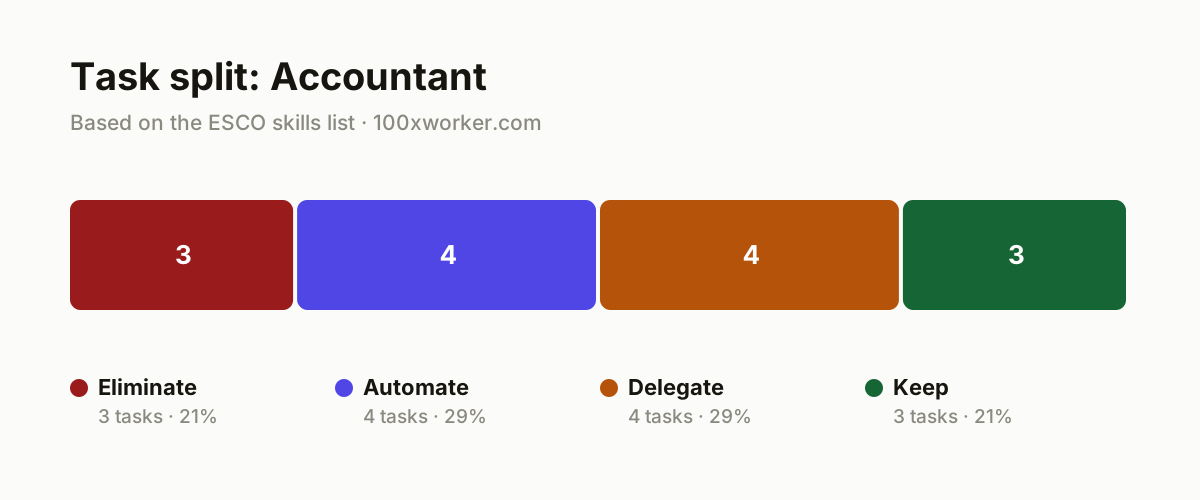
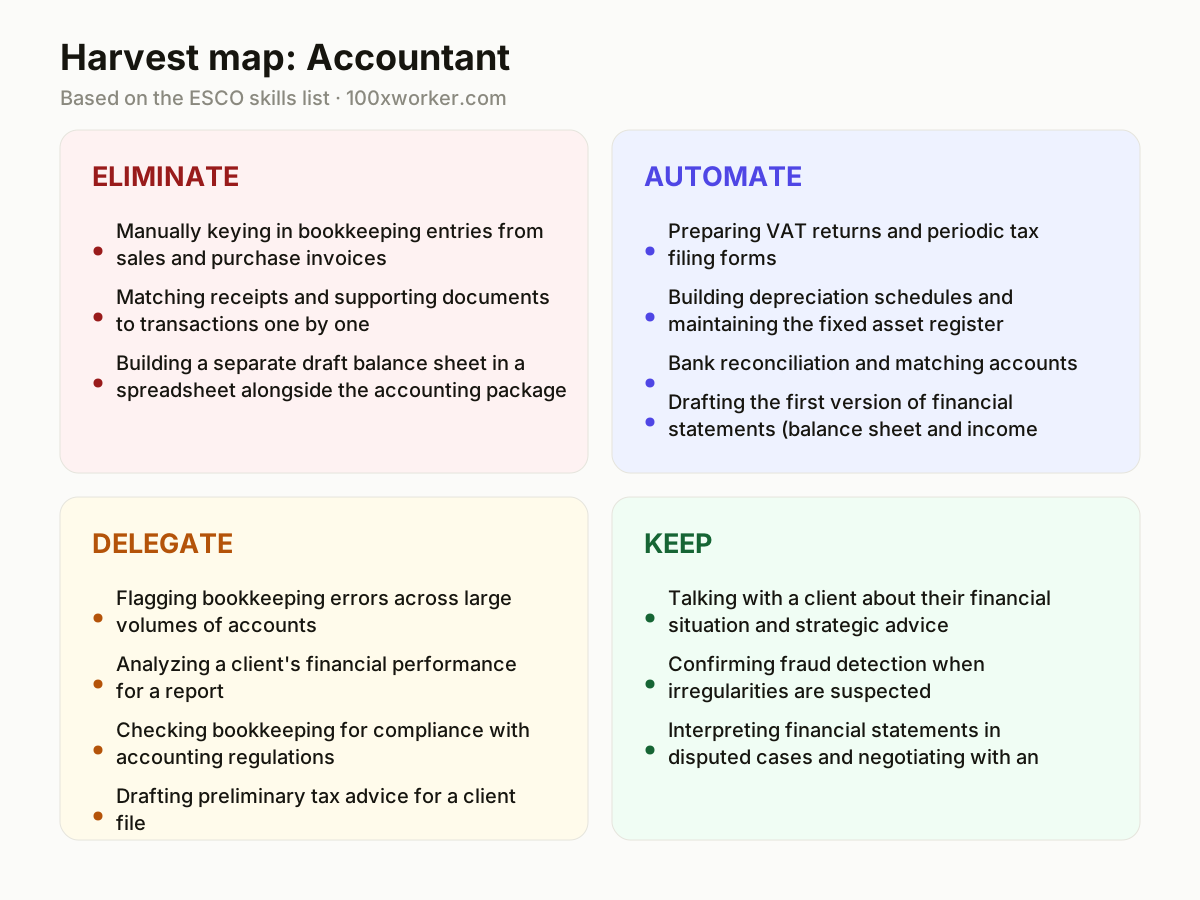
Sorting accountant work into four buckets makes the change concrete instead of abstract. Eliminate covers tasks that software already does end to end, no human step needed anymore. Automate covers tasks an AI agent can run on its own, with you reviewing the output before it goes out. Delegate covers tasks where AI does a first pass and you add judgment, context, or a final check. Keep covers tasks where the human presence itself is the point: trust, liability, and negotiation. The goal is not to guess which bucket your whole job falls into, but to sort your actual task list.
| Task | Bucket | Why |
|---|---|---|
| Manually keying in bookkeeping entries from sales and purchase invoices | eliminate | OCR and accounting software now read invoices and post them straight to the general ledger. |
| Matching receipts and supporting documents to transactions one by one | eliminate | Matching algorithms link documents to transactions faster and with fewer errors than manual searching. |
| Building a separate draft balance sheet in a spreadsheet alongside the accounting package | eliminate | The software already generates this in real time from the live ledger, so duplicate manual work is unnecessary. |
| Preparing VAT returns and periodic tax filing forms | automate | An agent pulls the figures from the accounting package and fills in the form for your final check. |
| Building depreciation schedules and maintaining the fixed asset register | automate | Fixed calculation rules and repeatable math make this ideal for an agent working without line-by-line oversight. |
| Bank reconciliation and matching accounts | automate | An agent matches transactions against bank statements and only surfaces the exceptions to you. |
| Drafting the first version of financial statements (balance sheet and income statement) | automate | Format and figures follow standard rules, so the agent builds the document while you check the assumptions. |
| Flagging bookkeeping errors across large volumes of accounts | delegate | AI screens thousands of lines and marks anomalies, and you decide whether each one is an actual error. |
| Analyzing a client's financial performance for a report | delegate | AI produces a first ratio analysis, and you add client context and industry knowledge. |
| Checking bookkeeping for compliance with accounting regulations | delegate | AI checks entries against rule sets, and you make the call on edge cases and gray areas. |
| Drafting preliminary tax advice for a client file | delegate | AI searches and summarizes tax legislation, and you test the summary against the client's actual situation. |
| Talking with a client about their financial situation and strategic advice | keep | Building trust and reading the real story behind the numbers takes a person. (Your edge: Clients trust a person, not a chatbot.) |
| Confirming fraud detection when irregularities are suspected | keep | The legal and human consequences of this decision require someone accountable. (Your edge: Liability and judgment about intent rest with a human.) |
| Interpreting financial statements in disputed cases and negotiating with an auditor or tax authority | keep | Negotiating gray areas takes experience, relationships, and authority built over years. (Your edge: You build the relationship with tax authorities and auditors through human work.) |
Will AI replace accountants?
No, not as a job title. Microsoft Research puts the AI applicability score for accountants and auditors at 19.5% of work activities, based on 200,000 real Copilot conversations. That is a meaningful chunk of routine work, but far below occupations like translation (49%). What changes is the task mix inside the job: less manual entry and matching, more reviewing AI-drafted output, checking assumptions, and handling the judgment calls software cannot make. The accountants most at risk are the ones who keep doing only the eliminate-bucket tasks by hand.
Which accountant tasks does AI already handle?
AI already reads invoices and posts entries to the ledger, matches receipts to transactions, and keeps running balance sheets up to date without a separate spreadsheet. Beyond that, AI agents can draft VAT returns, build depreciation schedules, reconcile bank accounts, and produce a first version of financial statements, all for you to review before sign-off. These are the eliminate and automate buckets: fully automated or agent-run with human approval at the end.
What can you do this month to start using AI as an accountant?
Pick one recurring task from the automate bucket, such as bank reconciliation or VAT prep, and run it through an AI tool for one client cycle. Compare the AI-generated output against what you would have produced manually, and time yourself. Keep a short log of where the AI draft was right, where it needed correction, and where you had to intervene. That log becomes your evidence for what to hand off next and what still needs a human eye.
How do you become the AI go-to person at your accounting firm?
Start by owning one automation end to end, not by talking about AI in general. Set up an agent for a repeatable task like reconciliation or depreciation schedules, document the time saved and the error rate, and present that to your team or partners with real numbers. Build a shared prompt library so colleagues don't each reinvent the same VAT or ratio-analysis prompt. Volunteer to own the review checklist that verifies AI-drafted statements before they go out, since that checklist role becomes more important as more first drafts come from AI.
Across occupations, generative AI already reaches close to one in five accountant work activities, without touching the job title itself.
Based on Microsoft Research, Working with AI (2025)
Become the AI person on your team
Automate one recurring task first
Pick bank reconciliation or VAT prep, the two most repeatable tasks on the automate list. Run an AI agent on it for one full cycle, then document the hours saved and the exceptions it flagged. Bring that evidence to your team meeting instead of a general pitch about AI.
Build a shared prompt library
Collect working prompts for tax research summaries, ratio analysis, and client email drafts in one shared document. Update it as you find better phrasing. This turns individual trial and error into a firm-wide shortcut.
Own the review checklist
As more first drafts come from AI, someone needs to own the checklist that verifies assumptions in financial statements and tax filings before they leave the office. Volunteer for that role and make the checklist explicit and shared.
Want this for your actual task list?
The free scan on the homepage builds your personal task map in 30 seconds, based on your role and industry.
Run the free task scanTools for this work
| Tool | For which tasks | The sober take |
|---|---|---|
| Xero with AI-assisted bank feeds | bank reconciliation, matching accounts | Handles routine matching well but still needs a human check on unusual transactions. |
| Microsoft Copilot for Excel | building depreciation schedules, drafting financial statement templates | Useful for formula-heavy work, not a substitute for judgment on assumptions. |
| Claude or ChatGPT for tax research drafts | drafting preliminary tax advice, summarizing legislation | Good as a first draft, always verify against the current tax code before sending. |
| OCR invoice capture tools (invoice scanning software) | eliminating manual invoice entry, receipt matching | Cuts manual keying but still needs spot checks on edge-case documents. |
Prompts to try today
Draft a VAT return summary
First-pass ratio analysis
Summarize tax legislation for a client situation
Related jobs
Frequently asked questions
Is the old robotization percentage for accountants still accurate?
Probably not. The widely cited robotization percentages that circulate for many occupations trace back to a 2013 Oxford study by Frey and Osborne, published years before large language models existed. Those numbers modeled a different kind of automation, mostly rules-based software and robotics, not generative AI drafting text and analysis. A task-level breakdown like the one in this article, built on newer data from Microsoft Research and the ESCO taxonomy, gives a more current picture than a single outdated percentage.
How many people actually use generative AI at work?
Across the EU, 32.7% of the population aged 16 to 74 used generative AI in the three months before being surveyed, according to Eurostat's 2025 data. That figure covers general use, not accounting-specific tool adoption, so the share of accountants actively using AI for client work is likely different, and firm-level adoption still varies a lot depending on which software the practice already runs.
What's the difference between AI automating and augmenting accounting work?
Anthropic's Economic Index, which classifies millions of Claude conversations against O*NET task categories, splits AI use into automation-like use, where AI completes the task with little human involvement, and augmentation-like use, where AI supports a person who stays in charge of the task. For accountants, tasks like invoice entry lean toward automation, while tasks like drafting client-specific tax advice lean toward augmentation, since a person still checks it against the real situation.
Will entry-level accountant tasks disappear first?
The task data points that way: manual invoice entry, receipt matching, and building duplicate spreadsheet balances, often the first tasks assigned to junior staff, sit in the eliminate and automate buckets. That suggests the entry point into the profession may shift toward reviewing AI output and learning judgment calls earlier than before. This is an inference from the task breakdown rather than a directly measured stat, so treat it as a trend to watch rather than a confirmed fact.
Sources
- Microsoft Research, Working with AI: Measuring the Applicability of Generative AI to Occupations (2025)
- Anthropic Economic Index
- Eurostat, Use of generative artificial intelligence (isoc_ai_iaiu)
- ESCO, European Commission occupational taxonomy
Hendrik De Winne, author of Becoming AI-Savvy, founder of VibeLab. Helps teams redesign their work with AI.
This article was drafted with AI assistance from public data sources and editorially reviewed.