100×worker · job analysis
Will AI Replace Copywriters, and What Should You Do About It?
Copywriting sits close to the top of the list when researchers measure where generative AI actually gets used at work. Microsoft Research analyzed 200,000 real Copilot conversations and scored occupations by how much of their daily work AI models can plausibly do. Writers and authors, the closest match to copywriting in the data, scored 45.4%. Only translators scored higher, at 49%. Nurses, by contrast, scored just 12%.
That number does not mean nearly half of copywriters will lose their jobs. It means nearly half of the concrete tasks that make up the job, drafting, rewriting, generating variants, checking grammar, can already be done by a language model with a decent prompt. Anthropic's Economic Index, which classifies millions of Claude conversations against standardized task lists, shows a similar pattern: AI use in writing work splits between tasks it fully automates and tasks where it augments a person who stays in the loop.
Across the EU, 32.7% of people aged 16 to 74 used generative AI in the three months before being surveyed in 2025, according to Eurostat. Adoption among people who write for a living is almost certainly higher. The practical question for a copywriter is not whether AI is coming. It is which of your daily tasks it already does better, faster, or both, and which ones still need you.
A copywriter creates the words behind ads, slogans, and campaigns, spoken or written.
The task split: what AI takes over and what stays yours
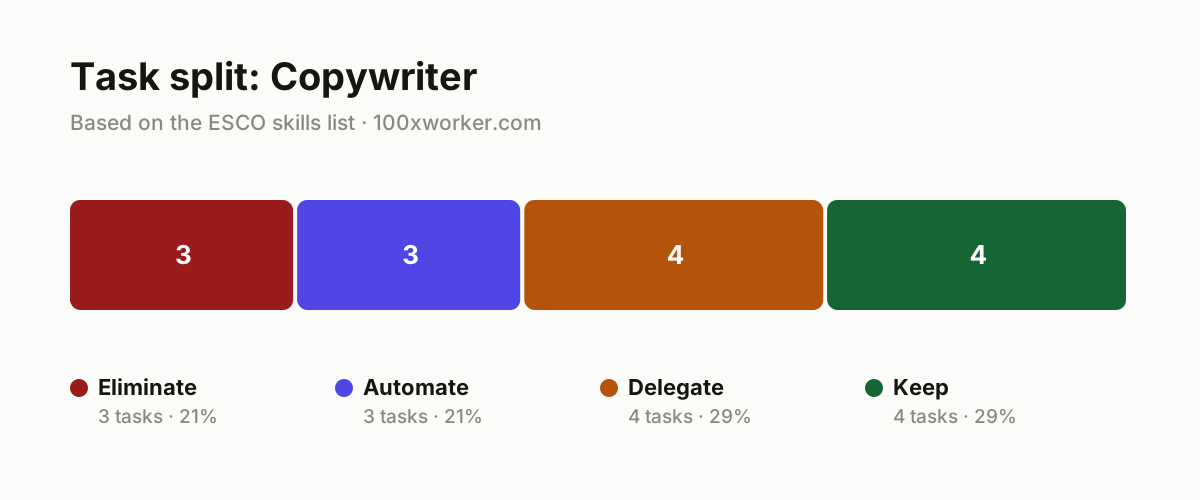
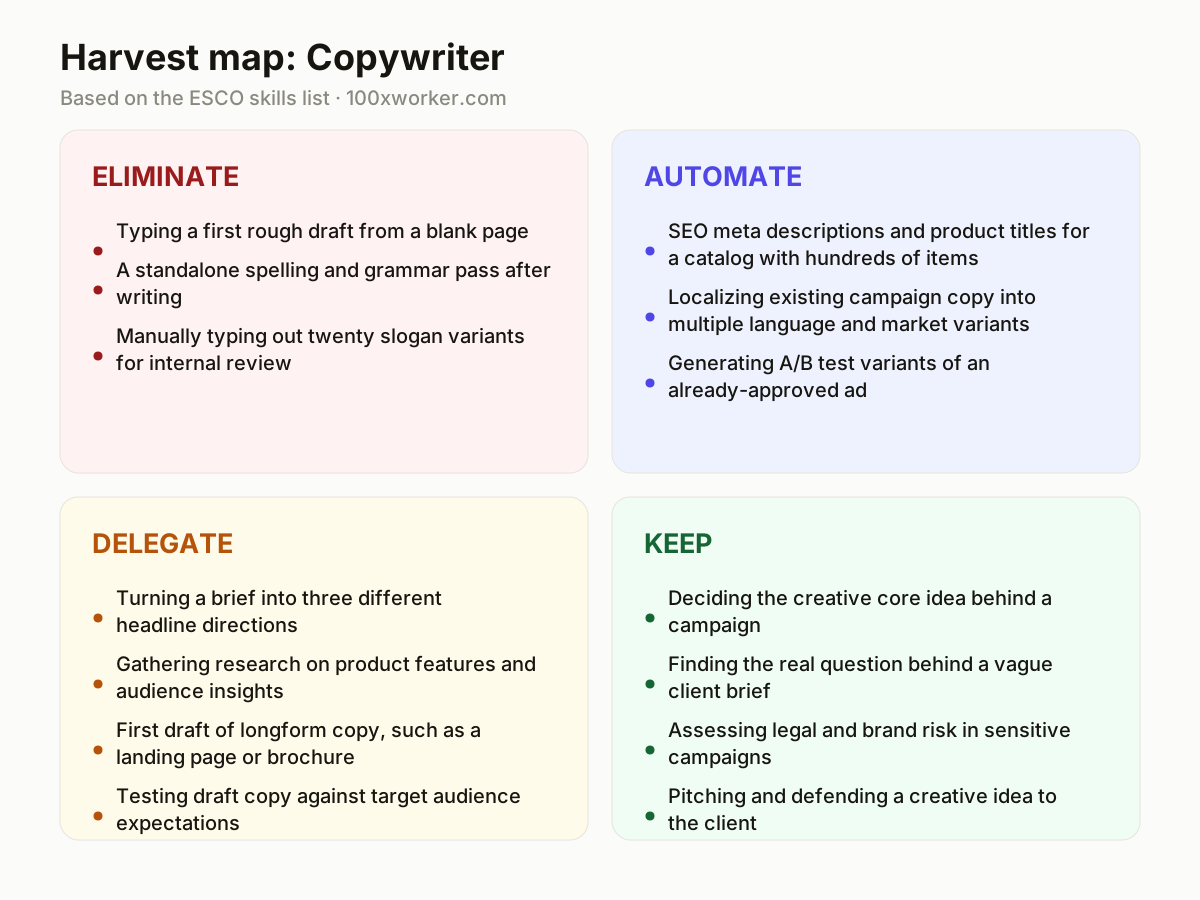
Sort a copywriter's actual work into four buckets: tasks AI makes pointless to do by hand (eliminate), tasks an AI agent can run without supervision (automate), tasks where AI drafts and you finish the work (delegate), and tasks that still need a person taking responsibility (keep). This is not a theory. It maps to what large language models can already do reliably versus what still requires judgment, a client relationship, or legal accountability.
| Task | Bucket | Why |
|---|---|---|
| Typing a first rough draft from a blank page | eliminate | A chatbot produces that zero draft faster, and in several variants at once. |
| A standalone spelling and grammar pass after writing | eliminate | Already built into standard word processors and writing tools. |
| Manually typing out twenty slogan variants for internal review | eliminate | AI generates hundreds of options in seconds, manual listing adds nothing extra. |
| SEO meta descriptions and product titles for a catalog with hundreds of items | automate | Fixed structure and repetition, an agent handles this unsupervised, item by item. |
| Localizing existing campaign copy into multiple language and market variants | automate | Pattern work guided by a terminology list, no creative reinterpretation needed. |
| Generating A/B test variants of an already-approved ad | automate | Mechanical rewriting inside a fixed frame, well suited to an agent. |
| Turning a brief into three different headline directions | delegate | AI supplies tone and structure, you pick the direction and sharpen the best version. |
| Gathering research on product features and audience insights | delegate | AI bundles sources fast, you check accuracy and add the actual insight. |
| First draft of longform copy, such as a landing page or brochure | delegate | AI provides structure and argument, you rewrite tone, rhythm, and sharpness. |
| Testing draft copy against target audience expectations | delegate | AI simulates an audience reaction, you judge whether that reaction matches reality. |
| Deciding the creative core idea behind a campaign | keep | It requires an unexpected connection between brand and audience that you have to feel out. (Your edge: Coming up with an idea nobody saw coming.) |
| Finding the real question behind a vague client brief | keep | Clients often say something different from what they actually need. (Your edge: Reading between the lines of an unclear brief.) |
| Assessing legal and brand risk in sensitive campaigns | keep | Copyright law and advertising regulation require a judgment call someone has to own. (Your edge: Taking responsibility that a tool cannot carry.) |
| Pitching and defending a creative idea to the client | keep | Persuasion needs presence, trust, and reading the room in the moment. (Your edge: Building trust that a chatbot cannot take over.) |
What tasks does AI take over from copywriters?
AI already handles the mechanical layer of copywriting: first drafts from a blank page, spelling and grammar passes, and bulk generation of slogan or headline variants. It also handles repetitive production work at scale, such as SEO meta descriptions across a large product catalog, localization of approved copy into other languages, and A/B test variants of copy that has already been signed off. These are pattern-based tasks with a fixed structure. Microsoft Research's applicability score of 45.4% for writing occupations reflects exactly this layer of work, not the strategic or client-facing parts of the job.
Will AI replace copywriters?
No single AI tool replaces a copywriter, because the job includes work that is not writing at all: reading a vague client brief correctly, judging legal and brand risk, and pitching an idea in a room. Anthropic's Economic Index shows AI use splitting between fully automated tasks and augmented ones where a person stays in the loop, which matches what happens in copywriting. What changes is the mix of tasks. Someone spending most of their day typing first drafts is at more risk than someone spending their day on strategy, judgment, and client relationships.
How do you become the AI person on your marketing team?
Start by mapping your own task list into the four buckets above, honestly. Build a small set of reusable prompts for briefs, headline generation, and audience testing, and share them with your team instead of keeping them to yourself. Run the first draft of every longform piece through an AI tool before you touch it by hand, then track how much editing time that actually saves. Being the AI person means knowing which tasks to hand off and which to keep, not knowing every tool on the market.
What can you do this month as a copywriter with AI?
Pick one recurring task from the automate bucket, such as product meta descriptions, and set up a repeatable AI workflow for it this week, including a review step. Build three prompt templates you reuse for brief-to-headline work, research gathering, and audience-reaction testing. Time yourself on a longform draft with and without an AI first pass, so you have a real number instead of a guess. Then have one conversation with your manager about which of your tasks should shift, based on that number.
Translation professionals show the highest AI applicability score among the occupations studied, at 49 percent, with writing occupations close behind at 45.4 percent.
Microsoft Research, Working with AI: Measuring the Applicability of Generative AI to Occupations (2025)
Become the AI person on your team
Build a shared prompt library, not a personal one
Save your working prompts for brief breakdowns, headline generation, and audience testing in a shared doc or workspace. This turns your individual speed gain into a team-wide one and makes you the person others ask for AI help.
Run an honest task audit before pitching AI to your manager
List your actual weekly tasks and sort them into eliminate, automate, delegate, and keep. Bring that list, not a tool name, to your next check-in. It shows you understand the work, not just the technology.
Track time saved, not just output produced
Measure how much editing time an AI-assisted draft takes versus a from-scratch one. A concrete number makes the case for reallocating your time toward strategy and client work far better than a general claim about efficiency.
Want this for your actual task list?
The free scan on the homepage builds your personal task map in 30 seconds, based on your role and industry.
Run the free task scanTools for this work
| Tool | For which tasks | The sober take |
|---|---|---|
| ChatGPT or Claude | First drafts, headline directions, research bundling, audience-reaction testing (delegate and eliminate buckets) | Good for structure and speed, weak on brand voice until you feed it examples. |
| DeepL | Localizing approved campaign copy across languages (automate bucket) | Handles terminology consistency better than general chatbots for straight translation. |
| Jasper or Copy.ai | Bulk SEO meta descriptions and product titles for large catalogs (automate bucket) | Built for volume production, needs a style guide fed in to avoid generic output. |
| Grammarly | Spelling and grammar passes (eliminate bucket) | Standard now, not a differentiator, just a baseline check before anything ships. |
Prompts to try today
Brief to three headline directions
Audience reaction test
Localization pass with terminology control
Related jobs
Frequently asked questions
Will AI replace copywriters?
AI is unlikely to eliminate the copywriter role, because much of the job involves interpreting vague briefs, judging legal and brand risk, and persuading clients in person. Microsoft Research's 45.4% applicability score for writing occupations reflects the drafting and repetitive parts of the job, not the whole role. The realistic outcome is a shift in task mix: less time on first drafts and grammar checks, more time on strategy, editing, and client relationships.
What skills should copywriters build now?
Prioritize prompt writing, editing AI-generated drafts for voice and accuracy, and briefing clarity, since AI drafts are only as good as the instructions behind them. Legal literacy around copyright and advertising rules matters more as AI-assisted output scales up. Client-facing skills like pitching and reading an unclear brief remain hard to automate and are worth deliberately practicing.
Can AI write a full ad campaign on its own?
AI can produce drafts, variants, and even a full campaign outline quickly, but someone still needs to set the creative direction, check it against the brand and the law, and adjust it based on how a real audience actually reacts. Anthropic's Economic Index shows AI use in writing tasks splitting between full automation and augmented use where a person stays in the loop, and campaign work tends to fall on the augmented side.
Is copywriting a dying career?
The task list is changing faster than the job title. Routine drafting and grammar checking are largely automatable now, which is why Microsoft Research puts writing occupations at 45.4% AI applicability. But the parts of copywriting tied to judgment, client trust, and legal responsibility are not disappearing. Copywriters who shift their time toward those tasks are better positioned than those who mainly produce first drafts.
Sources
- Microsoft Research, Working with AI: Measuring the Applicability of Generative AI to Occupations (2025)
- Anthropic Economic Index
- Eurostat, Individuals using generative AI (isoc_ai_iaiu)
- ESCO, European Commission occupation and skills taxonomy
Hendrik De Winne, author of Becoming AI-Savvy, founder of VibeLab. Helps teams redesign their work with AI.
This article was drafted with AI assistance from public data sources and editorially reviewed.