100×worker · job analysis
Will AI Replace Journalists?
Journalism has always been a mix of routine and judgment: transcribing tape, checking a comma, and also knowing which source to trust and which lead to chase. AI is now taking over a specific slice of that routine. Microsoft Research analyzed 200,000 real Copilot conversations and gave journalism-related occupations an AI applicability score of 38.3%, meaning generative AI shows demonstrable use in that share of the work activities involved. That places journalism in the middle of the pack, well behind translation (49%) and well ahead of nursing (12%).
Anthropic's Economic Index, which classifies millions of Claude conversations against O*NET task lists, splits AI use into automation-like use (AI does the task) and augmentation-like use (AI helps a person do the task). For journalism, most current use falls into the second category: drafting, summarizing, and research support rather than full task replacement. Meanwhile, general adoption keeps climbing. Eurostat found that 32.7% of the EU population aged 16 to 74 used generative AI in the three months before being surveyed in 2025, so readers and sources increasingly assume you already use these tools too.
The European Commission's ESCO taxonomy lists journalist as one of 3,039 occupations with a defined skill set, including interviewing, editorial standards, and deadline writing. This article works through that task list bucket by bucket: what disappears, what runs on autopilot, what you hand off with review, and what stays yours because it depends on judgment, trust, and legal accountability that cannot be delegated.
A journalist investigates, verifies, and writes news; AI mainly changes how much of that process runs automatically.
The task split: what AI takes over and what stays yours
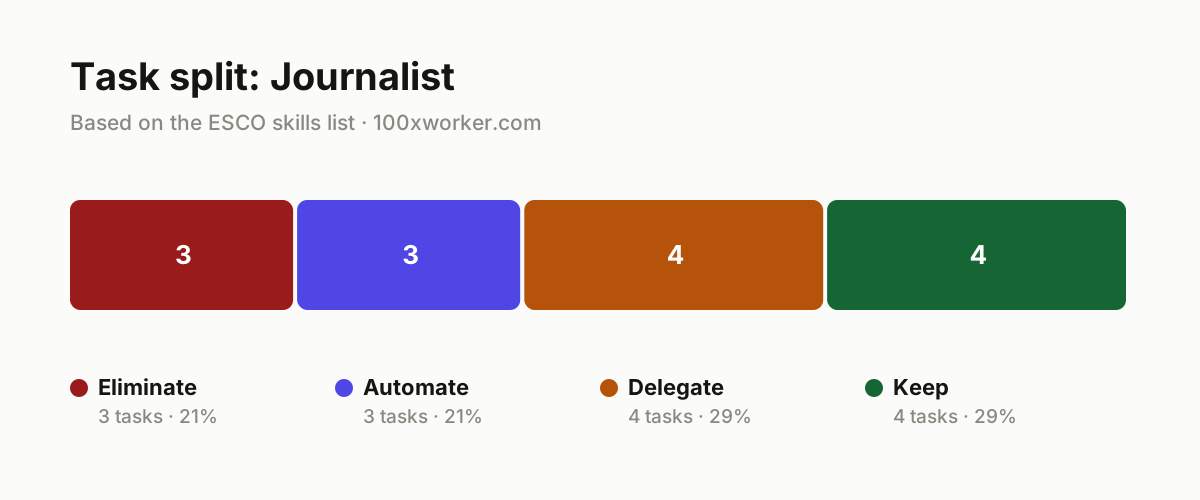
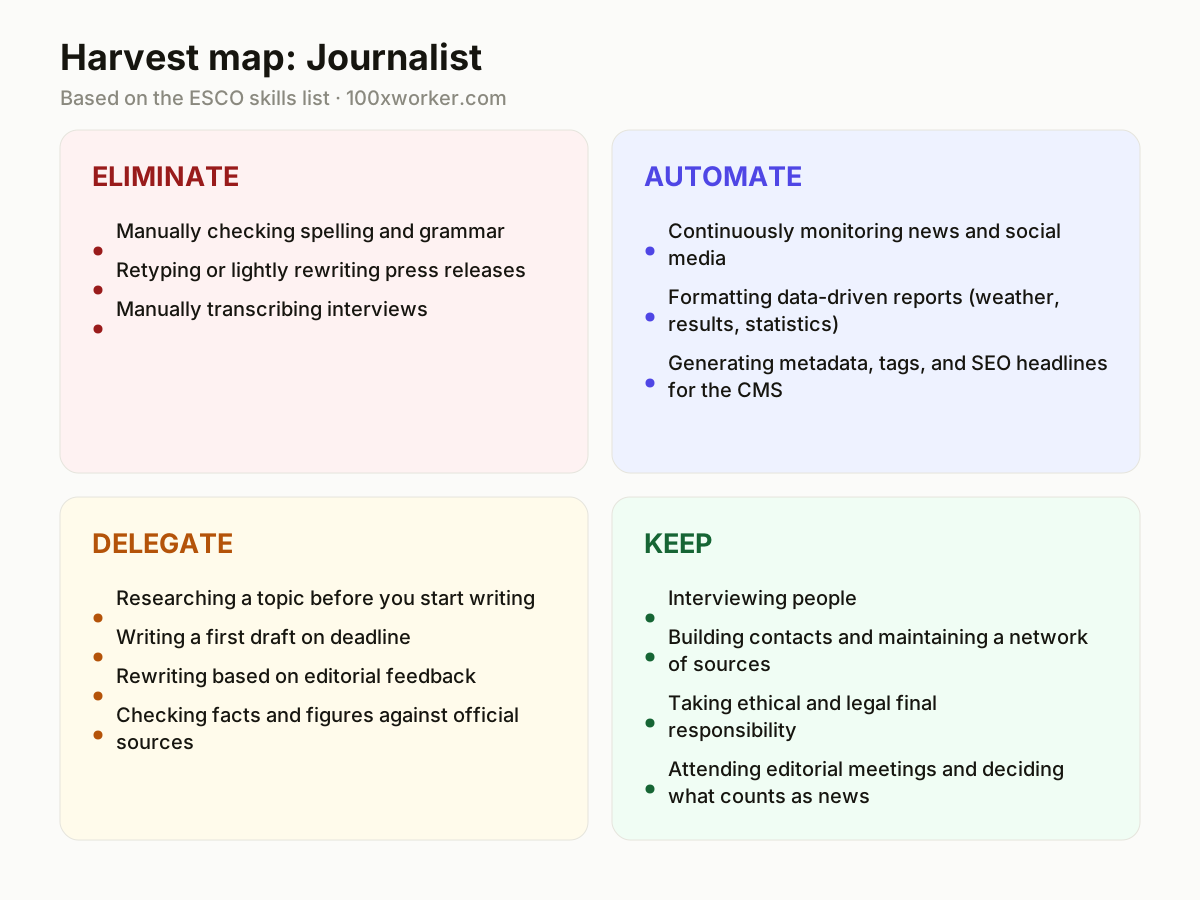
Not every task in a journalist's job responds to AI the same way. Some tasks disappear because software now does them by default. Some run fully automated once you set up the pipeline. Some you delegate to AI for a first pass, then check and finish yourself. And some stay with you because they depend on trust, judgment, or legal accountability that no model can carry. Sorting your own task list into these four buckets, eliminate, automate, delegate, keep, is more useful than asking whether AI will replace the job as a whole.
| Task | Bucket | Why |
|---|---|---|
| Manually checking spelling and grammar | eliminate | AI proofreading catches errors faster and more consistently than a copy editor checking every comma. |
| Retyping or lightly rewriting press releases | eliminate | A language model rewrites a press release in seconds, with no loss of journalistic value beyond what already existed. |
| Manually transcribing interviews | eliminate | Speech-to-text software now transcribes accurately, freeing up hours you used to spend typing out tape. |
| Continuously monitoring news and social media | automate | Agents scan sources and social feeds around the clock and filter for relevance to your beat. |
| Formatting data-driven reports (weather, results, statistics) | automate | A template linked to a data feed produces publish-ready copy without anyone touching it. |
| Generating metadata, tags, and SEO headlines for the CMS | automate | An agent delivers this straight into the editorial system, ready to publish. |
| Researching a topic before you start writing | delegate | AI summarizes sources and background, you verify the essentials and decide what matters. |
| Writing a first draft on deadline | delegate | AI produces a rough version, you rewrite it with your own voice, nuance, and context. |
| Rewriting based on editorial feedback | delegate | AI adjusts tone and structure to instructions, you approve the final version. |
| Checking facts and figures against official sources | delegate | AI finds and cites sources quickly, you verify at the source before you publish. |
| Interviewing people | keep | Following up on an unexpected answer and sensing when someone is lying takes a human. (Your edge: You cannot build trust with a prompt.) |
| Building contacts and maintaining a network of sources | keep | Tips come from relationships built over years, not from a chatbot. (Your edge: A source calls you, not an algorithm.) |
| Taking ethical and legal final responsibility | keep | Press law, copyright, and right of reply stay with the journalist who signs off. (Your edge: You cannot delegate liability.) |
| Attending editorial meetings and deciding what counts as news | keep | Deciding what matters as news today is an editorial judgment, not a calculation. (Your edge: News sense is not a dataset.) |
What tasks does AI take over from journalists?
AI removes the mechanical layer first: transcribing interviews, catching spelling and grammar errors, and turning a press release into readable copy. It also runs fully automated pipelines, such as monitoring news and social feeds around the clock, formatting weather or results data into publish-ready text, and generating metadata and SEO headlines for your CMS. None of this requires editorial judgment, so it is either gone from your day or running in the background without you touching it. What stays out of reach is anything that needs a source relationship, a legal signature, or an on-the-spot read of a person.
Will AI replace journalists?
Not as a whole job. Microsoft Research found generative AI applicable to 38.3% of journalism-related work activities, a solid share but far from full automation, and below translators (49%). The tasks AI struggles with, interviewing, source relationships, and legal accountability for what gets published, sit at the core of the job, not at its edges. What is more likely is fewer people doing the routine parts (transcribing, formatting, monitoring) and more time spent on reporting, verification, and judgment calls that AI cannot make. The job's task list is shrinking on one end and staying intact on the other.
How do you become the AI-savvy person in the newsroom?
Start by using AI openly for research summaries and first drafts, then show colleagues the before-and-after so they see the time saved without mistaking it for a finished story. Build a habit of fact-checking every AI-sourced claim against the primary source before it runs, and document that step so editors trust the process. Offer to set up shared prompts or templates for recurring formats like data reports or metadata tags, since that saves the whole desk time, not just you. Being known as the person who verifies AI output carefully is more valuable than being known as the person who uses AI the most.
What can you do this month as a journalist with AI?
Pick one recurring task, most likely transcription or a data-driven report format, and set up an AI tool for it this week. Test it on three real assignments and compare the output against your usual process for accuracy and time saved. Write down a short verification checklist for anything AI drafts or summarizes, so fact-checking becomes a repeatable step rather than an afterthought. Bring the result to your editor as a concrete proposal: which task moves to AI, what stays manual, and how you will keep checking sources and facts by hand.
Across 200,000 real Copilot conversations, generative AI reached measurable applicability in 38.3% of journalism-related work activities, well below the ceiling for translators and far above the floor for nurses.
Microsoft Research, Working with AI: Measuring the Applicability of Generative AI to Occupations (2025)
Become the AI person on your team
Set up a monitoring agent for your beat
Configure a feed-scanning tool to flag mentions relevant to your beat instead of scrolling social media manually. Share the setup with your desk so others benefit, not just you.
Build a source-verification checklist for AI drafts
Every AI-assisted draft gets a short checklist: primary source confirmed, quotes checked against the recording, numbers matched to the original document. Attach it to the story before it goes to an editor.
Turn one template into an automated pipeline
Take a recurring format, such as weather or results reporting, and connect it to a live data feed so the draft appears automatically. You edit and approve, you do not type it from scratch.
Want this for your actual task list?
The free scan on the homepage builds your personal task map in 30 seconds, based on your role and industry.
Run the free task scanTools for this work
| Tool | For which tasks | The sober take |
|---|---|---|
| Otter.ai or similar transcription tools | Eliminating manual interview transcription | Accuracy varies with audio quality, so still spot-check quotes against the recording. |
| Grammarly or built-in AI proofreading | Eliminating manual spelling and grammar checks | Useful as a first pass, not a substitute for a style-aware copy editor. |
| Claude or ChatGPT | Delegating research summaries, first drafts, and feedback-based rewrites | Anthropic's Economic Index classifies most journalist use of Claude as augmentation, not full automation. |
| Social and news monitoring agents | Automating continuous news and social media monitoring | Set clear relevance filters or the feed becomes noise instead of a beat tool. |
| CMS-integrated metadata and headline generators | Automating metadata, tags, and SEO headline generation | Review generated headlines for accuracy before publishing, they can overstate a story. |
Prompts to try today
Research summary before writing
Rewrite after editorial feedback
Fact-check pass on a draft
Related jobs
Frequently asked questions
Will AI take over journalism jobs entirely?
No single occupation-wide replacement is supported by the current evidence. Microsoft Research's applicability score of 38.3% for journalism-related work means AI is demonstrably useful in a meaningful share of tasks, but the same research puts translators higher at 49% and nurses much lower at 12%, showing this is a spectrum, not a cliff. The tasks that resist automation, interviewing, source relationships, and legal accountability, sit at the center of the job, so the role changes shape rather than disappearing.
Which journalism tasks does AI handle best right now?
AI is strongest on mechanical and pattern-based work: transcribing interviews, checking spelling and grammar, formatting data into structured reports, and generating metadata or SEO headlines for a CMS. Anthropic's Economic Index shows that even in tasks people delegate to AI, most current use is augmentation rather than full automation, meaning a person still reviews and finishes the output rather than publishing it untouched.
How is journalist AI use different from general AI adoption?
General population adoption gives useful context but is not occupation-specific. Eurostat found 32.7% of the EU population aged 16 to 74 used generative AI in the prior three months in 2025. Journalist-specific data instead comes from task-level studies like Microsoft Research's applicability scoring and Anthropic's Economic Index, which look at what AI actually does inside real work conversations rather than whether someone used a chatbot at all.
Should I worry about older automation-risk statistics for journalism?
Be cautious with widely cited 'robotization percentages' by occupation. Many trace back to Frey and Osborne's 2013 Oxford study, published before large language models existed, and it measured a different kind of automation risk. Task-level studies published in 2025, such as Microsoft Research's applicability scoring and Anthropic's Economic Index, give a more current picture because they are based on actual AI conversations rather than pre-LLM predictions.
Sources
- Microsoft Research, Working with AI: Measuring the Applicability of Generative AI to Occupations (2025)
- Anthropic Economic Index
- Eurostat, isoc_ai_iaiu (2025)
- ESCO, European Commission
Hendrik De Winne, author of Becoming AI-Savvy, founder of VibeLab. Helps teams redesign their work with AI.
This article was drafted with AI assistance from public data sources and editorially reviewed.