100×worker · job analysis
Will AI Replace Translators, and What Should You Do About It?
Translation is one of the professions where generative AI applicability is measured highest, not lowest. Microsoft Research analyzed 200,000 real Copilot conversations across occupations and published an AI applicability score for each one. Translators topped that list at 49.2 percent, well above nurses at the other end of the scale (12 percent). That does not mean half a translator's job disappears. It means a specific set of tasks, drafting, terminology lookup, formatting, moves to software, while other tasks stay firmly human.
Across the EU, 32.7 percent of people aged 16 to 74 used generative AI in the last three months of 2025, according to Eurostat. Translation work sits inside a wider shift where AI chat tools have become normal research assistants, not just novelty apps. The European Commission's ESCO taxonomy still lists translator as a distinct occupation among 3,039 profiles, built around skills like proofreading, terminology work, and confidentiality, skills that don't disappear just because a draft comes from a machine.
This article breaks the translator's task list into four buckets: what disappears entirely, what software now handles alone, what you hand to AI but still check, and what stays yours no matter how good the models get.
A translator converts written text from one language into another, preserving meaning and nuance.
The task split: what AI takes over and what stays yours
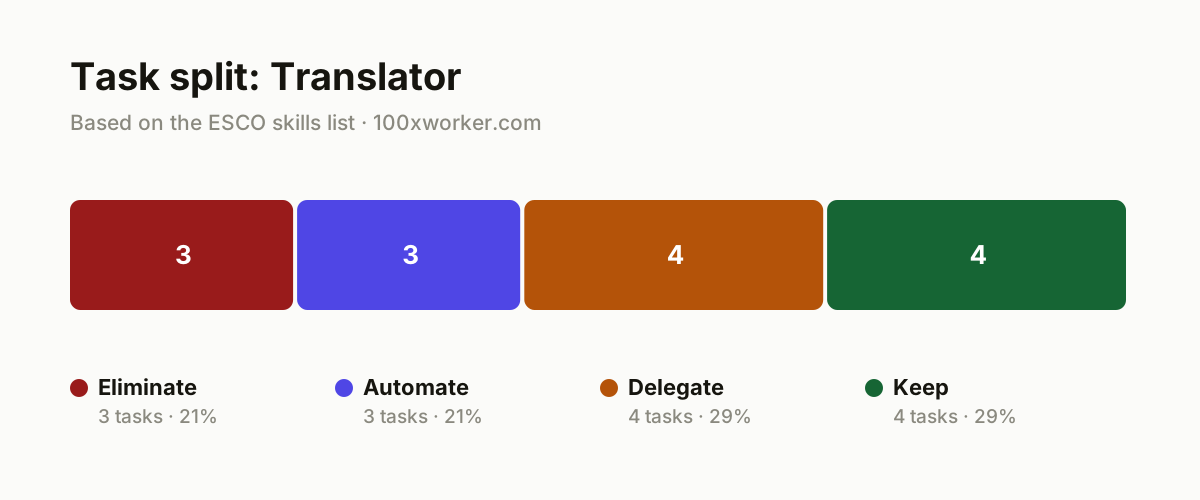
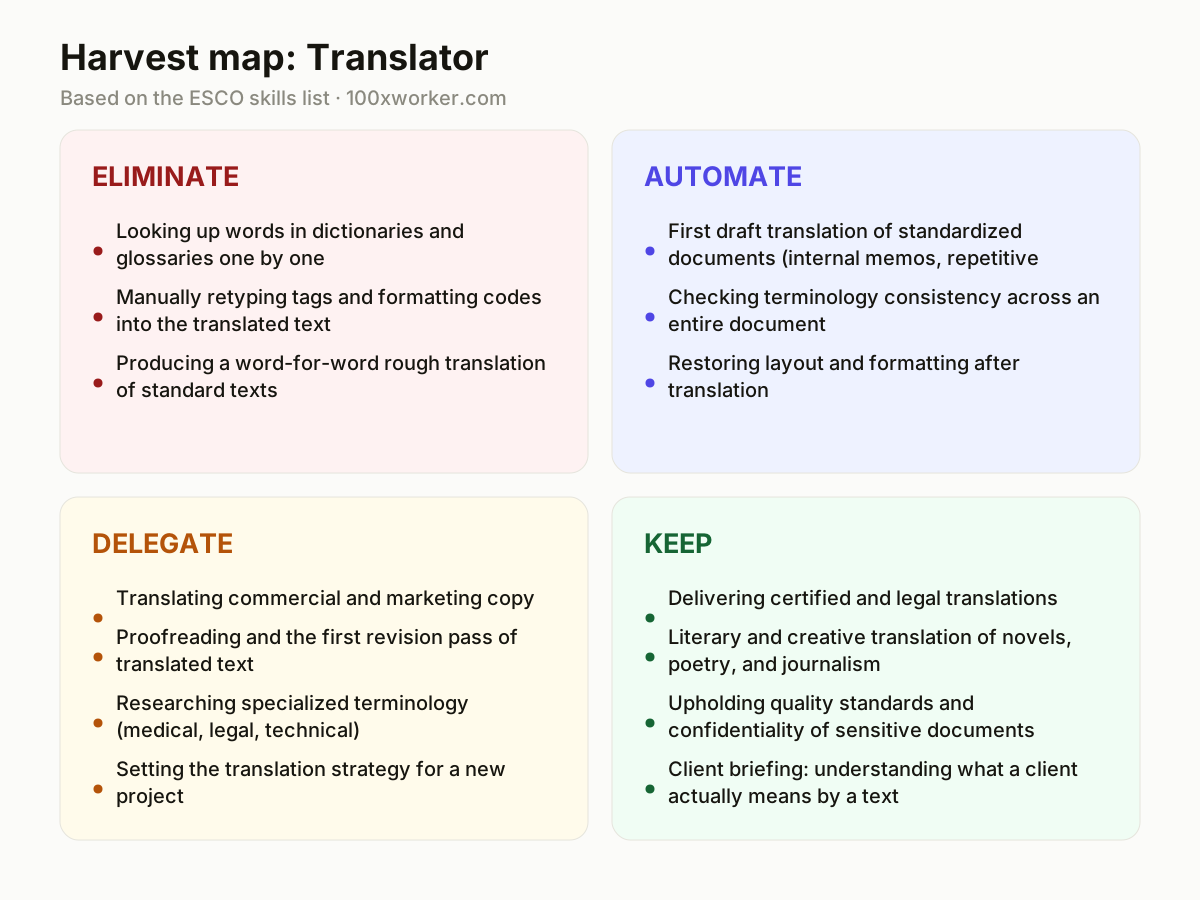
The eliminate/automate/delegate/keep framework sorts a translator's actual task list by how much of it AI can take over today. Eliminate covers manual steps that machines already do better. Automate covers tasks a tool completes without you checking every line. Delegate covers work AI drafts but you must verify and finish. Keep covers tasks tied to legal responsibility, cultural judgment, or client trust that no model can take on.
| Task | Bucket | Why |
|---|---|---|
| Looking up words in dictionaries and glossaries one by one | eliminate | A language model searches terminology sources in seconds, so manual lookup no longer serves a purpose. |
| Manually retyping tags and formatting codes into the translated text | eliminate | CAT tools and AI translation modules carry tags automatically, so retyping them is obsolete. |
| Producing a word-for-word rough translation of standard texts | eliminate | Generative AI produces that first rough version faster and more consistently than a person can. |
| First draft translation of standardized documents (internal memos, repetitive product catalogs) | automate | AI agents turn these texts into publication-ready drafts, with limited risk if something is slightly off. |
| Checking terminology consistency across an entire document | automate | Software checks every term against the glossary database, without missing a single instance. |
| Restoring layout and formatting after translation | automate | Office software with AI plugins rebuilds tables, styles, and page numbering automatically. |
| Translating commercial and marketing copy | delegate | AI produces a strong first version, you rewrite tone and culturally sensitive nuance. |
| Proofreading and the first revision pass of translated text | delegate | AI catches spelling and grammar errors, you judge meaning and style. |
| Researching specialized terminology (medical, legal, technical) | delegate | AI suggests candidate terms, you verify them against trusted sources. |
| Setting the translation strategy for a new project | delegate | AI generates a first style guide based on the target audience, you finalize it. |
| Delivering certified and legal translations | keep | The translator signs and carries personal responsibility for legal validity. (Your edge: No model can carry legal liability or a signature.) |
| Literary and creative translation of novels, poetry, and journalism | keep | Cultural nuance, rhythm, and stylistic feel stay human work, even with AI as a sounding board. (Your edge: Stylistic feel and cultural intuition cannot be automated.) |
| Upholding quality standards and confidentiality of sensitive documents | keep | Someone has to guarantee that confidential information never ends up inside an AI system. (Your edge: Trust and discretion require a person who takes responsibility.) |
| Client briefing: understanding what a client actually means by a text | keep | You read the context, purpose, and tone of an assignment from a conversation, not from a prompt. (Your edge: Client contact and context reading remain a human skill.) |
What tasks does AI take over from translators?
AI takes over the mechanical layer of translation work. Manual dictionary lookups disappear because a language model searches terminology in seconds. Retyping tags and formatting codes disappears because CAT tools and AI translation modules carry them automatically. Producing a rough first draft of standard, repetitive text, internal memos, product catalogs, moves to software entirely, since agents generate publishable drafts with limited risk. Checking terminology consistency across a whole document and rebuilding layout after translation also shift to tools. None of this removes the translator from the process. It removes the parts of the job that were always mechanical, freeing time for review and judgment calls that actually need a person.
Will AI replace translators?
No, but the task list changes. Microsoft Research's applicability score puts translators at 49.2 percent, the highest of any occupation in its study, meaning close to half of a translator's work activities show AI applicability in real usage data. That figure describes tasks, not jobs. Certified and legal translations still require a human signature and legal liability. Literary and journalistic translation still depends on cultural nuance and stylistic feel that models approximate but don't fully replicate. Client briefings still require reading context from a conversation. The realistic outcome is fewer translators doing pure drafting and more translators doing review, verification, and judgment-heavy work that AI cannot sign off on.
How do you become the AI-savvy person on a translation team?
Start by building a documented workflow: which AI tool drafts, which terminology database checks it, and which human step signs off. Test two or three AI translation tools (DeepL, ChatGPT, Claude) on your actual document types and write down where each one fails, not just where it succeeds. Build a shared glossary and style guide that you feed into prompts, so output stays consistent across a team. Offer to run a short session for colleagues on prompt structure for terminology research and first-draft generation. Being the AI-savvy person means owning the verification step, not the drafting step, since that is where trust and liability actually sit.
What can you do this month as a translator?
Pick one recurring document type you translate often and run it through an AI tool to see exactly where it breaks: idioms, legal phrasing, brand voice, formatting. Write down the failure points, they become your glossary and quality checklist. Set up a terminology database if you don't have one, even a shared spreadsheet, and start feeding it into your AI prompts. Quote certified, literary, or highly specialized work separately from routine drafting work, since the pricing and time investment differ now that AI handles the first draft of the latter.
Translators show the highest generative AI applicability score of any occupation studied, at 49.2 percent of work activities.
Microsoft Research, Working with AI: Measuring the Applicability of Generative AI to Occupations (2025)
Become the AI person on your team
Document your AI/human handoff
Write down which step AI drafts and which step you check, so clients and colleagues know exactly where responsibility sits. This turns a vague claim of using AI into a process others can trust.
Build a living glossary
Turn every terminology decision into a shared, searchable glossary entry instead of tribal knowledge in your head. Feed that glossary into AI prompts so drafts arrive closer to your standard the first time.
Specialize where AI applicability is lowest
Certified, legal, and literary translation sit furthest from AI's comfort zone. Move your practice deliberately toward the work that requires a signature or a cultural ear.
Want this for your actual task list?
The free scan on the homepage builds your personal task map in 30 seconds, based on your role and industry.
Run the free task scanTools for this work
| Tool | For which tasks | The sober take |
|---|---|---|
| DeepL | Automate: first draft translation of standard, repetitive text | Strong for straightforward document types, weaker on marketing tone and idiom. |
| memoQ / SDL Trados Studio with AI integration | Automate: terminology consistency checks and tag handling; Eliminate: manual tag retyping | CAT tools with AI plugins are now the professional standard, not a novelty. |
| ChatGPT or Claude | Delegate: marketing translation drafts, terminology research, style guide drafts | Useful as a fast first pass, always needs a human review step for tone and accuracy. |
| Xbench / Verifika | Automate: quality assurance and consistency checks across long documents | Catches inconsistencies a human reviewer would miss on a tight deadline. |
Prompts to try today
First-draft translation with terminology constraints
Terminology candidate check
Style guide draft for a new client
Related jobs
Frequently asked questions
Do I need to learn to use AI tools as a translator?
Yes, in practice most professional translation work already runs through a CAT tool with AI features or a standalone AI draft step. Clients increasingly expect a faster turnaround because that first draft step is no longer manual. Skipping AI tools entirely does not protect your work, since the tasks that disappear are drafting tasks, not your judgment, review, and specialization. Learning the tools lets you spend more time on the review and client-facing work that still needs you.
Which translation specializations are safest from AI?
Certified and legal translation stay safest because they require a signature and personal legal liability that no AI system can take on. Literary, poetic, and creative translation stay largely human because they depend on rhythm, cultural nuance, and stylistic judgment. Highly confidential work such as legal disputes, medical records, or government documents also stays human, since someone has to guarantee that sensitive text never passes through an external AI system.
How reliable is the Microsoft Research applicability score for translators?
The score comes from analyzing 200,000 real Copilot conversations and measuring how often generative AI was applicable to specific work activities, published as open data under a CC BY 4.0 license in 2025. It measures applicability of tasks, not job loss, and it uses the closest matching US occupation category, Interpreters and Translators, rather than a country-specific job title. Treat it as a strong signal about task-level exposure, not a prediction of headcount.
Should freelance translators worry about AI competing on price?
Rough machine translation is now essentially free, so translators competing purely on speed and price for standard, non-specialized text face real pressure. The realistic response is repositioning around specialization, legal, medical, literary, certified work, and around the review and verification step, where clients still need a human who checks accuracy, tone, and cultural fit rather than just producing a draft.
Sources
- Microsoft Research, Working with AI: Measuring the Applicability of Generative AI to Occupations (2025)
- Anthropic Economic Index
- Eurostat, isoc_ai_iaiu (2025)
- ESCO, European Commission
Hendrik De Winne, author of Becoming AI-Savvy, founder of VibeLab. Helps teams redesign their work with AI.
This article was drafted with AI assistance from public data sources and editorially reviewed.