100×worker · job analysis
Will AI Replace Copy Editors, and What Should You Do About It?
Copy editing sits close to the top of most automation lists, and for good reason. A lot of the daily work, catching typos, checking a style guide, flagging inconsistent capitalization, is exactly what large language models are good at. Microsoft Research analyzed 200,000 real Copilot conversations and scored occupations by how much of their actual work activities generative AI can plausibly handle. Proofreaders and copy markers, the closest US category to copy editors, scored 36.9%. Translators topped the list at 49%, nurses sat near the bottom at 12%.
That number describes tasks, not jobs. Anthropic's Economic Index, which classifies millions of Claude conversations against standardized occupational task lists, splits AI use into two kinds: automation-like use, where AI does the task instead of you, and augmentation-like use, where AI helps you do it. For copy editors, both patterns show up in the same week, sometimes the same article. This piece breaks the role into four buckets, eliminate, automate, delegate, and keep, so you can see exactly where each pattern applies.
A copy editor is the last human check on language, facts, and form before publication.
The task split: what AI takes over and what stays yours
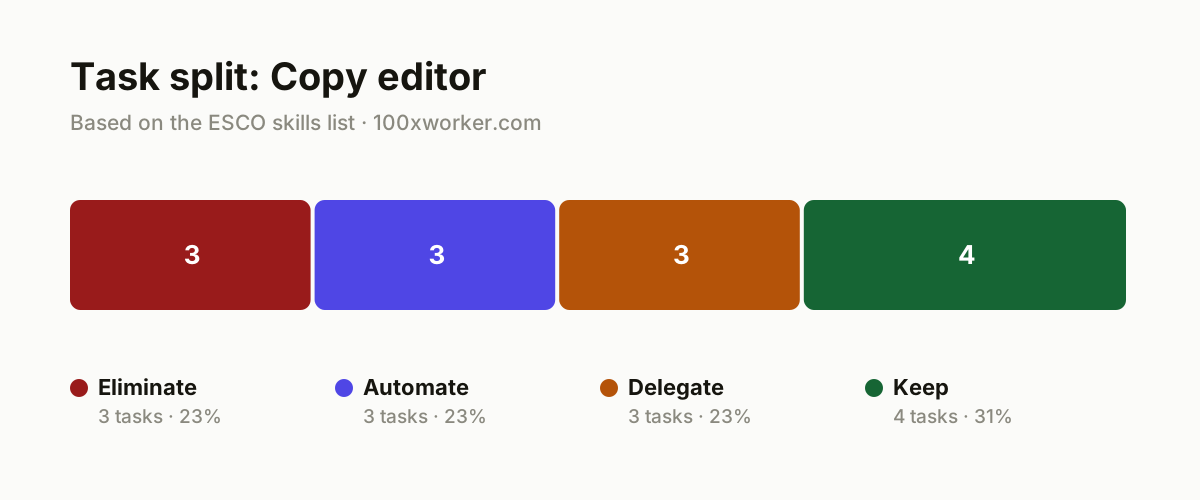
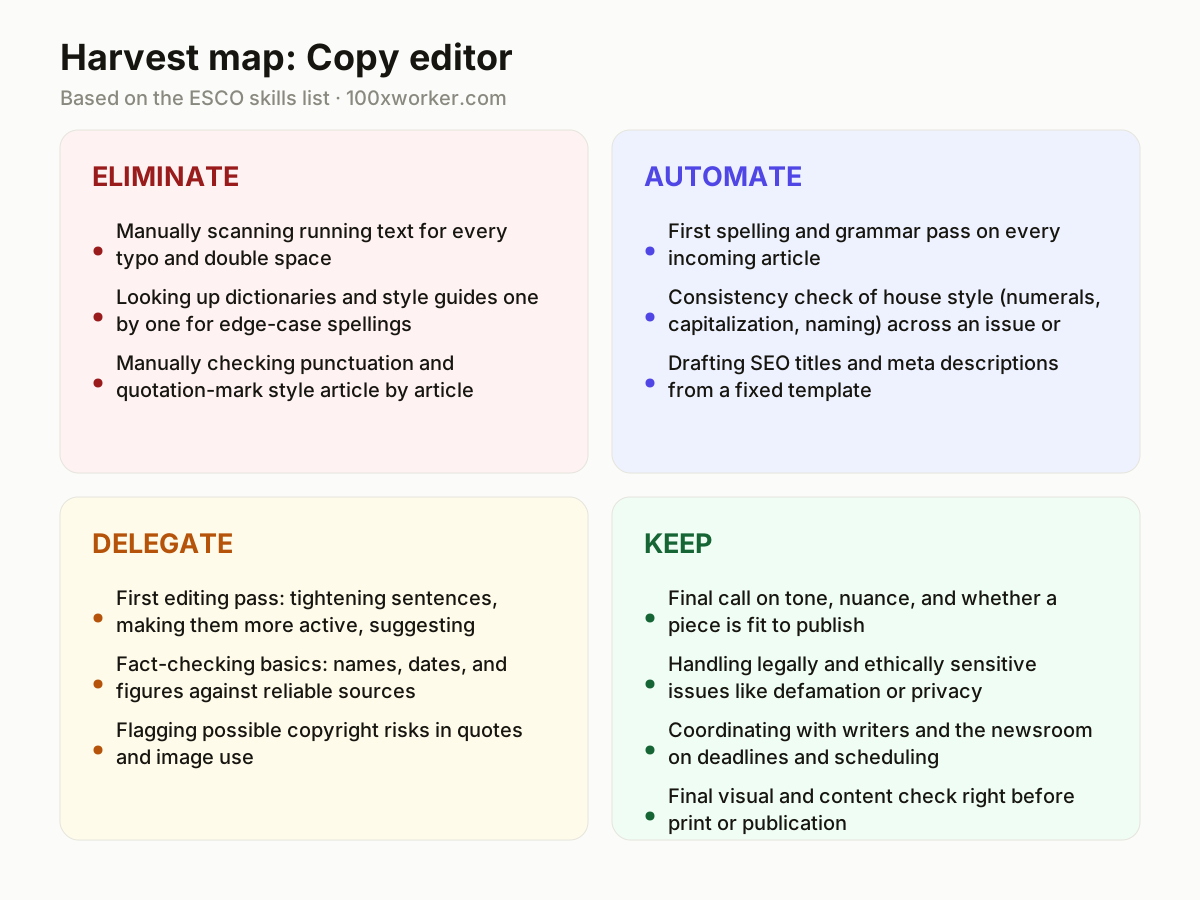
Not every task in a copy editor's day faces the same pressure from AI. Some tasks disappear because a tool now does them by default. Others get fully automated inside an editorial workflow, with no human touch needed on the first pass. A third group gets delegated to AI as a draft or a flag, with a person making the final call. And a fourth group stays firmly human, because it depends on judgment, liability, or reading a room that no model can sit in. Sorting your own task list this way is more useful than asking whether the job as a whole will survive.
| Task | Bucket | Why |
|---|---|---|
| Manually scanning running text for every typo and double space | eliminate | Spell-checkers and AI catch this faster and more consistently, especially in long, repetitive copy. |
| Looking up dictionaries and style guides one by one for edge-case spellings | eliminate | AI searches style guides and dictionaries in seconds, cutting lookup time to nearly zero. |
| Manually checking punctuation and quotation-mark style article by article | eliminate | An automated style check spots deviations faster and never skips a page. |
| First spelling and grammar pass on every incoming article | automate | Rule-based AI checks handle this cleanly and consistently without human input. |
| Consistency check of house style (numerals, capitalization, naming) across an issue or site | automate | An AI agent compares every article against the style guide automatically. |
| Drafting SEO titles and meta descriptions from a fixed template | automate | This follows a set structure, ideal work for an agent without creative input. |
| First editing pass: tightening sentences, making them more active, suggesting headlines | delegate | AI produces a strong first draft, you decide what stays and what goes. |
| Fact-checking basics: names, dates, and figures against reliable sources | delegate | AI flags discrepancies quickly, you judge the source and the risk of an error. |
| Flagging possible copyright risks in quotes and image use | delegate | AI marks borderline cases, the legal judgment and final responsibility stay with you. |
| Final call on tone, nuance, and whether a piece is fit to publish | keep | Context, sensitivity, and brand voice require judgment no model has. (Your edge: Sensing what a piece will do to a reader.) |
| Handling legally and ethically sensitive issues like defamation or privacy | keep | Liability for publication rests with a person, not an AI tool. (Your edge: Taking on responsibility that cannot be delegated.) |
| Coordinating with writers and the newsroom on deadlines and scheduling | keep | Planning with people takes negotiation, motivation, and reading tension in the room. (Your edge: Managing human relationships under time pressure.) |
| Final visual and content check right before print or publication | keep | Seeing the whole page in context, at the moment of publishing, stays human work. (Your edge: Holding the whole picture right before the button is pressed.) |
Which copy editing tasks does AI take over?
AI handles the mechanical layer first: typo detection, spelling, basic grammar, and checking a piece against a fixed style guide (numerals, capitalization, preferred terms). These are pattern-matching tasks with a right answer, which is why they show up at the top of the automation list. Anthropic's Economic Index classifies this kind of work as automation-like use, meaning the tool does the task rather than assisting a person doing it. Drafting templated elements like SEO titles and meta descriptions falls in the same category. What AI does not take over cleanly is judgment about tone, risk, or whether a piece should run at all.
Will AI replace copy editors?
Not as a full job, no. Microsoft Research measured applicability at 36.9% of work activities for the closest matching occupation, which means roughly two-thirds of the role's activities are not well covered by current generative AI. The role changes shape: less time on typo-hunting and mechanical style checks, more time on judgment calls, fact verification, legal risk, and final sign-off. Titles that survive tend to be the ones where a human absorbs liability for what gets published. Titles built entirely around mechanical proofreading, with no editorial judgment attached, face more pressure to shrink or merge into other roles.
How much of a copy editor's work can AI handle, according to research?
The best available figure comes from Microsoft Research's 2025 study of 200,000 real Copilot conversations, which scored proofreaders and copy markers at 36.9% AI applicability, the share of work activities where generative AI shows demonstrated use. For comparison, translators scored 49% and nurses scored 12%. Anthropic's Economic Index adds a second dimension by splitting AI use into automation-like (AI replaces a step) and augmentation-like (AI assists a step) patterns across occupations. Older figures sometimes cited for this role come from Frey and Osborne's 2013 Oxford study, which predates large language models and should not be treated as current.
What can you do this month as a copy editor with AI?
Pick one recurring task from your automate or delegate list and set up a repeatable workflow for it this month. A practical start: run every incoming article through an AI style-consistency check before your own read, so you spend your attention on tone, structure, and risk instead of numerals and capitalization. Track how many catches the tool makes versus what you catch yourself, so you know where your judgment is actually adding value. Then move one delegate-bucket task, like first-pass fact-checking of names and dates, into a standard step you run before every deadline.
Some AI use replaces a task outright, other use extends what a person can do; the two are not the same.
Anthropic Economic Index
Become the AI person on your team
Run a style pass before you touch the piece
Feed the article into an AI tool set up against your house style guide before you start reading. You catch mechanical inconsistencies in seconds and spend your read on tone and structure instead.
Use AI as a second fact-checker, not the first
Ask AI to list every checkable claim, name, date, and number in a piece before you verify sources. You still confirm each one, but you no longer build the checklist by hand.
Keep a personal log of AI misses
Note the specific errors AI tools miss or get wrong in your workflow, tone shifts, sarcasm, legal nuance. This log becomes your argument for why the judgment layer of the job still needs a person.
Want this for your actual task list?
The free scan on the homepage builds your personal task map in 30 seconds, based on your role and industry.
Run the free task scanTools for this work
| Tool | For which tasks | The sober take |
|---|---|---|
| Grammarly Business | Eliminate and automate buckets: typo detection, grammar, basic style consistency | Good for volume, weak on nuance and house-specific style rules. |
| Microsoft Editor | Eliminate bucket: spelling, punctuation, quotation-mark consistency | Built into Microsoft 365, useful as a first-pass filter before human review. |
| ProWritingAid | Automate bucket: style-guide consistency checks across long documents | Stronger on consistency reports than on judgment-based edits. |
| Claude or a similar large language model | Delegate bucket: first editing pass, fact-check checklist, copyright risk flags | Treat its output as a draft; you still verify sources and make the call. |
Prompts to try today
First-pass tightening
Fact-check checklist
House style audit
Related jobs
Frequently asked questions
Is copy editing one of the jobs most exposed to AI?
It ranks in the middle of Microsoft Research's list, not at the very top. Translators scored highest at 49% AI applicability, copy editors and proofreaders scored 36.9%, and nurses scored 12%. That places the role above average exposure but well below the most affected occupations. The exposure is concentrated in mechanical tasks like spelling and style checks, not in judgment-heavy work like final sign-off or handling legally sensitive content.
Should I list AI tools on my resume as a copy editor?
Yes, if you can point to a specific workflow. Naming the tool alone (Grammarly, ChatGPT, Claude) says little. Describing what you built with it, for example a style-consistency check run before human review, or a fact-check checklist generator, shows you understand where AI fits into an editorial process rather than replacing your judgment entirely.
Does AI usage data show copy editors actually using these tools?
There is no occupation-specific usage figure in the current data, but general adoption is high and rising. Eurostat found that 32.7% of the EU population aged 16 to 74 used generative AI in the last three months of 2025. A Google and Ipsos survey found 61% of Belgians had used an AI chatbot in 2025. Professional adoption in editorial roles is plausibly higher than the general population, though a direct figure for copy editors specifically is not available in the cited sources.
What should a copy editor learn now to stay relevant?
Focus less on catching typos faster and more on the tasks AI cannot absorb: assessing legal and reputational risk, judging tone against a specific audience, and making the final call on whether a piece is ready. Learning to direct and check AI output, rather than compete with it on mechanical accuracy, is the more durable skill.
Sources
- Microsoft Research, Working with AI: Measuring the Applicability of Generative AI to Occupations (2025)
- Anthropic Economic Index
- Eurostat, Individuals using generative AI (isoc_ai_iaiu)
- ESCO, European Commission occupation taxonomy
Hendrik De Winne, author of Becoming AI-Savvy, founder of VibeLab. Helps teams redesign their work with AI.
This article was drafted with AI assistance from public data sources and editorially reviewed.