100×worker · job analysis
Will AI Replace Subtitlers?
Subtitling software already generates a rough transcript, times it, and drafts a first translation before you even open the file. Generative AI adoption has grown fast: 32.7% of the EU population aged 16 to 74 used a generative AI tool in the three months before being surveyed in 2025, according to Eurostat. For a job built on typing, timing, and translating text, that adoption curve matters directly.
The European Commission's ESCO taxonomy lists subtitler as its own occupation among more than 3,000 profiles, split into intralingual work (same-language captions, mainly for deaf and hard-of-hearing viewers) and interlingual work (translation between languages). Both branches share one core skill: synchronizing text with sound, image, and dialogue. Microsoft Research has studied how generative AI gets used across hundreds of occupations by analyzing 200,000 real Copilot conversations, and it treats writing- and language-heavy jobs like subtitling as strong candidates for task-level change rather than outright replacement.
This article breaks the job into four buckets: tasks AI eliminates, tasks it automates, tasks you delegate to AI but still check, and tasks you keep because they need human judgment.
A subtitler turns spoken language into synchronized on-screen text for deaf, hard-of-hearing, or foreign-language viewers.
The task split: what AI takes over and what stays yours
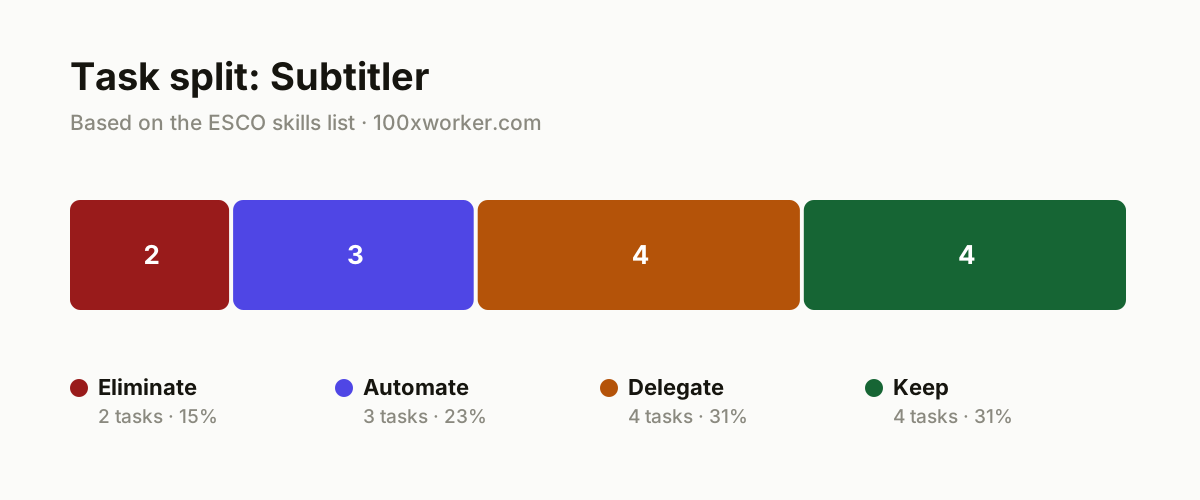
Subtitling tasks do not all change at the same speed. Some vanish because software already does them better (eliminate). Others run automatically now but still need a spec and a check (automate). Some are best handed to AI as a first draft that you then correct, since you stay accountable for the result (delegate). And some stay firmly with you, because they need taste, cultural judgment, or a relationship with a client (keep). This split follows the task-level approach that researchers use when they study how AI reshapes work: break the job into its parts before deciding what changes.
| Task | Bucket | Why |
|---|---|---|
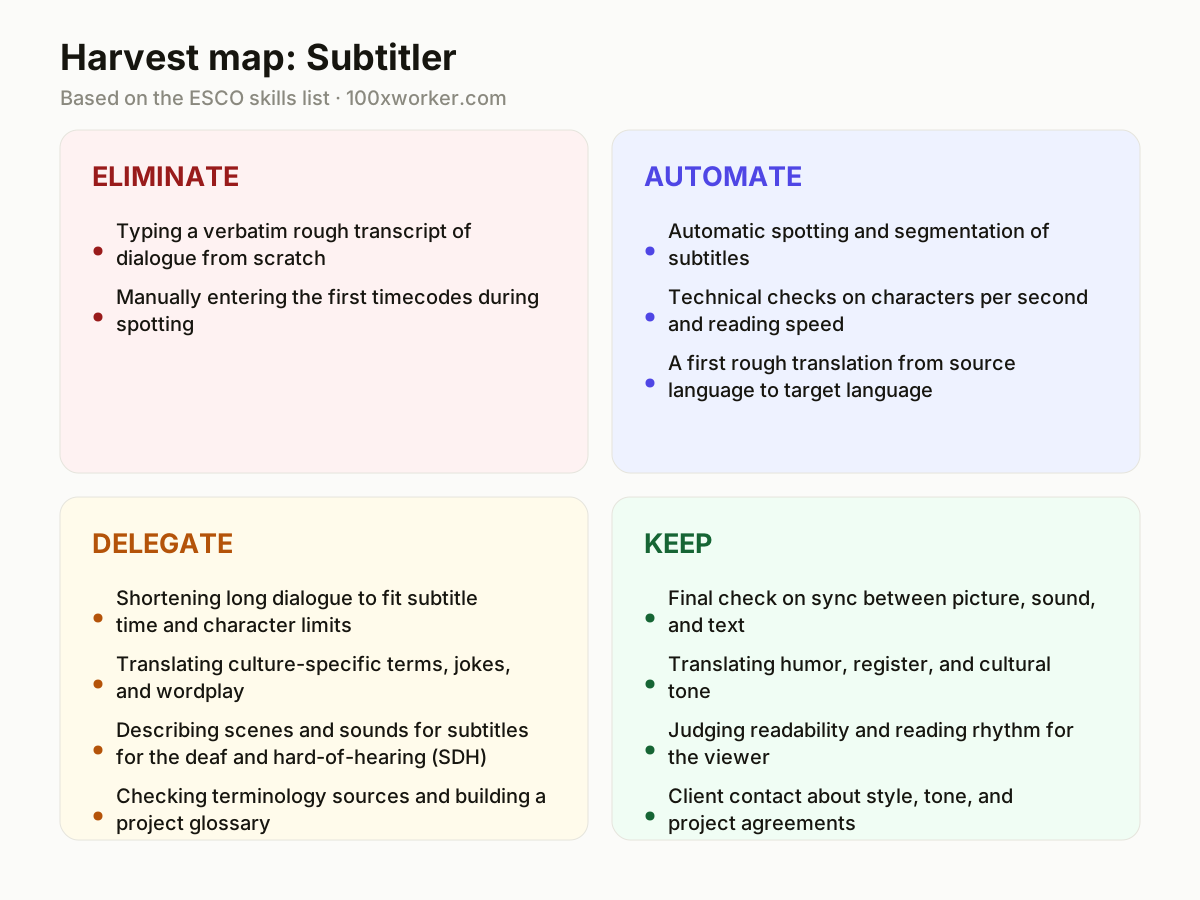
| Typing a verbatim rough transcript of dialogue from scratch | eliminate | Speech recognition converts audio to text accurately now, so manual transcription from zero is no longer needed. |
| Manually entering the first timecodes during spotting | eliminate | Software detects speech pauses and sets in and out points on its own, so manual entry is outdated. |
| Automatic spotting and segmentation of subtitles | automate | Software splits dialogue into blocks based on speech pauses and reading-speed rules. |
| Technical checks on characters per second and reading speed | automate | Tools calculate reading speed and character counts automatically and flag violations instantly. |
| A first rough translation from source language to target language | automate | Translation engines built into subtitling software produce a usable first draft in the target language. |
| Shortening long dialogue to fit subtitle time and character limits | delegate | AI proposes a shortened version, you guard meaning, tone, and readability. |
| Translating culture-specific terms, jokes, and wordplay | delegate | AI offers translation options for jokes and wordplay, you pick what actually works for the audience. |
| Describing scenes and sounds for subtitles for the deaf and hard-of-hearing (SDH) | delegate | AI generates a first scene description, you check relevance, tone, and accuracy. |
| Checking terminology sources and building a project glossary | delegate | AI searches and collects consistent terms, you confirm and manage the final choices. |
| Final check on sync between picture, sound, and text | keep | Human eyes and ears catch timing errors that software often misses. (Your edge: A trained sense of screen rhythm and pacing.) |
| Translating humor, register, and cultural tone | keep | Humor, irony, and cultural nuance need context that machines lack. (Your edge: Cultural feel and knowledge of the audience.) |
| Judging readability and reading rhythm for the viewer | keep | Only a human senses whether a subtitle reads well while watching. (Your edge: Experience with how viewers actually read on screen.) |
| Client contact about style, tone, and project agreements | keep | Clients want to discuss style and accountability with a person, not a tool. (Your edge: Trust and taking responsibility toward the client.) |
Which subtitler tasks does AI take over?
AI already handles the mechanical front end of the job. Speech recognition produces a full transcript from audio in minutes, and subtitling software uses that transcript to set spotting points, split lines into readable blocks, and flag reading speed automatically. A first machine translation into the target language is usually ready before you open the project. What AI does not finish is the judgment layer: choosing which shortened phrasing keeps the joke intact, deciding how a scene description should sound for a deaf viewer, or confirming that a translated line still fits the character on screen. Those steps move from typing tasks to review and editing tasks.
Will AI replace subtitlers?
Unlikely as a full replacement, likely as a change in daily tasks. ESCO describes subtitling as work built around synchronizing text with sound, image, and dialogue, a skill that depends on judgment about timing and meaning together, not just language conversion. Microsoft Research frames this kind of shift as applicability at the task level: some subtitling tasks match generative AI well (transcription, first-draft translation, technical checks), others do not (cultural nuance, client trust, final sync checks). The realistic outcome is fewer subtitlers doing pure typing and more subtitlers doing editing, quality control, and specialized work like SDH and dialect handling.
What does AI already do well, and where does it still go wrong in subtitling?
AI is reliable at transcription, automatic spotting, character and reading-speed checks, and producing a usable first-pass translation. It struggles with jokes that depend on wordplay in the source language, cultural references that need a local equivalent rather than a literal translation, and scene descriptions that require judging what actually matters to a deaf viewer versus what is just noise. It also misses subtle sync problems, like a line that is technically timed correctly but reads awkwardly against the pace of the scene. Anthropic's Economic Index describes this split as automation-like use, where the model does the work, versus augmentation-like use, where it supports a person's judgment. Subtitling sits in both categories depending on the task.
What can you do this month as a subtitler?
Start by testing a speech-to-text tool on a real project and timing how much correction the transcript still needs, so you know where to trust it. Build a personal glossary workflow where AI proposes terms and you approve them, instead of starting from a blank list each time. Practice editing machine-translated subtitles for jokes and cultural references specifically, since that is where clients notice quality fastest. If you do SDH work, compare an AI-generated scene description against your own and note the gaps. Then update how you describe your services to clients: position yourself as the person who guarantees sync, tone, and cultural accuracy, not just the person who types.
AI use in real conversations splits into automation-like tasks, where the model does the work, and augmentation-like tasks, where it supports a person's judgment.
Anthropic Economic Index
Become the AI person on your team
Learn to post-edit machine translation fast
Instead of translating every line from scratch, take the AI draft and focus your time on jokes, idioms, and cultural references. This changes your job from producing text to correcting and improving it.
Specialize in SDH and accessibility work
AI scene descriptions still need a human to judge relevance and tone for deaf and hard-of-hearing viewers. Building expertise here makes you harder to replace than a generalist interlingual translator.
Turn your glossary into a reusable asset
Use AI to search and propose consistent terminology across a series or client, then keep your approved list as a project glossary. This saves time on every future episode or film for that client.
Sell yourself as the quality-control layer
Tell clients explicitly that you check sync, reading speed, and cultural accuracy after AI drafts the first pass. This makes your role legible instead of invisible when clients decide what they are paying for.
Want this for your actual task list?
The free scan on the homepage builds your personal task map in 30 seconds, based on your role and industry.
Run the free task scanTools for this work
| Tool | For which tasks | The sober take |
|---|---|---|
| OpenAI Whisper (or similar speech-to-text engines) | Automatic transcription and rough timecoding (eliminate and automate buckets) | Good for a fast first pass, still needs correction for names, accents, and background noise. |
| Subtitle Edit / EZTitles-style spotting tools | Automatic spotting, segmentation, and reading-speed checks (automate bucket) | Handles formatting rules reliably but does not judge tone or meaning. |
| DeepL or similar integrated machine translation | First rough translation and support for culture-specific terms (automate and delegate buckets) | Produces a usable draft, jokes and wordplay still need a human rewrite. |
| Amara or Trint-style review platforms | Collaborative review and SDH scene description drafting (delegate bucket) | Speeds up team review but relevance checks for SDH stay manual. |
Prompts to try today
Shorten a subtitle line without losing meaning
Get translation options for a joke or cultural reference
Draft an SDH scene description
Related jobs
Frequently asked questions
Can AI create subtitles automatically, without any human involvement?
Speech recognition and machine translation can produce a full draft: transcript, timing, and a translated version, without a person touching it. But that draft usually contains errors in names, terminology, and cultural references, and it will not judge whether a joke lands or whether a line reads naturally at the pace of the scene. For anything meant for broadcast or paid distribution, a human review pass is still standard practice.
Do I need to learn new software to keep working as a subtitler?
Most subtitling software already includes AI-assisted transcription, spotting, and machine translation as built-in features, so you are likely using some of this already. The bigger shift is workflow: spending less time typing from scratch and more time editing, checking sync, and managing a terminology glossary. Getting fast at post-editing machine translation is more valuable right now than learning a brand-new tool.
Will subtitling jobs disappear because of AI?
The available evidence points to task-level change rather than the job disappearing. ESCO treats subtitling as a distinct occupation built on synchronizing text with image and sound, and Microsoft Research's approach to measuring AI applicability looks at which specific tasks within a job match generative AI well. Transcription and first-draft translation match well. Cultural judgment, client relationships, and final quality checks do not, at least not yet.
What is the difference between automation-like and augmentation-like AI use for subtitlers?
Anthropic's Economic Index classifies AI use into these two patterns. Automation-like use means the AI produces the output directly, such as a rough transcript or a first-pass translation. Augmentation-like use means the AI supports a person who still makes the final call, such as suggesting joke translations that a subtitler then picks between. Most of subtitling work is shifting toward the second pattern.
Sources
- Working with AI: Measuring the Applicability of Generative AI to Occupations, Microsoft Research (2025)
- Anthropic Economic Index
- Eurostat, Individuals using generative AI (isoc_ai_iaiu)
- ESCO, European Commission
Hendrik De Winne, author of Becoming AI-Savvy, founder of VibeLab. Helps teams redesign their work with AI.
This article was drafted with AI assistance from public data sources and editorially reviewed.