100×worker · job analysis
Will AI Replace Advertising Managers?

Advertising managers spend their days juggling campaign concepts, media plans, client briefs, and performance reports. Generative AI now touches nearly every one of those tasks, but not equally. Microsoft Research analyzed 200,000 real Copilot conversations and built an AI applicability score across occupations (Working with AI: Measuring the Applicability of Generative AI to Occupations, 2025). The pattern for marketing and advertising work is consistent: the more a task looks like drafting, summarizing, or pattern-matching, the more AI already does it well.
Across the EU, 32.7% of people aged 16 to 74 used generative AI in the three months before being surveyed in 2025 (Eurostat, isoc_ai_iaiu). Anthropic's Economic Index, which classifies millions of Claude conversations against O*NET task lists, splits usage into automation-like and augmentation-like patterns, a distinction that maps directly onto how advertising work is splitting today.
This article breaks the advertising manager job into four buckets: tasks to eliminate, automate, delegate, and keep. Think of it as a map of where your time is already shifting, rather than a prediction about job loss.
An advertising manager plans and directs ad campaigns, from concept through media buying to results measurement.
The task split: what AI takes over and what stays yours
Not every task in an advertising manager's week responds to AI the same way. Some tasks disappear because AI does them faster than you ever could by hand. Some get fully automated end to end. Others get delegated to AI as a first draft that you still check and shape. And some stay with you because they depend on trust, judgment, or a room full of people. Sorting your own week into these four buckets is the fastest way to see where your time should actually go.
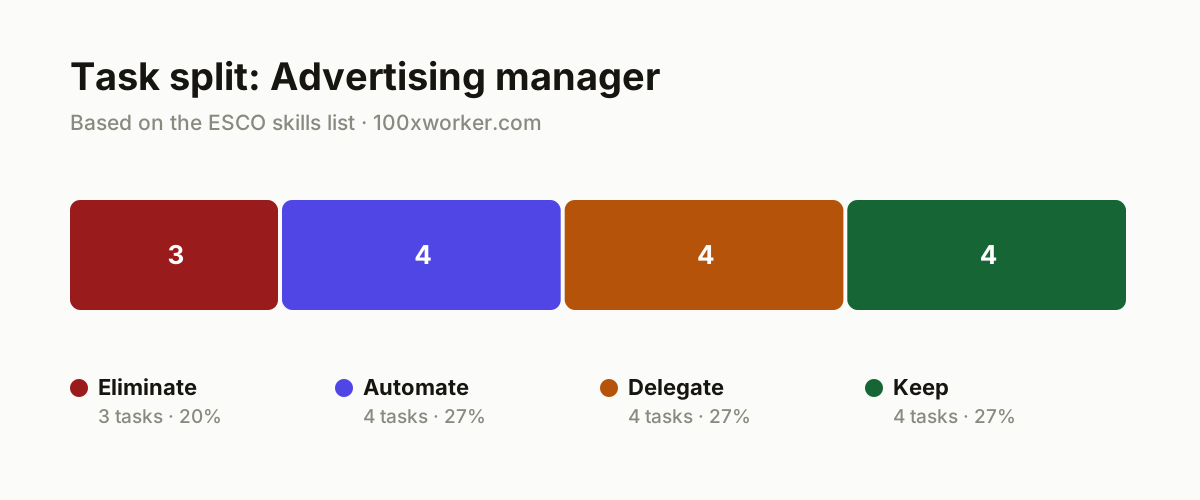
| Task | Bucket | Why |
|---|---|---|
| Typing out dozens of ad copy variants by hand for A/B tests | eliminate | AI generates more variants in seconds than a person can draft in an hour. |
| Manually collecting hashtags and keywords for each campaign or channel | eliminate | A language model produces this list faster and more consistently than a person. |
| Screenshotting competitor ads and comparing them by hand | eliminate | AI monitoring tracks competitors continuously, so you no longer chase screenshots. |
| Building campaign reports from ad platforms (CTR, CPC, ROAS) | automate | An agent pulls numbers from multiple platforms and turns them into a readable report. |
| Localizing ad copy for different markets and languages | automate | Translation and local tone are repeatable work AI can deliver production-ready. |
| Generating A/B test variants and compiling a results report | automate | Setting up and summarizing tests follows a fixed pattern. |
| Filling a content calendar per channel with posts and posting times | automate | Template-based scheduling is repetitive and automates well. |
| Drafting first creative concepts for a campaign | delegate | AI delivers a set of usable directions, you pick and refine the strongest one. |
| Turning a client brief into a creative brief for the agency | delegate | AI structures the first draft, you check it against what the client actually means. |
| Proposing a media plan and budget split across channels | delegate | AI runs through scenarios fast, you weigh the proposals against commercial reality. |
| Building audience segments and personas from data | delegate | AI processes the data faster, you judge whether the segments hold up in the real market. |
| Negotiating with agencies and media partners over rates and terms | keep | This stays a conversation between people with interests and trust at stake. (Your edge: You don't build negotiating leverage or goodwill with a prompt.) |
| Taking final responsibility for sensitive or high-risk campaigns | keep | Reputational damage and legal exposure need an accountable person, not a model. (Your edge: Risk judgment and liability stay with a human.) |
| Pitching and defending a campaign idea to leadership or a client | keep | Persuading a room takes presence, timing, and the ability to adapt on the spot. (Your edge: Persuasion happens in the room, not on a screen.) |
| Maintaining relationships with sales, product, and other internal teams | keep | Internal alignment runs on trust built over time. (Your edge: Political sensitivity and long-term trust stay human work.) |
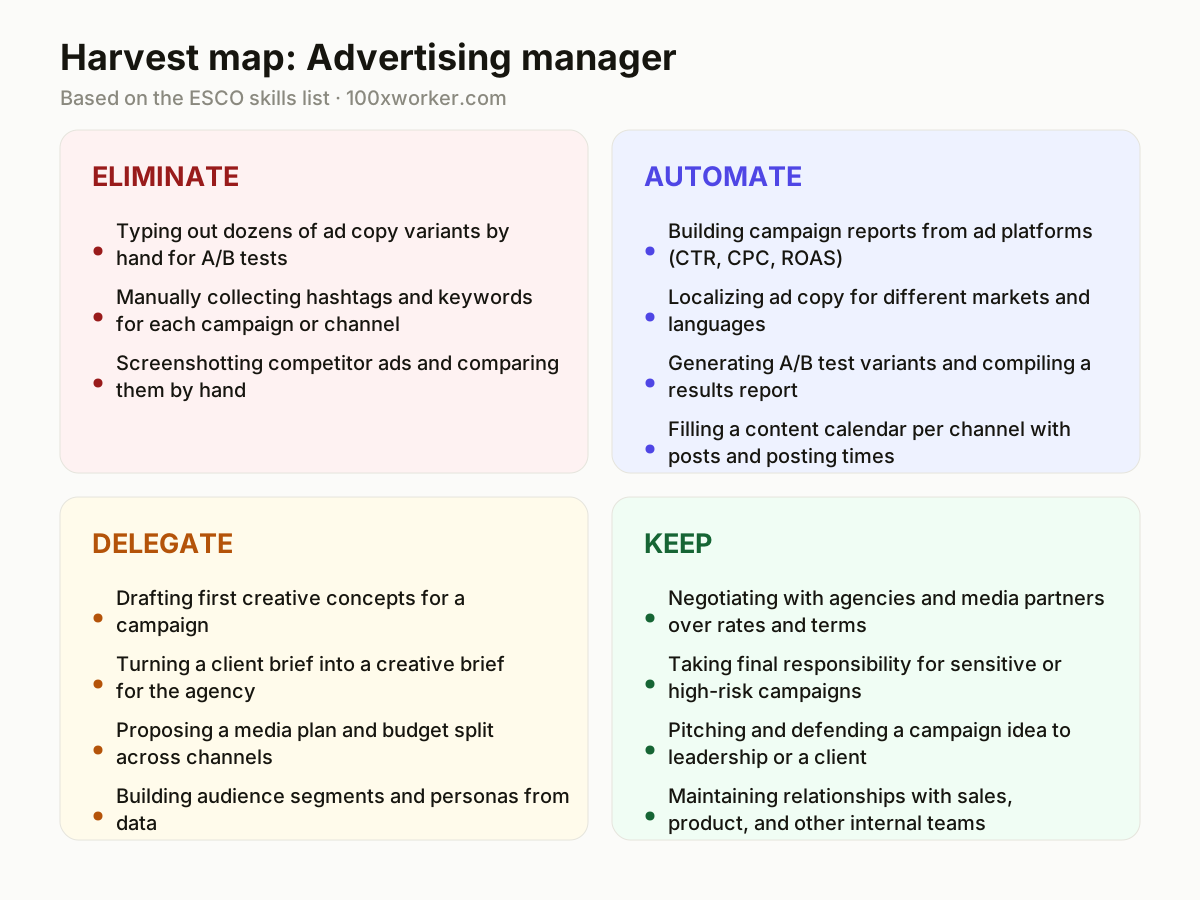
Which advertising manager tasks will AI take over first?
The tasks that go first are the ones with a clear input, a clear output, and no real judgment call in between. That includes writing multiple ad copy variants for testing, pulling keyword and hashtag lists together, and tracking competitor ads manually. Reporting work follows close behind: pulling CTR, CPC, and ROAS numbers out of ad platforms and turning them into a readable summary. These tasks are structured and repetitive, which is exactly what current AI applicability research points to as the strongest fit for generative AI (Microsoft Research, 2025).
Will AI replace advertising managers?
No single AI applicability score exists yet for this specific role, but the pattern from Microsoft Research's 200,000-conversation study holds across marketing occupations: AI handles drafting, summarizing, and reporting well, and struggles with negotiation, accountability, and reading a room. An advertising manager's job is a mix of both. The tasks that get automated shrink your workload. The tasks that stay, client trust, negotiation, final judgment calls, define what the job actually is once the repetitive layer is gone.
What's the difference between tasks AI automates and tasks you delegate?
Automated tasks run without you checking every step. A report generator that pulls campaign numbers into a template and sends it, that's automation. Delegated tasks still need your review before they go anywhere. A first draft of creative concepts, a proposed media plan, a client brief turned into a creative brief, these come back to you for judgment before anyone acts on them. Automation removes a task from your plate. Delegation moves the first draft to AI while the decision stays with you.
What can you do this month as an advertising manager?
Pick one recurring task from each bucket and test it for two weeks. Automate your next campaign report by connecting your ad platforms to a reporting agent instead of building the spreadsheet by hand. Delegate your next creative brief by having AI produce a first draft from the client's raw notes, then edit it yourself. Track how much time each swap actually saves. That gives you real numbers to justify changing your workflow, instead of a vague sense that AI 'should' help.
Task-level classification, not job titles, is the right unit for measuring where generative AI actually changes work.
Anthropic Economic Index
Become the AI person on your team
Turn reporting into a five-minute check, not a half-day build
Connect your ad platforms to an AI reporting tool and let it draft the weekly CTR, CPC, and ROAS summary. You review and adjust the narrative, you don't build the tables from scratch anymore.
Use AI as your first creative round, not your last
Ask AI for ten campaign concept directions before your team brainstorm, then use the session to argue about which three are worth developing. This moves the team's time from generating ideas to judging them.
Keep the negotiation, hand off the prep
Let AI draft the media plan scenarios and budget splits ahead of a rate negotiation with an agency. Walk into the actual conversation with numbers ready so you can focus on the relationship and the terms.
Want this for your actual task list?
The free scan on the homepage builds your personal task map in 30 seconds, based on your role and industry.
Run the free task scanTools for this work
| Tool | For which tasks | The sober take |
|---|---|---|
| Microsoft Copilot | Campaign reporting, ad copy variants, keyword lists | Useful for pulling structured drafts together fast, but check numbers against the source platform. |
| Claude (Anthropic) | Creative concept drafts, client brief structuring, persona building | Anthropic's own Economic Index shows this kind of drafting work skews toward augmentation, not full automation. |
| Meta Advantage+ / Google Performance Max | A/B test variant generation and budget allocation across channels | These platform-native tools automate testing and spend decisions, so your job shifts to setting guardrails. |
| Semrush or similar SEO/ad intelligence tools | Competitor ad tracking and keyword research | Continuous monitoring replaces manual screenshot comparisons, but still needs a human read on strategy. |
Prompts to try today
Campaign report draft
Creative concept directions
Media plan first draft
Related jobs
Frequently asked questions
Is advertising management a job AI can fully automate?
No. Current research, including Microsoft Research's 200,000-conversation applicability study, shows generative AI is strong at drafting, summarizing, and reporting tasks but weak at negotiation, accountability, and in-person persuasion. An advertising manager's job includes both types of tasks, so full automation of the role is not supported by current evidence.
Which AI skill matters most for advertising managers right now?
Prompting and reviewing AI output matters more than any single tool. You need to write a clear brief for AI (what audience, what goal, what constraints) and then judge whether the draft actually fits the brand and the client's real intent. That review step is where your judgment adds value.
Do junior advertising roles disappear because of AI?
The tasks that traditionally trained junior staff, writing endless ad copy variants, building keyword lists, compiling reports, are exactly the tasks AI now handles fastest. This changes what junior roles need to focus on: reviewing AI drafts, learning client context, and building judgment earlier, rather than doing repetitive production work.
How common is generative AI use in marketing roles across Europe?
32.7% of the EU population aged 16 to 74 used generative AI in the three months before being surveyed in 2025 (Eurostat, isoc_ai_iaiu). Adoption in marketing and advertising specifically tends to run higher than the general population, since drafting and analysis are core parts of the job.
Sources
- Microsoft Research, Working with AI: Measuring the Applicability of Generative AI to Occupations (2025)
- Anthropic Economic Index
- Eurostat, isoc_ai_iaiu (generative AI use, 2025)
- ESCO occupation taxonomy, European Commission
Hendrik De Winne, author of Becoming AI-Savvy, founder of VibeLab. Helps teams redesign their work with AI.
This article was drafted with AI assistance from public data sources and editorially reviewed.