100×worker · job analysis
Will AI Replace Content Marketers?

Content marketing means planning, writing, and distributing content that positions a brand. That part of the job has not changed. What has changed is which pieces of that work still need a person and which pieces a language model can do just as well, or faster.
Microsoft Research analyzed 200,000 real conversations between professionals and its Copilot AI assistant and published an AI applicability score for occupations across the economy (Working with AI: Measuring the Applicability of Generative AI to Occupations, 2025). The pattern shows up across many roles: writing, research, summarizing, and formatting tasks sit near the top of what generative AI already handles well.
This article breaks the content marketer's job into four buckets: tasks to eliminate outright, tasks to fully automate, tasks to delegate to AI with human review, and tasks to keep because they need judgment, relationships, or legal accountability a model cannot carry.
A content marketer plans, writes, and distributes content that positions a brand, using AI for research and formatting.
The task split: what AI takes over and what stays yours
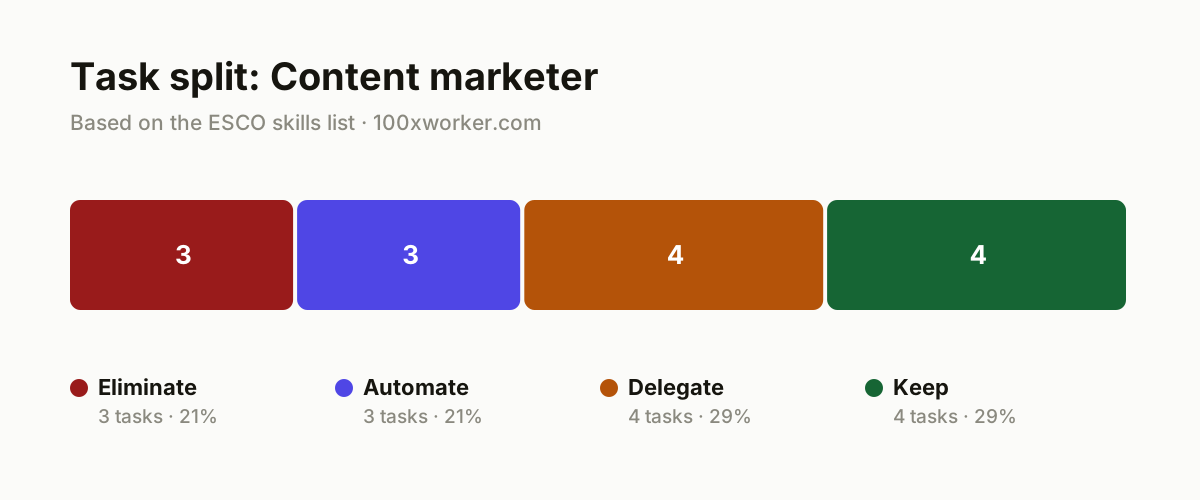
AI does not replace a content marketer's job in one move. It removes or reshapes tasks one at a time. Some tasks disappear because a tool now does them instantly (eliminate). Some get handed fully to an AI agent with only occasional spot checks (automate). Others stay a two-step process where AI drafts and a person finishes (delegate). And some tasks stay entirely human because they involve legal risk, trust, or reading a room (keep). Sorting your actual task list into these four buckets is more useful than asking whether your job title will survive.
| Task | Bucket | Why |
|---|---|---|
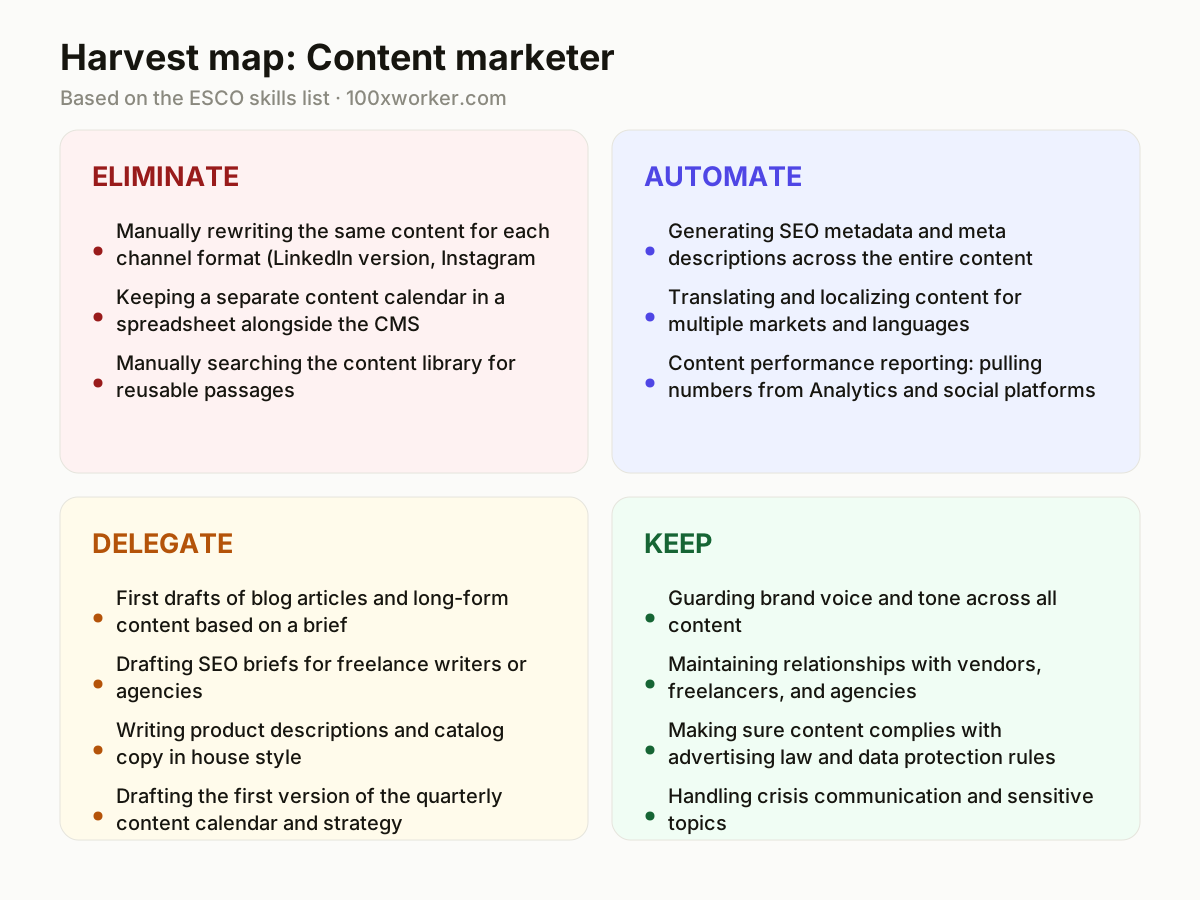
| Manually rewriting the same content for each channel format (LinkedIn version, Instagram version, newsletter version) | eliminate | A single prompt with the right length and tone per channel does this faster and more consistently. |
| Keeping a separate content calendar in a spreadsheet alongside the CMS | eliminate | Integrated tools keep calendar, status, and deadlines synced automatically. |
| Manually searching the content library for reusable passages | eliminate | AI searches and clusters existing content in seconds, with a summary attached. |
| Generating SEO metadata and meta descriptions across the entire content library | automate | Repetitive, rule-based text without brand-sensitive nuance, ideal for an agent. |
| Translating and localizing content for multiple markets and languages | automate | Translation models produce publication-ready text; a human checks only tone and legal context. |
| Content performance reporting: pulling numbers from Analytics and social platforms into a dashboard | automate | Data retrieval and visualization is mechanical work an agent can handle fully. |
| First drafts of blog articles and long-form content based on a brief | delegate | AI writes most of the structure and argument; you edit for facts and brand voice. |
| Drafting SEO briefs for freelance writers or agencies | delegate | AI clusters keywords and structure; you decide which angle is strategically right. |
| Writing product descriptions and catalog copy in house style | delegate | AI fills in product features from a template; you check for accuracy and compliance. |
| Drafting the first version of the quarterly content calendar and strategy | delegate | AI proposes a plan based on goals; you check it against priorities and budget. |
| Guarding brand voice and tone across all content | keep | Consistency in feel and nuance requires a human who knows the brand. (Your edge: Only you can tell what sounds on-brand, not just correct.) |
| Maintaining relationships with vendors, freelancers, and agencies | keep | Building trust and negotiating remains a social process. (Your edge: You cannot build trust with a prompt.) |
| Making sure content complies with advertising law and data protection rules | keep | Legal risk and final accountability sit with a person, not a model. (Your edge: You sign off on the mistake, not the AI.) |
| Handling crisis communication and sensitive topics | keep | Reading context, showing empathy, and shifting quickly requires judgment. (Your edge: The wrong tone in a crisis costs more than time.) |
What tasks will AI take over from content marketers?
AI is strongest at content marketing tasks that are repetitive, rule-based, or purely mechanical. That includes rewriting one piece of content into different formats for LinkedIn, Instagram, or a newsletter, generating SEO metadata across a large content library, translating and localizing copy for different markets, and pulling numbers from Analytics and social platforms into a reporting dashboard. These are tasks where the input and output are clearly defined and the risk of a wrong answer is low. A content marketer used to spend hours on this kind of production work; a well-set-up tool or agent now does most of it in minutes, leaving a short review step for a human.
Will AI replace content marketers?
Not in the sense of the job disappearing. The ESCO taxonomy lists thousands of occupations built from underlying tasks, and most content and marketing tasks still need a person somewhere in the loop. Anthropic's Economic Index, which classifies millions of real AI conversations against standard occupational task lists, shows a split between automation-like use, where AI does a task directly, and augmentation-like use, where AI assists while a person decides. Content marketing leans toward the second pattern for higher-stakes work: drafting is often automated, but strategy, brand judgment, and final sign-off stay augmentation. The job changes task by task, not in one event.
How do you become the AI-savvy person on the content team?
Start by mapping your actual weekly tasks against the four buckets: eliminate, automate, delegate, keep. Learn to write clear briefs, since a vague prompt produces a vague draft. Build a habit of using AI for the first draft of routine content, such as product copy, meta descriptions, and social variations, and spend the time you save on strategy, editing for voice, and relationships with writers and vendors. Track which prompts and tools actually save time versus which just move the work around. Share what works with the team instead of keeping it as a personal trick; that is what makes someone the go-to AI person rather than just an early user.
What can you do this month to get started?
Pick one repetitive task, such as writing meta descriptions or reformatting a blog post for three channels, and set up a working AI prompt or tool for it this week. Test it on five real pieces of content and compare the output to what you would have written by hand. Keep a short log of time saved and errors caught. Next, draft one SEO brief or content brief with AI assistance and have a colleague review it blind, without knowing which parts were AI-written. Use that feedback to build a small internal guide on where AI drafts are good enough and where they still need a heavy edit.
AI's usefulness to a job depends on the specific tasks inside that job, not the job title.
Working with AI: Measuring the Applicability of Generative AI to Occupations, Microsoft Research, 2025
Become the AI person on your team
Turn production time into strategy time
If AI now drafts your product descriptions and meta tags, do not fill the freed hours with more of the same. Use them for competitor research, content audits, or planning the next quarter's angles.
Build a personal prompt library
Save the briefs and prompts that reliably produce usable first drafts, organized by content type. Reuse and refine them instead of starting from scratch every time.
Learn to edit AI output, not just write from scratch
Editing a draft for brand voice, accuracy, and compliance is a different skill from writing one. Practice spotting where an AI draft is generic, factually loose, or off-tone before it ships.
Want this for your actual task list?
The free scan on the homepage builds your personal task map in 30 seconds, based on your role and industry.
Run the free task scanTools for this work
| Tool | For which tasks | The sober take |
|---|---|---|
| ChatGPT or Claude | First drafts of blog posts, product descriptions, and SEO briefs (delegate) | Useful for structure and volume, but every fact and claim still needs a human check. |
| DeepL or a similar AI translation tool | Translating and localizing content for different markets (automate) | Good enough for most marketing copy, but legal or regulated claims still need review. |
| SurferSEO, Semrush, or similar SEO platforms | Generating metadata, keyword clusters, and SEO briefs (automate, delegate) | These mix rule-based automation with AI suggestions, so output quality depends on input quality. |
| Looker Studio, HubSpot, or Analytics with AI summaries | Content performance reporting (automate) | Handles the number-crunching well; the strategic 'so what' still needs a person. |
Prompts to try today
Channel reformatting
SEO brief for a freelancer
Blind draft review checklist
Related jobs
Frequently asked questions
Is content marketing a job at risk from AI?
The job title is not at risk in the near term, but a large share of the routine writing, formatting, and reporting work inside it is. Microsoft Research's 2025 analysis of real Copilot conversations found writing- and research-heavy tasks among those AI already handles well. What stays is brand judgment, vendor relationships, legal compliance, and crisis response, none of which a model can fully own.
What is the difference between automating and delegating a content task?
Automating means an AI agent completes the task with little to no human review, such as generating standard SEO metadata. Delegating means AI produces a first version, a draft blog post or SEO brief, and a person edits it before it goes out. The difference is how much the output can be trusted without a human check.
Do I need to learn to code or use complex AI tools to keep up?
No. Most useful AI tools for content marketing work through plain-language prompts in a chat interface or a marketing platform's built-in AI feature. What matters more is writing a clear brief, checking output for accuracy and tone, and knowing which tasks are safe to automate versus which still need your judgment.
How is AI use in content marketing actually measured?
Two of the more rigorous public sources are Microsoft Research's applicability score, built from 200,000 real Copilot conversations, and Anthropic's Economic Index, which classifies millions of Claude conversations against standard occupational task lists and splits usage into automation-like and augmentation-like patterns. Older 'robotization percentage' figures often cited online come from Frey and Osborne's 2013 Oxford study, done before large language models existed, and should be read with that caveat.
Sources
- Microsoft Research, Working with AI: Measuring the Applicability of Generative AI to Occupations (2025)
- Anthropic Economic Index
- Eurostat, isoc_ai_iaiu dataset
- ESCO, European Commission occupation and skills taxonomy
Hendrik De Winne, author of Becoming AI-Savvy, founder of VibeLab. Helps teams redesign their work with AI.
This article was drafted with AI assistance from public data sources and editorially reviewed.