100×worker · job analysis
Will AI Replace Call Centre Agents?
Call centre work is built from repeatable phone contact: answering, routing, logging, and selling. That repetitiveness is exactly what generative AI is good at automating. Microsoft Research analyzed 200,000 real Copilot conversations and scored how applicable generative AI is to different occupations. For customer service representatives, the closest US category to call centre agents, the applicability score came out at 40.8%. For comparison, translators score highest at 49%, while nurses score low at 12%.
That 40.8% is not a job-loss number. It measures the share of work activities where AI can plausibly help or take over, not the share of people who lose their jobs. Anthropic's Economic Index, which classifies millions of Claude conversations against the O*NET task framework, makes a similar point: AI use splits into automation-like patterns (AI does the task) and augmentation-like patterns (AI helps a person do the task faster). For call centre work, both patterns are already visible in the same job description.
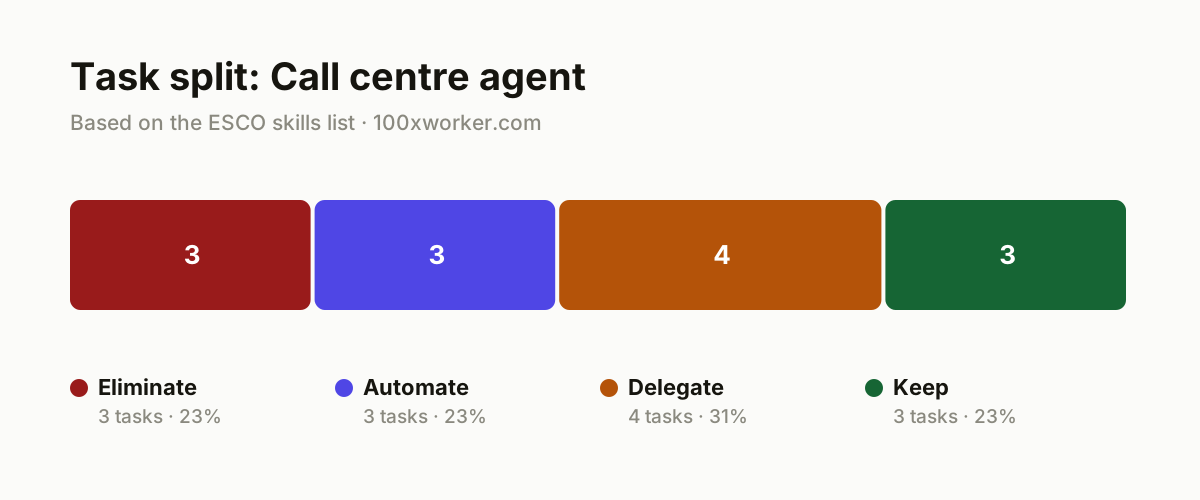
This article breaks the call centre agent role into four buckets: tasks AI is eliminating, tasks AI already automates end to end, tasks you delegate to AI and then check, and tasks that stay human because they depend on live judgment, emotion, or trust.
A call centre agent handles phone-based customer contact and sales, work whose first-line share AI already automates.
The task split: what AI takes over and what stays yours
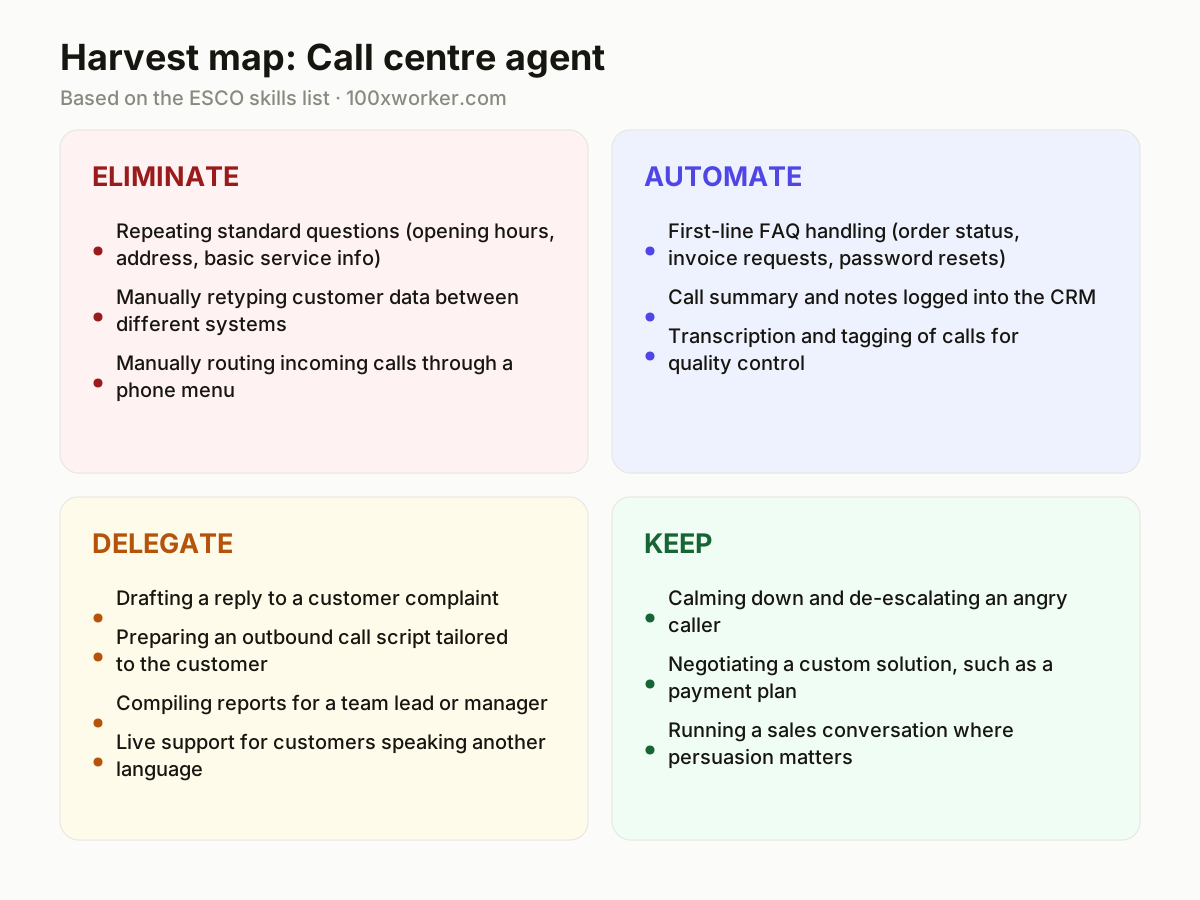
Not every task in a call centre agent's job changes the same way. Some tasks disappear because a system now handles them without anyone noticing. Some get fully automated end to end. Some get delegated: AI drafts, you check and send. And some stay firmly human because they need live judgment a model cannot supply. Sorting the job this way, task by task, gives a clearer picture than a single applicability percentage.
| Task | Bucket | Why |
|---|---|---|
| Repeating standard questions (opening hours, address, basic service info) | eliminate | A chatbot or voicebot answers this accurately around the clock, without an agent involved. |
| Manually retyping customer data between different systems | eliminate | Systems get connected, and AI syncs data automatically without anyone copying it by hand. |
| Manually routing incoming calls through a phone menu | eliminate | Smart routing recognizes the request from voice or text and forwards it directly to the right team. |
| First-line FAQ handling (order status, invoice requests, password resets) | automate | A chatbot or voicebot resolves this fully on its own, with no human step needed. |
| Call summary and notes logged into the CRM | automate | AI generates the wrap-up note automatically from the transcript, ready to use. |
| Transcription and tagging of calls for quality control | automate | Speech-to-text and classification happen automatically, so no one has to listen and label manually. |
| Drafting a reply to a customer complaint | delegate | AI writes a first version based on the case file and tone guide, you rewrite and send it. |
| Preparing an outbound call script tailored to the customer | delegate | AI drafts a script and likely objections, you adjust it once the real conversation starts. |
| Compiling reports for a team lead or manager | delegate | AI pulls numbers and trends from the data, you interpret them and present the conclusions. |
| Live support for customers speaking another language | delegate | AI translates during the call, you manage tone and confirm the nuance is right. |
| Calming down and de-escalating an angry caller | keep | Recognizing emotion and defusing it on a live call requires real-time empathy. (Your edge: Voice and timing no model replicates.) |
| Negotiating a custom solution, such as a payment plan | keep | This needs discretion and trust that a policy document can't fully script. (Your edge: Building trust in the moment itself.) |
| Running a sales conversation where persuasion matters | keep | Timing, tone, and reading the customer decide whether a sale closes. (Your edge: Improvising based on what you actually hear.) |
Will AI replace call centre agents?
Not the whole job, but a large chunk of the task list. Microsoft Research put generative AI's applicability to customer service representative work at 40.8% of work activities. That covers routine questions, data entry, and call logging, work that a chatbot, voicebot, or CRM assistant can already do. It does not cover de-escalation, negotiation, or persuasive selling, which stay with people. The realistic outcome is fewer routine calls per agent and more calls that need real judgment, not zero call centre agents.
Which call centre agent tasks does AI take over first?
AI moves first on the most repeatable parts of the job: answering standard questions, retyping data between systems, and routing calls through a menu. These get eliminated or fully automated because they follow a fixed pattern every time. Next comes first-line FAQ handling like order status and password resets, plus automatic call summaries and transcription for quality checks. Anything with a clear script and low judgment goes to AI before anything that needs empathy, negotiation, or persuasion.
What can you do this month as a call centre agent to work with AI?
Start with one delegate task: let AI draft your reply to complaints or your outbound call script, then edit and send it yourself. Time how much editing that saves you. Ask your team lead which chatbot or voicebot handles your FAQs, and learn how to escalate a call out of it cleanly when a customer gets frustrated. Check whether your CRM already generates call summaries automatically. If it does, stop writing them by hand and spend that time on harder calls.
How do you become the AI person on your team?
Volunteer to test new call center AI tools before your team rolls them out, and write down what breaks: wrong routing, bad translations, tone that misses the customer. Share short, concrete feedback with whoever manages the tooling instead of general complaints. Build a small library of AI-drafted templates for complaints, payment plans, and outbound scripts that colleagues can reuse and adapt. Being the person who knows how to prompt, check, and fix AI output makes you the reference point when something goes wrong.
AI use in customer service splits into automation-like patterns, where AI does the task, and augmentation-like patterns, where AI helps a person do the task.
Anthropic Economic Index
Become the AI person on your team
Build a template library
Collect the AI-drafted replies and scripts that actually worked, and turn them into a shared folder. Colleagues save time, and you become the go-to person for phrasing.
Track escalation failures
Note every time the chatbot or voicebot fails to route a frustrated customer to a human fast enough. Bring specific examples to whoever configures the routing rules.
Pilot before rollout
Ask to test new AI tools, such as live-call translation or automatic summaries, on a small batch of calls first. Report concrete issues, not just general impressions.
Want this for your actual task list?
The free scan on the homepage builds your personal task map in 30 seconds, based on your role and industry.
Run the free task scanTools for this work
| Tool | For which tasks | The sober take |
|---|---|---|
| Chatbot and voicebot platforms | Eliminate: standard questions, call routing; Automate: first-line FAQ handling | Handles repeatable, scripted contact without an agent picking up the phone. |
| CRM with AI-generated call summaries | Automate: wrap-up notes and reports; Delegate: management reporting | Produces the after-call note automatically from the transcript, so you review instead of write. |
| Speech-to-text and call tagging software | Automate: transcription and quality tagging | Removes manual listening and labeling from quality control work. |
| Real-time AI translation for calls | Delegate: live support for customers speaking another language | Translates during the call, but tone and nuance still need a human check. |
| AI reporting assistants | Delegate: compiling reports for team lead or management | Pulls trends from call data quickly, but the interpretation stays your job. |
Prompts to try today
Draft a complaint reply
Prepare an outbound call script
Summarize call data for a report
Related jobs
Frequently asked questions
Is the call centre agent job disappearing because of AI?
No, but its task mix is shifting fast. Microsoft Research scored generative AI applicable to 40.8% of customer service representative work activities, mostly routine, repeatable contact. The parts of the job built on live empathy, negotiation, and persuasion are not disappearing, so expect fewer agents handling routine volume and more agents focused on harder calls.
What is the difference between automation and augmentation in call centre AI?
Automation means AI completes the task without a person, like a chatbot answering an FAQ. Augmentation means AI helps a person do the task faster, like drafting a complaint reply that an agent edits before sending. Anthropic's Economic Index tracks both patterns separately across millions of real conversations, and call centre work shows a mix of the two rather than one clean category.
Which call centre tasks are safest from AI automation?
Tasks that depend on live judgment stay hardest to automate: de-escalating an angry caller, negotiating a custom solution like a payment plan, and running a persuasive sales conversation. These rely on reading tone, timing, and emotion in real time, which is harder for a model to replicate than answering a scripted question.
How official is the 40.8% AI applicability figure for call centre agents?
It comes from Microsoft Research's 2025 paper 'Working with AI: Measuring the Applicability of Generative AI to Occupations,' based on 200,000 real Copilot conversations, and applies to the US occupational category 'Customer Service Representatives,' the closest match to call centre agents. It measures where generative AI is applicable to work activities, not a prediction of job losses, and the underlying data is published openly on GitHub under CC BY 4.0.
Sources
- Microsoft Research, Working with AI: Measuring the Applicability of Generative AI to Occupations (2025)
- Anthropic Economic Index
- Eurostat, Use of generative AI (isoc_ai_iaiu)
- ESCO, European Commission occupation taxonomy
Hendrik De Winne, author of Becoming AI-Savvy, founder of VibeLab. Helps teams redesign their work with AI.
This article was drafted with AI assistance from public data sources and editorially reviewed.