100×worker · job analysis
Will AI Replace Social Workers?

Hospital social work sits at the crossroads of medicine, law, and grief, and it is one of the professions AI struggles to touch. Microsoft Research analyzed 200,000 real Copilot conversations across hundreds of occupations and gave healthcare social workers an AI applicability score of just 18.9%, one of the lowest scores in the entire study, far below translators at 49% and only slightly above nurses at 12%. That number does not mean AI has nothing to offer you. It means most of what fills your day, from crisis conversations to ethical judgment calls, does not fit the pattern-matching that generative AI is good at.
The tasks AI handles well are the ones with fixed structure and no real judgment call: retyping notes, drafting standard letters, searching regulations. The tasks that stay with you are the ones built on trust, presence, and responsibility. Anthropic's Economic Index, which sorts millions of Claude conversations against standard occupational task lists, finds the same pattern across many jobs: drafting and administrative tasks lean toward AI doing the work, while relational and judgment-heavy tasks lean toward AI supporting a person who stays in charge.
This article sorts your actual task list into four groups: tasks to eliminate, tasks to automate, tasks to delegate to AI with review, and tasks to keep for yourself. Use it to decide where AI actually saves you time this month, and where it should stay out of the room.
A hospital social worker helps patients and families cope with illness, emotional distress, and social or financial problems.
The task split: what AI takes over and what stays yours
AI changes a job by changing its tasks, not by replacing the person doing them. Sort your task list into four groups: tasks you can eliminate because AI or existing software already does them better, tasks you can automate with an AI agent that produces a first draft, tasks you delegate to AI but still review and sign off on, and tasks you keep because they need a human in the room, accountable and present. For a hospital social worker, that last group is large: crisis intervention, grief conversations, and ethical decisions do not move into the automate or delegate column.
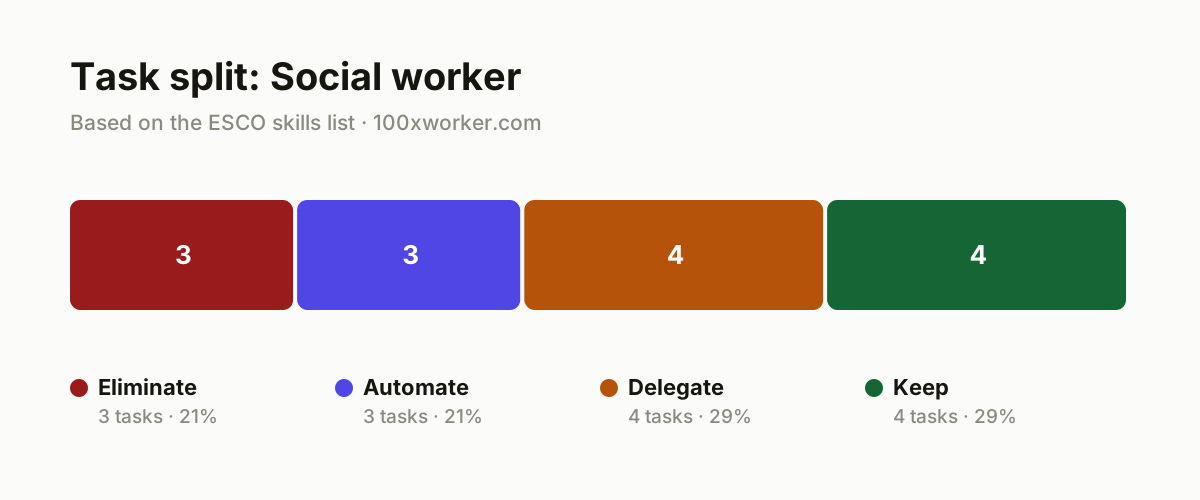
| Task | Bucket | Why |
|---|---|---|
| Manually retyping handwritten or dictated session notes into the case file system | eliminate | This is pure transcription with no judgment involved. AI does it faster and with fewer errors. |
| Drafting standard referral forms and referral letters from scratch | eliminate | Fixed structure, repeated content, no judgment call required. |
| Manually looking up which legislation or procedure applies to a routine situation | eliminate | A language model searches regulations faster than a binder of statutes. |
| Drafting the first version of a social care plan from intake data | automate | An AI agent fills in the standard structure. You add the context and nuance. |
| Summarizing the multidisciplinary team meeting into a case file note | automate | AI distills decisions and action items from a longer discussion, ready for the file. |
| Filling in discharge letters and home care request forms from patient data | automate | Repeatable structure with fixed fields, well suited to automatic drafting. |
| Draft report after an intake interview | delegate | AI writes the first draft. You review, correct, and take responsibility for it. |
| Translating legislation and regulations into plain language for the patient | delegate | AI translates the jargon. You verify that the legal meaning still holds. |
| Preparing a case overview and risk assessment for case management | delegate | AI structures the facts. You weigh the risks and decide. |
| Looking up and summarizing regulations and rights per case for your advocacy role | delegate | AI gathers the sources. You decide the argument you make for the patient. |
| Crisis intervention with a patient shortly after a severe diagnosis | keep | Requires presence in the moment. No AI can take that over. (Your edge: Human presence at the moment of crisis.) |
| Conversation with patient and family about fear, loss, and grief | keep | Empathy and trust build in a real conversation, not through a screen. (Your edge: Empathy cannot be automated.) |
| Negotiating with a doctor, insurer, or family about a care plan | keep | Requires relational engagement and reading interests on the spot. (Your edge: Negotiation needs live judgment of people.) |
| Weighing ethical dilemmas and making decisions within a case | keep | Responsibility and moral judgment stay with the professional. (Your edge: You cannot outsource responsibility.) |
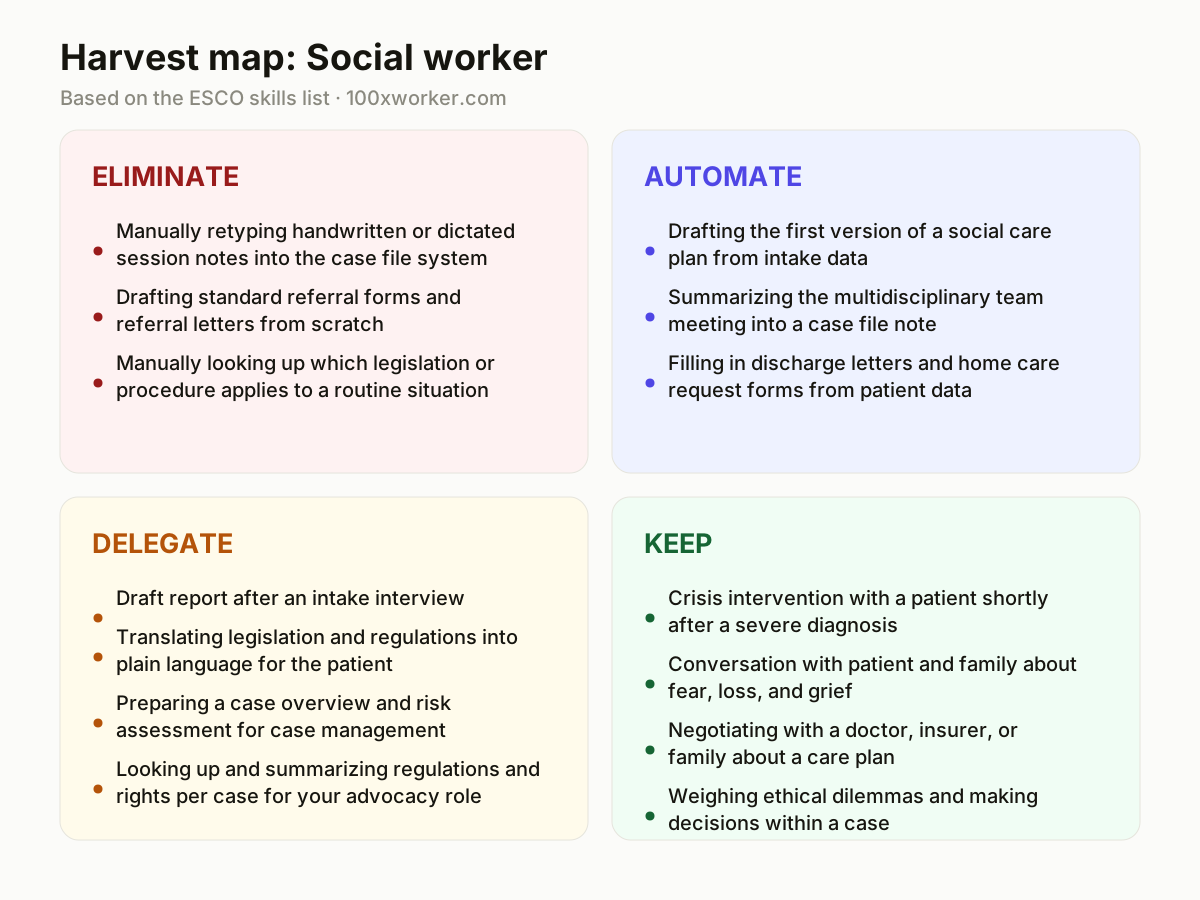
Which tasks can AI take over from a social worker?
AI works well on tasks with fixed structure and no judgment call. That includes retyping session notes, drafting standard referral letters, and producing a first-pass social care plan from intake data. Tools built into hospital documentation systems can also summarize multidisciplinary meetings into case notes and pre-fill discharge or home care request forms. None of this removes your signature or your legal responsibility. You still read, correct, and approve every document before it enters the record. Think of AI as a fast drafting assistant for repetitive paperwork, not as a decision-maker in the casework itself.
Will AI replace social workers?
No. Microsoft Research's applicability score for healthcare social workers sits at 18.9%, one of the lowest scores among the occupations it studied, well below professions like translation at 49%. The job depends on trust built face to face, on reading a family's grief in the room, and on carrying legal and ethical responsibility for decisions. AI can draft a report or summarize a meeting. It cannot sit with a patient minutes after a terminal diagnosis or negotiate a discharge plan with an insurer. Expect your task list to shift toward review, judgment, and direct contact, and away from typing and searching.
Why does social work score low on AI applicability compared to other jobs?
Generative AI is strongest on tasks that are mostly language and pattern based: drafting text, summarizing documents, searching regulations. Hospital social work centers on tasks that resist that pattern: crisis intervention, reading emotional cues in a room, building trust with a frightened family, and making case-by-case ethical calls that carry legal weight. Anthropic's Economic Index, which classifies millions of Claude conversations against O*NET task lists, shows this same split across occupations: administrative and drafting tasks lean toward automation-like use, while judgment-heavy, relational tasks lean toward augmentation, where AI supports a person rather than replacing them. Social work sits firmly in the second category.
What can you do this month with AI as a social worker?
Start small. Pick one recurring document, such as a discharge summary or intake report, and test whether a general AI tool can produce a usable first draft from your notes. Keep patient data out of consumer tools unless your hospital has approved and secured a specific system. Use AI to summarize your own multidisciplinary meeting notes into action points, then check them against your memory of the meeting. Ask it to translate a piece of legislation or a policy document into plain language you can read aloud to a patient. Track how much time each use saves before rolling it out further.
Translators show the highest AI applicability score at 49%, nurses one of the lowest at 12%, and healthcare social workers close behind at 18.9%.
Microsoft Research, Working with AI: Measuring the Applicability of Generative AI to Occupations (2025)
Become the AI person on your team
Draft first, verify always
Let AI produce the first version of a care plan or discharge letter from your intake notes. You still check every clinical and legal detail before it goes in the file.
Turn meetings into records
Note the multidisciplinary meeting yourself, then have AI turn it into a structured case note with decisions and action points. You confirm accuracy and add anything the tool missed.
Keep the room human
Reserve your energy for the conversations that need a person present: crisis moments, grief, and negotiations with families or insurers. Let AI handle the paperwork trail around those conversations.
Want this for your actual task list?
The free scan on the homepage builds your personal task map in 30 seconds, based on your role and industry.
Run the free task scanTools for this work
| Tool | For which tasks | The sober take |
|---|---|---|
| Microsoft Copilot (in Microsoft 365 tools your hospital may already license) | Drafting referral letters, first-pass care plans, meeting summaries | Only paste patient details into versions your hospital's IT and privacy office have explicitly approved. |
| ChatGPT or Claude (general-purpose chat assistants) | Plain-language translation of legislation, drafting non-identifiable case report language | Useful for research and drafting without patient identifiers, not for storing case data. |
| Medical dictation software with AI transcription | Converting spoken session notes into text for the case file | Speeds up note-taking but still needs a human read-through for accuracy. |
| AI features built into your hospital's electronic health record system | Summarizing multidisciplinary meetings, pre-filling discharge and home care forms | Use only the modules your hospital has certified for patient data, not a generic outside tool. |
Prompts to try today
Draft a social care plan from intake notes
Summarize a multidisciplinary meeting
Translate legislation into plain language
Related jobs
Frequently asked questions
Can AI write my case notes for me?
AI can draft a first version of a case note or summary from your own notes or a recording of a meeting, but you have to read it, correct it, and take responsibility for what goes into the patient file. Treat it as a fast typist, not as the person who decided what happened in the room. Never paste identifiable patient data into a general consumer AI tool unless your hospital has approved a secure version for that purpose.
Is my job at risk because of AI?
Not based on the numbers available. Microsoft Research puts AI applicability for healthcare social workers at 18.9%, among the lowest scores of any studied occupation, because the core of the job (crisis intervention, trust-building, ethical judgment) resists automation. Expect your task list to shift rather than your job to disappear. Administrative work shrinks, direct contact and complex judgment calls take up more of your time.
What AI skills should a hospital social worker learn?
Learn to write a clear prompt, to check an AI draft against your own notes for accuracy, and to know what patient information you can and cannot enter into a given tool. You do not need to code. You need to know how to review AI output critically, since you remain accountable for every document with your name on it.
Does public AI adoption affect how patients see AI in healthcare settings?
Yes, broadly. Eurostat found that 32.7% of the EU population aged 16 to 74 used generative AI in the last three months of 2025. Patients increasingly arrive having already asked a chatbot about their diagnosis, their rights, or their treatment options. That changes the conversation you walk into and can shift what they expect from you as a social worker.
Sources
- Microsoft Research, Working with AI: Measuring the Applicability of Generative AI to Occupations (2025)
- Anthropic Economic Index
- Eurostat, Use of generative artificial intelligence (isoc_ai_iaiu), 2025
- ESCO (European Skills, Competences, Qualifications and Occupations), European Commission
Hendrik De Winne, author of Becoming AI-Savvy, founder of VibeLab. Helps teams redesign their work with AI.
This article was drafted with AI assistance from public data sources and editorially reviewed.