100×worker · job analysis
Will AI Replace Nurse Practitioners?
Every few months a headline claims AI is coming for healthcare jobs. For nurse practitioners, the data tells a calmer story. Microsoft Research analyzed 200,000 real Copilot conversations and scored how applicable generative AI is to work activities across occupations. Nurse practitioners scored 14.3%, one of the lowest scores in the whole study, well below translators at 49%. That does not mean AI is irrelevant to your job. It means AI applies to a narrow slice of what you do: drafting, summarizing, and scheduling, not diagnosing or treating.
Generative AI use is climbing everywhere. Eurostat reports that 32.7% of the EU population aged 16 to 74 used generative AI in the three months before being surveyed in 2025. Anthropic's Economic Index, which classifies millions of Claude conversations against standardized occupational task lists, splits AI use into automation-like use (AI does the task) and augmentation-like use (AI helps you do it faster). For clinical roles like yours, augmentation is where most of the real gains sit.
This article breaks your job into four buckets: tasks AI eliminates outright, tasks it automates for you, tasks you delegate to AI and check, and tasks you keep because they need clinical judgment, physical presence, or accountability.
A nurse practitioner is a nurse with advanced clinical authority who diagnoses, treats, and prescribes in complex care situations.
The task split: what AI takes over and what stays yours
Not every task in a nurse practitioner's job responds to AI the same way. Some administrative steps disappear entirely once systems talk to each other. Others get a first draft from AI that you still review. Some data work gets handed to AI with you checking the output. And some tasks, especially anything involving diagnosis, hands-on emergency response, or a patient relationship, stay firmly with you because they require judgment, accountability, or physical presence AI cannot provide.
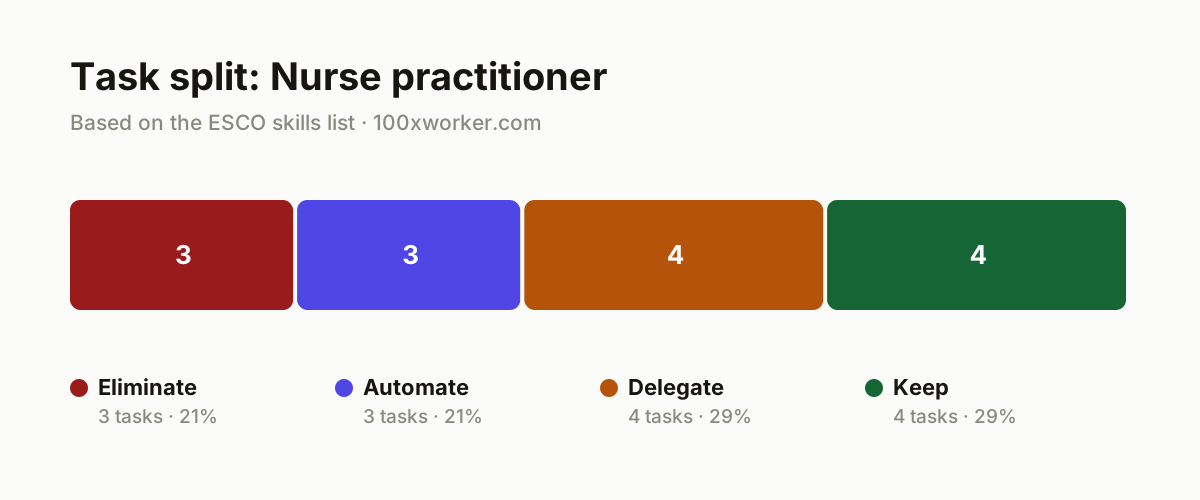
| Task | Bucket | Why |
|---|---|---|
| Manually re-entering patient data across different EHR systems and forms | eliminate | System integration and structured data entry make double typing unnecessary. |
| Filing and organizing paper notes and reports by hand | eliminate | Digital storage with automatic indexing fully replaces physical archiving. |
| Filling out standard referral and intake forms by hand | eliminate | Form fields populate automatically from existing patient records. |
| Drafting discharge letters and care transfer plans from consult notes | automate | An AI agent structures existing notes into the right letter format immediately. |
| Scheduling and updating the nursing team's rosters and calendars | automate | Scheduling rules and staff availability are fixed inputs, not clinical judgment. |
| Summarizing clinical literature and guidelines and keeping them current | automate | Summarizing fixed source material is repeatable, checkable work. |
| Drafting personalized patient education on lifestyle and disease prevention | delegate | AI writes a solid first draft, you check it against the patient in front of you. |
| Preparing first drafts of protocols and policy documents | delegate | The structure comes together fast, the clinical and legal review stays with you. |
| Analyzing care quality data and reporting to management | delegate | AI finds patterns in data faster, interpretation and action stay human. |
| First-pass screening of patient records for advanced-care risk factors | delegate | AI flags notable signals, you decide whether further workup is needed. |
| Making clinical decisions in advanced practice for individual patients | keep | Diagnosis and treatment choices require context, experience, and accountability. (Your edge: You carry the responsibility, not an algorithm.) |
| Talking with patients and families, listening actively, showing empathy | keep | Building trust in a vulnerable situation is human work. (Your edge: Empathy and presence cannot be automated.) |
| Leading the team, delegating tasks, coaching and evaluating colleagues | keep | Leadership in healthcare requires nuance, trust, and context. (Your edge: People lead people, not a system.) |
| Responding to emergencies and initiating life-saving measures | keep | Acute care requires immediate, physical action under time pressure. (Your edge: Seconds count, AI has no hands at the bedside.) |
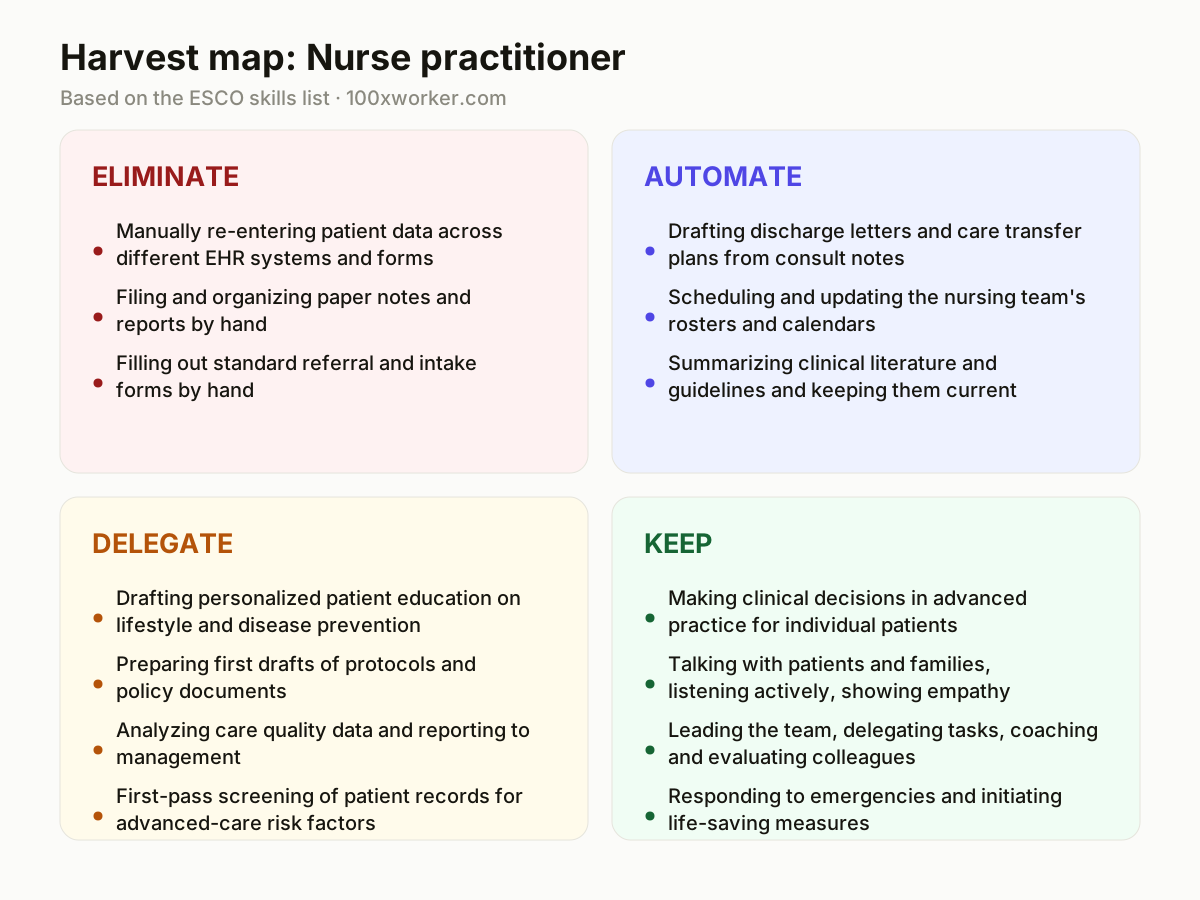
Which tasks can AI take over from a nurse practitioner?
AI handles the administrative and documentation layer of the job well. It drafts discharge letters and transfer plans from your consult notes, keeps rosters and calendars updated, and summarizes clinical guidelines so you don't have to read every update yourself. Manual data entry between systems and paper filing largely disappear once records are digital and connected. AI also produces solid first drafts of patient education material and policy documents, though you still review those before they go out. What AI does not do is decide what treatment a patient needs or take responsibility for that decision.
Will AI replace nurse practitioners?
No. Microsoft Research measured how applicable generative AI is to real work activities across occupations and scored nurse practitioners at 14.3%, close to the low end of the scale and far behind occupations like translation at 49%. The job center is clinical judgment, prescribing, physical examination, emergency response, and relationships with patients and families, none of which a language model performs. AI changes the task list around that center: less retyping, less manual scheduling, faster first drafts. The clinical core of the role stays with you, and demand for people who combine that clinical judgment with comfort using AI tools is likely to grow.
How do you become the AI point person on your care team?
Start by mapping your own task list into the four buckets above and sharing that breakdown with your team lead. Pick one repetitive task, like discharge letter drafting or guideline summaries, and pilot an AI workflow for it yourself before proposing it more broadly. Keep a short log of where AI output needed correction versus where it was usable as-is, since that record makes the case for or against wider adoption. Being the person who can explain what AI is actually good for on a care team, in plain terms, matters more than being the most technical person in the room.
What can you do this month to start using AI?
Pick one document type you write often, such as discharge summaries or patient education handouts, and test an AI assistant on a de-identified example. Compare the draft against what you'd normally write and note what needed fixing. Ask your organization's IT or compliance team which AI tools are approved for use with patient data before you use any real records. Try one literature summary task to see how much reading time it saves. Small, checkable pilots like these build real judgment about where AI helps and where it doesn't.
Generative AI's applicability to an occupation is a measurable share of its work activities, not a measure of whether the job itself will disappear.
Microsoft Research, Working with AI (2025)
Become the AI person on your team
Run a documentation pilot
Pick discharge letters or transfer plans and test whether an approved AI tool can produce a usable first draft from your notes. Track how much editing time you save over two weeks and share the numbers with your team.
Build a one-page task map
List your recurring tasks under eliminate, automate, delegate, and keep, and bring it to a team meeting. This gives colleagues a concrete starting point instead of a vague conversation about AI.
Own the guideline summary habit
Set up a routine where AI drafts summaries of new clinical guidelines and you verify them against the source before circulating. Becoming the person who keeps the team current, faster, builds real standing.
Want this for your actual task list?
The free scan on the homepage builds your personal task map in 30 seconds, based on your role and industry.
Run the free task scanTools for this work
| Tool | For which tasks | The sober take |
|---|---|---|
| Ambient clinical documentation assistants | automate: drafting discharge letters and transfer plans from consult notes | These tools produce a first draft from spoken or typed notes, but every draft needs your clinical review before it goes in the chart. |
| General-purpose AI assistants (e.g. Copilot, ChatGPT, Claude) | delegate: patient education drafts, protocol and policy drafts, literature summaries | Useful for first drafts and summarizing, not for storing or processing identifiable patient data unless your organization has approved it. |
| EHR-integrated scheduling and rostering features | automate: team rosters and calendar updates | Rule-based scheduling logic handles availability and shift patterns without clinical input needed. |
| Structured EHR form automation | eliminate: manual data entry and standard referral forms | Once systems are integrated, fields populate from existing records instead of being typed twice. |
Prompts to try today
Draft a discharge summary from consult notes
Write patient education material
Summarize a clinical guideline update
Related jobs
Frequently asked questions
Will AI take over prescribing for nurse practitioners?
No. Prescribing in advanced practice requires clinical judgment about a specific patient's history, current condition, and risk factors, along with legal accountability that sits with the prescriber. AI can help you look up drug interactions or summarize dosing guidelines faster, but the decision to prescribe and the responsibility for that decision stay with you. Microsoft Research's applicability scoring places nurse practitioners near the low end of occupations affected by generative AI, and prescribing is one of the clearest reasons why.
Which AI tool should a nurse practitioner start with?
Start with whatever your organization has already approved for clinical use, since patient data rules differ by employer and jurisdiction. If you're piloting something informally, use it only on de-identified text, such as summarizing a guideline or drafting generic patient education material. Ambient documentation tools that draft notes from conversations are worth testing if your organization supports them, since documentation is where AI applicability is highest for this role.
Does using AI as a nurse practitioner raise liability concerns?
Yes, and that's exactly why AI output in this role should always be treated as a draft, not a final answer. Any AI-generated clinical content, from a discharge summary to a risk flag, needs your review and sign-off before it affects patient care. Check your organization's policy on AI use with patient data before using any tool, since compliance requirements vary and using an unapproved tool with identifiable data can create real liability.
How much are nurse practitioners actually using AI right now?
Exact figures specific to nurse practitioners aren't available in current published data, but general population adoption gives context: Eurostat found 32.7% of the EU population aged 16 to 74 used generative AI in the past three months in 2025. Anthropic's Economic Index shows healthcare-related conversations lean toward augmentation-like use, meaning people use AI to help with a task rather than hand it off entirely, which matches what the task-level data suggests for this role.
Sources
- Microsoft Research, Working with AI: Measuring the Applicability of Generative AI to Occupations (2025)
- Anthropic Economic Index
- Eurostat, Use of generative artificial intelligence (isoc_ai_iaiu)
- ESCO, European Commission occupational taxonomy
Hendrik De Winne, author of Becoming AI-Savvy, founder of VibeLab. Helps teams redesign their work with AI.
This article was drafted with AI assistance from public data sources and editorially reviewed.