100×worker · job analysis
Will AI Replace Dietitians, and What Should You Do About It?
Dietitians spend a lot of time on tasks that do not need a nutrition degree: calculating macros, retyping food diaries, checking allergen lists against product labels. Generative AI is already good at exactly that kind of work. Microsoft Research analyzed 200,000 real Copilot conversations and scored how applicable generative AI is to different occupations. For dietitians and nutritionists, the applicability score comes out at 22.1% of work activities, well below translators at 49% but above nurses at 12% (Microsoft Research, 2025).
That gap between 22% and 49% matters. It means AI reaches deep into the paperwork and repetitive parts of the job, but leaves the clinical core largely untouched. Adoption is already widespread: 32.7% of the EU population aged 16 to 74 used generative AI in the past three months in 2025, according to Eurostat. The real question for dietitians is which parts of the job actually change.
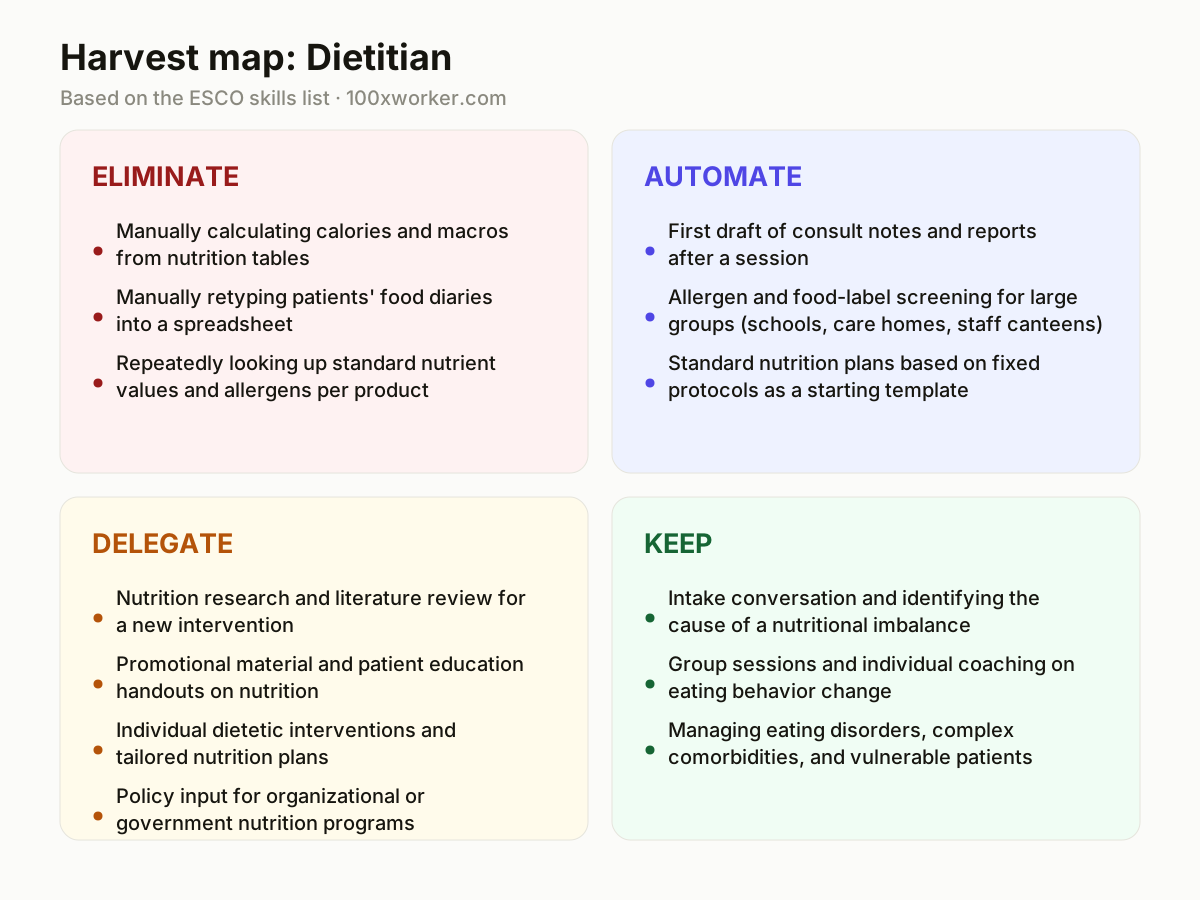
This article breaks the dietitian's task list into four groups: tasks AI eliminates outright, tasks it automates with a human check, tasks you delegate to AI and then review, and tasks you keep because they require judgment, trust, or direct responsibility for someone's health.
A dietitian translates nutritional needs into evidence-based advice that protects or restores health.
The task split: what AI takes over and what stays yours
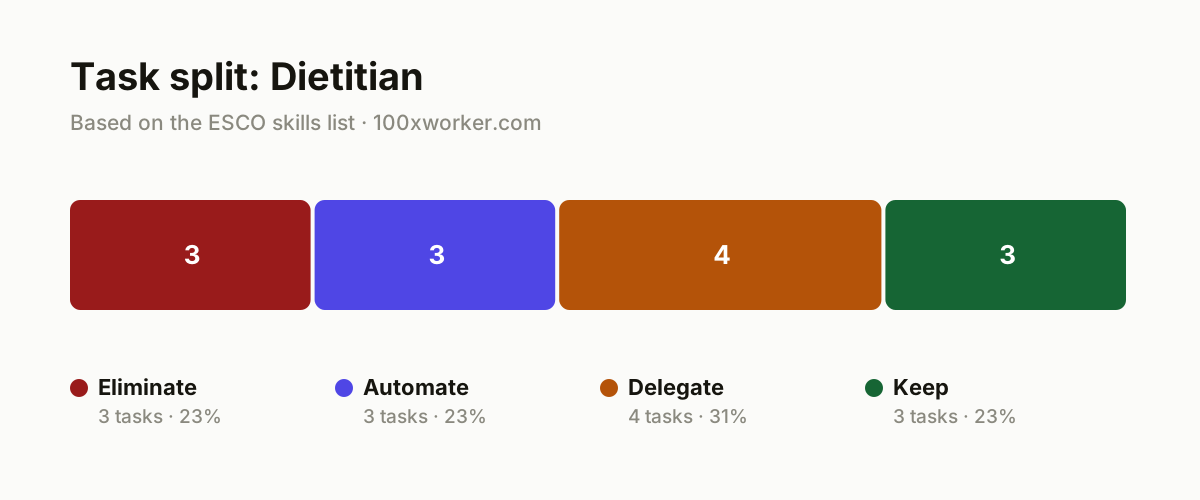
Not every dietitian task changes the same way. Some tasks disappear because software already does them better than a spreadsheet ever could. Others get automated, meaning AI produces a first version and you check it before anything goes into a record. A third group you delegate: AI does the groundwork, you make the clinical call. A last group stays entirely human, because it involves trust, risk, or a person's health where a wrong AI suggestion can cause real harm.
| Task | Bucket | Why |
|---|---|---|
| Manually calculating calories and macros from nutrition tables | eliminate | Software and AI tools compute this faster and with fewer errors than a hand-built table. |
| Manually retyping patients' food diaries into a spreadsheet | eliminate | Entry now runs through apps and photo recognition, retyping adds nothing. |
| Repeatedly looking up standard nutrient values and allergens per product | eliminate | An AI assistant retrieves this faster and more consistently than manual database searches. |
| First draft of consult notes and reports after a session | automate | Speech-to-text plus AI summarization produces a structured note ready for the record. |
| Allergen and food-label screening for large groups (schools, care homes, staff canteens) | automate | An AI agent screens lists more consistently and faster than manual checking. |
| Standard nutrition plans based on fixed protocols as a starting template | automate | For routine protocols, such as sodium-restricted diets, an AI starting template works as well as a hand-built one. |
| Nutrition research and literature review for a new intervention | delegate | AI gathers and summarizes sources, you judge clinical relevance and quality. |
| Promotional material and patient education handouts on nutrition | delegate | AI drafts the text, you check it for clinical accuracy, tone, and audience fit. |
| Individual dietetic interventions and tailored nutrition plans | delegate | AI proposes a first plan from the intake data, you adjust it to the person. |
| Policy input for organizational or government nutrition programs | delegate | AI structures the data and options, you decide and defend the final call. |
| Intake conversation and identifying the cause of a nutritional imbalance | keep | This requires reading context that does not fit a form or a prompt. (Your edge: Building trust and reading non-verbal cues, no model can do that.) |
| Group sessions and individual coaching on eating behavior change | keep | Motivation and resistance need live adjustment, not a script. (Your edge: Sensing when someone disengages and steering the conversation back.) |
| Managing eating disorders, complex comorbidities, and vulnerable patients | keep | High risk, high nuance, direct medical responsibility. (Your edge: Risk judgment where a wrong call genuinely harms someone.) |
Which dietitian tasks does AI take over?
AI takes over the repetitive, data-heavy parts of dietetics first. Calorie and macro calculations, nutrient database lookups, and allergen checks on product labels are largely mechanical, and AI tools already do them faster and with fewer errors than manual work. Drafting consult notes from a recorded session, building a first-pass standard nutrition plan for a routine protocol, and screening food lists for institutional kitchens also move to AI, though a dietitian still reviews the output before it goes into a patient file. Research summaries and patient handouts follow a similar pattern: AI drafts, you edit for clinical accuracy and tone. None of this replaces the intake conversation or the judgment call on a complex case.
Will AI replace dietitians?
No. Microsoft Research's applicability score for dietitians and nutritionists sits at 22.1%, meaning roughly a fifth of the job's activities are places where generative AI is genuinely useful, not the whole job. The rest, intake interviews, reading a person's resistance to changing their diet, managing eating disorders and comorbidities, stays squarely human because it requires trust, live judgment, and direct responsibility for someone's health. What changes is the shape of the job: less time on calculations and note-taking, more time on the parts of nutrition counseling that actually need a trained person in the room.
How do you become the AI go-to person in your dietitian practice or service?
Start by mapping your own task list against the four buckets: eliminate, automate, delegate, keep. Pick one AI tool for note-taking or literature summaries and use it for a month before rolling it out to colleagues. Document which outputs needed correction and why, that record becomes your practice's quality check. Offer to test new tools first and report back at team meetings, since someone has to translate AI output into something a clinical team trusts. Understanding both the tool's limits and the clinical requirements, accuracy, hygiene rules, documentation standards, makes you the natural point of contact when the practice decides what to adopt.
What can you do this month as a dietitian?
Pick one recurring task, drafting session notes or checking a standard sodium-restricted meal plan, and test an AI tool on it for two weeks. Keep a log of every correction you make to the AI's output. Use that log to decide whether the task moves fully to AI-with-review or stays manual. Separately, ask your team or employer what documentation and privacy rules apply before you feed any patient data into a chatbot. Small, logged experiments beat a full rollout, because you build evidence for what actually saves time in your specific setting rather than guessing from a generic tool description.
Dietitians use evidence-based approaches to enable individuals, families and groups to obtain or select food that is nutritionally adequate, safe, palatable and sustainable.
ESCO, European Commission
Become the AI person on your team
Run a task audit
List every task you do in a week and sort it into eliminate, automate, delegate, or keep. Share the list with your team so everyone works from the same map instead of adopting tools ad hoc.
Pilot before you roll out
Test one AI tool on one task for two to four weeks and log every correction. This gives your practice real data instead of vendor claims.
Own the review step
Whatever AI drafts, from notes to meal plans to patient handouts, someone reviews it before it reaches a patient or a record. Volunteer to be that reviewer and you become the person others ask when something looks off.
Want this for your actual task list?
The free scan on the homepage builds your personal task map in 30 seconds, based on your role and industry.
Run the free task scanTools for this work
| Tool | For which tasks | The sober take |
|---|---|---|
| Speech-to-text and clinical note tools (e.g., Otter.ai-style transcription) | Automate: first-draft consult notes and session reports | Cuts note drafting time, still needs a clinician read-through before filing. |
| Nutrition database and calorie/macro calculators with AI-assisted lookup | Eliminate: manual calorie/macro math, nutrient and allergen lookups | Faster and more consistent than manual table lookups, verify the data source covers your country's labeling rules. |
| General-purpose AI assistants (ChatGPT, Claude, Copilot) | Delegate: literature review, patient handouts, policy drafting | Good first drafts, always verify sources and clinical claims yourself. |
| Template-based meal-plan generators | Automate: standard protocol nutrition plans | Useful for routine diets, not a substitute for individualized assessment. |
Prompts to try today
Literature scan for an intervention
Draft a consult note
Patient handout draft
Related jobs
Frequently asked questions
Does AI understand medical nutrition therapy well enough to write a treatment plan?
AI can produce a reasonable first draft for routine, well-documented protocols such as sodium-restricted or standard diabetic diets, based on patterns in the input data. It cannot weigh a patient's full medical history, comorbidities, or personal circumstances the way a dietitian does during an intake. Microsoft Research's 22.1% applicability score for the occupation reflects this: AI reaches into a meaningful share of the work but leaves the core clinical judgment to the practitioner. Any AI-generated plan needs a dietitian's review before it reaches a patient.
Will AI reduce the number of dietitian jobs?
Current data does not point to dietitians being replaced. Microsoft Research's applicability score of 22.1% shows AI reaches a limited slice of the job, mostly documentation, calculations, and lookups, not the counseling and clinical judgment that make up most of a dietitian's day. The more likely shift is in task composition: less time on notes and standard calculations, more time on the parts of the job that need a trained person, such as intake assessments and behavior-change coaching.
How much are people already using AI for nutrition-related questions?
Adoption is already broad among the general public. Eurostat reports that 32.7% of the EU population aged 16-74 used generative AI in the three months before being surveyed in 2025. That means patients increasingly arrive having already asked a chatbot about their diet, which changes the intake conversation: dietitians now often correct or contextualize AI-generated advice a patient picked up on their own, rather than starting from a blank page.
Which dietitian tasks are safest from AI for the next few years?
Tasks that involve direct risk to a person's health and require reading unspoken cues stay hardest to automate: intake interviews that uncover the real cause of a nutritional imbalance, group and individual counseling on eating behavior change, and care for eating disorders or patients with complex comorbidities. These require trust-building, live judgment about when someone is disengaging, and risk assessment where a wrong call causes real harm. No current AI applicability data suggests these move to automation soon.
Sources
- Microsoft Research, Working with AI: Measuring the Applicability of Generative AI to Occupations (2025)
- Anthropic Economic Index
- Eurostat, isoc_ai_iaiu (generative AI use, 2025)
- ESCO, European Commission
Hendrik De Winne, author of Becoming AI-Savvy, founder of VibeLab. Helps teams redesign their work with AI.
This article was drafted with AI assistance from public data sources and editorially reviewed.