100×worker · job analysis
Will AI Replace Speech Therapists, and What Should You Do About It?
Speech and language therapists (ESCO code 2266.2) treat speech, language, voice, and swallowing disorders in patients from infants to stroke survivors. The job leans heavily on hands-on sessions, clinical judgment, and building trust with people who often struggle to communicate at all. That is exactly why it scores low on AI exposure: Microsoft Research analyzed 200,000 real Copilot conversations and gave speech-language pathologists an AI applicability score of 13.8%, one of the lowest of any profession studied, far below translators at 49%.
That does not mean nothing changes. Across the EU, 32.7% of people aged 16 to 74 used generative AI in the last three months of 2025, according to Eurostat. Anthropic's Economic Index, which classifies millions of Claude conversations against O*NET task categories, shows a growing split between AI used to automate a task outright and AI used to augment a person doing it. For speech therapists, almost all real AI use falls into the second category: drafting, summarizing, and searching, not replacing clinical work.
The European Commission's ESCO taxonomy lists 3,039 occupations and dozens of specific skills tied to speech therapy, from audiometry to swallowing disorder treatment to case formulation. Breaking the job down to that task level, rather than asking "will this job survive," is the useful way to think about what AI actually touches.
A speech therapist treats speech, language, voice, and swallowing disorders; AI supports diagnosis, documentation, and practice materials.
The task split: what AI takes over and what stays yours
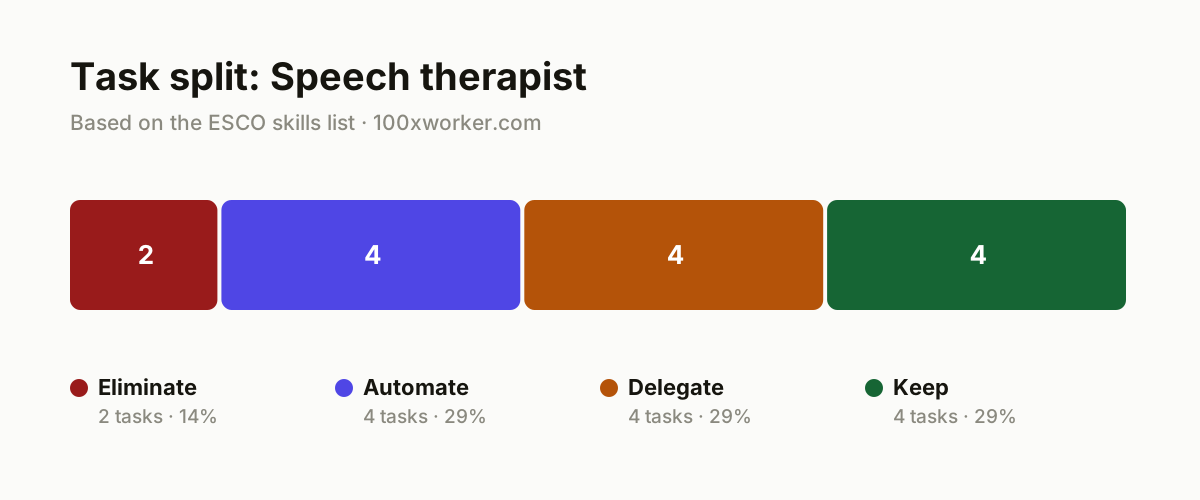
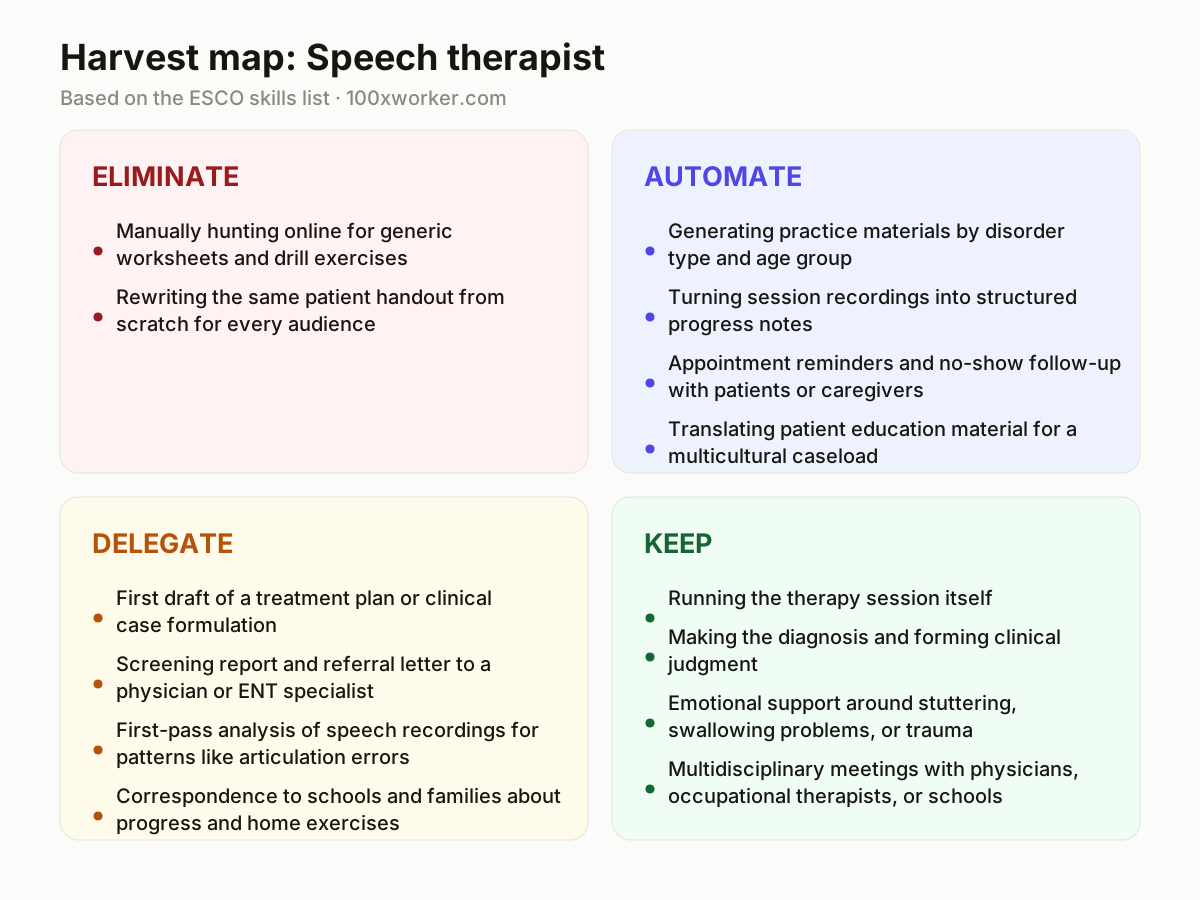
Sort the job into four buckets: tasks AI makes pointless to do manually (eliminate), tasks a tool can run end to end (automate), tasks where AI drafts and you check (delegate), and tasks that stay with you because they need presence, judgment, or trust (keep). For speech therapists, the split is lopsided toward keep, which matches the low Microsoft applicability score, but the automate and delegate buckets still save real hours every week.
| Task | Bucket | Why |
|---|---|---|
| Manually hunting online for generic worksheets and drill exercises | eliminate | AI generates material matched to age, disorder, and attention span instantly, so searching and clipping adds nothing. |
| Rewriting the same patient handout from scratch for every audience | eliminate | A tool rewrites one base text to a different reading level or age group in seconds, not a half hour. |
| Generating practice materials by disorder type and age group | automate | A tool delivers usable articulation, language, or stuttering exercises tailored to the patient right away. |
| Turning session recordings into structured progress notes | automate | Transcription and summarizing a session runs automatically, so you stop typing session notes by hand. |
| Appointment reminders and no-show follow-up with patients or caregivers | automate | This is pure logistics and repetitive scheduling work with no clinical content. |
| Translating patient education material for a multicultural caseload | automate | Translation and reading-level adjustment happens faster and more consistently than doing it by hand. |
| First draft of a treatment plan or clinical case formulation | delegate | AI produces an initial version from assessment data; you review it clinically and adjust it. |
| Screening report and referral letter to a physician or ENT specialist | delegate | AI writes the first draft; you check the clinical content and sign off. |
| First-pass analysis of speech recordings for patterns like articulation errors | delegate | AI flags notable patterns as a screening step; clinical interpretation stays with you. |
| Correspondence to schools and families about progress and home exercises | delegate | AI drafts the message; you revise tone, nuance, and clinical accuracy. |
| Running the therapy session itself | keep | Guiding speech, language, and swallowing exercises requires physical presence and moment-to-moment adjustment. (Your edge: adjusting in real time to the patient's response) |
| Making the diagnosis and forming clinical judgment | keep | Complex or atypical cases need years of clinical experience and context, not pattern-matching alone. (Your edge: clinical reasoning in borderline cases) |
| Emotional support around stuttering, swallowing problems, or trauma | keep | Building trust with a child or a stroke patient does not happen through a screen. (Your edge: empathy and trust built in the therapy room) |
| Multidisciplinary meetings with physicians, occupational therapists, or schools | keep | Coordinating care requires negotiation and human judgment about what works for this specific patient. (Your edge: negotiating and deciding jointly with other clinicians) |
Which tasks does AI take over for speech therapists?
AI takes over the parts of the job that are repetitive or paperwork-heavy: generating practice worksheets by disorder and age, transcribing sessions into progress notes, sending appointment reminders, and translating patient handouts. It also drafts documents you still need to check, like referral letters, screening reports, and first-pass treatment plan outlines. It does not run the therapy session, make the diagnosis, or handle the emotional side of working with a stuttering child or a stroke patient relearning speech. Microsoft Research's 13.8% applicability score reflects exactly this: a small, mostly administrative slice of the job.
Will AI replace speech therapists?
No. Speech therapy depends on physical presence, real-time adjustment to a patient's response, and building trust, none of which a chatbot or an app can do. Microsoft Research measured speech-language pathologists at 13.8% AI applicability, one of the lowest scores of any profession in the study, well below roles like translation at 49%. Anthropic's Economic Index shows AI use in this field is almost entirely augmentation (drafting and searching), not automation of the actual clinical work. The job changes shape around the edges. The core of it, the therapy session and the diagnosis, stays human.
What does AI mean for speech therapists internationally?
Adoption of generative AI varies by country, but the direction is the same everywhere: more clinicians using AI as a search and drafting tool, not as a replacement for the session. Eurostat measured 32.7% of EU adults aged 16-74 using generative AI in the last three months of 2025. ESCO's occupation taxonomy, covering 3,039 roles across the EU in 28 languages, already lists the specific skills, like audiometry, speech technique, and swallowing disorder treatment, that define this job and stay largely untouched by current AI tools. Wherever you practice, the practical shift is the same: less manual paperwork, same clinical core.
What can you actually do about it this month?
Pick one repetitive task and hand it to a tool: session note transcription, worksheet generation, or patient handout translation are the easiest wins. Set up a template prompt for referral letter drafts so you only edit, not write from scratch. Keep a short log of how much time this saves over two weeks. Do not touch how you run sessions or make diagnoses; that part of the job is not where the 13.8% applicability sits, and building AI habits around the paperwork buys you more time for the clinical work AI cannot do.
Generative AI applies to only 13.8% of a speech-language pathologist's work activities, one of the lowest applicability scores measured across occupations.
Microsoft Research, Working with AI: Measuring the Applicability of Generative AI to Occupations (2025)
Become the AI person on your team
Automate your session notes
Record sessions with consent and run the audio through a transcription tool, then have an AI tool turn the transcript into a structured progress note using your clinic's template. Review it before it goes into the patient file; this cuts documentation time without changing what you do in the room.
Build a worksheet library with AI, not a browser tab
Instead of searching for generic articulation or language worksheets online, generate them directly for each patient's age, disorder, and goal. Save the good outputs as your own reusable templates so you are not regenerating from scratch every time.
Use AI for the first draft, never the final sign-off
Let AI produce a first version of a referral letter, screening report, or treatment plan outline from your notes. Always review the clinical content yourself before it goes to a physician, school, or family; the draft saves time, the judgment stays yours.
Want this for your actual task list?
The free scan on the homepage builds your personal task map in 30 seconds, based on your role and industry.
Run the free task scanTools for this work
| Tool | For which tasks | The sober take |
|---|---|---|
| ChatGPT or Claude | generating practice worksheets, drafting referral letters and progress summaries, rewriting patient handouts for reading level | General-purpose tools; still require clinical review before anything goes into a patient file. |
| Otter.ai (or a similar transcription tool) | turning recorded sessions into text for progress notes | Speeds up documentation but needs a human check for clinical accuracy. |
| DeepL | translating patient education material for a multicultural caseload | Faster and more consistent than manual translation, but still needs a native-language check for sensitive material. |
| Practice-management software with AI notes (e.g. SimplePractice, TheraPlatform) | scheduling, reminders, no-show follow-up, and basic note templates | Handles the logistics layer so session time stays for the patient. |
Prompts to try today
Generate age-matched articulation exercises
Draft a referral letter from session notes
Rewrite a patient handout for a lower reading level
Related jobs
Frequently asked questions
Is speech therapy at high risk from AI compared to other healthcare jobs?
No. Microsoft Research's applicability score for speech-language pathologists is 13.8%, one of the lowest measured, close to nursing at 12%. Jobs built around language translation, drafting, and text processing score far higher, with translators at 49%. Speech therapy scores low because the core work, running a session and reading a patient's real-time response, is not something current generative AI tools do.
What is the difference between AI automating a task and AI augmenting it?
Anthropic's Economic Index splits AI use into automation, where AI does the task instead of you, and augmentation, where AI helps you do it faster. For speech therapists, almost all real AI use is augmentation: drafting a letter, transcribing a session, or generating a worksheet that you still check and use. Very little of the job gets handed over outright.
Should I worry about AI taking over diagnosis in speech therapy?
Not based on current evidence. Diagnosis in speech therapy depends on clinical judgment built over years, especially for atypical or complex cases, and on direct observation of a patient in the room. AI can flag patterns in a recording as a screening aid, but the applicability data shows this kind of complex clinical judgment sits firmly in the part of the job that stays human.
What should a speech therapist actually start doing with AI this month?
Start with documentation, not clinical work. Use a transcription tool for session notes, generate a first draft of one recurring letter type (referral or progress summary), and try generating a worksheet for one specific patient instead of searching online. Track the time saved over two weeks before deciding what else to change.
Sources
- Microsoft Research, Working with AI: Measuring the Applicability of Generative AI to Occupations (2025)
- Anthropic Economic Index
- Eurostat, isoc_ai_iaiu (generative AI use, EU, 2025)
- ESCO, European Commission occupation taxonomy
Hendrik De Winne, author of Becoming AI-Savvy, founder of VibeLab. Helps teams redesign their work with AI.
This article was drafted with AI assistance from public data sources and editorially reviewed.