100×worker · job analysis
Will AI Replace Youth Workers, and What Should You Do About It?

Youth workers spend their days between paperwork and people: writing case notes, drafting funding reports, and sitting with a teenager in crisis. Generative AI is already showing up in the paperwork half of that job, and 2025 data gives a clearer picture of how much.
Across the European Union, 32.7% of people aged 16 to 74 used generative AI in the three months before being surveyed in 2025 (Eurostat, isoc_ai_iaiu). Microsoft Research went further and looked inside job categories. Its analysis of 200,000 real Copilot conversations assigns Social and Human Service Assistants, the closest US occupational match to youth worker, an AI applicability score of 25.5%, the share of work activities where generative AI is demonstrably useful. For comparison, translators score 49% and nurses score 12% (Microsoft Research, Working with AI: Measuring the Applicability of Generative AI to Occupations, 2025).
That number sits in the middle of the pack. It tells you AI is useful for a meaningful slice of a youth worker's paperwork and planning, and largely absent from the relationship-based core of the job. The rest of this article breaks that slice into tasks you can eliminate, automate, delegate, or keep.
A youth worker guides young people's personal, social, and educational growth, with AI as a support tool.
The task split: what AI takes over and what stays yours
Not every task in a youth worker's day carries the same weight, and AI does not touch all of them equally. This framework sorts tasks into four groups: eliminate (work AI-era tools make pointless), automate (work AI does well with a quick human check), delegate (work AI drafts and you finish), and keep (work that stays entirely human because it depends on trust, presence, or judgment). Sorting your own tasks this way, rather than asking whether the job will survive, gives you a practical starting point.
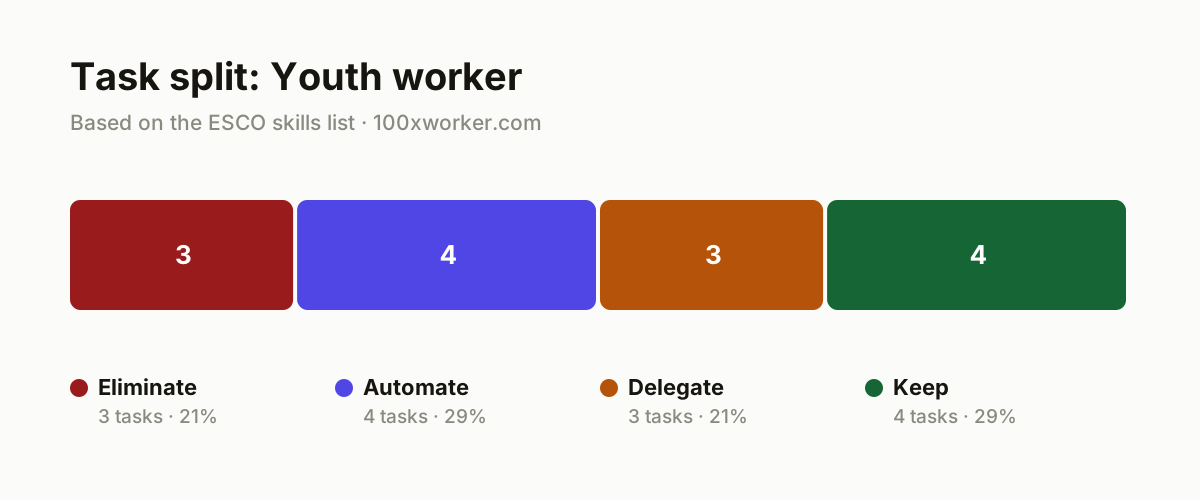
| Task | Bucket | Why |
|---|---|---|
| Typing up conversation notes and case file entries fully by hand after every youth contact | eliminate | Speech-to-text and summarizing tools do this faster and more consistently than manual typing. |
| Re-entering the same intake data into separate systems for local authorities, funders, and your own case file | eliminate | Repeated data entry wastes time once systems or AI integrations can carry it over automatically. |
| Keeping separate spreadsheets per project just to justify funding | eliminate | Automated reporting from one source file replaces manually maintained separate spreadsheets. |
| First draft of the mandatory annual report or work plan for local authorities or funders | automate | AI agents structure numbers and text into a usable starting document; you add context and nuance. |
| Summarizing case files when handing over work due to vacation, illness, or staff turnover | automate | A consistent summary built from existing notes prevents information loss between colleagues. |
| Translating information brochures and forms for parents and young people with a migration background | automate | Translation tools produce usable text immediately, essential when working in culturally diverse communities. |
| Scheduling and reminders for home visits, group activities, and meetings | automate | Scheduling agents combine availability and propose a workable calendar automatically. |
| Drafting a first social service plan based on intake information | delegate | AI structures goals and actions; you check the plan against the young person's situation and decide. |
| Preparing project proposals and funding applications for youth and community projects | delegate | AI supplies a strong text structure; you supply the numbers, the context, and final accountability. |
| Analyzing signals across multiple reports to spot patterns in a neighborhood or group | delegate | AI spots patterns in large volumes of text; you interpret what that means for your approach. |
| Crisis intervention and street-level intervention in acute situations | keep | In-the-moment decisions require reading danger and context that no system takes over. (Your edge: Presence and split-second judgment on the ground) |
| Building a trust relationship with a young person | keep | Trust grows out of repeated, genuine human contact, not a chat window. (Your edge: Recognition and closeness built over time) |
| Ethical judgment calls when abuse or neglect is suspected | keep | Child protection requires personal responsibility and legal-ethical judgment. (Your edge: Responsibility you carry yourself) |
| Advocating for a young person's rights with an agency or organization | keep | Negotiating and persuading requires a relationship and persuasive skill AI does not supply. (Your edge: Persuasion built on a real relationship) |
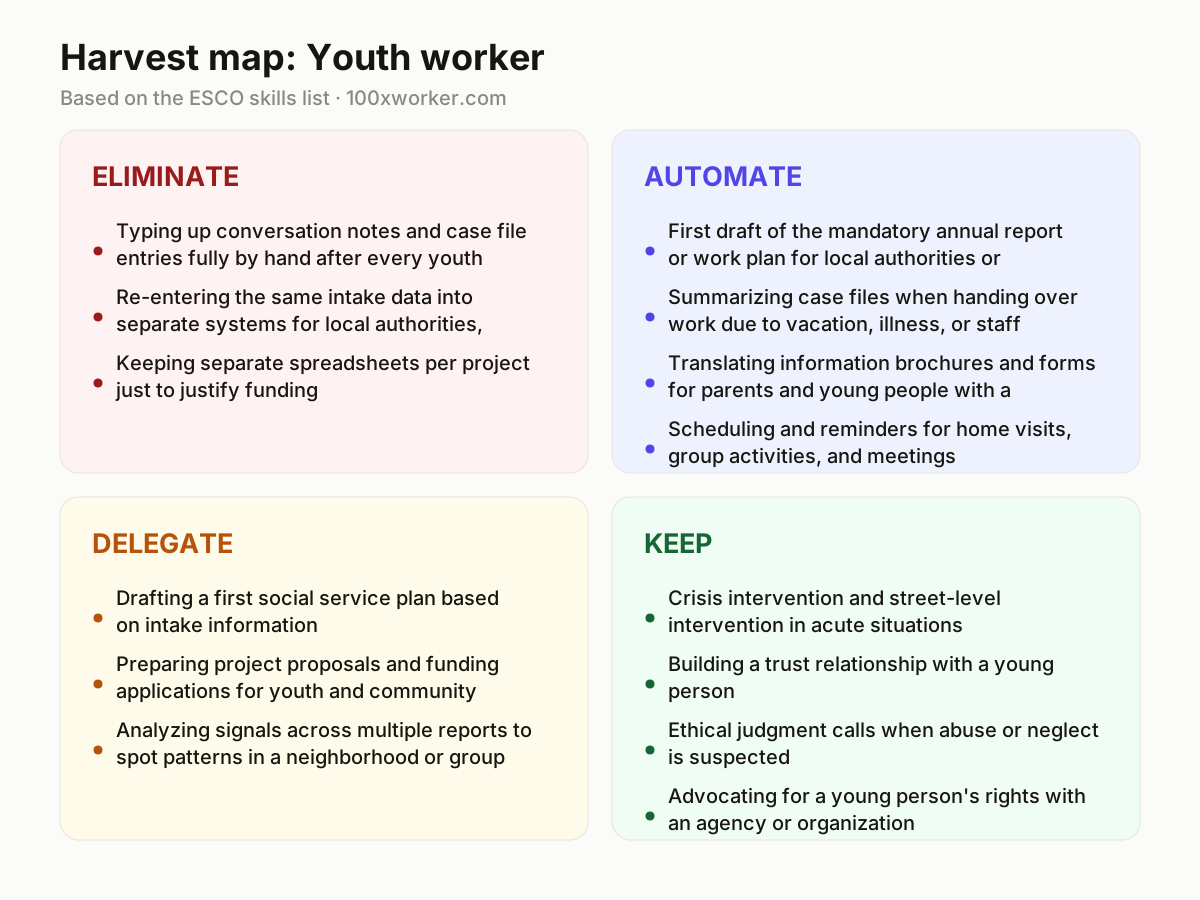
Which tasks can AI take over from a youth worker?
AI is most useful in the paperwork and planning side of youth work. It can turn a recorded conversation into a written case note, draft a first version of an annual report or funding proposal, translate a brochure into a parent's home language, and suggest a schedule for home visits and group sessions across a busy week. None of this happens without you: you check translations for tone, correct drafts for accuracy, and decide what goes into an official report. What AI mostly removes is retyping, re-entering data across systems, and building spreadsheets from scratch. Those are hours, not judgment calls, and that is where time savings show up first.
Will AI replace youth workers?
No single tool replaces a youth worker, because the job centers on trust, presence, and judgment calls that AI cannot make. Microsoft Research's applicability score for the closest matching US role, Social and Human Service Assistants, sits at 25.5%, meaning roughly a quarter of typical work activities are places where generative AI is demonstrably useful, well below translators (49%) and above nurses (12%). Crisis intervention, relationship-building, and child protection decisions sit outside that slice entirely. Older estimates that predicted near-total automation for care-adjacent roles, like the widely cited 2013 Frey and Osborne study, predate large language models and should be read with that caveat.
What does the youth worker who becomes the team's AI point person do?
Every youth work team benefits from one person who tests tools before they go team-wide. That person checks whether a transcription tool handles regional accents and the slang teenagers actually use, verifies that a translation tool gets youth-specific terms right in the languages your families speak, and builds a small library of prompts colleagues can reuse for report drafts or case summaries. They also flag where AI output needs a privacy check, since case notes often include information about minors that should never go into a public AI tool. This role is about vetting and sharing, not about replacing casework judgment.
What can you do this month as a youth worker?
Pick one recurring paperwork task, such as your monthly activity report or a case handover summary, and try drafting it with an AI tool before writing it from scratch. Keep sensitive details about minors out of any tool not approved by your organization's data policy; describe the case in general terms first if you are unsure. Ask your supervisor whether a transcription or translation tool is already approved for use with families. Compare the time you spend editing an AI draft against the time you used to spend writing from a blank page, and use that comparison to decide where AI earns a permanent place in your workflow.
Youth workers help young people achieve their full potential by facilitating their growth on a personal, social, and educational level.
ESCO, European Commission
Become the AI person on your team
Pilot one tool with anonymized case data
Before rolling anything out, test a transcription or summarizing tool on a handful of anonymized notes, not live client files. Check accuracy on regional slang and youth vocabulary, since generic tools often mishear informal speech.
Build a shared prompt library
Collect three or four prompts that consistently work, for drafting funding reports, translating brochures, or summarizing case files, and put them somewhere the whole team can reuse them. This saves colleagues from reinventing the same prompt every week.
Set a clear line on what never goes into AI tools
Agree as a team on which details, names, addresses, health or abuse information, never get typed into a public AI chatbot, and write that rule down. This protects the young people you work with and your organization's data policy.
Want this for your actual task list?
The free scan on the homepage builds your personal task map in 30 seconds, based on your role and industry.
Run the free task scanTools for this work
| Tool | For which tasks | The sober take |
|---|---|---|
| Otter.ai (or a similar transcription tool) | Eliminate: typing up conversation notes and case file entries by hand | Useful for turning a recorded conversation into text, but check accuracy on slang and background noise before trusting it fully. |
| DeepL | Automate: translating information brochures and forms for parents and young people | Handles common European languages well; always have a native speaker skim sensitive material before it goes out. |
| Microsoft Copilot or ChatGPT | Automate and delegate: first drafts of annual reports, work plans, and funding proposals | Good at structuring a draft from bullet points, weak at knowing your local funding rules. |
| An AI-assisted shared calendar (e.g. Motion) | Automate: scheduling home visits, group activities, and meetings | Works only as well as the availability data your team keeps up to date. |
Prompts to try today
Draft a funding report section
Summarize a case file for handover
Translate a parent brochure
Related jobs
Frequently asked questions
Will AI take over youth worker jobs entirely?
No. Microsoft Research's applicability score for the closest matching US role, Social and Human Service Assistants, is 25.5%, meaning only about a quarter of typical work activities are places where generative AI is clearly useful. Crisis intervention, relationship-building, and child protection decisions sit outside that slice. AI changes the shape of the job, mostly the paperwork and planning side, without removing the need for a person doing the relationship-based work.
Is it safe to put case notes about minors into AI tools?
Only if your organization has explicitly approved the tool for that use. Many AI chatbots store or process input in ways that are not compliant with data protection rules for minors' personal information. A safer habit is to anonymize names, addresses, and identifying details before summarizing a case with AI, and to check with your organization's data policy first.
Are the old 'percentage of your job that will be automated' numbers reliable?
Be cautious with them. The widely cited automation-risk percentages that circulate for many occupations come from a 2013 Oxford study (Frey and Osborne) published before large language models existed. Newer research, like Microsoft Research's 2025 applicability scores based on real Copilot conversations, measures which specific work activities AI is actually useful for today, which gives a more current and more task-specific picture.
How does the ESCO taxonomy relate to AI and this job?
ESCO, the European Commission's occupational classification, describes 3,039 occupations and their required skills in 28 languages, including a detailed skills list for youth worker. That level of task detail is exactly what makes it possible to ask which specific skills or tasks (case management, crisis intervention, report writing) are affected by AI, instead of asking a vague question about the whole job.
Sources
- Microsoft Research, Working with AI: Measuring the Applicability of Generative AI to Occupations (2025)
- Anthropic Economic Index
- Eurostat, isoc_ai_iaiu (generative AI use, 2025)
- ESCO, European Commission
Hendrik De Winne, author of Becoming AI-Savvy, founder of VibeLab. Helps teams redesign their work with AI.
This article was drafted with AI assistance from public data sources and editorially reviewed.