100×worker · job analysis
Will AI Replace Social Media Managers, and What Should You Do About It?

Social media managers spend a lot of their week on tasks that a language model can now do faster: drafting captions, pulling hashtags, building a content calendar, or summarizing engagement numbers into a report. That does not mean the job disappears. It means the task mix inside the job is shifting, and the shift is already visible in usage data.
According to Eurostat, 32.7% of the EU population aged 16 to 74 used generative AI in the three months before the 2025 survey (isoc_ai_iaiu). Microsoft Research analyzed 200,000 real Copilot conversations across occupations and found that content drafting, summarizing, and research-style tasks are among the most common uses of generative AI at work (Working with AI: Measuring the Applicability of Generative AI to Occupations, 2025). For a role built almost entirely around content, research, and communication, that overlap is direct.
This article breaks the social media manager job into four buckets: tasks to eliminate, tasks to automate, tasks to delegate to AI with your review, and tasks to keep doing yourself. The goal is not to guess a percentage that will be automated. It is to give you a task-level map you can use this month.
A social media manager runs a brand's digital communities across social platforms, forums, and other online channels.
The task split: what AI takes over and what stays yours
Not every task in this job faces the same pressure from AI. Some tasks are pure mechanics and disappear once a tool does them automatically. Some are repetitive enough to run on autopilot with occasional checks. Others are useful for AI to draft first, but need your judgment before they go anywhere near a customer. And a few tasks depend on trust, brand feel, or crisis judgment that no model has. The four buckets below sort the real tasks in this ESCO occupation profile (public relations professionals, code 2432.5) into those categories.
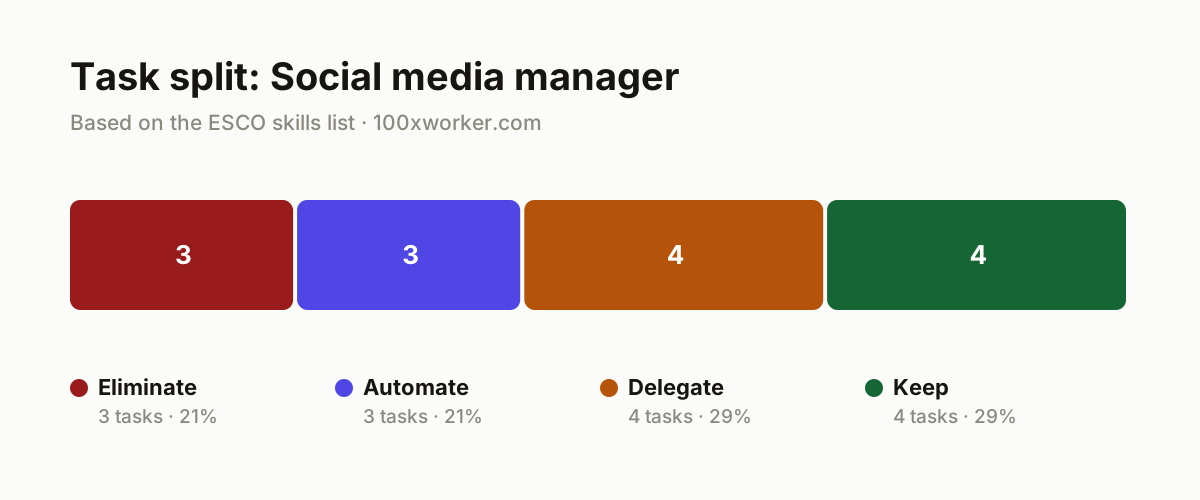
| Task | Bucket | Why |
|---|---|---|
| Manually copying and pasting individual posts into each separate scheduling tool per channel | eliminate | Scheduling platforms now handle this end to end, no manual re-entry needed. |
| Collecting screenshots for a monthly performance report | eliminate | Dashboards pull reach and engagement automatically from every connected channel. |
| Manually researching hashtags and keywords for each individual post | eliminate | Content models generate relevant hashtags based on past post performance. |
| Building a basic content calendar for the week or month | automate | An AI agent fills a template with themes, channels, and posting times, ready to use. |
| Answering repetitive, simple community questions | automate | Standard questions about hours, returns, or pricing get a usable answer instantly. |
| KPI reporting on reach, engagement, and follower growth | automate | Platform data converts into a readable report automatically, no manual exports needed. |
| Drafting captions and post copy for new content | delegate | AI produces a first draft from the content strategy, you fix tone and approve it. |
| Summarizing buying trends and consumer behavior from social data | delegate | AI extracts patterns from large datasets, you decide what matters for strategy. |
| Drafting a first crisis response during a community escalation | delegate | AI produces a quick first response, you judge tone, timing, and risk before publishing. |
| Summarizing competitor analysis and market research | delegate | AI gathers and structures public information, you draw the strategic conclusion. |
| Guarding tone of voice and brand identity in every piece of content | keep | Every post has to fit the brand, even when AI wrote the first version. (Your edge: a feel for brand and context no model has) |
| Personally handling escalations and sensitive conflicts in the community | keep | With angry customers or delicate situations, judgment matters more than speed. (Your edge: empathy and risk judgment in a live situation) |
| Building relationships with influencers, journalists, and partners | keep | Trust and collaboration come from personal contact, not a generated message. (Your edge: building trust stays a human job) |
| Deciding which channels and campaigns actually serve the brand | keep | The strategic call, and the responsibility for it, sits with the manager, not the model. (Your edge: business judgment and ownership of the decision) |
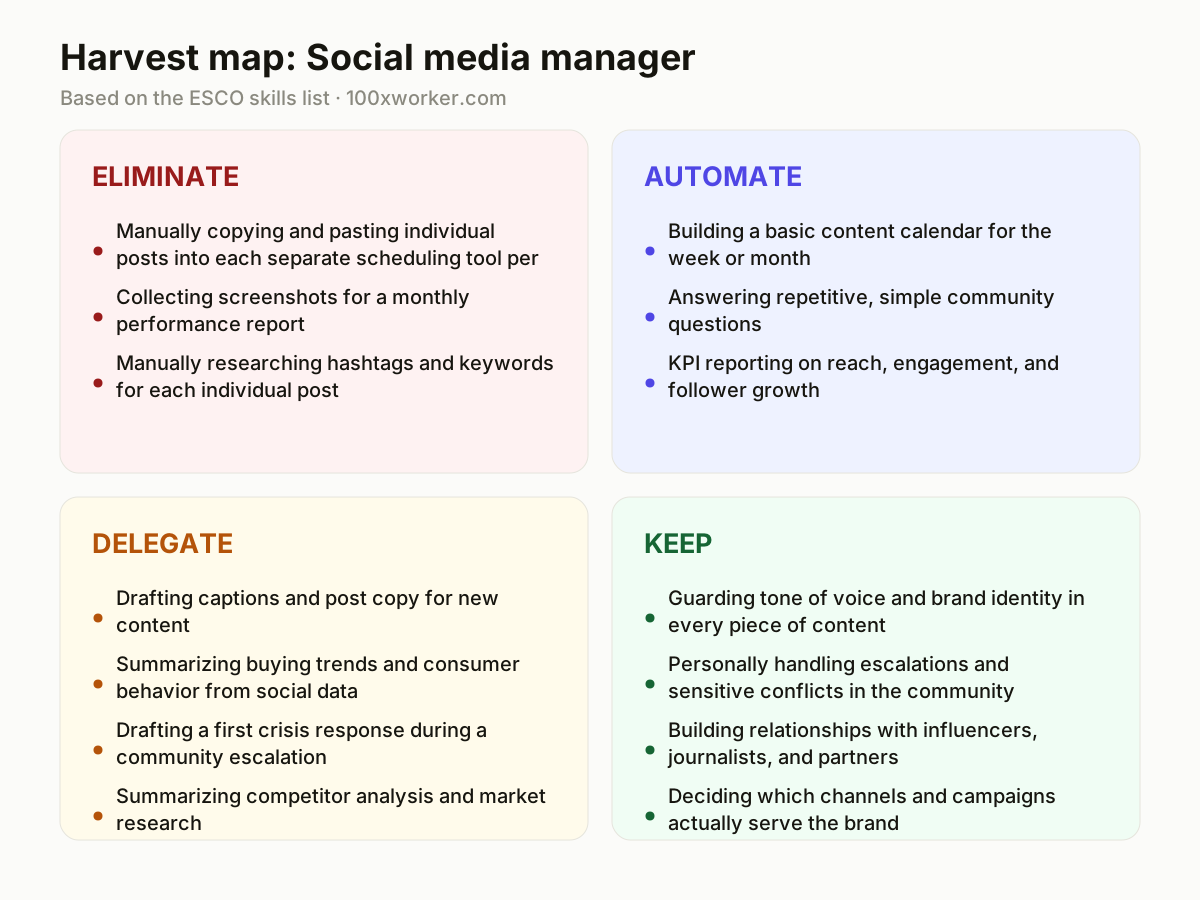
Which social media manager tasks does AI take over?
AI takes over the mechanical and repetitive parts of the job first: copying posts between tools, hunting for hashtags, and stitching together screenshots for a report. It also drafts things well, like captions, content calendars, and summaries of buying trends or competitor moves. What it does not take over is the decision layer: which tone fits the brand, which crisis response actually goes out, and which partnerships are worth building. Microsoft Research's analysis of real Copilot conversations found drafting, summarizing, and research tasks among the most common uses of AI at work, which matches this job closely.
Will AI replace social media managers?
No single occupation like this one gets replaced wholesale. What changes is the task mix inside the role. Anthropic's Economic Index, which classifies millions of Claude conversations against O*NET tasks, splits AI use into automation-like use (the model does the task) and augmentation-like use (the model supports a person's judgment). Social media work leans toward augmentation: AI drafts, summarizes, and researches, while the manager decides what ships. The job title survives. The daily task list looks different within a year or two.
How do you become the AI person on your marketing team?
Start by mapping your own weekly tasks into the four buckets above. Pick one recurring task, like drafting the content calendar or writing the monthly report, and build a repeatable AI workflow for it: a prompt template, a review step, and a place it lives (a shared doc, a tool). Share that workflow with your team instead of keeping it to yourself. Being the person who has already tested and documented three working AI workflows makes you the go-to person when leadership asks 'can AI help with this?'
What can you change about your way of working this month?
Pick two tasks: one from the eliminate bucket and one from the delegate bucket. Set up a scheduling tool to stop the copy-paste work, and build a caption-drafting workflow where AI writes the first version and you edit for tone. Track how much time each saves over two weeks. That gives you a concrete number to bring to your manager, instead of a vague sense that 'AI probably helps.'
AI use splits into automation-like use, where the model completes the task directly, and augmentation-like use, where it supports a person's own judgment.
Anthropic Economic Index
Become the AI person on your team
Turn your best prompt into a shared template
If you have a caption-drafting prompt that reliably nails your brand tone, write it down as a reusable template with placeholders. Share it in your team's shared drive so others stop reinventing it.
Build a one-page AI workflow map for your role
List every task you do in a normal week, mark which bucket it falls into (eliminate, automate, delegate, keep), and share that map with your manager. It turns a vague 'AI is changing things' conversation into a concrete plan.
Own the crisis-response draft process
Set up a template where AI drafts a first response to community escalations within minutes, and you review and approve before anything posts. Document the approval steps so the process survives if you are unavailable.
Want this for your actual task list?
The free scan on the homepage builds your personal task map in 30 seconds, based on your role and industry.
Run the free task scanTools for this work
| Tool | For which tasks | The sober take |
|---|---|---|
| Scheduling platforms (Buffer, Hootsuite, Sprout Social) | Eliminates manual cross-posting and calendar building | These already automate the copy-paste work; the AI layer on top just adds draft suggestions. |
| Microsoft Copilot | Drafting captions, summarizing reports, first-pass research | Widely used for drafting and summarizing tasks according to Microsoft's own analysis of Copilot conversations. |
| Claude or ChatGPT | Drafting crisis responses, summarizing competitor research, content calendar drafts | Useful for augmentation-style work where you still review before anything goes public. |
| Analytics dashboards (native platform analytics, Google Analytics) | KPI reporting on reach, engagement, follower growth | Removes the screenshot-collecting step entirely, no AI needed for this part. |
Prompts to try today
Draft a week of captions in brand voice
Summarize consumer trend data from social comments
Draft a first crisis response
Related jobs
Frequently asked questions
Do social media managers need to learn to code to use AI tools?
No. Most of the AI tools relevant to this job, scheduling platforms with AI drafting features, Copilot, Claude, or ChatGPT, work through plain-language prompts. What helps more than coding skill is knowing your brand voice well enough to write a good prompt and to edit AI drafts quickly.
Which part of the job is safest from AI?
Anything involving trust and judgment in real time: handling an angry customer in the community, deciding whether a joke fits the brand today, or negotiating a partnership with an influencer. These depend on reading context and taking responsibility for a call, which is not something a model does.
How fast is this actually changing?
Adoption data shows the shift is already underway, not hypothetical. Eurostat found 32.7% of the EU population aged 16 to 74 used generative AI in the past three months in 2025, and a Google/Ipsos survey found 61% of Belgians had used an AI chatbot in 2025. For a content-heavy role like this one, that usage is concentrated in exactly the drafting and research tasks social media managers do daily.
Should I ignore old automation-risk percentages I've seen for this job?
Yes, treat them with caution. Widely cited 'robotization percentage' figures for occupations often trace back to a 2013 Oxford study (Frey & Osborne) done before large language models existed. It measured a different kind of automation. Task-level breakdowns based on current AI usage data, like the buckets in this article, are a more accurate guide today.
Sources
- Microsoft Research: Working with AI: Measuring the Applicability of Generative AI to Occupations (2025)
- Anthropic Economic Index
- Eurostat, isoc_ai_iaiu
- ESCO, European Commission
Hendrik De Winne, author of Becoming AI-Savvy, founder of VibeLab. Helps teams redesign their work with AI.
This article was drafted with AI assistance from public data sources and editorially reviewed.