100×worker · job analysis
Will AI Replace SEO Specialists?

SEO work has always meant juggling data, content, and technical fixes at the same time. That mix is exactly what generative AI is good at reshaping. Microsoft Research analyzed 200,000 real Copilot conversations across occupations and found that for marketing and market research roles, the closest match to SEO work, generative AI is applicable to 35.0% of daily work activities. That is a meaningful share, but far from the whole job.
Anthropic's Economic Index, which classifies millions of Claude conversations against standard occupational task lists, draws a similar line: AI use splits into automation-like work (AI does the task) and augmentation-like work (AI supports a person doing it). For SEO, that split maps almost exactly onto what changes and what does not. Keyword clustering, meta tag drafts, and report summaries move toward automation. Strategy calls, client trust, and editorial judgment stay augmentation, meaning you still do the work with AI as a tool, not a replacement.
This article breaks the SEO specialist role into four buckets: tasks to stop doing by hand, tasks to hand fully to software, tasks to draft with AI and finish yourself, and tasks that stay with you because they depend on judgment, relationships, or business context AI does not have.
An SEO specialist optimizes web pages so they rank higher in search results and attract more qualified visitors.
The task split: what AI takes over and what stays yours
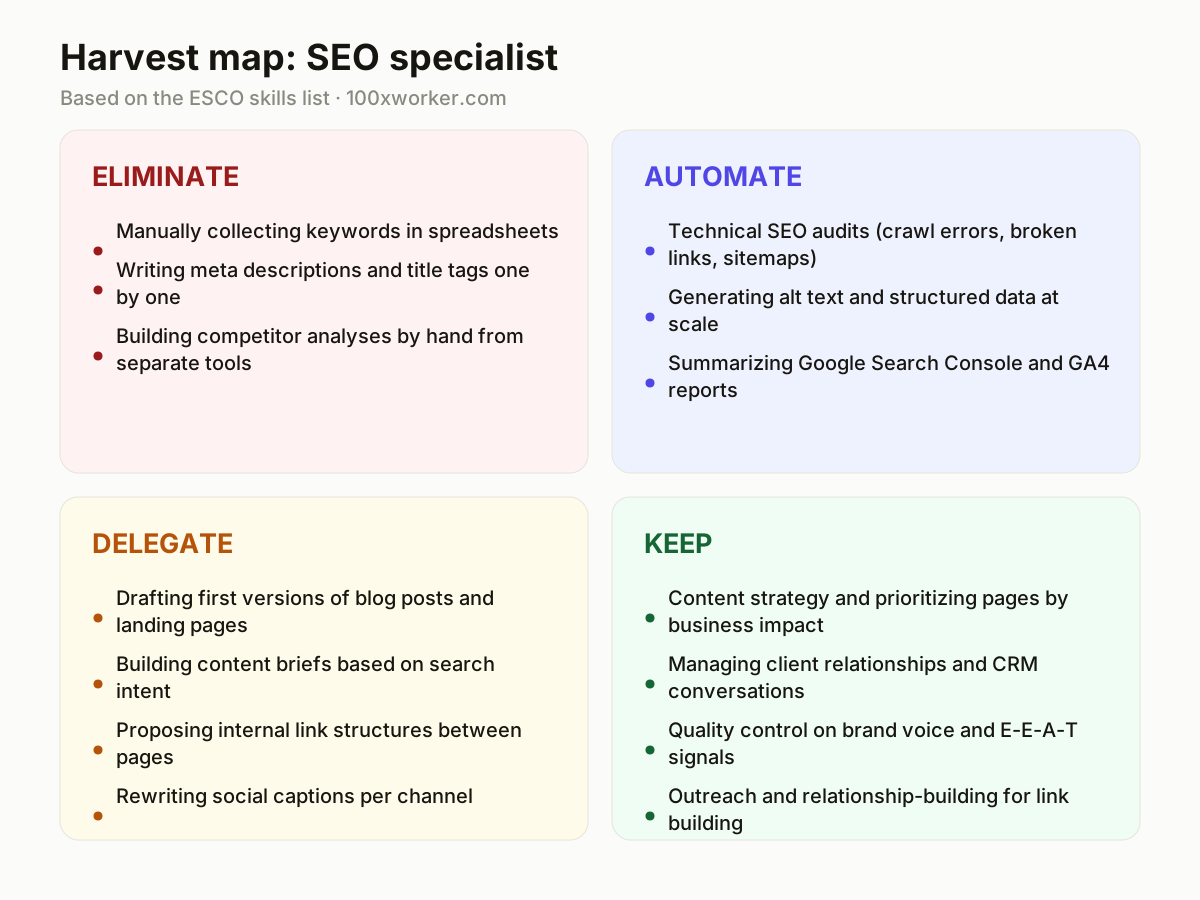
Not every SEO task is affected the same way by AI. Some tasks disappear because the manual version was never the point, just a slow way to get an output. Others get fully automated by existing tools. A third group gets delegated: AI drafts, you edit and approve. The last group stays firmly human because it depends on business context, trust, or judgment calls no model can make. Sorting your actual task list into these four buckets is more useful than asking whether SEO as a job will vanish.
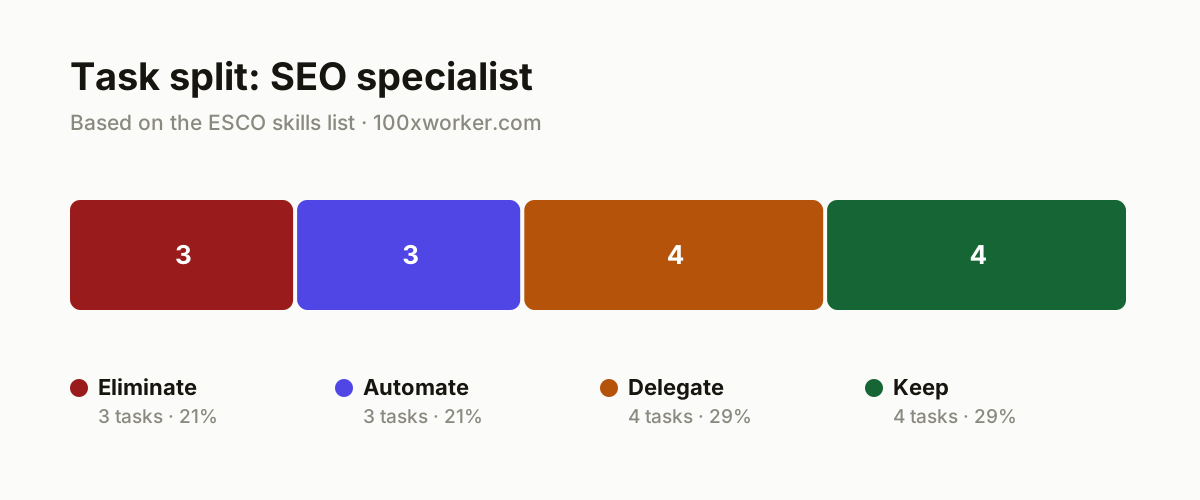
| Task | Bucket | Why |
|---|---|---|
| Manually collecting keywords in spreadsheets | eliminate | Tools generate and cluster keyword lists faster and more completely than manual research. |
| Writing meta descriptions and title tags one by one | eliminate | AI generates variants at scale; a person picks and refines the strongest option. |
| Building competitor analyses by hand from separate tools | eliminate | Automated platforms pull data from multiple sources faster than copy-paste work. |
| Technical SEO audits (crawl errors, broken links, sitemaps) | automate | Crawlers and AI summaries produce a prioritized fix list without manual page-by-page checks. |
| Generating alt text and structured data at scale | automate | Pattern recognition across product data is exactly what language models handle efficiently. |
| Summarizing Google Search Console and GA4 reports | automate | Data aggregation and trend detection take an AI agent seconds instead of hours. |
| Drafting first versions of blog posts and landing pages | delegate | AI produces most of the text; you check facts and brand voice before publishing. |
| Building content briefs based on search intent | delegate | AI structures the brief; you judge whether the intent actually matches your audience. |
| Proposing internal link structures between pages | delegate | AI spots patterns in the sitemap; you decide which links matter for the business. |
| Rewriting social captions per channel | delegate | AI adjusts tone and length per platform; you keep the brand voice consistent. |
| Content strategy and prioritizing pages by business impact | keep | Requires knowledge of margins, sales strategy, and company goals that AI does not have. (Your edge: You know the business, the model doesn't.) |
| Managing client relationships and CRM conversations | keep | Building trust with clients or stakeholders remains a human skill. (Your edge: Trust isn't built with a prompt.) |
| Quality control on brand voice and E-E-A-T signals | keep | Judging whether content shows real expertise, authority, and trustworthiness requires human judgment. (Your edge: You catch nuances a model misses.) |
| Outreach and relationship-building for link building | keep | Link building depends on genuine relationships between people; automated outreach emails rarely convert. (Your edge: You build the relationship, no prompt does.) |
Will AI replace SEO specialists?
Not as a full replacement, but the task mix changes fast. Microsoft Research's applicability score of 35.0% for marketing and market research roles shows AI covers a real chunk of the work: keyword research, first drafts, technical audits, reporting. What it doesn't cover is deciding which pages matter for revenue, managing client trust, or judging whether content actually meets quality and authority standards. The role shifts from producing content and reports by hand to directing AI output and making the calls AI can't make. Specialists who only did the mechanical parts of SEO face the most pressure; those who own strategy and client relationships do not.
Which SEO tasks does AI take over?
AI takes over the repetitive, pattern-based parts: keyword clustering, meta tag generation, alt text and structured data at scale, technical crawl audits, and summarizing GA4 or Search Console data. Anthropic's Economic Index describes this as automation-like use, where AI completes the task with little human input. Content drafting, briefs, and internal linking suggestions move into augmentation-like use: AI produces a draft or a recommendation, and a person reviews, corrects, and finalizes it. The tasks that stay fully human involve business judgment, client relationships, and quality control, none of which show up as automatable in occupational task data.
What can I do this month as an SEO specialist?
Start by listing your actual weekly tasks and sorting them into the four buckets: eliminate, automate, delegate, keep. Pick one automate task, like technical audit summaries, and set up a tool to do it end to end this week. Pick one delegate task, like blog drafts, and build a review checklist so you're editing instead of writing from scratch. Spend the time you free up on the keep-bucket work: talk to clients about what actually drives their revenue, and audit your published content for accuracy and authority signals, since that judgment work is what AI still can't do for you.
Is AI changing the search engine you optimize for?
Yes, and this matters as much as tool changes. Eurostat reports that 32.7% of the EU population aged 16 to 74 used generative AI in the last three months of 2025, and a large share of that use is search-like: asking a chatbot a question instead of typing it into Google. That means part of your audience now finds answers inside AI chat interfaces, not on a results page. Optimizing purely for classic search rankings misses this shift. SEO work increasingly includes making sure your content is structured so AI systems can cite it accurately, not just so it ranks well in a traditional search engine.
Generative AI use splits clearly into automation-like conversations, where AI completes the task, and augmentation-like conversations, where AI supports a person still doing the work.
Anthropic Economic Index
Become the AI person on your team
Turn audits into a weekly automated report
Set your crawl tool to run automatically and pipe the output into an AI summary that flags only the top 10 fixes by impact. Review that list instead of the raw crawl data every week.
Build a two-pass content workflow
Let AI produce the first draft from your brief, then do a dedicated human pass focused only on facts, brand voice, and E-E-A-T signals. Don't mix drafting and quality control into one step.
Move client conversations up the priority list
Use the hours saved on manual keyword research and reporting to actually talk to clients or stakeholders about business goals. That context is what should drive your content prioritization, and AI doesn't have it.
Want this for your actual task list?
The free scan on the homepage builds your personal task map in 30 seconds, based on your role and industry.
Run the free task scanTools for this work
| Tool | For which tasks | The sober take |
|---|---|---|
| Screaming Frog | Automated technical SEO audits (crawl errors, broken links, sitemaps) | Handles the crawl; you still decide which fixes actually matter for the business. |
| Ahrefs or Semrush | Keyword clustering, competitor analysis, rank tracking | Replaces manual spreadsheet keyword research, but strategy calls stay yours. |
| Surfer SEO | Content briefs and on-page optimization suggestions based on search intent | Generates structure fast; check whether the suggested intent actually fits your audience. |
| Claude or ChatGPT | Drafting meta descriptions, blog posts, alt text, and social captions | Fast at producing volume; someone still needs to check facts and brand voice. |
| Google Search Console and GA4 with an AI summary layer | Turning raw traffic and ranking data into a plain-language weekly report | Saves time on data pulling, but the interpretation of what to do next is still a judgment call. |
Prompts to try today
Prioritize technical fixes from a crawl report
Draft a content brief from search intent
Check a draft for brand voice and factual gaps
Related jobs
Frequently asked questions
Will SEO jobs disappear because of AI?
No evidence in current occupational data supports that. Microsoft Research's applicability score for marketing and market research roles is 35.0%, meaning most of the work still requires human input. What changes is the task mix: more time spent reviewing AI output and talking to clients, less time on manual keyword lists and one-off meta tags. Roles built entirely around mechanical, repetitive tasks face the most pressure. Roles built around strategy, client trust, and quality judgment are more stable.
Should I still learn technical SEO skills if AI can audit sites?
Yes. AI tools flag crawl errors and structural issues fast, but you still need to understand why those issues matter and which fixes actually affect rankings or revenue. Without that background, you can't judge whether an AI-generated priority list makes sense for your specific site and business goals. Technical knowledge becomes the filter you apply to AI output, not a skill you skip.
How much of my content should AI write?
There's no single verified number for what share of SEO content should come from AI drafts, and any specific percentage claim should be treated with caution. What's consistent across sources is the pattern: AI produces a draft, a person checks facts, brand voice, and E-E-A-T signals before publishing. Treat AI as a first-draft tool, not a final-copy tool, especially for anything making factual or expert claims.
Does AI chat use change how I should do SEO?
Yes. Eurostat reports that 32.7% of the EU population aged 16 to 74 used generative AI in the last three months of 2025, much of it for search-like questions. That means part of your audience gets answers from AI chat tools instead of clicking through search results. Structuring content so AI systems can accurately reference and cite it is becoming as relevant as classic keyword optimization for traditional search engines.
Sources
- Microsoft Research, Working with AI: Measuring the Applicability of Generative AI to Occupations (2025)
- Anthropic Economic Index
- Eurostat, Use of AI in the EU (isoc_ai_iaiu)
- ESCO, European Commission occupation taxonomy
Hendrik De Winne, author of Becoming AI-Savvy, founder of VibeLab. Helps teams redesign their work with AI.
This article was drafted with AI assistance from public data sources and editorially reviewed.