100×worker · job analysis
Will AI Replace Marketers, and What Should You Do About It?
Marketing managers spend their days on strategy, budget, pricing, and campaign planning, but a good chunk of that day is also spreadsheets, status reports, and first drafts. That mix is exactly where generative AI is landing first. Microsoft Research analyzed 200,000 real conversations people had with Copilot and built an applicability score per occupation. For the category closest to marketing management, Market Research Analysts and Marketing Specialists, the score came out at 35%. That is well above nurses (12%) and well below translators, who top the list at 49%.
Across the EU, 32.7% of people aged 16 to 74 had used generative AI in the three months before being surveyed in 2025, according to Eurostat. Anthropic's Economic Index, which classifies millions of Claude conversations against O*NET task lists, shows a similar split everywhere it looks: some AI use replaces a task outright (automation-style), and some use makes a person faster at a task they still own (augmentation-style). That split is the real story for marketers.
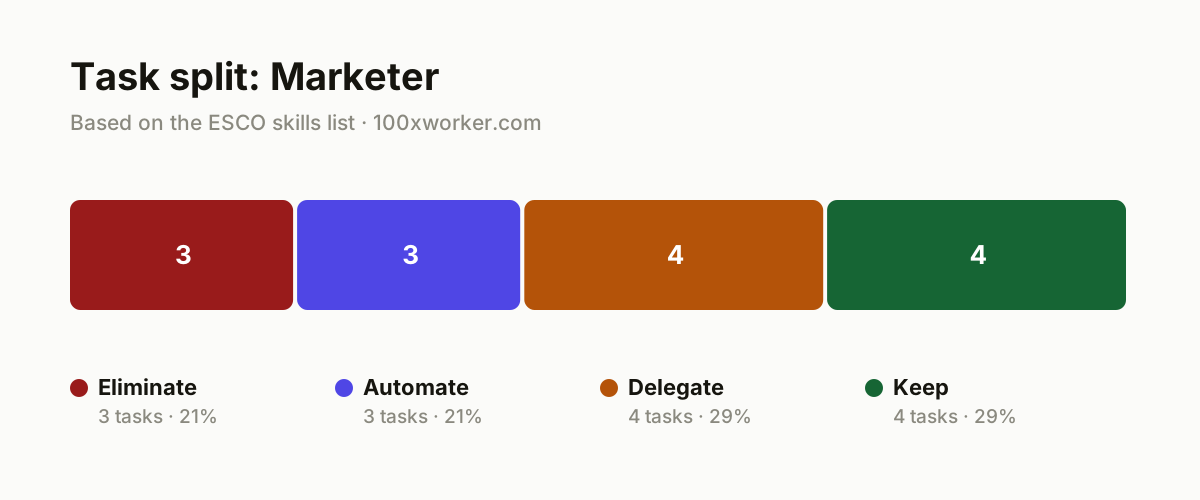
This article breaks the marketing manager job down into four buckets: tasks to eliminate, tasks to automate, tasks to delegate to AI with your oversight, and tasks to keep for yourself. The goal is not to guess whether 'marketing' survives as a job title. It is to see, task by task, where you should hand off work and where your judgment still decides the outcome.
A marketing manager plans and directs strategy, budget, and campaigns to make products profitably visible to buyers.
The task split: what AI takes over and what stays yours
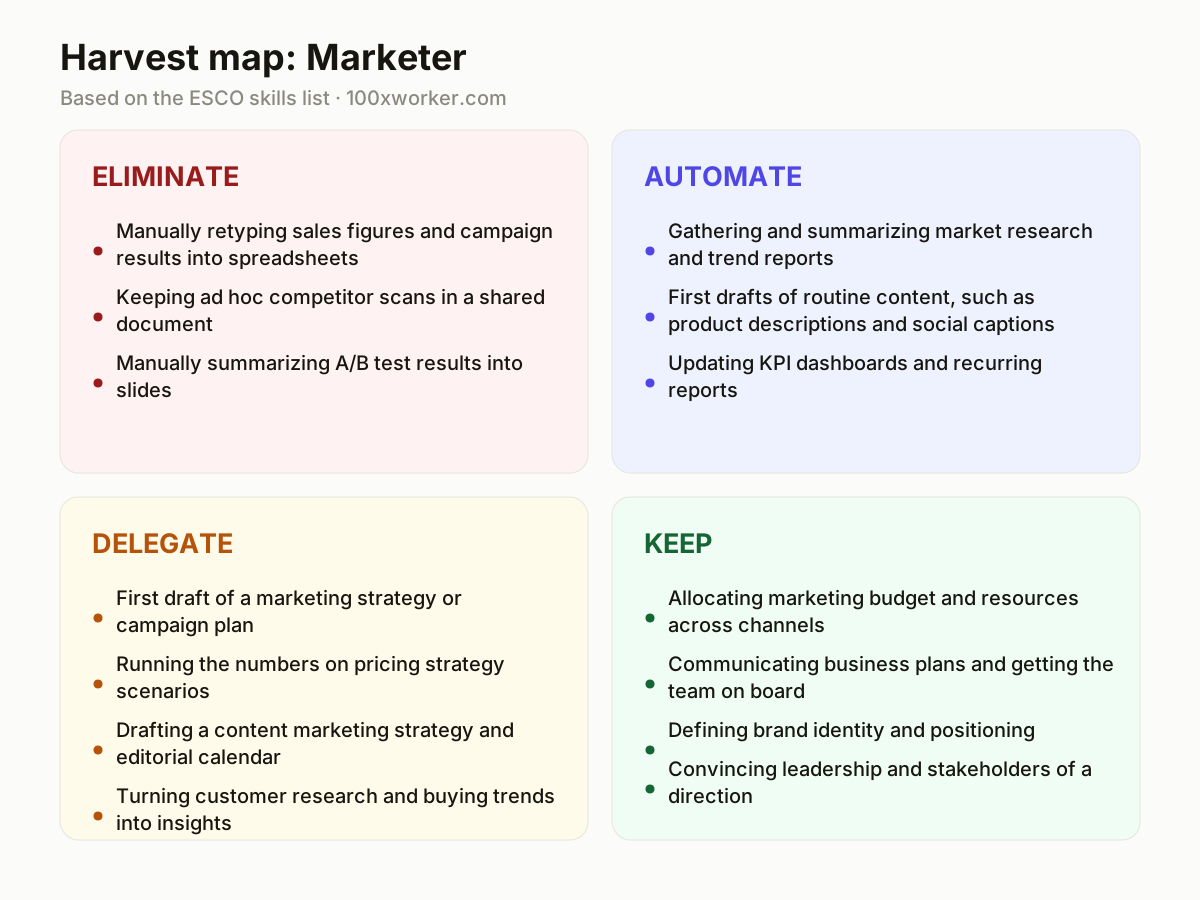
Not every part of a marketing manager's job changes the same way. Some tasks disappear because a system now does them automatically. Some get automated, meaning AI runs them with a template or a workflow behind them. Some get delegated to AI, meaning it produces a first version that you review and correct. And some stay firmly with you, because they involve risk, taste, or relationships that a model cannot carry. Sorting your own task list into these four buckets is the fastest way to see where your time should actually go.
| Task | Bucket | Why |
|---|---|---|
| Manually retyping sales figures and campaign results into spreadsheets | eliminate | Direct integrations between CRM, ad platforms, and reporting tools do this instantly and without errors. |
| Keeping ad hoc competitor scans in a shared document | eliminate | Continuous monitoring tools replace a snapshot that is outdated the moment you save it. |
| Manually summarizing A/B test results into slides | eliminate | Testing platforms generate the summary automatically as soon as a test ends. |
| Gathering and summarizing market research and trend reports | automate | An AI agent searches sources, filters noise, and delivers a readable summary. |
| First drafts of routine content, such as product descriptions and social captions | automate | Format and tone are usually fixed, so a template with AI fill-in is enough. |
| Updating KPI dashboards and recurring reports | automate | The numbers change weekly, but the report's layout and logic do not. |
| First draft of a marketing strategy or campaign plan | delegate | AI structures goals, audience, and resources, you check it against business reality. |
| Running the numbers on pricing strategy scenarios | delegate | AI calculates variants quickly, you decide which risk you are willing to take. |
| Drafting a content marketing strategy and editorial calendar | delegate | AI fills in the schedule, you protect the brand voice and the right sequence. |
| Turning customer research and buying trends into insights | delegate | AI finds patterns in the data, you translate that into a decision that costs money. |
| Allocating marketing budget and resources across channels | keep | This decision carries financial and political consequences you are accountable for. (Your edge: You carry the risk, not the AI.) |
| Communicating business plans and getting the team on board | keep | Persuading and motivating people takes presence, not a text generator. (Your edge: You build trust yourself, not through a prompt.) |
| Defining brand identity and positioning | keep | This is the strategic core of the brand, not a fill-in exercise. (Your edge: Taste and judgment cannot be automated.) |
| Convincing leadership and stakeholders of a direction | keep | Negotiating budget and direction stays human work with real competing interests. (Your edge: You read the politics yourself, not your AI tool.) |
Which marketing tasks is AI already taking over?
AI is already handling the repetitive, structured parts of marketing work. That includes pulling sales and campaign data into reports, summarizing A/B test results, drafting routine content like product descriptions or social captions, and keeping KPI dashboards current. These are tasks with a fixed format and a clear input, which is exactly what generative AI handles well. What AI is not doing yet is deciding your budget split, your positioning, or which stakeholder gets which message. Microsoft Research's 35% applicability figure for marketing and research roles reflects this: a real share of the job, not the whole job, is affected.
Will AI replace marketers?
No single tool replaces a marketing manager, because the job includes budget decisions, brand judgment, and internal negotiation that AI cannot own. What changes is the shape of the day. Anthropic's Economic Index shows AI use splitting into automation-style use, where AI fully takes over a task, and augmentation-style use, where a person stays in charge but works faster. For marketing managers, most of the shift so far falls in that second category: research, drafting, and reporting speed up, while strategy, pricing calls, and stakeholder buy-in stay with the person holding the title.
How do you become the AI-savvy person on the marketing team?
Start by mapping your own task list into the four buckets: eliminate, automate, delegate, keep. Then pick one recurring task, such as the monthly trend report, and build a repeatable AI workflow for it instead of starting from scratch every time. Share what works with your team, including the prompts and the checks you run before trusting the output. Being the AI-savvy person is less about knowing every tool and more about knowing which tasks are safe to hand off and which decisions need your name on them.
What can you do this month as a marketer?
Pick three recurring tasks from your calendar: one reporting task, one content task, and one research task. Test an AI tool on each and time the difference against doing it manually. Write down which outputs you trust without review and which ones you always need to check. Then use that list to renegotiate your own priorities with your manager: less time on dashboard updates, more time on pricing decisions and brand calls that AI cannot make for you.
Generative AI is already applicable to roughly a third of the work activities found in marketing and market research roles, based on real usage patterns rather than job titles.
Microsoft Research, Working with AI (2025)
Become the AI person on your team
Run a two-week task audit
Log every task you do for two weeks and mark it eliminate, automate, delegate, or keep. Most marketing managers find that a third of their week falls into the first two buckets, freeing time for strategy work.
Build one repeatable AI workflow
Pick a recurring task, such as the monthly market scan, and turn it into a saved prompt sequence with a fixed source list and a fixed output format. Reuse it instead of rebuilding it from scratch each cycle.
Set a review rule before you trust an output
Decide upfront which AI outputs need a second pair of eyes, such as anything with a number attached to it, and which ones can go out with a light check, such as a first content draft.
Want this for your actual task list?
The free scan on the homepage builds your personal task map in 30 seconds, based on your role and industry.
Run the free task scanTools for this work
| Tool | For which tasks | The sober take |
|---|---|---|
| Microsoft Copilot (Microsoft 365) | KPI dashboard updates, market research summaries, first drafts of routine reports | The tool Microsoft's own applicability research is based on, so its strengths line up closely with the 35% figure. |
| Claude (Anthropic) | Content marketing strategy drafts, customer research synthesis, editorial calendar planning | Anthropic's Economic Index shows heavy use for both fast drafting and deeper research-style work. |
| ChatGPT (OpenAI) | Campaign plan first drafts, pricing scenario calculations, competitor scan summaries | General purpose and widely used, but no occupation-level applicability data is cited here for it specifically. |
| HubSpot AI tools | Routine content drafts, automated dashboard reporting, A/B test summaries | Built into a marketing platform many teams already run, so it removes a manual export step. |
Prompts to try today
Market research summary
Campaign plan first draft
Pricing scenario check
Related jobs
Frequently asked questions
Is a marketing manager's job at risk from AI?
The job title is not at risk, but the task mix inside it is changing. Microsoft Research's applicability score of 35% for marketing and research roles means a real share of daily tasks, mostly reporting, drafting, and research gathering, can now be handled with generative AI. Budget decisions, brand positioning, and stakeholder management stay with the person in the role, because they involve judgment and accountability that a model does not carry.
Which AI tool should a marketing manager start with?
Start with whatever tool is already inside your existing stack, such as Microsoft Copilot if your company runs Microsoft 365, since that removes the friction of a new login and new data-sharing approval. Add a general-purpose model like Claude or ChatGPT for drafting and research tasks that fall outside your platform's built-in AI features.
How much of marketing work actually involves AI right now?
Across the EU, 32.7% of people aged 16 to 74 reported using generative AI in the past three months, according to Eurostat's 2025 data. Anthropic's Economic Index shows that within professional use, marketing-adjacent tasks split between AI fully completing a task and AI supporting a person who still owns the decision, with the second pattern more common for strategic work.
What should I stop doing manually as a marketer this year?
Stop manually retyping performance data between systems, stop keeping competitor notes in a static document, and stop building A/B test summaries by hand. These are tasks where a direct tool integration or automated report removes the manual step entirely, freeing time for the pricing, budget, and positioning decisions that still need you.
Sources
- Microsoft Research, Working with AI: Measuring the Applicability of Generative AI to Occupations (2025)
- Anthropic Economic Index
- Eurostat, isoc_ai_iaiu (2025)
- ESCO, European Commission
Hendrik De Winne, author of Becoming AI-Savvy, founder of VibeLab. Helps teams redesign their work with AI.
This article was drafted with AI assistance from public data sources and editorially reviewed.