100×worker · job analysis
Will AI Replace Media Planners, and What Should You Do About It?

Media planners spend a lot of time on things a spreadsheet or a script can now do faster: pulling rate cards, comparing channel costs, and building the first draft of a media schedule. That is exactly the kind of work generative AI is already good at.
Microsoft Research analyzed 200,000 real conversations with its Copilot assistant and scored how applicable generative AI is to different occupations. For advertising and promotions managers, the closest US occupation to media planner, the applicability score is 18.9%. That is far below translators (49%) but well above nurses (12%), which puts media planning in the middle: some tasks are ripe for automation, most still need a person.
Separately, Anthropic's Economic Index tracks how people actually use its Claude models against the O*NET task list, splitting usage into automation-like requests (do this for me) and augmentation-like requests (help me think this through). Across the EU, 32.7% of people aged 16 to 74 used generative AI in the last three months of 2025, according to Eurostat. Adoption is no longer a niche behavior on media and marketing teams; it is a daily tool for roughly a third of the working-age population.
A media planner picks the media channels and budget split that carry an ad message to its audience.
The task split: what AI takes over and what stays yours
Not every media planning task changes the same way. Some tasks disappear because software already handles them better. Some run on autopilot once you set them up, with an AI agent doing the work end to end. Some are worth handing to AI for a first draft that you then check and improve. And some stay firmly with you, because they involve negotiation, judgment, or accountability that no model can carry. Sorting your own task list into these four buckets, eliminate, automate, delegate, keep, tells you where to spend your time next.
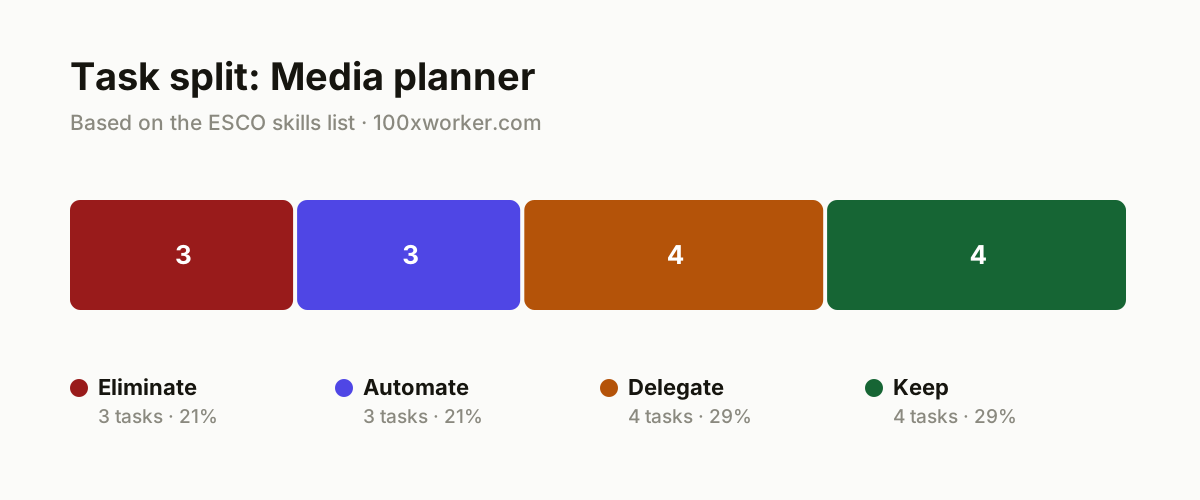
| Task | Bucket | Why |
|---|---|---|
| Manually comparing rate cards and channel prices across separate spreadsheets | eliminate | Pricing data lives online or in feeds; an agent pulls and compares it faster and with fewer errors than copy-paste work. |
| Manually formatting standard media overviews per channel (print, radio, display) | eliminate | Fixed templates with a fixed structure are exactly the repetitive output an unsupervised agent can produce. |
| Retyping data between the planning tool, invoicing system, and reporting spreadsheet | eliminate | Connect the systems or let an agent handle the transfer; typing without judgment adds no value. |
| Collecting reach, frequency, and cost data per channel (media channel research) | automate | An agent searches rate data and historical campaign figures and returns a structured overview, ready for you to assess. |
| Drafting first media schedule options based on budget, audience, and KPIs | automate | The arithmetic part, splitting budget across channels to hit reach targets, is now routine for an agent. |
| Automatic reporting and dashboards on running campaigns | automate | Pulling numbers into a readable dashboard is work that can run without a person in the loop. |
| Drafting a full media plan with channel mix and rationale | delegate | AI writes a strong first version; you check it against the brand, the budget, and the client. |
| Summarizing market research into audience insights | delegate | AI reads through research reports faster; you judge whether the conclusions match what you know about the market. |
| First draft of a client presentation on media strategy | delegate | A draft comes together quickly; the persuasion and the tone for that specific client stay your work. |
| Building a competitive analysis of media spend | delegate | AI structures who is advertising where; you draw the strategic conclusion for your own plan. |
| Negotiating with media agencies and sales houses over rates and terms | keep | This is relationship work built on interests, memory, and mutual trust, not a task for a language model. (Your edge: Trust built over years is not something an agent can replicate.) |
| Handling difficult demands from clients and internal stakeholders | keep | Setting priorities under pressure and reassuring people requires reading who is in front of you. (Your edge: You read the room; AI only reads text.) |
| Judging whether a media plan fits the brand, context, and copyright rules | keep | Sensitivities around image and copyright law require judgment, not just knowledge of the rules. (Your edge: Final responsibility cannot be outsourced.) |
| Making the final call on sensitive or crisis-prone campaigns | keep | When a message can land badly with the target audience, experience and accountability matter more than output. (Your edge: You sign off, you carry the consequence.) |
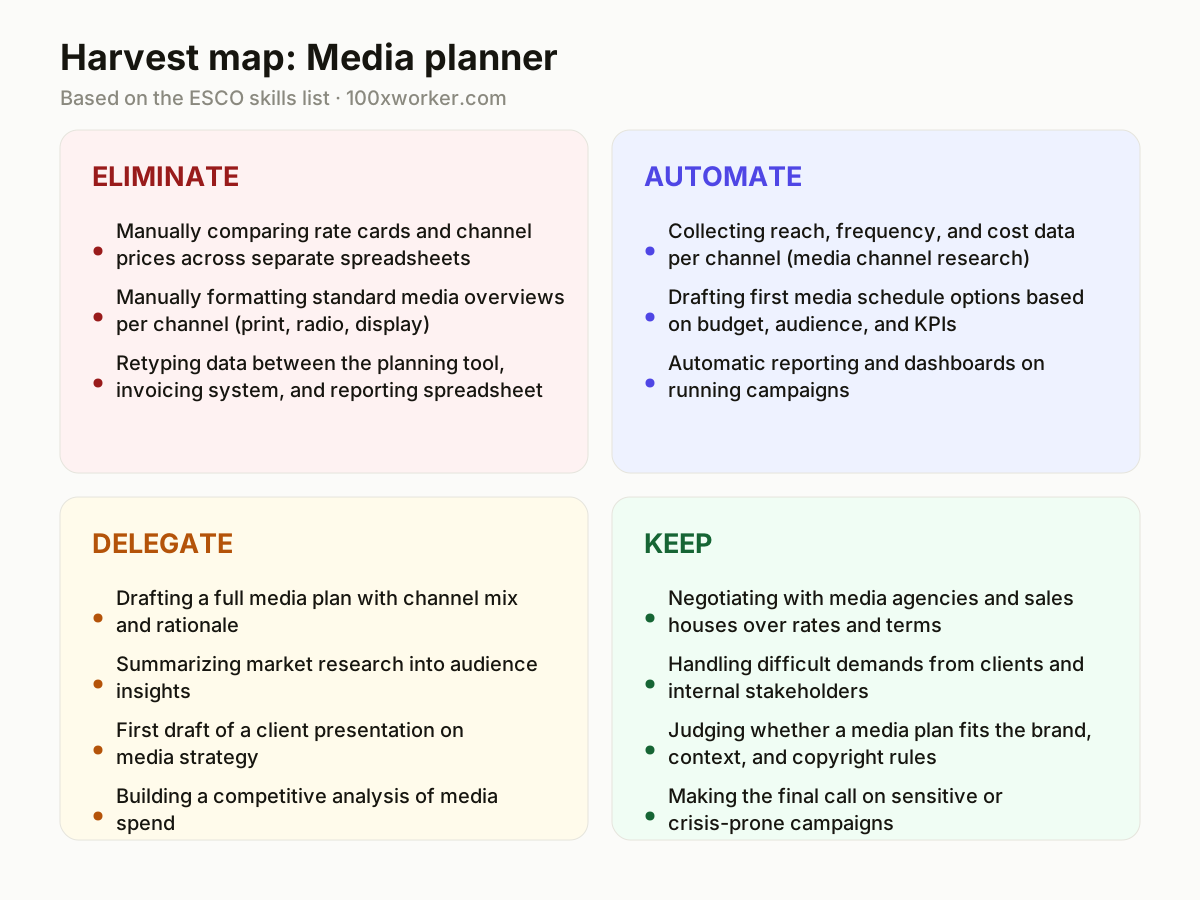
Which media planner tasks does AI take over?
AI takes over the parts of media planning that are mostly data handling: pulling rate cards, comparing channel costs, and building the first draft of a media schedule from budget and audience inputs. Reporting and dashboards on running campaigns can also run without daily human input once they are set up. Anthropic's Economic Index, which classifies how people use its Claude models against O*NET tasks, finds that this kind of automation-like use (do this for me) is common for data compilation and formatting work, while tasks like reading a client's mood or negotiating a rate stay in the augmentation category, where AI helps a person think rather than replacing them.
Will AI replace media planners?
No single tool replaces the full job. Microsoft Research's applicability score for advertising and promotions managers, the closest US occupation to media planner, is 18.9%, meaning generative AI is demonstrably useful for well under a fifth of daily work activities. Compare that to translators at 49% or nurses at 12%. The ESCO occupational database still describes the media planner's core skills as advising on channels, negotiating with advertising professionals, and meeting audience expectations, none of which a model does on its own. What changes is the task mix: less manual data work, more time spent judging AI-generated drafts and defending a strategy to a client.
How do you become the AI-savvy person on the media team?
Start by using AI daily for the tasks in the automate and delegate buckets: draft schedules, summarize research, build first-pass client decks. Learn to write a clear brief (budget, audience, KPIs, tone) so the output needs less rework. Keep a short log of prompts that worked well for recurring tasks like competitive spend analysis, and share them with your team. Push back when AI output looks confident but is not grounded in real rate data or your own market knowledge. Being the AI-savvy planner means knowing exactly where the model is useful and where it guesses.
What can you do this month to start using AI as a media planner?
Pick one recurring task, for example your weekly channel comparison, and run it through an AI tool for two weeks alongside your normal method. Compare the time saved and the error rate. Write one clear brief template you can reuse for AI-drafted media plans, listing budget, audience, KPIs, and brand constraints. Ask your agency or in-house AI lead which tools are already approved for handling client data, since media budgets and campaign data are often confidential. By the end of the month, you should have one task fully moved to the automate bucket and one moved to delegate.
Advertising and promotions managers show a generative AI applicability score of 18.9%, compared with 49% for translators and 12% for nurses.
Microsoft Research, Working with AI: Measuring the Applicability of Generative AI to Occupations (2025)
Become the AI person on your team
Automate the data pull
Set up a workflow that pulls channel rate cards and historical performance data automatically, instead of copying it into spreadsheets by hand. Feed that structured data into your planning tool so schedule drafts start from real numbers, not guesses.
Draft before you think
Use AI to produce a first-pass media plan or client deck before your own strategy session. Reviewing a draft is faster than starting from a blank page, and it surfaces gaps in your brief early.
Own the judgment calls
Reserve your time for negotiation, stakeholder pressure, and sign-off on sensitive campaigns. These are the tasks where your experience and accountability cannot be delegated, so protect the time AI frees up for them.
Want this for your actual task list?
The free scan on the homepage builds your personal task map in 30 seconds, based on your role and industry.
Run the free task scanTools for this work
| Tool | For which tasks | The sober take |
|---|---|---|
| ChatGPT or Claude | Drafting media plans, summarizing market research, building client presentation outlines | General-purpose, useful for first drafts, but check numbers against your actual rate data. |
| Microsoft Copilot | Reporting and dashboards, data transfer between spreadsheets and planning tools | Works inside Excel and Office files many media teams already use for reporting. |
| Google Gemini | Market research summaries, competitive spend analysis | Handles long documents well but still needs a human check on conclusions. |
| Built-in AI functions in Excel or Sheets | Comparing rate cards and channel prices, formatting standard overviews | Cuts most of the copy-paste work without needing a separate tool. |
Prompts to try today
First-draft media schedule
Client presentation outline
Competitive spend analysis
Related jobs
Frequently asked questions
Will AI take over media planning jobs entirely?
No. Microsoft Research's applicability score for the closest US occupation, advertising and promotions managers, is 18.9%, meaning generative AI is useful for a minority of daily tasks. Negotiation with agencies, reading client politics, and final sign-off on campaigns stay with people. What changes is the mix of tasks: less manual data work, more reviewing and directing AI output.
Which AI tools should a media planner actually use?
General chat assistants like ChatGPT, Claude, or Gemini handle drafting, summarizing, and first-pass analysis well. Microsoft Copilot fits teams that already run reporting in Excel or PowerPoint. None of them should be trusted with final rate negotiations or client-sensitive budget data without a human check, and you should confirm your agency's data policy before uploading campaign figures.
How much are people actually using generative AI at work?
Adoption is broad and growing. Eurostat found that 32.7% of the EU population aged 16 to 74 used generative AI in the three months before its 2025 survey. Anthropic's Economic Index shows this usage splits between automation-like requests, where people ask AI to do a task outright, and augmentation-like requests, where AI helps someone think through a problem.
Does the ESCO occupation description for media planner already account for AI?
No. The ESCO taxonomy, maintained by the European Commission and covering 3,039 occupations across 28 languages, still lists core media planner skills such as negotiating with advertising professionals, building media schedules, and researching channels. It does not yet reflect which of those tasks AI now handles, which is why breaking the job into buckets like eliminate, automate, delegate, and keep is more useful than reading the official skill list alone.
Sources
- Microsoft Research, Working with AI: Measuring the Applicability of Generative AI to Occupations (2025)
- Anthropic Economic Index
- Eurostat, isoc_ai_iaiu
- ESCO, European Commission
Hendrik De Winne, author of Becoming AI-Savvy, founder of VibeLab. Helps teams redesign their work with AI.
This article was drafted with AI assistance from public data sources and editorially reviewed.