100×worker · job analysis
Will AI Replace Doctors (General Practitioners)?
General practitioners keep hearing that AI will change medicine within a few years. The honest picture is narrower than that. Across the EU, 32.7% of people aged 16 to 74 used generative AI in the last three months of 2025, according to Eurostat. That is a lot of patients walking into your office having already asked a chatbot about their symptoms, but it says little about what happens to your own workload.
Microsoft Research analyzed 200,000 real conversations with its Copilot AI assistant and scored how applicable generative AI is to different occupations, based on what people actually asked it to do. Family medicine physicians, the closest match to general practitioners in the data, scored 16.5%. That places doctors well below translators (49%) and above nurses (12%), meaning a meaningful but limited slice of the job is exposed to today's AI.
The useful move is not to ask whether AI will replace you. It is to break the job into individual tasks and sort each one: gone entirely, safe to automate, worth delegating to an AI tool with your review, or firmly yours to keep. That is the framework this article uses.
A general practitioner is the generalist physician who promotes health, diagnoses illness, and treats patients of every age.
The task split: what AI takes over and what stays yours
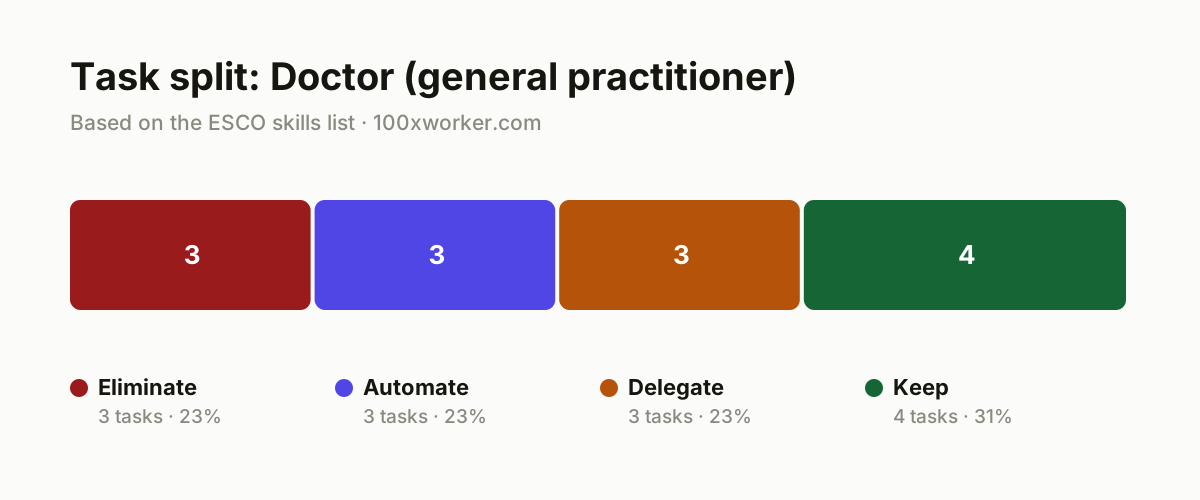
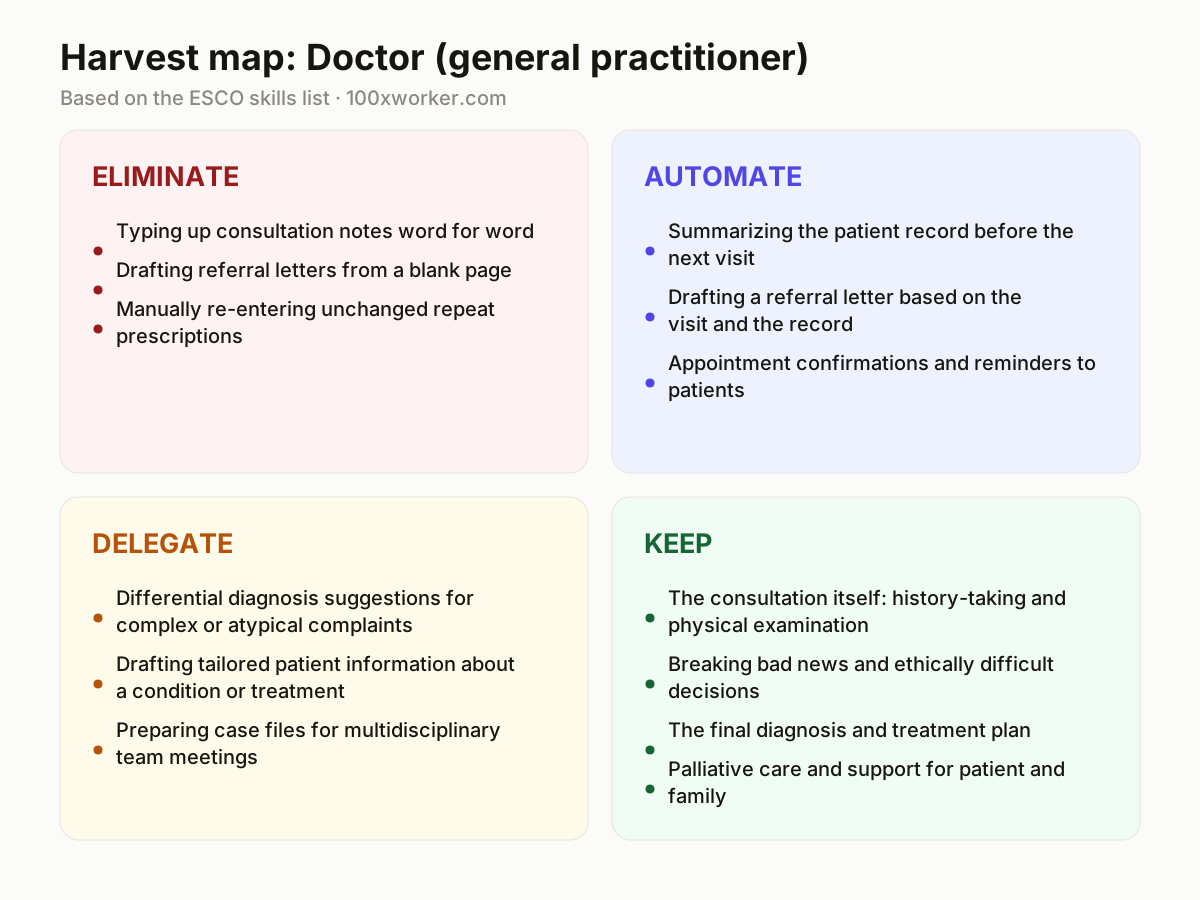
Instead of asking whether AI replaces doctors, split the job into tasks. Eliminate covers work that disappears once AI tools exist. Automate covers work an AI system runs with light oversight. Delegate covers work AI drafts or suggests, with you making the final call. Keep covers the parts of the job that stay human because they need physical presence, judgment, or accountability that AI cannot carry.
| Task | Bucket | Why |
|---|---|---|
| Typing up consultation notes word for word | eliminate | Speech-to-text and summarization tools do this faster and more consistently than manual typing after every visit. |
| Drafting referral letters from a blank page | eliminate | A template filled with data from the patient record gives you a first draft that only needs checking. |
| Manually re-entering unchanged repeat prescriptions | eliminate | Routine refills with no clinical change no longer need a doctor's time, just a checkpoint. |
| Summarizing the patient record before the next visit | automate | An agent can summarize history, medication, and lab results so you start the visit with the right focus. |
| Drafting a referral letter based on the visit and the record | automate | The agent drafts structure and content, you sign off and send after a quick check. |
| Appointment confirmations and reminders to patients | automate | This is pure logistics that needs no medical judgment and can run fully automated. |
| Differential diagnosis suggestions for complex or atypical complaints | delegate | AI generates possibilities based on symptoms and guidelines, you weigh them against the patient in front of you. |
| Drafting tailored patient information about a condition or treatment | delegate | AI writes a first, understandable explanation, you adjust language and tone to what this patient needs. |
| Preparing case files for multidisciplinary team meetings | delegate | AI gathers and organizes relevant data from multiple sources, you decide what actually matters for the discussion. |
| The consultation itself: history-taking and physical examination | keep | This requires observation, touch, and trust that you build only in the room with the patient. (Your edge: Physical presence and clinical intuition cannot be automated.) |
| Breaking bad news and ethically difficult decisions | keep | Word choice, timing, and empathy in these conversations are human work from the first minute to the last. (Your edge: Empathy in the moment stays human territory.) |
| The final diagnosis and treatment plan | keep | You carry the medical and legal responsibility, AI at most supplies input. (Your edge: Responsibility and liability rest with the doctor.) |
| Palliative care and support for patient and family | keep | Presence, closeness, and human support at end of life cannot be delegated to software. (Your edge: Closeness in vulnerable moments cannot be replaced.) |
Which tasks can AI take over from a general practitioner?
AI is strongest on the paperwork side of the job. Consultation notes, referral letter drafts, and unchanged repeat prescriptions can move to eliminate or automate categories once you set up the right tools. An agent can also summarize a patient's history and lab results before you walk into the room, so preparation time shrinks. None of this touches the exam room or the diagnosis itself. It removes typing, template-filling, and routine data entry, the parts of the job that never needed a medical degree in the first place.
Will AI replace general practitioners?
No single occupation-wide number supports that claim. Microsoft Research's applicability score for family medicine physicians sits at 16.5%, meaning most of the job falls outside what generative AI currently handles well. Anthropic's Economic Index, which classifies millions of Claude conversations against occupational task lists, separates AI use into automation-like and augmentation-like patterns, and medical work leans toward augmentation: AI assists, it does not replace judgment. Older headline figures claiming much higher automation risk for doctors trace back to Frey and Osborne's 2013 Oxford study, done before large language models existed. Treat those numbers as outdated.
How do you become the AI-savvy doctor in your practice?
Start by mapping your own week against the four buckets: what you type, what a tool could draft, what an assistant could prepare, and what only you can do. Pick one recurring task, such as referral letters, and test an AI drafting tool on it for two weeks before rolling it out further. Share what works with colleagues and staff, since practices adopt tools faster when one person tests them first. Track time saved on documentation and reinvest it in patient contact, not just in seeing more patients back to back.
What can you do this month as a GP with AI?
Pick one low-risk, high-volume task and automate it first. Referral letter drafting or pre-visit record summaries are good starting points because you can check the output against the source record before sending anything. Set a rule that AI drafts and you approve, never the reverse. Ask your practice manager what documentation software already includes AI features you are not using yet. Avoid rolling out five tools at once. One task, tested properly, beats a scattered rollout that nobody trusts.
AI use in the workplace splits into automation-like and augmentation-like patterns, and clinical work leans toward augmentation rather than replacement.
Anthropic Economic Index
Become the AI person on your team
Run one AI drafting tool for two weeks before judging it
Pick referral letters or visit summaries and route every one through the same tool for a fixed period. Compare time spent and error rate against your old process before deciding to keep or drop it.
Write down what you check, not just what you approve
When you review an AI-drafted referral or patient explanation, note what you actually corrected. Over a month this list tells you exactly where the tool is reliable and where it still needs a human pass.
Bring one colleague along on the first rollout
Practices move faster when two people, not one, test a new tool on real cases. It catches mistakes sooner and gives you someone to compare notes with when deciding whether to expand use.
Want this for your actual task list?
The free scan on the homepage builds your personal task map in 30 seconds, based on your role and industry.
Run the free task scanTools for this work
| Tool | For which tasks | The sober take |
|---|---|---|
| AI medical scribe / dictation software | Eliminate: typing up consultation notes | Cuts documentation time but still needs a human check for accuracy before filing. |
| Microsoft Copilot (or similar assistant integrated into practice software) | Automate: record summaries, draft referral letters | Useful for first drafts, not for final clinical wording without review. |
| General-purpose AI chat tools (ChatGPT, Claude) | Delegate: drafting patient information, organizing case notes for team meetings | Treat outputs as a first draft only, never as a diagnosis or final patient communication. |
| Practice scheduling software with automated reminders | Automate: appointment confirmations and reminders | Pure logistics automation, low risk, no clinical content involved. |
Prompts to try today
Pre-visit record summary
Draft referral letter
Patient-friendly explanation of a diagnosis
Related jobs
Frequently asked questions
Will AI replace doctors within the next few years?
Unlikely on current evidence. Microsoft Research's applicability score for family medicine physicians is 16.5%, meaning most of the job, including physical examination, diagnosis, and patient conversations, falls outside what generative AI handles well today. AI is reshaping the documentation and preparation side of the job faster than the clinical core. Expect changes to your task list, not to the existence of the role, at least based on the data available so far.
Which part of a GP's job is most exposed to AI?
Documentation and drafting. Writing up consultation notes, drafting referral letters, and preparing summaries before a visit are the tasks that AI tools already handle reasonably well. These are largely administrative rather than clinical, which is why the overall applicability score for the profession stays relatively low compared to occupations built more heavily around writing and translation.
Can AI make a diagnosis instead of a doctor?
AI can generate differential diagnosis suggestions based on symptoms and clinical guidelines, which is useful input for complex or atypical cases. It cannot examine a patient, read body language, or take legal and medical responsibility for a treatment plan. That responsibility, and the judgment behind it, stays with the doctor regardless of what tools are used to prepare the groundwork.
How is AI adoption in healthcare tracked at the EU level?
Eurostat measures generative AI use across the general EU population rather than by occupation. In 2025, 32.7% of people aged 16 to 74 had used generative AI in the prior three months. Occupation-specific figures come from separate sources like Microsoft Research's applicability scores and Anthropic's Economic Index, which classify AI conversations against standardized task lists such as ESCO or O*NET.
Sources
- Microsoft Research, Working with AI: Measuring the Applicability of Generative AI to Occupations (2025)
- Anthropic Economic Index
- Eurostat, isoc_ai_iaiu (2025)
- ESCO, European Commission occupation taxonomy
- Frey & Osborne, The Future of Employment (Oxford Martin School, 2013)
Hendrik De Winne, author of Becoming AI-Savvy, founder of VibeLab. Helps teams redesign their work with AI.
This article was drafted with AI assistance from public data sources and editorially reviewed.