100×worker · job analysis
Will AI Replace Auditors, and What Should You Do About It?
Auditors spend a lot of their week on tasks that have little to do with judgment: retyping numbers, matching invoices, sampling ledgers. That is exactly the kind of work generative AI is good at. Microsoft Research analyzed 200,000 real Copilot conversations across occupations and found that AI applies to about 19.5% of the work activities in accounting and auditing roles, well below translators (49%) but well above nurses (12%).
That number does not mean one in five auditors loses a job. It means one in five hours of typical audit work, the data entry, the matching, the first-pass screening, can be handled by software instead of a person. The Anthropic Economic Index, which classifies millions of Claude conversations against O*NET task lists, draws the same line: some AI use is automation-like (AI does the task), some is augmentation-like (AI helps a person do the task faster). For auditors, most of the near-term change falls into the second category.
This article breaks the auditor's job into four buckets: tasks that disappear, tasks a system now runs end to end, tasks you hand to AI as a first draft, and tasks that stay with you because they require professional judgment, legal accountability, or trust built face to face.
A financial auditor checks financial records for accuracy, fraud, and compliance with regulation.
The task split: what AI takes over and what stays yours
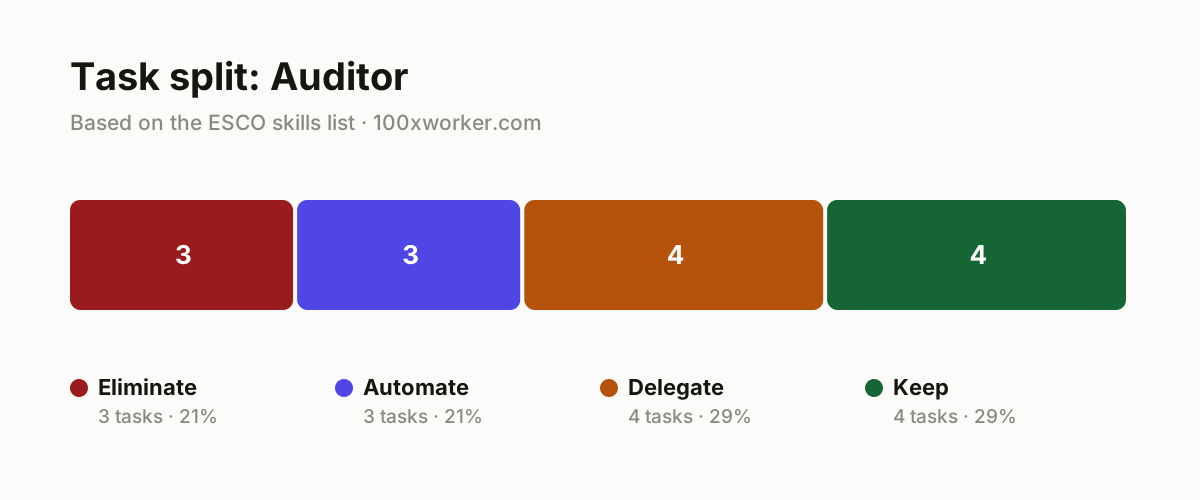
Not every audit task changes the same way. Some disappear outright once software does the checking. Some get fully automated end to end. Some get delegated to AI for a first draft that a human still reviews and signs off on. And some stay firmly with the auditor because they involve judgment, legal liability, or a relationship with a client or board. Sorting your own task list into these four buckets is a more useful exercise than asking whether 'auditing' as a job will survive.
| Task | Bucket | Why |
|---|---|---|
| Manually retyping numbers from PDFs and spreadsheets into audit software | eliminate | Document extraction tools pull structured data automatically, so repeating it by hand adds nothing. |
| Manually building sample sets from the general ledger | eliminate | AI systems can review the full population instead of a 10% sample, making manual sampling redundant. |
| First-pass screening of invoices and expense claims for completeness | eliminate | Automated matching against contracts and bank statements replaces this check directly. |
| Three-way matching of invoices, contracts, and bank statements | automate | A system compares documents and flags mismatches without anyone reading each one line by line. |
| Detecting duplicate entries and anomalies in journal postings | automate | Pattern detection across the full dataset catches more than manual spot checks ever could. |
| Drafting standard work programs for each audit cycle | automate | Templates fill in automatically based on client profile and prior-year files. |
| Analyzing financial risk and prioritizing red flags | delegate | AI produces a draft risk list, but the auditor decides which flags actually matter. |
| Drafting financial audit reports (first version) | delegate | AI writes the initial text from findings, the auditor rewrites for judgment and nuance. |
| Interpreting financial statements and flagging deviations | delegate | AI summarizes differences against prior year and sector benchmarks, the auditor tests materiality. |
| Preparing questions about documents ahead of a client meeting | delegate | AI generates a draft question list, the auditor selects and sharpens it for the conversation. |
| Developing the audit plan and organizing the audit | keep | Requires knowledge of client context, risk tolerance, and regulation, not a fill-in-the-blank template. (Your edge: Professional judgment on scope and materiality stays human.) |
| Fraud investigation and judgment about intent | keep | Requires reading behavior, conversation, and context that goes beyond what documents show. (Your edge: Assessing intent and integrity requires human judgment.) |
| Reporting and presenting to the board or shareholders | keep | Trust and persuasion in a live conversation are not output a model can generate. (Your edge: Building trust in a room is not something a model does.) |
| Maintaining confidentiality and professional skepticism | keep | Professional liability and disciplinary accountability sit with the auditor, not with any tool. (Your edge: Legal responsibility for the opinion stays with the human.) |
Which auditor tasks does AI take over?
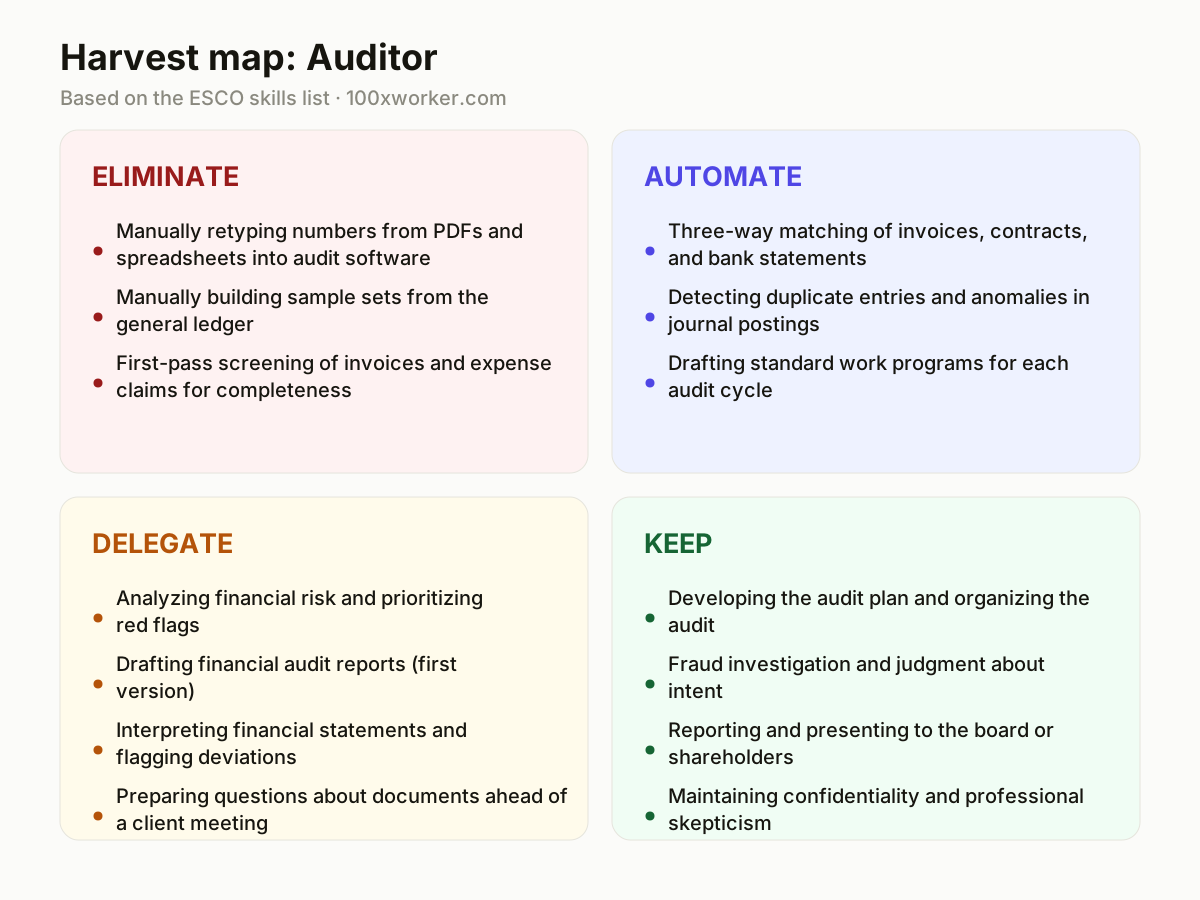
AI takes over the mechanical parts of the job first: pulling numbers out of PDFs and spreadsheets, matching invoices against contracts and bank statements, flagging duplicate journal entries, and drafting standard work programs. These are high-volume, rule-based tasks where a system can check the entire population of transactions instead of a sample. What AI does not take over is the judgment layer: deciding whether a flagged transaction actually matters, whether a client's explanation holds up, and what belongs in the final opinion presented to a board.
Will AI replace auditors?
No single occupation code called 'auditor' disappears because of AI. Microsoft Research found that generative AI applies to about 19.5% of the work activities in accounting and auditing roles, which is a meaningful share of a working week but far from the whole job. What changes is the task mix: less time on data entry and matching, more time on risk judgment, fraud review, and explaining findings to clients or boards. Auditors who shift their time toward that judgment work, and let AI handle the repetitive checking, are the ones whose jobs get more secure, not less.
What can you do this month to become the AI person on the audit team?
Start by picking one recurring task from your own files, such as drafting the first version of a report section or building a risk flag list, and run it through an AI tool for two weeks. Compare the draft against what you would have written and note where it saved time and where it missed context. Write a short internal note for your team on what worked. That single documented experiment is usually enough to make you the person colleagues ask when a new AI tool comes up in a review meeting.
How much audit work is actually automatable, according to research?
Microsoft Research's applicability score, based on 200,000 real Copilot conversations, puts accountants and auditors at 19.5%, meaning roughly a fifth of typical work activities show clear generative AI applicability. That is a middle-of-the-pack figure: translators score highest at 49%, nurses lowest at 12%. Older 'robotization' percentages that circulate online, often citing Frey and Osborne's 2013 Oxford study, predate large language models and tend to overstate full-job automation risk rather than task-level change. The Microsoft and Anthropic data are more current and task-specific.
AI usage in professional work splits into automation-like use, where AI does the task, and augmentation-like use, where AI helps a person do it.
Anthropic Economic Index
Become the AI person on your team
Run one report draft through AI and compare
Take a report section you would normally write from scratch and generate a first draft with an AI tool instead. Time both approaches and note where the AI draft needed the most rewriting.
Build a reusable risk-flag prompt for your engagement type
Instead of asking a general question each time, write a standing prompt template that lists your client's industry, prior findings, and materiality thresholds so every draft risk list starts from the same baseline.
Document what AI got wrong, not just what it got right
Keep a short log of cases where a draft missed context or flagged something irrelevant. This record is useful for training junior staff and for justifying where human review stays mandatory.
Want this for your actual task list?
The free scan on the homepage builds your personal task map in 30 seconds, based on your role and industry.
Run the free task scanTools for this work
| Tool | For which tasks | The sober take |
|---|---|---|
| Microsoft Copilot | drafting report language, summarizing findings, preparing client questions (delegate bucket) | The tool whose real usage data underpins the Microsoft Research applicability score. |
| Claude (Anthropic) | drafting risk summaries and interpreting financial statement deviations (delegate bucket) | Tracked in the Anthropic Economic Index, which splits usage into automation-like and augmentation-like patterns. |
| Document extraction tools built into audit software | pulling data from PDFs and spreadsheets (eliminate bucket) | General category; check your firm's specific audit platform for what is already built in. |
| Anomaly and duplicate detection modules in ERP/audit systems | three-way matching and journal entry checks (automate bucket) | Usually a module inside existing audit or ERP software rather than a standalone product. |
Prompts to try today
Draft a risk flag list from trial balance notes
First draft of an audit report finding
Prepare client meeting questions from a document set
Related jobs
Frequently asked questions
Will AI replace auditors entirely?
No. Microsoft Research's applicability score for accounting and auditing roles is 19.5%, meaning generative AI is demonstrably useful for about a fifth of typical work activities, not the whole job. The parts that stay human, professional judgment on materiality, fraud investigation, and presenting findings to a board, cannot currently be delegated to a model. The job changes shape rather than disappearing.
Which audit tasks should I stop doing by hand?
Stop manually retyping numbers from PDFs and spreadsheets, stop building manual samples from the general ledger, and stop doing first-pass completeness checks on invoices by eye. All three are now handled more reliably by extraction, matching, and anomaly-detection tools that review entire datasets instead of a sample.
Can I let AI write my audit report?
You can let AI draft the first version of a finding or report section based on your notes, but you should not submit that draft as is. The auditor's judgment on materiality, tone, and legal wording carries professional liability, and that responsibility does not transfer to a tool. Use AI drafts as a starting point you rewrite, not a final product.
How is AI use among auditors likely to compare with other professions?
Based on Microsoft Research's occupation-level data, auditors and accountants sit in the middle of the applicability range, at 19.5%, well below translators (49%) and well above nurses (12%). Broader adoption data shows generative AI use is already widespread among the general population: Eurostat reports that 32.7% of EU residents aged 16 to 74 used generative AI in the last three months of 2025.
Sources
- Microsoft Research, Working with AI: Measuring the Applicability of Generative AI to Occupations (2025)
- Anthropic Economic Index
- Eurostat, isoc_ai_iaiu (generative AI use, 2025)
- ESCO (European Commission occupation and skills taxonomy)
Hendrik De Winne, author of Becoming AI-Savvy, founder of VibeLab. Helps teams redesign their work with AI.
This article was drafted with AI assistance from public data sources and editorially reviewed.