100×worker · job analysis
Will AI Replace Mortgage Advisors, and What Should You Do About It?

Mortgage advisory work is built on paperwork: pay stubs, business registration extracts, financial statements, property titles. That makes it a natural target for generative AI, which is now good at reading, summarizing, and calculating from documents. Microsoft Research analyzed 200,000 real Copilot conversations and scored occupations by how much of their daily work generative AI can plausibly touch. Loan officers, the closest U.S. category to mortgage advisors, scored 24.7% on that scale, well below translators at 49% but above nurses at 12%.
That number does not mean a quarter of mortgage advisors lose their jobs. It means roughly a quarter of the tasks that make up the job, mostly data entry, document sorting, and ratio calculations, are ready for automation now. Anthropic's Economic Index, which classifies millions of real Claude conversations against detailed task lists, shows a similar pattern across knowledge work: AI use splits between automation-like tasks (data extraction, formatting) and augmentation-like tasks (drafting, summarizing) where a person still reviews the output. This article breaks the mortgage advisor role down task by task, using ESCO's own occupational description as the starting point, so you can see exactly where AI changes your week and where it does not.
A mortgage advisor evaluates loan applications, risk, and property documents to approve or deny mortgages.
The task split: what AI takes over and what stays yours
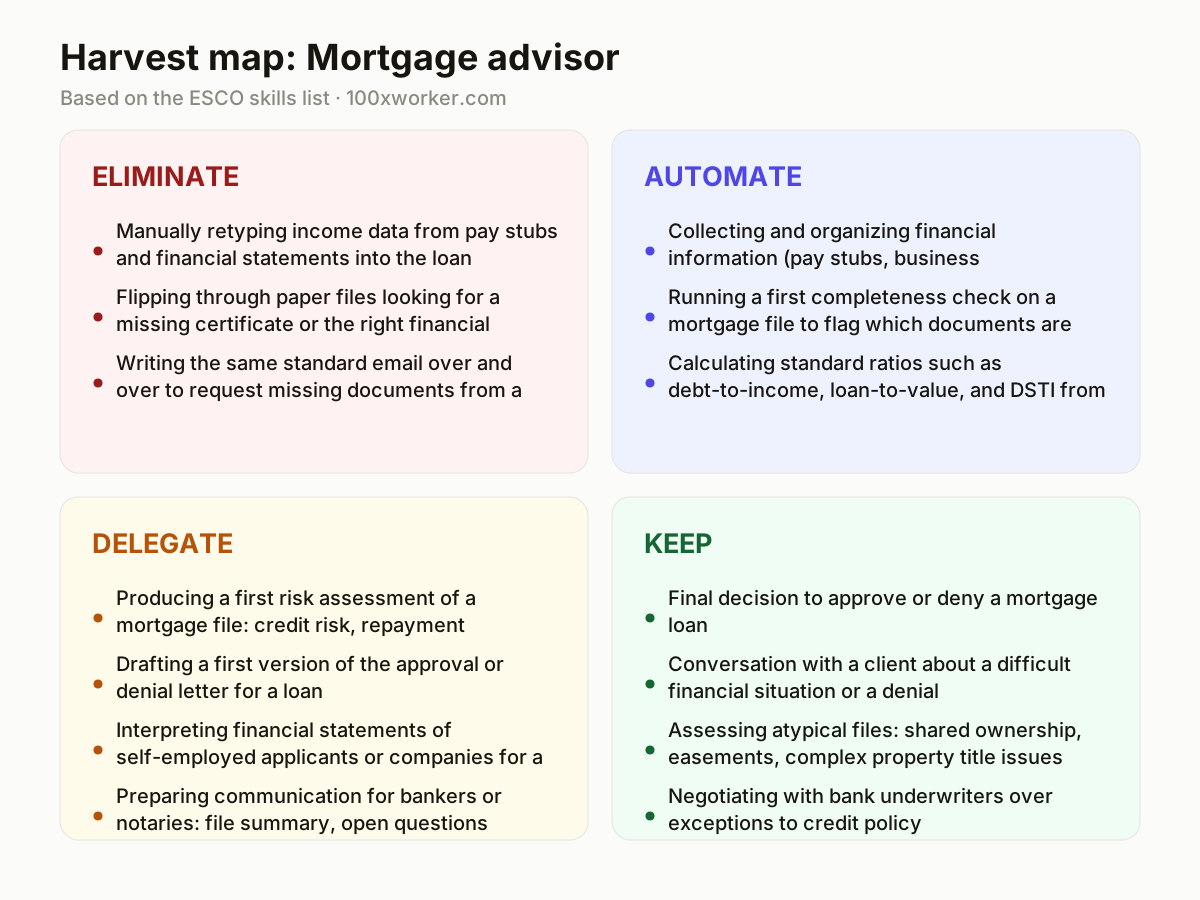
Not every task in a mortgage advisor's day carries the same weight, and AI does not affect all of them equally. Some tasks disappear entirely once you adopt the right tools, some get handled automatically by software, some get done first by AI and finished by you, and some stay entirely human because they require judgment, accountability, or trust. Splitting the mortgage advisor's task list into four buckets, eliminate, automate, delegate, and keep, shows where AI genuinely changes daily work. That view matters more than debating whether the job title itself will survive.
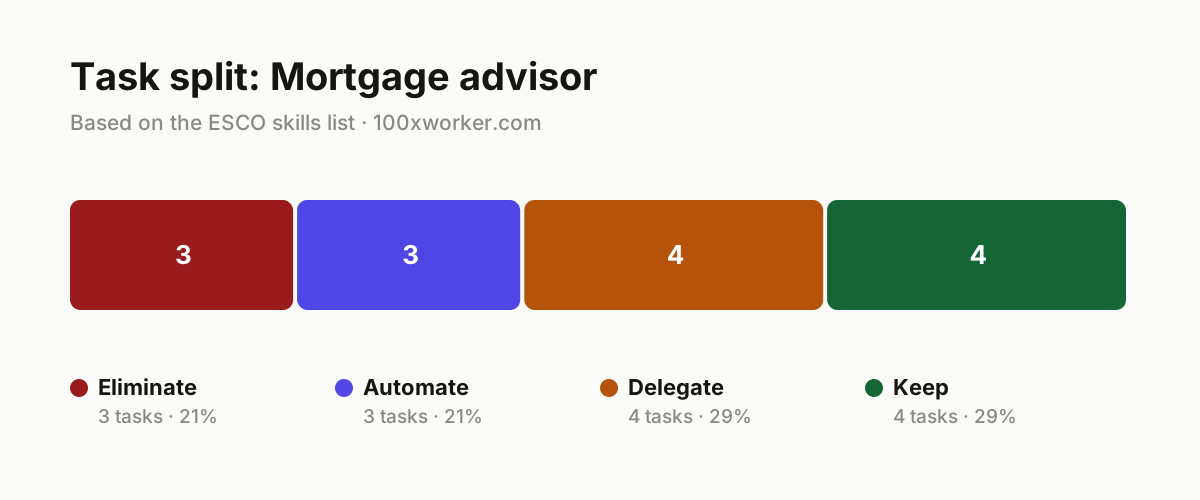
| Task | Bucket | Why |
|---|---|---|
| Manually retyping income data from pay stubs and financial statements into the loan system | eliminate | Pure data entry with no judgment involved; a document recognition tool does this faster and without typos. |
| Flipping through paper files looking for a missing certificate or the right financial statement | eliminate | Searching physical stacks of paper adds no value once files are scanned and tagged. |
| Writing the same standard email over and over to request missing documents from a client | eliminate | Pure repetition with no nuance; a template with automatic follow-up replaces this completely. |
| Collecting and organizing financial information (pay stubs, business registration extract, financial statements) into a file structure | automate | The rules are fixed and repeatable; an AI agent extracts data from documents and files it correctly. |
| Running a first completeness check on a mortgage file to flag which documents are still missing | automate | Checklist work that a system performs faster and more consistently than a person. |
| Calculating standard ratios such as debt-to-income, loan-to-value, and DSTI from entered figures | automate | Fixed-formula math with no interpretation required, a natural fit for automation. |
| Producing a first risk assessment of a mortgage file: credit risk, repayment capacity | delegate | AI puts a solid first analysis on the table; you check it against context and internal guidelines. |
| Drafting a first version of the approval or denial letter for a loan | delegate | AI writes a first justification; you rewrite tone, legal nuance, and exceptions. |
| Interpreting financial statements of self-employed applicants or companies for a preliminary analysis | delegate | AI reads the numbers quickly; you judge business context and one-off items. |
| Preparing communication for bankers or notaries: file summary, open questions | delegate | AI turns the file into a clear summary; you steer the conversation and sign off. |
| Final decision to approve or deny a mortgage loan | keep | Responsibility and liability sit with you, not with a model. (Your edge: Legal accountability remains work no algorithm can take on.) |
| Conversation with a client about a difficult financial situation or a denial | keep | Trust gets built in a conversation where someone feels heard. (Your edge: Empathy and trust cannot be automated.) |
| Assessing atypical files: shared ownership, easements, complex property title issues | keep | Local case law and experience with exceptions require human judgment. (Your edge: Experience with edge cases outweighs data every time.) |
| Negotiating with bank underwriters over exceptions to credit policy | keep | Relationships and trust between people carry more weight here than figures. (Your edge: You do not build a relationship through a prompt.) |
Will AI replace mortgage advisors?
No, not as a full job. Microsoft Research analyzed 200,000 real Copilot conversations and scored occupations by how much of their work generative AI can plausibly touch. Loan officers, the closest U.S. category to mortgage advisors, scored 24.7%, meaning roughly a quarter of daily work activities. Translators topped the list at 49%, nurses scored just 12%. That places mortgage advisory work in the middle: enough repetitive document and calculation work to automate, but final lending decisions, risk judgment on unusual files, and client conversations remain squarely human. The job title survives; the task list underneath it changes substantially over the next few years.
Which mortgage advisor tasks does AI take over?
AI takes over the parts of the job that are repetitive and rule-based. That includes retyping income data from pay stubs into loan systems, hunting through paper files for missing documents, and sending the same request-for-documents email. Higher up, AI can gather and organize financial documents into a file structure, run a first completeness check on a mortgage file, and calculate ratios like debt-to-income or loan-to-value from entered figures. What it does not take over: the final approval or denial, conversations with clients about a hard financial situation, judgment on unusual property titles, and negotiating exceptions with a bank's underwriting team.
What can you do this month as a mortgage advisor?
Start by listing every task you did last week and marking each one eliminate, automate, delegate, or keep. Pick one delegate task, for example drafting the first version of an approval or denial letter, and run it through an AI assistant like Copilot or Claude for two weeks. Compare the draft against what you would have written and note what it misses on legal nuance or exceptions. Ask your loan origination system provider what AI features they already ship; many now include document extraction and completeness checks. Skip investing time in eliminate-bucket tasks; automate them with existing document tools instead.
How do you become the AI-savvy person on your team as a mortgage advisor?
Become the person who tests AI tools on real files before anyone else asks you to. Build a short internal guide showing colleagues which prompts produce a usable first draft of a decline letter or a dossier summary for a banker, and which ones need heavy editing. Volunteer to pilot a new document-intelligence feature in your loan origination system and report back on accuracy with actual client files, not test data. Track how much time delegate-bucket tasks take with AI assistance versus without, so you have real numbers when your manager asks whether the investment is worth it.
Generative AI is applicable to about a quarter of the work activities that make up loan officer roles, not to the job as a whole.
Microsoft Research, Working with AI (2025)
Become the AI person on your team
Run a task audit before anyone asks
List your last two weeks of work and sort every task into eliminate, automate, delegate, or keep. Share the list with your manager as a starting point for a real conversation about workflow, not a hypothetical one.
Pilot one delegate task publicly
Pick the approval or denial letter draft, or the financial statement summary, run it through Copilot or Claude for a month, and keep a log of edits you had to make. Present the log at a team meeting so colleagues see concrete evidence, not opinions.
Learn the limits, not just the features
Feed an AI tool an atypical file, shared ownership, an easement, a business with irregular income, and document exactly where it gets the risk assessment wrong. Knowing the failure points makes you the person colleagues ask before they trust an AI-generated recommendation.
Want this for your actual task list?
The free scan on the homepage builds your personal task map in 30 seconds, based on your role and industry.
Run the free task scanTools for this work
| Tool | For which tasks | The sober take |
|---|---|---|
| Microsoft Copilot | Delegate tasks: drafting approval/denial letters, summarizing financial statements, preparing dossier summaries for bankers. | Useful for a fast first draft, but legal and policy nuance still needs a human edit. |
| Claude (Anthropic) | Delegate tasks: interpreting financial statements, drafting communication for notaries or bank underwriters. | Anthropic's own usage data shows most real-world use in this kind of work leans toward augmentation rather than full automation. |
| Document intelligence tools (e.g., Azure Document Intelligence, ABBYY) | Eliminate and automate tasks: extracting income data from pay stubs, tagging scanned files, running completeness checks. | Accuracy depends heavily on document quality and consistent templates. |
| AI features inside loan origination systems (e.g., Encompass, nCino) | Automate tasks: calculating debt-to-income, loan-to-value, and DSTI ratios; organizing files. | Check which AI features are already licensed in your existing platform before buying a separate tool. |
Prompts to try today
Draft a mortgage decline letter
Summarize a self-employed applicant's financial statements
Prepare a file summary for a bank underwriter
Related jobs
Frequently asked questions
Is the mortgage advisor job at risk of disappearing?
Not based on current data. Microsoft Research's applicability score for loan officers, the closest U.S. occupational match, sits at 24.7%, meaning roughly a quarter of work activities show clear AI applicability. That is a real shift in daily tasks, but far from a full replacement. Occupations with much higher scores, like translation at 49%, are not disappearing either. What changes is the mix of tasks inside the job, with routine documentation and calculation work shrinking and judgment-heavy tasks staying.
What skills should mortgage advisors build for the next few years?
Focus on the skills AI does not replicate well: reading atypical files (shared ownership, easements, irregular income), explaining a denial to a client in a way that preserves trust, and negotiating exceptions with bank underwriters. Alongside that, get comfortable prompting AI tools for first drafts of letters and summaries, and learn to spot where an AI-generated risk assessment misses local context or an unusual clause in a property title.
How does AI actually get used in this kind of work, automation or assistance?
Anthropic's Economic Index classifies millions of real Claude conversations against detailed task lists and splits usage into automation-like and augmentation-like patterns. For document-heavy, judgment-light work like data entry, usage skews toward automation. For tasks like drafting a denial letter or summarizing a complex financial statement, usage skews toward augmentation, where the AI produces a draft and a person edits it. Mortgage advisory work sits mostly in the second category.
Do all countries adopt generative AI at the same pace?
No. Eurostat found that 32.7% of the EU population aged 16 to 74 used generative AI in the three months before being surveyed in 2025, but adoption varies widely by country and age group. Younger and more digitally active groups adopt it fastest. For a role like mortgage advisor, workplace adoption also depends heavily on what AI features your bank or lender's loan origination platform actually ships, not just general public usage rates.
Sources
- Microsoft Research, Working with AI: Measuring the Applicability of Generative AI to Occupations (2025)
- Anthropic Economic Index
- Eurostat, isoc_ai_iaiu (generative AI use, EU population 16-74)
- ESCO (European Commission occupational taxonomy)
Hendrik De Winne, author of Becoming AI-Savvy, founder of VibeLab. Helps teams redesign their work with AI.
This article was drafted with AI assistance from public data sources and editorially reviewed.